


Clean-in-Place Market Size, Share, and Emerging Trends Driving Industry Growth
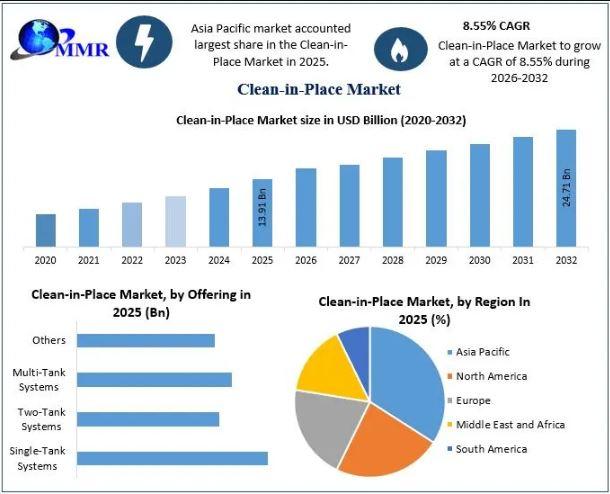
Clean-in-Place Market to Reach USD 24.71 Billion by 2032 as Automation and Food Safety Drive Demand
The Clean-in-Place Market is expanding as food, beverage, dairy, pharmaceutical and bioprocess manufacturers invest in automated hygiene technologies. According to Maximize Market Research, the market was valued at USD 13.91 billion in 2025 and is projected to grow at a CAGR of 8.55% from 2026 to 2032, reaching nearly USD 24.71 billion by 2032. CIP systems clean internal surfaces of pipes, vessels, equipment, filters and fittings without dismantling machinery, reducing labor, downtime and cleaning costs while delivering repeatable sanitation.
Growth is being supported by rising consumption of processed and convenience foods, expanding dairy and beverage production, increasing pharmaceutical manufacturing and wider automation of processing plants. Strict hygiene requirements are encouraging manufacturers to replace manual cleaning with controlled, documented systems. Manufacturers are also seeking systems that reduce water, chemicals, energy use and wastewater costs, creating opportunities for intelligent controls, sensor monitoring, optimized dosing and water recovery.
US Market Trends and Investment
The United States remains an important market under stringent sanitation and quality requirements. In 2025, FDA draft guidance addressed sanitation programs for low-moisture ready-to-eat foods. Industry investment also highlighted U.S. food-processing modernization. Cayuga Milk Ingredients opened an expanded consumer-goods facility in New York as part of a two-phase, USD 270 million expansion developed with Tetra Pak technology. Meanwhile, 2025 CIP developments focused on automation, shorter cleaning cycles and lower resource consumption.
Request Your Sample Report Now : https://www.maximizemarketresearch.com/request-sample/27293/
Market Segmentation
By system type, Reuse CIP Systems are projected to hold the largest market share during the forecast period. Reuse systems recirculate cleaning solutions and water, allowing resources from previous cycles to be recovered and reused during subsequent stages. This approach can reduce water, chemical and wastewater costs. The segment benefits from emphasis on sustainability and cost control.
0 Comments
·0 Shares