


Synthetic Rubber Market Future Growth, Demand Analysis and Industry Outlook
Key Highlights
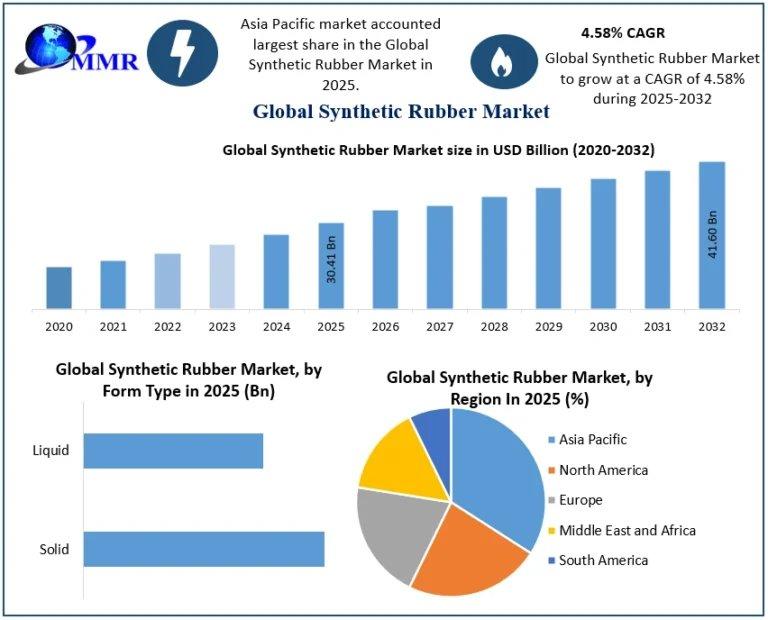
The Synthetic Rubber Market was valued at USD 30.41 billion in 2025, establishing a substantial base.
Revenue is expected to reach nearly USD 41.60 billion by 2032 at a 4.58% CAGR from 2026 to 2032, indicating steady expansion.
Asia Pacific led the market in 2025, supported by automotive manufacturing and tire production.
SBR dominated the type segment in 2025, reflecting its importance in tire manufacturing.
Bio-based materials, recycled inputs, and EV-focused technologies are reshaping investment priorities.
Market Overview: Synthetic Rubber Market
The Synthetic Rubber Market is entering a phase where performance, sustainability, and mobility requirements increasingly overlap. Valued at USD 30.41 billion in 2025, it serves automotive, tires, construction, industrial goods, footwear, consumer products, and medical applications. This scale creates room for capacity expansion and specialized materials.
Synthetic rubber is used in tires, hoses, seals, gaskets, conveyor belts, and other components because selected grades provide durability, flexibility, abrasion resistance, and heat or chemical resistance. For buyers, consistent quality and application-specific performance are important.
Why This Market Matters Now
Automotive demand remains central to the Synthetic Rubber Market. Vehicle production and replacement tire requirements support consumption, while electric mobility adds new performance demands. EV tires require low rolling resistance to improve energy efficiency, increasing interest in advanced rubber formulations.
At the same time, producers face volatile petrochemical feedstock prices and stricter environmental expectations. These pressures are increasing the importance of cost control, supply reliability, and cleaner production.
Request Your Sample Report Now : https://www.maximizemarketresearch.com/request-sample/513/
Key Trends Driving Growth
Sustainability is reshaping the Synthetic Rubber Market. Companies are investing in bio-based rubber, recycled materials, and lower-emission manufacturing because tire and rubber producers increasingly need materials that support environmental targets without sacrificing performance.
Advanced elastomers for EV tires and specialized industrial applications are another important trend. S-SBR is gaining attention where rolling resistance and energy efficiency matter, shifting competition toward formulation quality and application-specific performance.
Key Highlights
The Synthetic Rubber Market was valued at USD 30.41 billion in 2025, establishing a substantial base.
Revenue is expected to reach nearly USD 41.60 billion by 2032 at a 4.58% CAGR from 2026 to 2032, indicating steady expansion.
Asia Pacific led the market in 2025, supported by automotive manufacturing and tire production.
SBR dominated the type segment in 2025, reflecting its importance in tire manufacturing.
Bio-based materials, recycled inputs, and EV-focused technologies are reshaping investment priorities.
Market Overview: Synthetic Rubber Market
The Synthetic Rubber Market is entering a phase where performance, sustainability, and mobility requirements increasingly overlap. Valued at USD 30.41 billion in 2025, it serves automotive, tires, construction, industrial goods, footwear, consumer products, and medical applications. This scale creates room for capacity expansion and specialized materials.
Synthetic rubber is used in tires, hoses, seals, gaskets, conveyor belts, and other components because selected grades provide durability, flexibility, abrasion resistance, and heat or chemical resistance. For buyers, consistent quality and application-specific performance are important.
Why This Market Matters Now
Automotive demand remains central to the Synthetic Rubber Market. Vehicle production and replacement tire requirements support consumption, while electric mobility adds new performance demands. EV tires require low rolling resistance to improve energy efficiency, increasing interest in advanced rubber formulations.
At the same time, producers face volatile petrochemical feedstock prices and stricter environmental expectations. These pressures are increasing the importance of cost control, supply reliability, and cleaner production.
Request Your Sample Report Now : https://www.maximizemarketresearch.com/request-sample/513/
Key Trends Driving Growth
Sustainability is reshaping the Synthetic Rubber Market. Companies are investing in bio-based rubber, recycled materials, and lower-emission manufacturing because tire and rubber producers increasingly need materials that support environmental targets without sacrificing performance.
Advanced elastomers for EV tires and specialized industrial applications are another important trend. S-SBR is gaining attention where rolling resistance and energy efficiency matter, shifting competition toward formulation quality and application-specific performance.
Synthetic Rubber Market Future Growth, Demand Analysis and Industry Outlook
Key Highlights
The Synthetic Rubber Market was valued at USD 30.41 billion in 2025, establishing a substantial base.
Revenue is expected to reach nearly USD 41.60 billion by 2032 at a 4.58% CAGR from 2026 to 2032, indicating steady expansion.
Asia Pacific led the market in 2025, supported by automotive manufacturing and tire production.
SBR dominated the type segment in 2025, reflecting its importance in tire manufacturing.
Bio-based materials, recycled inputs, and EV-focused technologies are reshaping investment priorities.
Market Overview: Synthetic Rubber Market
The Synthetic Rubber Market is entering a phase where performance, sustainability, and mobility requirements increasingly overlap. Valued at USD 30.41 billion in 2025, it serves automotive, tires, construction, industrial goods, footwear, consumer products, and medical applications. This scale creates room for capacity expansion and specialized materials.
Synthetic rubber is used in tires, hoses, seals, gaskets, conveyor belts, and other components because selected grades provide durability, flexibility, abrasion resistance, and heat or chemical resistance. For buyers, consistent quality and application-specific performance are important.
Why This Market Matters Now
Automotive demand remains central to the Synthetic Rubber Market. Vehicle production and replacement tire requirements support consumption, while electric mobility adds new performance demands. EV tires require low rolling resistance to improve energy efficiency, increasing interest in advanced rubber formulations.
At the same time, producers face volatile petrochemical feedstock prices and stricter environmental expectations. These pressures are increasing the importance of cost control, supply reliability, and cleaner production.
Request Your Sample Report Now : https://www.maximizemarketresearch.com/request-sample/513/
Key Trends Driving Growth
Sustainability is reshaping the Synthetic Rubber Market. Companies are investing in bio-based rubber, recycled materials, and lower-emission manufacturing because tire and rubber producers increasingly need materials that support environmental targets without sacrificing performance.
Advanced elastomers for EV tires and specialized industrial applications are another important trend. S-SBR is gaining attention where rolling resistance and energy efficiency matter, shifting competition toward formulation quality and application-specific performance.
0 Comments
·0 Shares
·357 Views