


Artificial Turf Market Growth, Demand Trends and Future Scope Analysis
Key Highlights
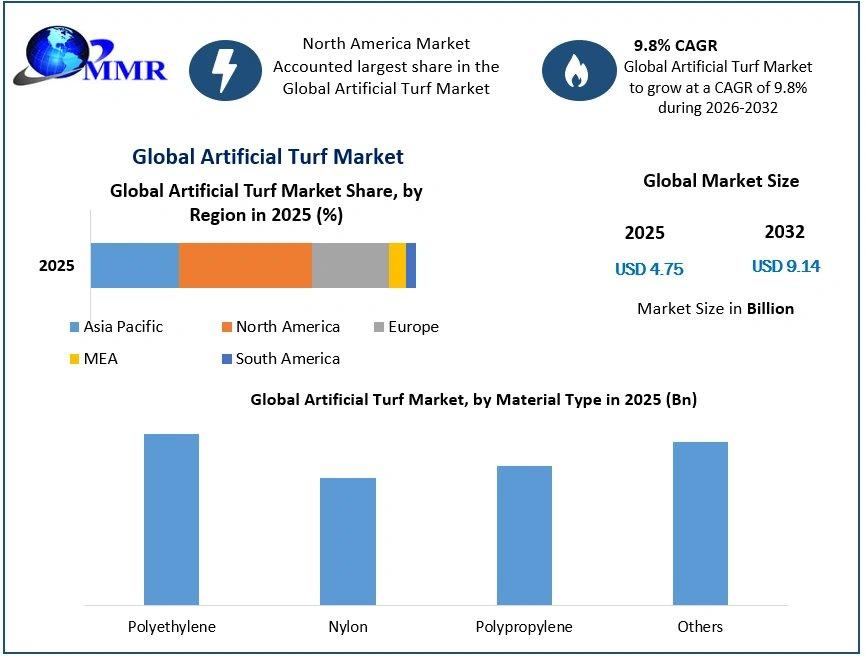
The Artificial Turf Market was valued at USD 4.75 billion in 2025.
Revenue is projected to reach nearly USD 9.14 billion by 2032.
The market is expected to expand at a 9.8% CAGR from 2026 to 2032.
Sports accounted for about 48% of the market by application in 2025.
North America held the largest market share in 2025.
Asia Pacific is expected to record the fastest growth during the forecast period.
Market Overview
The Artificial Turf Market is moving beyond its traditional role in sports facilities and becoming a practical surface solution for residential, commercial and landscaping applications. The Artificial Turf Market reached USD 4.75 billion in 2025, showing that demand is increasingly connected to broader construction, recreation and water-management requirements.
Unlike natural grass, synthetic turf requires limited maintenance and does not depend on regular sunlight or watering. This difference matters for buyers managing operating costs, particularly in regions where water availability and maintenance requirements influence property development decisions.
Sports remains the strongest application area. In 2025, the segment represented about 48% of the market, supported by adoption across football, rugby, hockey, golf, baseball and multipurpose sports facilities. Heavy-use surfaces that provide consistent playing conditions are encouraging stadiums and sports authorities to reconsider traditional grass.
Why This Market Matters Now
Urbanization and construction activity are expanding the addressable market for synthetic surfaces. Residential gardens, commercial properties, playgrounds, patios, medians and poolside areas are increasingly becoming potential applications.
Water scarcity is another important catalyst. Artificial turf can reduce dependence on irrigation, making it attractive where maintaining natural lawns is difficult or expensive. Consequently, procurement decisions are increasingly influenced not only by appearance and durability but also by maintenance requirements and resource consumption.
Request Your Sample Report Now : https://www.maximizemarketresearch.com/request-sample/119541/
Key Highlights
The Artificial Turf Market was valued at USD 4.75 billion in 2025.
Revenue is projected to reach nearly USD 9.14 billion by 2032.
The market is expected to expand at a 9.8% CAGR from 2026 to 2032.
Sports accounted for about 48% of the market by application in 2025.
North America held the largest market share in 2025.
Asia Pacific is expected to record the fastest growth during the forecast period.
Market Overview
The Artificial Turf Market is moving beyond its traditional role in sports facilities and becoming a practical surface solution for residential, commercial and landscaping applications. The Artificial Turf Market reached USD 4.75 billion in 2025, showing that demand is increasingly connected to broader construction, recreation and water-management requirements.
Unlike natural grass, synthetic turf requires limited maintenance and does not depend on regular sunlight or watering. This difference matters for buyers managing operating costs, particularly in regions where water availability and maintenance requirements influence property development decisions.
Sports remains the strongest application area. In 2025, the segment represented about 48% of the market, supported by adoption across football, rugby, hockey, golf, baseball and multipurpose sports facilities. Heavy-use surfaces that provide consistent playing conditions are encouraging stadiums and sports authorities to reconsider traditional grass.
Why This Market Matters Now
Urbanization and construction activity are expanding the addressable market for synthetic surfaces. Residential gardens, commercial properties, playgrounds, patios, medians and poolside areas are increasingly becoming potential applications.
Water scarcity is another important catalyst. Artificial turf can reduce dependence on irrigation, making it attractive where maintaining natural lawns is difficult or expensive. Consequently, procurement decisions are increasingly influenced not only by appearance and durability but also by maintenance requirements and resource consumption.
Request Your Sample Report Now : https://www.maximizemarketresearch.com/request-sample/119541/
Artificial Turf Market Growth, Demand Trends and Future Scope Analysis
Key Highlights
The Artificial Turf Market was valued at USD 4.75 billion in 2025.
Revenue is projected to reach nearly USD 9.14 billion by 2032.
The market is expected to expand at a 9.8% CAGR from 2026 to 2032.
Sports accounted for about 48% of the market by application in 2025.
North America held the largest market share in 2025.
Asia Pacific is expected to record the fastest growth during the forecast period.
Market Overview
The Artificial Turf Market is moving beyond its traditional role in sports facilities and becoming a practical surface solution for residential, commercial and landscaping applications. The Artificial Turf Market reached USD 4.75 billion in 2025, showing that demand is increasingly connected to broader construction, recreation and water-management requirements.
Unlike natural grass, synthetic turf requires limited maintenance and does not depend on regular sunlight or watering. This difference matters for buyers managing operating costs, particularly in regions where water availability and maintenance requirements influence property development decisions.
Sports remains the strongest application area. In 2025, the segment represented about 48% of the market, supported by adoption across football, rugby, hockey, golf, baseball and multipurpose sports facilities. Heavy-use surfaces that provide consistent playing conditions are encouraging stadiums and sports authorities to reconsider traditional grass.
Why This Market Matters Now
Urbanization and construction activity are expanding the addressable market for synthetic surfaces. Residential gardens, commercial properties, playgrounds, patios, medians and poolside areas are increasingly becoming potential applications.
Water scarcity is another important catalyst. Artificial turf can reduce dependence on irrigation, making it attractive where maintaining natural lawns is difficult or expensive. Consequently, procurement decisions are increasingly influenced not only by appearance and durability but also by maintenance requirements and resource consumption.
Request Your Sample Report Now : https://www.maximizemarketresearch.com/request-sample/119541/
0 Comments
·0 Shares
·291 Views