


Polymer Foams Market Development Segments and Industry Growth Outlook
Polymer Foam Market to Reach US$ 157.37 Billion by 2032, Driven by Lightweight Materials and Sustainable Foam Innovation
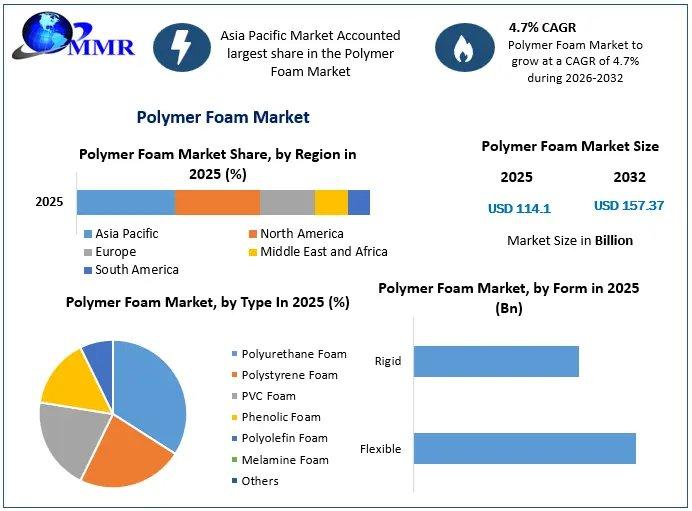
The Polymer Foam Market is entering a sustained growth phase as industries increasingly demand lightweight, durable, energy-efficient, and high-performance materials. According to Maximize Market Research, the global Polymer Foam Market was valued at US$ 114.1 billion in 2025 and is expected to grow at a CAGR of 4.7% from 2026 to 2032, reaching nearly US$ 157.37 billion by 2032.
Polymer foams such as polyurethane, polystyrene, polyethylene, polypropylene, and PVC provide thermal insulation, cushioning, impact resistance, sound absorption, and weight reduction. These properties are driving adoption across construction, automotive, packaging, furniture and bedding, electronics, medical applications, aerospace, and consumer goods.
Market Estimation, Growth Drivers and Opportunities
The market is benefiting from the increasing use of lightweight materials in automotive and electric vehicles, where foam components help reduce vehicle weight, improve energy efficiency, enhance passenger comfort, and support longer driving ranges. Construction is another major growth engine, as polymer foams provide effective thermal and acoustic insulation while supporting energy-efficient building designs.
Rapid urbanization, infrastructure development, e-commerce expansion, and rising demand for protective packaging are further increasing consumption. The growing adoption of polymer foams in electric vehicles, renewable-energy systems, refrigeration, healthcare equipment, and advanced industrial applications is creating additional opportunities.
Sustainability is becoming a major market opportunity. Manufacturers are investing in recyclable, bio-based, low-emission, and circular polymer foam technologies. Advances in extrusion, injection molding, automated processing, and specialty foam formulations are helping companies reduce material consumption while improving performance.
Request Your Sample Report Now : https://www.maximizemarketresearch.com/request-sample/33278/
U.S. Market Trends and Investment
The United States remains an important market because of strong demand from construction, automotive, aerospace, healthcare, packaging, and advanced electronics. In 2025, sustainability and energy efficiency were particularly important themes. BASF expanded its North American polyurethane portfolio with biomass-balance flexible foam systems for furniture applications, offering the potential for substantially lower product carbon footprints. The company also continued developing sustainable insulation technologies for buildings.
U.S. manufacturers are also responding to increasing requirements for energy-efficient construction and higher-performance materials. Federal and housing energy-efficiency initiatives continued supporting demand for insulation products, including rigid and spray foam solutions. At the same time, investments in electric vehicles, battery systems, data centers, and advanced electronics are creating demand for specialized foams that provide cushioning, sealing, thermal management, acoustic control, and flame resistance.
Polymer Foam Market to Reach US$ 157.37 Billion by 2032, Driven by Lightweight Materials and Sustainable Foam Innovation
The Polymer Foam Market is entering a sustained growth phase as industries increasingly demand lightweight, durable, energy-efficient, and high-performance materials. According to Maximize Market Research, the global Polymer Foam Market was valued at US$ 114.1 billion in 2025 and is expected to grow at a CAGR of 4.7% from 2026 to 2032, reaching nearly US$ 157.37 billion by 2032.
Polymer foams such as polyurethane, polystyrene, polyethylene, polypropylene, and PVC provide thermal insulation, cushioning, impact resistance, sound absorption, and weight reduction. These properties are driving adoption across construction, automotive, packaging, furniture and bedding, electronics, medical applications, aerospace, and consumer goods.
Market Estimation, Growth Drivers and Opportunities
The market is benefiting from the increasing use of lightweight materials in automotive and electric vehicles, where foam components help reduce vehicle weight, improve energy efficiency, enhance passenger comfort, and support longer driving ranges. Construction is another major growth engine, as polymer foams provide effective thermal and acoustic insulation while supporting energy-efficient building designs.
Rapid urbanization, infrastructure development, e-commerce expansion, and rising demand for protective packaging are further increasing consumption. The growing adoption of polymer foams in electric vehicles, renewable-energy systems, refrigeration, healthcare equipment, and advanced industrial applications is creating additional opportunities.
Sustainability is becoming a major market opportunity. Manufacturers are investing in recyclable, bio-based, low-emission, and circular polymer foam technologies. Advances in extrusion, injection molding, automated processing, and specialty foam formulations are helping companies reduce material consumption while improving performance.
Request Your Sample Report Now : https://www.maximizemarketresearch.com/request-sample/33278/
U.S. Market Trends and Investment
The United States remains an important market because of strong demand from construction, automotive, aerospace, healthcare, packaging, and advanced electronics. In 2025, sustainability and energy efficiency were particularly important themes. BASF expanded its North American polyurethane portfolio with biomass-balance flexible foam systems for furniture applications, offering the potential for substantially lower product carbon footprints. The company also continued developing sustainable insulation technologies for buildings.
U.S. manufacturers are also responding to increasing requirements for energy-efficient construction and higher-performance materials. Federal and housing energy-efficiency initiatives continued supporting demand for insulation products, including rigid and spray foam solutions. At the same time, investments in electric vehicles, battery systems, data centers, and advanced electronics are creating demand for specialized foams that provide cushioning, sealing, thermal management, acoustic control, and flame resistance.
Polymer Foams Market Development Segments and Industry Growth Outlook
Polymer Foam Market to Reach US$ 157.37 Billion by 2032, Driven by Lightweight Materials and Sustainable Foam Innovation
The Polymer Foam Market is entering a sustained growth phase as industries increasingly demand lightweight, durable, energy-efficient, and high-performance materials. According to Maximize Market Research, the global Polymer Foam Market was valued at US$ 114.1 billion in 2025 and is expected to grow at a CAGR of 4.7% from 2026 to 2032, reaching nearly US$ 157.37 billion by 2032.
Polymer foams such as polyurethane, polystyrene, polyethylene, polypropylene, and PVC provide thermal insulation, cushioning, impact resistance, sound absorption, and weight reduction. These properties are driving adoption across construction, automotive, packaging, furniture and bedding, electronics, medical applications, aerospace, and consumer goods.
Market Estimation, Growth Drivers and Opportunities
The market is benefiting from the increasing use of lightweight materials in automotive and electric vehicles, where foam components help reduce vehicle weight, improve energy efficiency, enhance passenger comfort, and support longer driving ranges. Construction is another major growth engine, as polymer foams provide effective thermal and acoustic insulation while supporting energy-efficient building designs.
Rapid urbanization, infrastructure development, e-commerce expansion, and rising demand for protective packaging are further increasing consumption. The growing adoption of polymer foams in electric vehicles, renewable-energy systems, refrigeration, healthcare equipment, and advanced industrial applications is creating additional opportunities.
Sustainability is becoming a major market opportunity. Manufacturers are investing in recyclable, bio-based, low-emission, and circular polymer foam technologies. Advances in extrusion, injection molding, automated processing, and specialty foam formulations are helping companies reduce material consumption while improving performance.
Request Your Sample Report Now : https://www.maximizemarketresearch.com/request-sample/33278/
U.S. Market Trends and Investment
The United States remains an important market because of strong demand from construction, automotive, aerospace, healthcare, packaging, and advanced electronics. In 2025, sustainability and energy efficiency were particularly important themes. BASF expanded its North American polyurethane portfolio with biomass-balance flexible foam systems for furniture applications, offering the potential for substantially lower product carbon footprints. The company also continued developing sustainable insulation technologies for buildings.
U.S. manufacturers are also responding to increasing requirements for energy-efficient construction and higher-performance materials. Federal and housing energy-efficiency initiatives continued supporting demand for insulation products, including rigid and spray foam solutions. At the same time, investments in electric vehicles, battery systems, data centers, and advanced electronics are creating demand for specialized foams that provide cushioning, sealing, thermal management, acoustic control, and flame resistance.
0 Comments
·0 Shares
·296 Views