

• The Tungsten Market was valued at USD 5.54 billion in 2025 and is projected to expand to USD 11.08 billion by 2034, registering a robust compound annual growth rate (CAGR) of 8% throughout the forecast period (2026–2034). The report highlights tungsten's irreplaceable role as a high-density, high-melting-point critical metal essential for next-generation defense systems, industrial automation, electronics, and aerospace components.

    The global tungsten market is undergoing a structural paradigm shift. Traditionally concentrated in a handful of mining jurisdictions, supply chains are now experiencing profound re-engineering catalyzed by international trade policies, geopolitical friction, and stringent import tariffs. In late 2025, trade authorities imposed major tariffs on tungsten imports from primary Asian suppliers, instantly forcing Western manufacturers to rethink procurement strategies.

    Key Findings from the Report
    Valuation Baseline: The global tungsten market was valued at USD 5.54 billion in 2025, scaling up to an estimated USD 11.08 billion by 2034.

    Growth Trajectory: The market is poised to advance at a stellar CAGR of 8.0% across the 2026–2034 forecast period.

    Dominant Product Segment: Tungsten carbide dominates the market by product type, fueled by its unmatched hardness and widespread utility in heavy-duty cutting tools, wear-resistant machine parts, and precision surgical instruments.

    Fastest-Growing Application: The aerospace and defense sector represents the fastest-growing end-user segment, driven by surging production of aircraft turbine blades, inertial navigation systems, missile components, and kinetic energy penetrators.

    Form Factor Insights: Specialized material formats—including tungsten wires, foils, tubes, and ribbons—are witnessing accelerated adoption within high-precision semiconductor fabrication and advanced electronics.

    Regional Dominance: Asia-Pacific retained its position as the dominant regional market in 2025, backed by extensive mining operations, robust industrial manufacturing bases, and heavy state-backed infrastructure investments in China and India.

    Investment Relevance: Heightened supply vulnerability is unlocking lucrative venture capital and private equity opportunities in closed-loop recycling technologies, scrap-processing facilities, and regional stockpile joint ventures.

    For further information, click the following link:https://www.stellarmr.com/report/req_sample/Tungsten-Market/2788
    Market Drivers and Restraints
    Drivers
    Surging Aerospace and Defense Modernization: Accelerated global defense spending and the post-pandemic recovery of commercial aviation are driving intense demand for heat-resistant superalloys, turbine components, and aircraft balancing weights.

    Expansion of Industrial Automation and Robotics: High-speed machining, precision cutting tools, and modern automated assembly lines rely heavily on tungsten carbide tooling to maintain operational efficiency and minimize downtime.

    Electrification and Energy Sector Growth: The energy, mining, and automotive sectors increasingly depend on tungsten-infused components to withstand harsh drilling environments, high-stress mechanical friction, and thermal fatigue.

    Restraints
    High Production and Processing Complexities: Extracting tungsten from low-concentration ores and refining it into high-purity powders or carbides requires intensive energy consumption and sophisticated pyrometallurgical processing infrastructure.

    Raw Material Scarcity and Trade Restrictions: Geopolitical trade barriers, export quotas, and heavy import tariffs limit open-market access, creating severe supply bottlenecks and escalating input costs for downstream manufacturers.

    Technology, Regulation, and Sustainability Trends
    Operational transformation in the tungsten sector is heavily anchored in ESG compliance and technological innovation. Environmental, Social, and Governance (ESG) pressures are compelling primary producers to transition away from carbon-heavy extraction methods toward green mining equipment and hydrometallurgical recycling.

    On the regulatory front, sweeping trade policies—such as the imposition of multi-percentage tariffs on imported tungsten oxides and carbides—have triggered aggressive compliance and localization mandates. Industrial consumers are actively adopting digital supply-chain traceability tools to verify conflict-free mineral sourcing. Furthermore, technological breakthroughs in additive manufacturing (3D printing) utilizing specialized tungsten powders are enabling the creation of complex, net-shape components, drastically reducing material waste in aerospace and medical engineering.

    Regional Insights
    Asia-Pacific (APAC): Dominating the global landscape, APAC is propelled by extensive upstream mining output in China, rapidly expanding manufacturing hubs in Southeast Asia, and robust technological integration across electronics and automotive sectors.

    North America: Experiencing aggressive market acceleration driven by strategic supply-chain legislation, domestic defense procurement mandates, and heavy private investments in regional tungsten oxide stockpiles and processing plants.

    Europe: Anchored by stringent environmental regulations and advanced manufacturing, Europe is heavily investing in closed-loop recycling capacities, led by major industrial recycling hubs in Germany and Austria.

    Middle East & Africa / South America: Emerging as vital secondary sourcing and mining frontiers, attracting foreign direct investment (FDI) aimed at diversifying the global mineral supply matrix.

    Recent Industry Developments
    H.C. Starck (2026): Announced an approximate EUR 50 million capital investment to scale up tungsten recycling capacity at its German processing plant, targeting an increase in scrap-processing capacity from 5,000 to 7,000 tonnes annually by 2028.

    Plansee & Manhattan Five Partners (2026): Entered a landmark framework agreement to establish a strategic tungsten oxide stockpile in the U.S. and expand regional processing output to 12,000 tonnes annually to fortify supply resilience.

    Mitsubishi Materials Corporation & Masan High-Tech Materials (2025): Finalized strategic equity and operational agreements regarding H.C. Starck GMBH holdings to vertically integrate advanced tungsten carbide manufacturing and secure stable international supply channels.

    United States Trade Regulatory Action (2025): Enacted a 25% tariff on specific incoming tungsten carbide and oxide shipments, instantly accelerating nearshoring initiatives and alternative supply-chain financing outside traditional dominant corridors.

    H.C. Starck & Nyobolt Collaboration (2022–2026): Advanced strategic financing and technological integration into tungsten-based ultra-fast-charging battery solutions, opening up high-growth commercial avenues in electric vehicle (EV) energy storage.

    Competitive Landscape
    The global tungsten market features a consolidated yet intensely competitive ecosystem characterized by vertical integration, strategic joint ventures, and rigorous R&D investments. Market leaders are actively prioritizing long-term supply agreements and secondary recycling capabilities to hedge against geopolitical volatility.

    Key players profiled in the Stellar Market Research report include Global Tungsten & Powders Corp., Kennametal Inc., Buffalo Tungsten Inc., Allegheny Technologies Inc., Elmet Technologies, Midwest Tungsten Service, Element Six, Specialty Metals Resources, H.C. Starck, and Xiamen Tungsten Co., Ltd.

    Analyst Commentary
    "The tungsten market is moving past the era of simple commodity extraction into an era of strategic national security and supply-chain resilience. With import tariffs and raw material scarcity squeezing traditional trade corridors, market participants can no longer rely on business-as-usual sourcing. Companies that successfully invest in secondary recycling, domestic stockpiling, and advanced metallurgical processing will capture outsized market share through 2034." — Senior Research Analyst, Stellar Market Research

    Future Outlook
    Through the remainder of the forecast period, the tungsten market will be defined by aggressive supply-chain diversification and technological upgrading. As aerospace defense modernization and industrial robotics accelerate, demand for ultra-pure tungsten powders and carbide components will outpace baseline economic growth. Long-term market success will increasingly hinge on closed-loop circular economy models, advanced recycling innovations, and agile regional partnerships designed to mitigate geopolitical risk.

    For further information, click the following link:https://www.stellarmr.com/report/req_sample/Tungsten-Market/2788
    About Stellar Market Research
    Stellar Market Research is a multifaceted market research and consulting company with professionals from several industries. Some of the industries we cover include medical devices, pharmaceutical manufacturers, science and engineering, electronic components, industrial equipment, technology and communication, cars and automobiles, chemical products and substances, general merchandise, beverages, personal care, and automated systems. To mention a few, we provide market-verified industry estimations, technical trend analysis, crucial market research, strategic advice, competition analysis, production and demand analysis, and client impact studies.

    Address
    Phase 3, Navale IT Zone, S.No. 51/2A/2, Office No. 202, 2nd floor, Near, Navale Brg, Narhe, Pune, Maharashtra 411041

    Email
    [email protected]

    Mobile
    +91 9607365656
    The Tungsten Market was valued at USD 5.54 billion in 2025 and is projected to expand to USD 11.08 billion by 2034, registering a robust compound annual growth rate (CAGR) of 8% throughout the forecast period (2026–2034). The report highlights tungsten's irreplaceable role as a high-density, high-melting-point critical metal essential for next-generation defense systems, industrial automation, electronics, and aerospace components. The global tungsten market is undergoing a structural paradigm shift. Traditionally concentrated in a handful of mining jurisdictions, supply chains are now experiencing profound re-engineering catalyzed by international trade policies, geopolitical friction, and stringent import tariffs. In late 2025, trade authorities imposed major tariffs on tungsten imports from primary Asian suppliers, instantly forcing Western manufacturers to rethink procurement strategies. Key Findings from the Report Valuation Baseline: The global tungsten market was valued at USD 5.54 billion in 2025, scaling up to an estimated USD 11.08 billion by 2034. Growth Trajectory: The market is poised to advance at a stellar CAGR of 8.0% across the 2026–2034 forecast period. Dominant Product Segment: Tungsten carbide dominates the market by product type, fueled by its unmatched hardness and widespread utility in heavy-duty cutting tools, wear-resistant machine parts, and precision surgical instruments. Fastest-Growing Application: The aerospace and defense sector represents the fastest-growing end-user segment, driven by surging production of aircraft turbine blades, inertial navigation systems, missile components, and kinetic energy penetrators. Form Factor Insights: Specialized material formats—including tungsten wires, foils, tubes, and ribbons—are witnessing accelerated adoption within high-precision semiconductor fabrication and advanced electronics. Regional Dominance: Asia-Pacific retained its position as the dominant regional market in 2025, backed by extensive mining operations, robust industrial manufacturing bases, and heavy state-backed infrastructure investments in China and India. Investment Relevance: Heightened supply vulnerability is unlocking lucrative venture capital and private equity opportunities in closed-loop recycling technologies, scrap-processing facilities, and regional stockpile joint ventures. For further information, click the following link:https://www.stellarmr.com/report/req_sample/Tungsten-Market/2788 Market Drivers and Restraints Drivers Surging Aerospace and Defense Modernization: Accelerated global defense spending and the post-pandemic recovery of commercial aviation are driving intense demand for heat-resistant superalloys, turbine components, and aircraft balancing weights. Expansion of Industrial Automation and Robotics: High-speed machining, precision cutting tools, and modern automated assembly lines rely heavily on tungsten carbide tooling to maintain operational efficiency and minimize downtime. Electrification and Energy Sector Growth: The energy, mining, and automotive sectors increasingly depend on tungsten-infused components to withstand harsh drilling environments, high-stress mechanical friction, and thermal fatigue. Restraints High Production and Processing Complexities: Extracting tungsten from low-concentration ores and refining it into high-purity powders or carbides requires intensive energy consumption and sophisticated pyrometallurgical processing infrastructure. Raw Material Scarcity and Trade Restrictions: Geopolitical trade barriers, export quotas, and heavy import tariffs limit open-market access, creating severe supply bottlenecks and escalating input costs for downstream manufacturers. Technology, Regulation, and Sustainability Trends Operational transformation in the tungsten sector is heavily anchored in ESG compliance and technological innovation. Environmental, Social, and Governance (ESG) pressures are compelling primary producers to transition away from carbon-heavy extraction methods toward green mining equipment and hydrometallurgical recycling. On the regulatory front, sweeping trade policies—such as the imposition of multi-percentage tariffs on imported tungsten oxides and carbides—have triggered aggressive compliance and localization mandates. Industrial consumers are actively adopting digital supply-chain traceability tools to verify conflict-free mineral sourcing. Furthermore, technological breakthroughs in additive manufacturing (3D printing) utilizing specialized tungsten powders are enabling the creation of complex, net-shape components, drastically reducing material waste in aerospace and medical engineering. Regional Insights Asia-Pacific (APAC): Dominating the global landscape, APAC is propelled by extensive upstream mining output in China, rapidly expanding manufacturing hubs in Southeast Asia, and robust technological integration across electronics and automotive sectors. North America: Experiencing aggressive market acceleration driven by strategic supply-chain legislation, domestic defense procurement mandates, and heavy private investments in regional tungsten oxide stockpiles and processing plants. Europe: Anchored by stringent environmental regulations and advanced manufacturing, Europe is heavily investing in closed-loop recycling capacities, led by major industrial recycling hubs in Germany and Austria. Middle East & Africa / South America: Emerging as vital secondary sourcing and mining frontiers, attracting foreign direct investment (FDI) aimed at diversifying the global mineral supply matrix. Recent Industry Developments H.C. Starck (2026): Announced an approximate EUR 50 million capital investment to scale up tungsten recycling capacity at its German processing plant, targeting an increase in scrap-processing capacity from 5,000 to 7,000 tonnes annually by 2028. Plansee & Manhattan Five Partners (2026): Entered a landmark framework agreement to establish a strategic tungsten oxide stockpile in the U.S. and expand regional processing output to 12,000 tonnes annually to fortify supply resilience. Mitsubishi Materials Corporation & Masan High-Tech Materials (2025): Finalized strategic equity and operational agreements regarding H.C. Starck GMBH holdings to vertically integrate advanced tungsten carbide manufacturing and secure stable international supply channels. United States Trade Regulatory Action (2025): Enacted a 25% tariff on specific incoming tungsten carbide and oxide shipments, instantly accelerating nearshoring initiatives and alternative supply-chain financing outside traditional dominant corridors. H.C. Starck & Nyobolt Collaboration (2022–2026): Advanced strategic financing and technological integration into tungsten-based ultra-fast-charging battery solutions, opening up high-growth commercial avenues in electric vehicle (EV) energy storage. Competitive Landscape The global tungsten market features a consolidated yet intensely competitive ecosystem characterized by vertical integration, strategic joint ventures, and rigorous R&D investments. Market leaders are actively prioritizing long-term supply agreements and secondary recycling capabilities to hedge against geopolitical volatility. Key players profiled in the Stellar Market Research report include Global Tungsten & Powders Corp., Kennametal Inc., Buffalo Tungsten Inc., Allegheny Technologies Inc., Elmet Technologies, Midwest Tungsten Service, Element Six, Specialty Metals Resources, H.C. Starck, and Xiamen Tungsten Co., Ltd. Analyst Commentary "The tungsten market is moving past the era of simple commodity extraction into an era of strategic national security and supply-chain resilience. With import tariffs and raw material scarcity squeezing traditional trade corridors, market participants can no longer rely on business-as-usual sourcing. Companies that successfully invest in secondary recycling, domestic stockpiling, and advanced metallurgical processing will capture outsized market share through 2034." — Senior Research Analyst, Stellar Market Research Future Outlook Through the remainder of the forecast period, the tungsten market will be defined by aggressive supply-chain diversification and technological upgrading. As aerospace defense modernization and industrial robotics accelerate, demand for ultra-pure tungsten powders and carbide components will outpace baseline economic growth. Long-term market success will increasingly hinge on closed-loop circular economy models, advanced recycling innovations, and agile regional partnerships designed to mitigate geopolitical risk. For further information, click the following link:https://www.stellarmr.com/report/req_sample/Tungsten-Market/2788 About Stellar Market Research Stellar Market Research is a multifaceted market research and consulting company with professionals from several industries. Some of the industries we cover include medical devices, pharmaceutical manufacturers, science and engineering, electronic components, industrial equipment, technology and communication, cars and automobiles, chemical products and substances, general merchandise, beverages, personal care, and automated systems. To mention a few, we provide market-verified industry estimations, technical trend analysis, crucial market research, strategic advice, competition analysis, production and demand analysis, and client impact studies. Address Phase 3, Navale IT Zone, S.No. 51/2A/2, Office No. 202, 2nd floor, Near, Navale Brg, Narhe, Pune, Maharashtra 411041 Email [email protected] Mobile +91 9607365656
    0 Comments ·0 Shares ·87 Views
  • The Capital Expenditure Market is undergoing a profound structural transformation, driven by massive investments in artificial intelligence infrastructure, renewable energy grids, and digital modernization. According to a comprehensive global market intelligence report released by Stellar Market Research, the market was valued at USD 31,608.9 billion in 2025 and is projected to scale aggressively to USD 48,378.3 billion by 2033, exhibiting a compound annual growth rate (CAGR) of 5.4% throughout the forecast period. This strategic market expansion underscores how corporations and public entities worldwide are re-allocating capital budgets toward advanced automation, supply chain resilience, and next-generation ICT frameworks.

    Modern corporate finance is no longer dictated solely by cost containment; instead, enterprise strategy has pivoted toward high-yield capital deployment in hyper-scalers, clean energy transition, and automated manufacturing systems. The global economy is experiencing a K-shaped capital expenditure cycle where traditional civil infrastructure grows at a steady pace, while technology-intensive assets—particularly ICT equipment and intelligent power grids—experience exponential acceleration. Enterprises are forced to balance the high initial outlays of asset replacement and capacity expansion against volatile macro-financing conditions, making strategic capital allocation a core differentiator for market leaders.

    Key Findings from the Report
    Valuation Trajectory: The global Capital Expenditure Market reached a base-year valuation of USD 31,608.9 billion in 2025, climbing toward a targeted USD 48,378.3 billion by 2033 at a 5.4% CAGR.

    Dominant Segment: Capacity Expansion leads asset deployment objectives, accounting for USD 14,019.7 billion in value, reflecting intensive global demand for scaling production footprints.

    Fastest-Growing Segment: The Information Communication Technology (ICT) equipment sector emerges as the high-growth hotspot, expanding at a remarkable 8.6% CAGR driven by enterprise digital transformation.

    Regional Dominance: Asia Pacific anchors global market leadership, capturing a dominant 43.9% market share in 2025 on the back of rapid industrialization and mega-project investments.

    European Steadiness: Europe accounts for 19.6% of the global market in 2025, underpinned by active institutional and corporate funding directed toward green assets and energy efficiency.

    Emerging Frontier: The Middle East and South America represent dynamic emerging zones, registering steady adoption in civil engineering and ICT infrastructure modernization.

    Financing Paradigm Shift: Internal cash generation and structured debt financing dominate corporate balance sheets as organizations navigate stringent lending costs.

    For further information, click the following link:https://www.stellarmr.com/report/req_sample/Capital-Expenditure-Market/2797
    Market Drivers and Restraints
    Drivers
    AI Infrastructure & Grid Expansion: Surging global demand for data centers, semiconductor fabrication plants, and smart power grids necessitates multi-billion-dollar capital investments.

    Technological Modernization: Organizations are aggressively upgrading legacy machinery and deploying IoT-enabled automation to optimize operational efficiency and counter margin compression.

    Asset Replacement Cycles: Aging industrial and energy infrastructure requires mandatory capital outlays to maintain operational continuity and safety compliance.

    Restraints
    Capital Cost Escalation: High interest rates and volatile inflation increase the cost of debt financing, prompting corporations to adopt cautious project scheduling.

    Rising Compliance Pressures: Stringent regulatory mandates and environmental compliance expenses squeeze corporate operating margins, occasionally delaying long-term project approvals.

    Technology, Regulation, and Sustainability Trends
    The integration of Environmental, Social, and Governance (ESG) frameworks is fundamentally altering capital allocation. Regulatory bodies across North America and Europe are enforcing stricter carbon disclosures, compelling enterprises to funnel capital expenditure into green bonds, renewable energy integration, and waste-reduction manufacturing technologies. Simultaneously, artificial intelligence is revolutionizing project appraisal, risk modeling, and automated due diligence, enabling CFOs to optimize capital deployment schedules and minimize project overruns.

    Regional Insights
    Asia Pacific: Retains its stronghold as the primary regional engine with a 43.9% market share in 2025, propelled by massive manufacturing expansions in East Asia, rapid urbanization across South Asia, and national infrastructure modernization blueprints.

    North America: Characterized by high-value investments in artificial intelligence hyper-scale data centers, cloud infrastructure, and aerospace modernization, positioning the region as a high-density capital deployment hub.

    Europe: Driven by strict sustainability regulations and green transition mandates, European corporations prioritize energy efficiency, circular economy assets, and decarbonized industrial manufacturing.

    Latin America & Middle East & Africa (MEA): Emerging regions are leveraging foreign direct investments and public-private partnerships (PPPs) to upgrade telecommunications networks, transport corridors, and utility grids.

    Recent Industry Developments
    PwC (2026): Released global M&A transaction insights indicating that megadeals exceeding $5 billion represent nearly 48% of total global deal value, directing substantial capital into power, utilities, and data center infrastructure.

    Deloitte (2026): Published corporate M&A pulse surveys highlighting that over 80% of corporate dealmakers anticipate increased cross-border capital deployment focused on digital transformation and supply chain localization.

    Siemens AG (2025): Announced multi-million-dollar capital investments toward expanding smart grid manufacturing capacities in North America and Europe to support decentralized energy transitions.

    Schneider Electric (2025): Scaled up capital expenditure for advanced software-defined energy management systems, achieving a 14% boost in production efficiency for hyper-scale data center clients.

    GE Vernova (2026): Executed targeted capital allocations toward gas turbine and grid electrification production lines, aligning output with accelerating global power demand.

    Competitive Landscape
    The global Capital Expenditure Market features a highly consolidated and competitive ecosystem dominated by multinational industrial technology giants. Key players—including Siemens AG, ABB Ltd, Schneider Electric SE, GE Vernova Inc., Hitachi, Ltd., Mitsubishi Electric Corporation, Honeywell International Inc., and Emerson Electric Co.—are actively deploying strategies centered on strategic mergers and acquisitions, portfolio diversification, and proprietary software-hardware integration. Major competitors are focusing on long-term service agreements and turnkey digital solutions to secure recurring revenue streams from asset-heavy clients.

    Analyst Commentary
    "Capital expenditure strategies have evolved past simple physical asset accumulation into a sophisticated, technology-driven balancing act. Corporations are no longer just expanding square footage; they are allocating billions into intelligent grid connectivity, AI-ready infrastructure, and green compliance. The projected climb to USD 48.37 trillion by 2033 highlights that organizations view strategic capital deployment as the ultimate safeguard against market volatility."

    — Senior Research Analyst, Stellar Market Research

    Future Outlook
    Through 2033, the Capital Expenditure Market will remain closely intertwined with macroeconomic stabilization and energy transition milestones. As interest rate environments normalize and digital automation matures, investment velocity is expected to shift toward autonomous manufacturing cells, decarbonized supply chains, and resilient local production hubs. Companies that successfully balance strict financial discipline with visionary tech-led capex will capture disproportionate market share.

    For further information, click the following link:https://www.stellarmr.com/report/req_sample/Capital-Expenditure-Market/2797
    About Stellar Market Research
    Stellar Market Research is a multifaceted market research and consulting company with professionals from several industries. Some of the industries we cover include medical devices, pharmaceutical manufacturers, science and engineering, electronic components, industrial equipment, technology and communication, cars and automobiles, chemical products and substances, general merchandise, beverages, personal care, and automated systems. To mention a few, we provide market-verified industry estimations, technical trend analysis, crucial market research, strategic advice, competition analysis, production and demand analysis, and client impact studies.

    Address
    Phase 3, Navale IT Zone, S.No. 51/2A/2, Office No. 202, 2nd floor, Near, Navale Brg, Narhe, Pune, Maharashtra 411041

    Email
    [email protected]

    Mobile
    +91 9607365656

    The Capital Expenditure Market is undergoing a profound structural transformation, driven by massive investments in artificial intelligence infrastructure, renewable energy grids, and digital modernization. According to a comprehensive global market intelligence report released by Stellar Market Research, the market was valued at USD 31,608.9 billion in 2025 and is projected to scale aggressively to USD 48,378.3 billion by 2033, exhibiting a compound annual growth rate (CAGR) of 5.4% throughout the forecast period. This strategic market expansion underscores how corporations and public entities worldwide are re-allocating capital budgets toward advanced automation, supply chain resilience, and next-generation ICT frameworks. Modern corporate finance is no longer dictated solely by cost containment; instead, enterprise strategy has pivoted toward high-yield capital deployment in hyper-scalers, clean energy transition, and automated manufacturing systems. The global economy is experiencing a K-shaped capital expenditure cycle where traditional civil infrastructure grows at a steady pace, while technology-intensive assets—particularly ICT equipment and intelligent power grids—experience exponential acceleration. Enterprises are forced to balance the high initial outlays of asset replacement and capacity expansion against volatile macro-financing conditions, making strategic capital allocation a core differentiator for market leaders. Key Findings from the Report Valuation Trajectory: The global Capital Expenditure Market reached a base-year valuation of USD 31,608.9 billion in 2025, climbing toward a targeted USD 48,378.3 billion by 2033 at a 5.4% CAGR. Dominant Segment: Capacity Expansion leads asset deployment objectives, accounting for USD 14,019.7 billion in value, reflecting intensive global demand for scaling production footprints. Fastest-Growing Segment: The Information Communication Technology (ICT) equipment sector emerges as the high-growth hotspot, expanding at a remarkable 8.6% CAGR driven by enterprise digital transformation. Regional Dominance: Asia Pacific anchors global market leadership, capturing a dominant 43.9% market share in 2025 on the back of rapid industrialization and mega-project investments. European Steadiness: Europe accounts for 19.6% of the global market in 2025, underpinned by active institutional and corporate funding directed toward green assets and energy efficiency. Emerging Frontier: The Middle East and South America represent dynamic emerging zones, registering steady adoption in civil engineering and ICT infrastructure modernization. Financing Paradigm Shift: Internal cash generation and structured debt financing dominate corporate balance sheets as organizations navigate stringent lending costs. For further information, click the following link:https://www.stellarmr.com/report/req_sample/Capital-Expenditure-Market/2797 Market Drivers and Restraints Drivers AI Infrastructure & Grid Expansion: Surging global demand for data centers, semiconductor fabrication plants, and smart power grids necessitates multi-billion-dollar capital investments. Technological Modernization: Organizations are aggressively upgrading legacy machinery and deploying IoT-enabled automation to optimize operational efficiency and counter margin compression. Asset Replacement Cycles: Aging industrial and energy infrastructure requires mandatory capital outlays to maintain operational continuity and safety compliance. Restraints Capital Cost Escalation: High interest rates and volatile inflation increase the cost of debt financing, prompting corporations to adopt cautious project scheduling. Rising Compliance Pressures: Stringent regulatory mandates and environmental compliance expenses squeeze corporate operating margins, occasionally delaying long-term project approvals. Technology, Regulation, and Sustainability Trends The integration of Environmental, Social, and Governance (ESG) frameworks is fundamentally altering capital allocation. Regulatory bodies across North America and Europe are enforcing stricter carbon disclosures, compelling enterprises to funnel capital expenditure into green bonds, renewable energy integration, and waste-reduction manufacturing technologies. Simultaneously, artificial intelligence is revolutionizing project appraisal, risk modeling, and automated due diligence, enabling CFOs to optimize capital deployment schedules and minimize project overruns. Regional Insights Asia Pacific: Retains its stronghold as the primary regional engine with a 43.9% market share in 2025, propelled by massive manufacturing expansions in East Asia, rapid urbanization across South Asia, and national infrastructure modernization blueprints. North America: Characterized by high-value investments in artificial intelligence hyper-scale data centers, cloud infrastructure, and aerospace modernization, positioning the region as a high-density capital deployment hub. Europe: Driven by strict sustainability regulations and green transition mandates, European corporations prioritize energy efficiency, circular economy assets, and decarbonized industrial manufacturing. Latin America & Middle East & Africa (MEA): Emerging regions are leveraging foreign direct investments and public-private partnerships (PPPs) to upgrade telecommunications networks, transport corridors, and utility grids. Recent Industry Developments PwC (2026): Released global M&A transaction insights indicating that megadeals exceeding $5 billion represent nearly 48% of total global deal value, directing substantial capital into power, utilities, and data center infrastructure. Deloitte (2026): Published corporate M&A pulse surveys highlighting that over 80% of corporate dealmakers anticipate increased cross-border capital deployment focused on digital transformation and supply chain localization. Siemens AG (2025): Announced multi-million-dollar capital investments toward expanding smart grid manufacturing capacities in North America and Europe to support decentralized energy transitions. Schneider Electric (2025): Scaled up capital expenditure for advanced software-defined energy management systems, achieving a 14% boost in production efficiency for hyper-scale data center clients. GE Vernova (2026): Executed targeted capital allocations toward gas turbine and grid electrification production lines, aligning output with accelerating global power demand. Competitive Landscape The global Capital Expenditure Market features a highly consolidated and competitive ecosystem dominated by multinational industrial technology giants. Key players—including Siemens AG, ABB Ltd, Schneider Electric SE, GE Vernova Inc., Hitachi, Ltd., Mitsubishi Electric Corporation, Honeywell International Inc., and Emerson Electric Co.—are actively deploying strategies centered on strategic mergers and acquisitions, portfolio diversification, and proprietary software-hardware integration. Major competitors are focusing on long-term service agreements and turnkey digital solutions to secure recurring revenue streams from asset-heavy clients. Analyst Commentary "Capital expenditure strategies have evolved past simple physical asset accumulation into a sophisticated, technology-driven balancing act. Corporations are no longer just expanding square footage; they are allocating billions into intelligent grid connectivity, AI-ready infrastructure, and green compliance. The projected climb to USD 48.37 trillion by 2033 highlights that organizations view strategic capital deployment as the ultimate safeguard against market volatility." — Senior Research Analyst, Stellar Market Research Future Outlook Through 2033, the Capital Expenditure Market will remain closely intertwined with macroeconomic stabilization and energy transition milestones. As interest rate environments normalize and digital automation matures, investment velocity is expected to shift toward autonomous manufacturing cells, decarbonized supply chains, and resilient local production hubs. Companies that successfully balance strict financial discipline with visionary tech-led capex will capture disproportionate market share. For further information, click the following link:https://www.stellarmr.com/report/req_sample/Capital-Expenditure-Market/2797 About Stellar Market Research Stellar Market Research is a multifaceted market research and consulting company with professionals from several industries. Some of the industries we cover include medical devices, pharmaceutical manufacturers, science and engineering, electronic components, industrial equipment, technology and communication, cars and automobiles, chemical products and substances, general merchandise, beverages, personal care, and automated systems. To mention a few, we provide market-verified industry estimations, technical trend analysis, crucial market research, strategic advice, competition analysis, production and demand analysis, and client impact studies. Address Phase 3, Navale IT Zone, S.No. 51/2A/2, Office No. 202, 2nd floor, Near, Navale Brg, Narhe, Pune, Maharashtra 411041 Email [email protected] Mobile +91 9607365656
    0 Comments ·0 Shares ·335 Views
  • Conductive Silicone Rubber Market Analysis and Projected Industry Growth

    Conductive Silicone Rubber Market to Reach USD 13.64 Billion by 2032, Driven by Automotive Electrification and Advanced Electronics

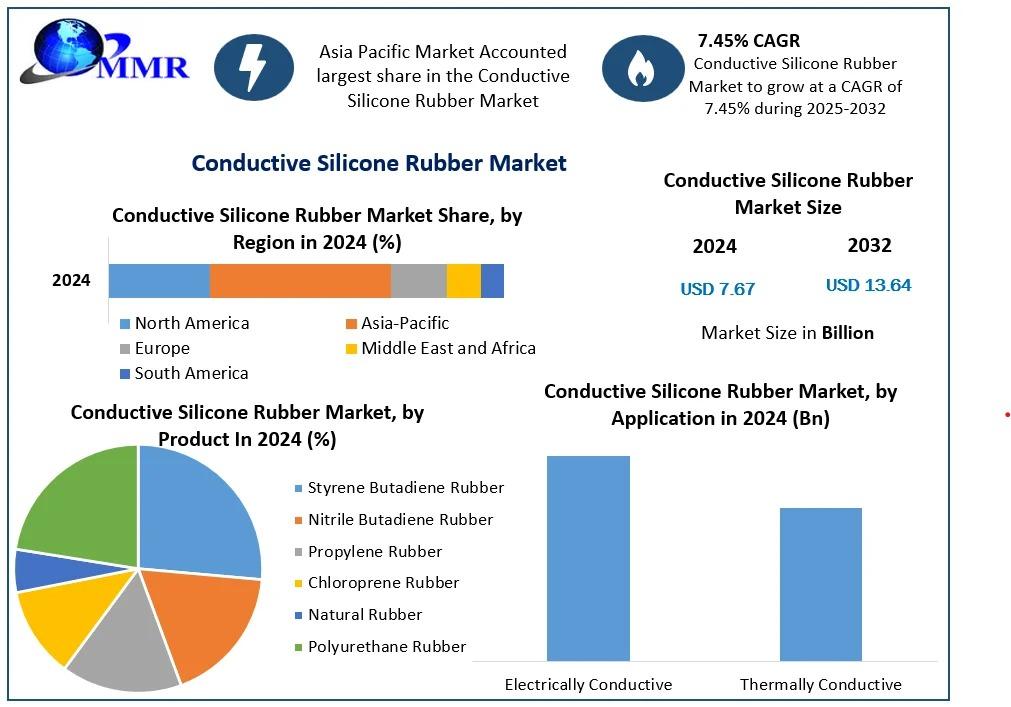
    The Conductive Silicone Rubber Market is gaining momentum as manufacturers seek materials combining conductivity, flexibility, durability and reliable performance. According to Maximize Market Research, the market was valued at USD 7.67 billion in 2024 and is projected to reach USD 13.64 billion by 2032, registering a CAGR of 7.45% during 2025–2032.

    Market Estimation, Growth Drivers and Opportunities

    Conductive silicone rubber consists of silicone compounds engineered to conduct electricity or transfer heat. Its ability to provide electromagnetic interference (EMI) and radio-frequency interference (RFI) shielding while retaining flexibility and environmental resistance makes it useful in electronic enclosures, sensors, circuit boards, communication equipment, LEDs and industrial components.

    Growth is supported by rising electronic content in vehicles and industrial machinery, electric-vehicle adoption, and demand from solar energy and LED applications. Expanding 5G infrastructure, data centres, automation and compact devices create opportunities for materials that protect sensitive components from interference and heat.

    United States: Trends and Investment

    The United States is an important demand centre due to its automotive, aerospace, electronics and semiconductor industries. In June 2025, Micron announced plans to invest approximately USD 200 billion in US semiconductor manufacturing and research and development, including new and expanded facilities in Idaho, New York and Virginia and advanced high-bandwidth memory packaging capabilities. Although this investment is not specific to conductive silicone rubber, it is expected to expand the domestic electronics ecosystem and demand for materials used in component protection, thermal management and EMI shielding.

    Get Your Free Sample Report Link : https://www.maximizemarketresearch.com/request-sample/70722/

    Conductive Silicone Rubber Market Analysis and Projected Industry Growth Conductive Silicone Rubber Market to Reach USD 13.64 Billion by 2032, Driven by Automotive Electrification and Advanced Electronics The Conductive Silicone Rubber Market is gaining momentum as manufacturers seek materials combining conductivity, flexibility, durability and reliable performance. According to Maximize Market Research, the market was valued at USD 7.67 billion in 2024 and is projected to reach USD 13.64 billion by 2032, registering a CAGR of 7.45% during 2025–2032. Market Estimation, Growth Drivers and Opportunities Conductive silicone rubber consists of silicone compounds engineered to conduct electricity or transfer heat. Its ability to provide electromagnetic interference (EMI) and radio-frequency interference (RFI) shielding while retaining flexibility and environmental resistance makes it useful in electronic enclosures, sensors, circuit boards, communication equipment, LEDs and industrial components. Growth is supported by rising electronic content in vehicles and industrial machinery, electric-vehicle adoption, and demand from solar energy and LED applications. Expanding 5G infrastructure, data centres, automation and compact devices create opportunities for materials that protect sensitive components from interference and heat. United States: Trends and Investment The United States is an important demand centre due to its automotive, aerospace, electronics and semiconductor industries. In June 2025, Micron announced plans to invest approximately USD 200 billion in US semiconductor manufacturing and research and development, including new and expanded facilities in Idaho, New York and Virginia and advanced high-bandwidth memory packaging capabilities. Although this investment is not specific to conductive silicone rubber, it is expected to expand the domestic electronics ecosystem and demand for materials used in component protection, thermal management and EMI shielding. Get Your Free Sample Report Link : https://www.maximizemarketresearch.com/request-sample/70722/
    0 Comments ·0 Shares ·371 Views
  • The Vibration Monitoring Market was valued at USD 1.77 billion in 2025 and is projected to expand at a robust compound annual growth rate (CAGR) of 8.7% through the forecast period, driven by industrial IoT (IIoT) adoption, strict plant safety mandates, and the shift toward proactive asset health management.

    Modern heavy industries are undergoing a profound operational transformation, transitioning from traditional calendar-based maintenance and reactive breakdown repairs to continuous, cloud-connected predictive intelligence. Unexpected machinery failures in critical infrastructure—such as high-speed turbines, multi-stage compressors, and mega-pumps—can result in catastrophic downtime costing millions of dollars per hour.

    Key Findings from the Report
    Market Valuation & Trajectory: The global vibration monitoring market reached US$ 1.77 billion in 2025 and is scaling at a CAGR of 8.7% over the forecast horizon.

    Component Segmentation: Hardware components (accelerometers, velocity sensors, and proximity probes) maintain the leading revenue share, anchored by the necessity of physical sensing nodes in every industrial deployment.

    Service-Led Growth: Services and cloud-analytics subscriptions are accelerating at the fastest pace as asset-heavy operators outsource complex diagnostic data interpretation to specialized managed-service providers.

    Monitoring Process Dynamics: Online and continuous monitoring systems dominate safety-critical and high-speed environments where millisecond response times are mandatory to prevent catastrophic failures.

    Leading Application Vertical: The oil and gas sector retains its position as the largest end-user vertical, driven by strict regulatory mandates and high asset criticality across upstream and midstream operations.

    Regional Dominance: North America leads the global market footprint due to deep-seated investments in advanced automation, digital transformation, and legacy infrastructure retrofits.

    Investment Relevance: Capital deployment is increasingly favored toward scalable Software-as-a-Service (SaaS) and edge-computing solutions that eliminate high on-premise infrastructure overheads.

    For further information, click the following link:https://www.stellarmr.com/report/req_sample/Vibration-Monitoring-Market/411
    Market Drivers and Restraints
    Drivers
    Proliferation of Smart Manufacturing and IIoT: The rapid expansion of Industry 4.0 initiatives encourages factories to deploy interconnected wireless sensor networks for real-time asset visibility.

    Escalating Costs of Unplanned Downtime: As industrial plants run at higher capacities to meet global demand, the financial penalty of unexpected equipment failure makes predictive maintenance non-negotiable.

    Miniaturization and Cost Deflation of Sensors: Advances in MEMS technology and wireless protocols (such as Bluetooth Low Energy and ISA100) have drastically reduced the deployment cost of vibration monitoring nodes across secondary balance-of-plant assets.

    Restraints
    High Initial CapEx for Comprehensive Retrofits: Upgrading legacy plants with hardwired continuous monitoring infrastructure requires substantial upfront capital allocation.

    Scarcity of Skilled Diagnostic Personnel: Interpreting complex spectral data and vibration waveforms requires specialized domain expertise, presenting a bottleneck for smaller industrial enterprises.

    Technology, Regulation, and Sustainability Trends
    The convergence of operational technology (OT) and information technology (IT) is reshaping plant floors. Modern vibration systems leverage edge-AI algorithms to process raw vibration signals locally, transmitting only actionable anomaly alerts to enterprise cloud platforms. This reduces bandwidth overhead while ensuring immediate safety shutdowns.

    From an ESG and sustainability perspective, optimal machinery balancing and real-time vibration tracking significantly lower friction, minimize mechanical energy loss, and curb excess power consumption in heavy motors. Furthermore, preventing catastrophic equipment failures averts hazardous industrial leaks and environmental spills, aligning heavy industries with stringent global carbon-reduction and safety compliance frameworks.

    Regional Insights
    North America: Anchored by the United States and Canada, North America leads the global market share. The region's growth is supported by mature petrochemical, power generation, and aerospace sectors rapidly modernizing legacy assets with cloud-integrated predictive software.

    Asia-Pacific: Representing the fastest-growing regional frontier, Asia-Pacific is propelled by aggressive industrialization, smart-manufacturing incentives in China and India, and massive investments in automotive and heavy manufacturing plants across Southeast Asia.

    Europe: Driven by stringent industrial safety regulations and rigorous carbon-neutrality mandates across Germany, the UK, and France, focusing heavily on energy-efficient rotating machinery.

    Middle East & Africa: Growth is anchored by mega-infrastructure projects, ongoing downstream expansion by national oil companies, and heavy cement and fertilizer plant automation.

    Recent Industry Developments
    Emerson Electric (2025): Acquired specialized vibration analytics and wireless sensor portfolios, expanding its Plantweb digital ecosystem and boosting enterprise diagnostic capabilities by an estimated 18% across process industries.

    SKF (2025): Launched next-generation wireless rotating machine condition monitoring units designed for hazardous environments, cutting on-site inspection labor requirements by up to 35% for heavy manufacturing clients.

    Baker Hughes (2025): Formed a strategic partnership with a major cloud provider to integrate real-time turbomachinery vibration diagnostics into AI-driven digital twin platforms, improving fleet uptime predictability for global LNG operators.

    Analog Devices (2026): Introduced ultra-low-power, high-bandwidth MEMS accelerometers tailored for edge-computed vibration monitoring, reducing sensor node power consumption by 40%.

    Schneider Electric (2026): Expanded its industrial services division through targeted capacity investments in remote asset health centers, supporting over 2,000 industrial facilities globally with round-the-clock vibration monitoring subscriptions.

    Competitive Landscape
    The global vibration monitoring market features a highly competitive landscape populated by major automation conglomerates, specialized sensor manufacturers, and software analytics providers. Key market leaders—including Emerson Electric, SKF, Baker Hughes, Rockwell Automation, General Electric (Baker Hughes), and Parker Hannifin—are actively pursuing vertical integration through strategic mergers and acquisitions (M&A).

    Leading players differentiate their portfolios by moving away from standalone hardware sales toward comprehensive, recurring-revenue service models that bundle edge sensors, automated machine learning diagnostics, and expert engineering support.

    Analyst Commentary
    "The transition in industrial maintenance is no longer a futuristic concept; it is an economic necessity," said a Senior Research Analyst at Stellar Market Research. "As organizations face tightening profit margins and labor constraints, the ability to predict mechanical failure through continuous vibration analytics separates market leaders from laggards. Vendors who seamlessly integrate hardware reliability with scalable, cloud-based diagnostic software will capture the lion's share of future market value."

    Future Outlook
    Over the forecast period through 2032, demand for vibration monitoring systems is poised for sustained acceleration. As artificial intelligence and machine learning models become native features of industrial operating systems, false-positive alarms will diminish while autonomous corrective feedback loops expand.

    For further information, click the following link:https://www.stellarmr.com/report/req_sample/Vibration-Monitoring-Market/411
    About Stellar Market Research
    Stellar Market Research is a multifaceted market research and consulting company with professionals from several industries. Some of the industries we cover include medical devices, pharmaceutical manufacturers, science and engineering, electronic components, industrial equipment, technology and communication, cars and automobiles, chemical products and substances, general merchandise, beverages, personal care, and automated systems. To mention a few, we provide market-verified industry estimations, technical trend analysis, crucial market research, strategic advice, competition analysis, production and demand analysis, and client impact studies.

    Address
    Phase 3, Navale IT Zone, S.No. 51/2A/2, Office No. 202, 2nd floor, Near, Navale Brg, Narhe, Pune, Maharashtra 411041

    Email
    [email protected]

    Mobile
    +91 9607365656

    The Vibration Monitoring Market was valued at USD 1.77 billion in 2025 and is projected to expand at a robust compound annual growth rate (CAGR) of 8.7% through the forecast period, driven by industrial IoT (IIoT) adoption, strict plant safety mandates, and the shift toward proactive asset health management. Modern heavy industries are undergoing a profound operational transformation, transitioning from traditional calendar-based maintenance and reactive breakdown repairs to continuous, cloud-connected predictive intelligence. Unexpected machinery failures in critical infrastructure—such as high-speed turbines, multi-stage compressors, and mega-pumps—can result in catastrophic downtime costing millions of dollars per hour. Key Findings from the Report Market Valuation & Trajectory: The global vibration monitoring market reached US$ 1.77 billion in 2025 and is scaling at a CAGR of 8.7% over the forecast horizon. Component Segmentation: Hardware components (accelerometers, velocity sensors, and proximity probes) maintain the leading revenue share, anchored by the necessity of physical sensing nodes in every industrial deployment. Service-Led Growth: Services and cloud-analytics subscriptions are accelerating at the fastest pace as asset-heavy operators outsource complex diagnostic data interpretation to specialized managed-service providers. Monitoring Process Dynamics: Online and continuous monitoring systems dominate safety-critical and high-speed environments where millisecond response times are mandatory to prevent catastrophic failures. Leading Application Vertical: The oil and gas sector retains its position as the largest end-user vertical, driven by strict regulatory mandates and high asset criticality across upstream and midstream operations. Regional Dominance: North America leads the global market footprint due to deep-seated investments in advanced automation, digital transformation, and legacy infrastructure retrofits. Investment Relevance: Capital deployment is increasingly favored toward scalable Software-as-a-Service (SaaS) and edge-computing solutions that eliminate high on-premise infrastructure overheads. For further information, click the following link:https://www.stellarmr.com/report/req_sample/Vibration-Monitoring-Market/411 Market Drivers and Restraints Drivers Proliferation of Smart Manufacturing and IIoT: The rapid expansion of Industry 4.0 initiatives encourages factories to deploy interconnected wireless sensor networks for real-time asset visibility. Escalating Costs of Unplanned Downtime: As industrial plants run at higher capacities to meet global demand, the financial penalty of unexpected equipment failure makes predictive maintenance non-negotiable. Miniaturization and Cost Deflation of Sensors: Advances in MEMS technology and wireless protocols (such as Bluetooth Low Energy and ISA100) have drastically reduced the deployment cost of vibration monitoring nodes across secondary balance-of-plant assets. Restraints High Initial CapEx for Comprehensive Retrofits: Upgrading legacy plants with hardwired continuous monitoring infrastructure requires substantial upfront capital allocation. Scarcity of Skilled Diagnostic Personnel: Interpreting complex spectral data and vibration waveforms requires specialized domain expertise, presenting a bottleneck for smaller industrial enterprises. Technology, Regulation, and Sustainability Trends The convergence of operational technology (OT) and information technology (IT) is reshaping plant floors. Modern vibration systems leverage edge-AI algorithms to process raw vibration signals locally, transmitting only actionable anomaly alerts to enterprise cloud platforms. This reduces bandwidth overhead while ensuring immediate safety shutdowns. From an ESG and sustainability perspective, optimal machinery balancing and real-time vibration tracking significantly lower friction, minimize mechanical energy loss, and curb excess power consumption in heavy motors. Furthermore, preventing catastrophic equipment failures averts hazardous industrial leaks and environmental spills, aligning heavy industries with stringent global carbon-reduction and safety compliance frameworks. Regional Insights North America: Anchored by the United States and Canada, North America leads the global market share. The region's growth is supported by mature petrochemical, power generation, and aerospace sectors rapidly modernizing legacy assets with cloud-integrated predictive software. Asia-Pacific: Representing the fastest-growing regional frontier, Asia-Pacific is propelled by aggressive industrialization, smart-manufacturing incentives in China and India, and massive investments in automotive and heavy manufacturing plants across Southeast Asia. Europe: Driven by stringent industrial safety regulations and rigorous carbon-neutrality mandates across Germany, the UK, and France, focusing heavily on energy-efficient rotating machinery. Middle East & Africa: Growth is anchored by mega-infrastructure projects, ongoing downstream expansion by national oil companies, and heavy cement and fertilizer plant automation. Recent Industry Developments Emerson Electric (2025): Acquired specialized vibration analytics and wireless sensor portfolios, expanding its Plantweb digital ecosystem and boosting enterprise diagnostic capabilities by an estimated 18% across process industries. SKF (2025): Launched next-generation wireless rotating machine condition monitoring units designed for hazardous environments, cutting on-site inspection labor requirements by up to 35% for heavy manufacturing clients. Baker Hughes (2025): Formed a strategic partnership with a major cloud provider to integrate real-time turbomachinery vibration diagnostics into AI-driven digital twin platforms, improving fleet uptime predictability for global LNG operators. Analog Devices (2026): Introduced ultra-low-power, high-bandwidth MEMS accelerometers tailored for edge-computed vibration monitoring, reducing sensor node power consumption by 40%. Schneider Electric (2026): Expanded its industrial services division through targeted capacity investments in remote asset health centers, supporting over 2,000 industrial facilities globally with round-the-clock vibration monitoring subscriptions. Competitive Landscape The global vibration monitoring market features a highly competitive landscape populated by major automation conglomerates, specialized sensor manufacturers, and software analytics providers. Key market leaders—including Emerson Electric, SKF, Baker Hughes, Rockwell Automation, General Electric (Baker Hughes), and Parker Hannifin—are actively pursuing vertical integration through strategic mergers and acquisitions (M&A). Leading players differentiate their portfolios by moving away from standalone hardware sales toward comprehensive, recurring-revenue service models that bundle edge sensors, automated machine learning diagnostics, and expert engineering support. Analyst Commentary "The transition in industrial maintenance is no longer a futuristic concept; it is an economic necessity," said a Senior Research Analyst at Stellar Market Research. "As organizations face tightening profit margins and labor constraints, the ability to predict mechanical failure through continuous vibration analytics separates market leaders from laggards. Vendors who seamlessly integrate hardware reliability with scalable, cloud-based diagnostic software will capture the lion's share of future market value." Future Outlook Over the forecast period through 2032, demand for vibration monitoring systems is poised for sustained acceleration. As artificial intelligence and machine learning models become native features of industrial operating systems, false-positive alarms will diminish while autonomous corrective feedback loops expand. For further information, click the following link:https://www.stellarmr.com/report/req_sample/Vibration-Monitoring-Market/411 About Stellar Market Research Stellar Market Research is a multifaceted market research and consulting company with professionals from several industries. Some of the industries we cover include medical devices, pharmaceutical manufacturers, science and engineering, electronic components, industrial equipment, technology and communication, cars and automobiles, chemical products and substances, general merchandise, beverages, personal care, and automated systems. To mention a few, we provide market-verified industry estimations, technical trend analysis, crucial market research, strategic advice, competition analysis, production and demand analysis, and client impact studies. Address Phase 3, Navale IT Zone, S.No. 51/2A/2, Office No. 202, 2nd floor, Near, Navale Brg, Narhe, Pune, Maharashtra 411041 Email [email protected] Mobile +91 9607365656
    0 Comments ·0 Shares ·382 Views
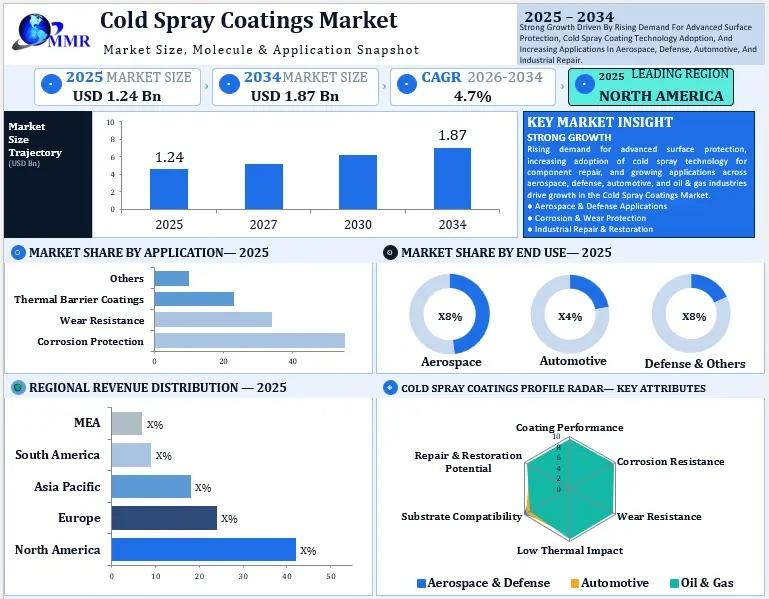
  • Cold Spray Coatings Market Revenue Forecast to Hit USD 1.87 Billion by 2034
    Overview:

    The global Cold Spray Coatings Market was valued at USD 1.24 billion in 2025 and is projected to reach USD 1.87 billion by 2034, expanding at a CAGR of 4.7% during 2026–2034, according to Maximize Market Research. Increasing demand for advanced surface protection, industrial component restoration, and lightweight manufacturing technologies is supporting market growth.

    The Cold Spray Coatings Market utilizes high-velocity powder deposition technology to create protective metallic and composite coatings without melting the feedstock materials. This solid-state process minimizes thermal distortion and preserves material properties, making it valuable for aerospace components, defense equipment, automotive parts, and industrial machinery.

    Download a Free Sample Report Today:

    https://www.maximizemarketresearch.com/request-sample/195190/
    Cold Spray Coatings Market Revenue Forecast to Hit USD 1.87 Billion by 2034 Overview: The global Cold Spray Coatings Market was valued at USD 1.24 billion in 2025 and is projected to reach USD 1.87 billion by 2034, expanding at a CAGR of 4.7% during 2026–2034, according to Maximize Market Research. Increasing demand for advanced surface protection, industrial component restoration, and lightweight manufacturing technologies is supporting market growth. The Cold Spray Coatings Market utilizes high-velocity powder deposition technology to create protective metallic and composite coatings without melting the feedstock materials. This solid-state process minimizes thermal distortion and preserves material properties, making it valuable for aerospace components, defense equipment, automotive parts, and industrial machinery. Download a Free Sample Report Today: https://www.maximizemarketresearch.com/request-sample/195190/
    0 Comments ·0 Shares ·137 Views
  • Rare Gas Market Revenue to Rise from US$ 4.21 Billion in 2025 to US$ 6.39 Billion by 2034
    Overview:

    The global Rare Gas Market was valued at US$ 4.21 billion in 2025 and is projected to reach US$ 6.39 billion by 2034, expanding at a CAGR of 4.75% during 2026–2034, according to Maximize Market Research. Increasing demand for high-purity industrial gases across semiconductor manufacturing, healthcare, aerospace, electronics, and metal fabrication is supporting industry expansion.The Rare Gas Market includes helium, neon, argon, krypton, xenon, and radon. These gases possess distinctive physical and chemical properties, making them essential for specialized industrial processes. Growing investments in semiconductor fabrication, medical imaging infrastructure, and advanced manufacturing are strengthening demand for reliable gas production and distribution systems.

    Download a Free Sample Report Today:
    https://www.maximizemarketresearch.com/request-sample/146681/

    Outlook and Future Trends:

    The Rare Gas Market is entering a period of technology-driven expansion as industries increasingly require ultra-high-purity gases for precision manufacturing. Semiconductor manufacturers utilize neon, argon, krypton, and xenon in specialized production processes, while helium remains essential for magnetic resonance imaging, scientific research, and cryogenic applications.

    Future development in the Rare Gas Market will be influenced by gas purification technologies, advanced air separation units, improved storage systems, and supply-chain diversification. Manufacturers are increasingly prioritizing long-term supply agreements to reduce exposure to production disruptions.

    Rare Gas Market Revenue to Rise from US$ 4.21 Billion in 2025 to US$ 6.39 Billion by 2034 Overview: The global Rare Gas Market was valued at US$ 4.21 billion in 2025 and is projected to reach US$ 6.39 billion by 2034, expanding at a CAGR of 4.75% during 2026–2034, according to Maximize Market Research. Increasing demand for high-purity industrial gases across semiconductor manufacturing, healthcare, aerospace, electronics, and metal fabrication is supporting industry expansion.The Rare Gas Market includes helium, neon, argon, krypton, xenon, and radon. These gases possess distinctive physical and chemical properties, making them essential for specialized industrial processes. Growing investments in semiconductor fabrication, medical imaging infrastructure, and advanced manufacturing are strengthening demand for reliable gas production and distribution systems. Download a Free Sample Report Today: https://www.maximizemarketresearch.com/request-sample/146681/ Outlook and Future Trends: The Rare Gas Market is entering a period of technology-driven expansion as industries increasingly require ultra-high-purity gases for precision manufacturing. Semiconductor manufacturers utilize neon, argon, krypton, and xenon in specialized production processes, while helium remains essential for magnetic resonance imaging, scientific research, and cryogenic applications. Future development in the Rare Gas Market will be influenced by gas purification technologies, advanced air separation units, improved storage systems, and supply-chain diversification. Manufacturers are increasingly prioritizing long-term supply agreements to reduce exposure to production disruptions.
    0 Comments ·0 Shares ·134 Views
  • Torque Sensor Market: Advancements in Wireless Sensing and Digital Measurement Technologies – Report by MMR

    Unveiling the Latest Trends in the Torque Sensor Market

    Maximize Market Research, a leading business consultancy firm, has released a comprehensive analysis of the Torque Sensor Market. The report offers valuable business insights, including demand and pricing analysis, as well as an overview of the competitive landscape. It provides a detailed examination of the current state of the Torque Sensor market, with projections extending through 2032

    Unlock more insights—request a free sample report now :https://www.maximizemarketresearch.com/request-sample/8098/

    Defining the Torque Sensor Market Scope Through Comprehensive Research

    The Torque Sensor market research delivers an in-depth analysis of key factors influencing industry growth, along with potential challenges that may arise. It provides stakeholders with a comprehensive understanding of the competitive landscape, including insights into leading companies, their product offerings, and emerging investment opportunities within the market. The report integrates both qualitative and quantitative insights, offering a well-rounded perspective on the industry’s current and future trajectory. Additionally, the MMR report includes a detailed competitive analysis, examining market players, their strategies, and key trends shaping the industry. The research is based on a blend of primary and secondary data sources, such as government publications, company websites, annual reports, and expert opinions from industry professionals and academics. Furthermore, the report identifies new market demands and trends, providing a thorough explanation of their impact on the Torque Sensor market’s evolution. By addressing consumer preferences, regulatory frameworks, and technological advancements, the study equips businesses with actionable insights to navigate the industry’s dynamic landscape effectively.

    Explore Regional Insights and Market Dynamics in the Torque Sensor Industry

    This report provides an in-depth regional analysis, covering essential aspects such as market size, growth rate, and trade activities, including imports and exports across different regions. By examining the geographic distribution of the Torque Sensor market, the study offers a clear understanding of industry trends and market conditions in various countries.

    The Torque Sensor market spans across North America, Europe, Asia Pacific, Latin America, Africa, and the Middle East, with each region presenting unique opportunities and challenges. This comprehensive analysis helps businesses identify regional growth potential, competitive landscapes, and key market drivers, enabling strategic decision-making in a dynamic global market

    Unlock the Key Market Segments Powering Torque Sensor Industry Growth :

    Torque Sensor Market was valued at US$ 1.85 Bn in 2025.Global Torque Sensor Market size is expected to grow at a CAGR of 20 % through the forecast period.

    Gain more details with a free sample report. Inquire now :https://www.maximizemarketresearch.com/request-sample/8098/

    Breaking Down the Torque Sensor Market: Key Segments Shaping the Industry

    by Product Type

    Reaction Torque
    Rotational Torque

    by Application

    Automotive
    Aerospace
    Manufacturing
    Medical
    Other

    by Mechanical Configuration

    Shaft Style
    Flange Style

    by Technology

    Strain Gauge
    Surface Acoustic Wave
    Optical
    Magnetoelastic
    Others

    Meet the Industry Leaders Revolutionizing the Torque Sensor Market

    1. ABB Ltd
    2. Crane Electronics Ltd
    3. TE Connectivity Ltd
    4. HBK Benelux (Spectris PLC)
    5. Applied Measurements Ltd.
    6. Honeywell International
    7. Norbar Torque Tools Ltd
    8. Infineon Technologies AG
    9. Teledyne Technologies, Inc.
    10. TE Connectivity Ltd
    11. Datum Electronics Ltd
    12. PCB Piezotronics, Inc.
    13. Kistler Instrumente AG
    14. MagCanica, Inc.
    15. FUTEK Advanced Sensor Technology
    16. Interfaceforce

    Uncover Key Insights Answering the Biggest Questions in the Torque Sensor Market

    What is Torque Sensor ?
    What is the growth rate of the Torque Sensor Market?
    Which are the factors expected to drive the Torque Sensor market growth?
    What is the CAGR at which the Torque Sensor market will grow during the forecast period?
    What are the different segments of the Torque Sensor Market?
    Which is the fastest growing region in the Torque Sensor market?
    What growth strategies are the players considering to increase their presence in Torque Sensor ?
    What are the upcoming opportunities and trends for the Torque Sensor Market?
    What are the recent industry trends that can be implemented to generate additional revenue streams for the Torque Sensor Market?
    Who are the leading companies and what are their portfolios in Torque Sensor Market?
    What segments are covered in the Torque Sensor Market?
    Who are the key players in the Torque Sensor market?
    Gain a Competitive Edge – Access Market Insights Through the Sample Link @https://www.maximizemarketresearch.com/market-report/automotive-data-management-market/147016/

    Explore the Revolutionary Products Powering Market Success

    Past Size and Competitive Landscape
    Past Pricing and price curve by region
    Size, Share, Size Forecast by different segment
    Dynamics Growth Drivers, Restraints, Opportunities, and Key Trends by Region
    Segmentation A detailed analysis by segment with their sub-segments and Region
    Competitive Landscape Profiles of selected key players by region from a strategic perspective
    Explore Our Trending Reports to Stay Ahead of Industry Shifts :

    Global Industrial Burner Market https://www.maximizemarketresearch.com/market-report/global-industrial-burner-market/55555/
    Global Self-Healing Concrete Market https://www.maximizemarketresearch.com/market-report/global-self-healing-concrete-market/65603/
    Global Artificial Intelligence (AI) Defence Market https://www.maximizemarketresearch.com/market-report/global-artificial-intelligence-ai-defence-market/21131/

    Connect with Maximize Market Research for Expert Insights In-Depth Analysis :

    +91 9607365656

    [email protected]
    Torque Sensor Market: Advancements in Wireless Sensing and Digital Measurement Technologies – Report by MMR Unveiling the Latest Trends in the Torque Sensor Market Maximize Market Research, a leading business consultancy firm, has released a comprehensive analysis of the Torque Sensor Market. The report offers valuable business insights, including demand and pricing analysis, as well as an overview of the competitive landscape. It provides a detailed examination of the current state of the Torque Sensor market, with projections extending through 2032 Unlock more insights—request a free sample report now :https://www.maximizemarketresearch.com/request-sample/8098/ Defining the Torque Sensor Market Scope Through Comprehensive Research The Torque Sensor market research delivers an in-depth analysis of key factors influencing industry growth, along with potential challenges that may arise. It provides stakeholders with a comprehensive understanding of the competitive landscape, including insights into leading companies, their product offerings, and emerging investment opportunities within the market. The report integrates both qualitative and quantitative insights, offering a well-rounded perspective on the industry’s current and future trajectory. Additionally, the MMR report includes a detailed competitive analysis, examining market players, their strategies, and key trends shaping the industry. The research is based on a blend of primary and secondary data sources, such as government publications, company websites, annual reports, and expert opinions from industry professionals and academics. Furthermore, the report identifies new market demands and trends, providing a thorough explanation of their impact on the Torque Sensor market’s evolution. By addressing consumer preferences, regulatory frameworks, and technological advancements, the study equips businesses with actionable insights to navigate the industry’s dynamic landscape effectively. Explore Regional Insights and Market Dynamics in the Torque Sensor Industry This report provides an in-depth regional analysis, covering essential aspects such as market size, growth rate, and trade activities, including imports and exports across different regions. By examining the geographic distribution of the Torque Sensor market, the study offers a clear understanding of industry trends and market conditions in various countries. The Torque Sensor market spans across North America, Europe, Asia Pacific, Latin America, Africa, and the Middle East, with each region presenting unique opportunities and challenges. This comprehensive analysis helps businesses identify regional growth potential, competitive landscapes, and key market drivers, enabling strategic decision-making in a dynamic global market Unlock the Key Market Segments Powering Torque Sensor Industry Growth : Torque Sensor Market was valued at US$ 1.85 Bn in 2025.Global Torque Sensor Market size is expected to grow at a CAGR of 20 % through the forecast period. Gain more details with a free sample report. Inquire now :https://www.maximizemarketresearch.com/request-sample/8098/ Breaking Down the Torque Sensor Market: Key Segments Shaping the Industry by Product Type Reaction Torque Rotational Torque by Application Automotive Aerospace Manufacturing Medical Other by Mechanical Configuration Shaft Style Flange Style by Technology Strain Gauge Surface Acoustic Wave Optical Magnetoelastic Others Meet the Industry Leaders Revolutionizing the Torque Sensor Market 1. ABB Ltd 2. Crane Electronics Ltd 3. TE Connectivity Ltd 4. HBK Benelux (Spectris PLC) 5. Applied Measurements Ltd. 6. Honeywell International 7. Norbar Torque Tools Ltd 8. Infineon Technologies AG 9. Teledyne Technologies, Inc. 10. TE Connectivity Ltd 11. Datum Electronics Ltd 12. PCB Piezotronics, Inc. 13. Kistler Instrumente AG 14. MagCanica, Inc. 15. FUTEK Advanced Sensor Technology 16. Interfaceforce Uncover Key Insights Answering the Biggest Questions in the Torque Sensor Market What is Torque Sensor ? What is the growth rate of the Torque Sensor Market? Which are the factors expected to drive the Torque Sensor market growth? What is the CAGR at which the Torque Sensor market will grow during the forecast period? What are the different segments of the Torque Sensor Market? Which is the fastest growing region in the Torque Sensor market? What growth strategies are the players considering to increase their presence in Torque Sensor ? What are the upcoming opportunities and trends for the Torque Sensor Market? What are the recent industry trends that can be implemented to generate additional revenue streams for the Torque Sensor Market? Who are the leading companies and what are their portfolios in Torque Sensor Market? What segments are covered in the Torque Sensor Market? Who are the key players in the Torque Sensor market? Gain a Competitive Edge – Access Market Insights Through the Sample Link @https://www.maximizemarketresearch.com/market-report/automotive-data-management-market/147016/ Explore the Revolutionary Products Powering Market Success Past Size and Competitive Landscape Past Pricing and price curve by region Size, Share, Size Forecast by different segment Dynamics Growth Drivers, Restraints, Opportunities, and Key Trends by Region Segmentation A detailed analysis by segment with their sub-segments and Region Competitive Landscape Profiles of selected key players by region from a strategic perspective Explore Our Trending Reports to Stay Ahead of Industry Shifts : Global Industrial Burner Market https://www.maximizemarketresearch.com/market-report/global-industrial-burner-market/55555/ Global Self-Healing Concrete Market https://www.maximizemarketresearch.com/market-report/global-self-healing-concrete-market/65603/ Global Artificial Intelligence (AI) Defence Market https://www.maximizemarketresearch.com/market-report/global-artificial-intelligence-ai-defence-market/21131/ Connect with Maximize Market Research for Expert Insights In-Depth Analysis : +91 9607365656 [email protected]
    0 Comments ·0 Shares ·227 Views
  • The global Supercomputer Market is undergoing a profound architectural transformation, transitioning from traditional numerical simulation to complex artificial intelligence training, generative AI workloads, and real-time scientific modeling. According to a comprehensive market intelligence report published by Stellar Market Research, the market is valued at USD 13.29 billion in 2026 and is projected to scale to approximately USD 33.48 billion by 2035, expanding at a robust compound annual growth rate (CAGR) of 10.82% over the forecast period.


    Today, enterprise buyers and government bodies are moving beyond legacy CPU-centric clusters, prioritizing massively parallel architectures powered by advanced GPUs, custom AI accelerators, and high-bandwidth memory (HBM). This shift is dismantling historical barriers to entry, moving supercomputers out of exclusive national laboratory environments and into commercial data centers, cloud infrastructure providers, and specialized research facilities. As organizations race to secure computational supremacy, the market is witnessing an intense race for exascale capabilities, where hardware performance, energy-efficient liquid cooling, and modular scalability dictate competitive advantage.

    Key Findings from the Report
    Valuation Trajectory: The global supercomputer market is anchored at USD 13.29 billion in 2026, advancing toward a projected milestone of USD 33.48 billion by 2035 at a 10.82% CAGR.

    Segment Dominance: By technology type, vector processing and tightly connected cluster computer machines accounted for the highest revenue share, capturing approximately 43.4% of the market in 2025 due to their unmatched parallel processing density.

    Fastest-Growing Application: Government entities and defense sectors represent dominant end-use verticals, with government-backed HPC deployments expanding at a rapid CAGR of 9.6% through the forecast period.

    Commercial Diversification: Commercial industries—including financial services risk modeling, automotive crash simulations, and pharmaceutical drug discovery—now represent the fastest-growing demand tier outside traditional public sector procurement.

    Regional Leadership: North America commands the largest regional market share (approximately 41%), propelled by aggressive national research initiatives and heavy private-sector investments in generative AI infrastructure.

    Emerging Hotspot: The Asia-Pacific region is registering the fastest growth rate globally, driven by sovereign AI initiatives, massive public-private partnerships, and rapid data center expansions in India, Japan, and China.

    Infrastructure Shifts: Advanced direct-liquid-cooling (DLC) and intelligent power orchestration are emerging as mandatory integration criteria, directly addressing the soaring thermal and energy footprints of next-gen exascale racks.

    For further information, click the following link:https://www.stellarmr.com/report/req_sample/supercomputer-market/2647
    Market Drivers and Restraints
    Drivers
    Proliferation of AI/ML and Generative Workloads: The integration of AI inference and training into traditional HPC workflows has fundamentally altered performance benchmarks, compelling data center operators to deploy high-bandwidth GPU clusters to handle multi-parameter neural networks.

    Surge in Sovereign AI and National HPC Initiatives: Governments worldwide are heavily subsidizing domestic supercomputing ecosystems to safeguard national security, reduce foreign semiconductor supply chain dependencies, and foster regional technological autonomy.

    Complex Simulation Needs in Commercial Verticals: Automotive, aerospace, and energy enterprises are increasingly reliant on digital twins, high-fidelity CFD (Computational Fluid Dynamics), and seismic data processing to compress product development cycles.

    Restraints
    Exorbitant Capital Expenditure and Maintenance Costs: The immense upfront costs associated with procuring leadership-class supercomputers, coupled with specialized facility renovation requirements, restrict adoption among mid-sized enterprises.

    Severe Power Consumption and Thermal Management Challenges: High-density server racks generate extreme thermal output, creating significant infrastructural bottlenecks and regulatory scrutiny regarding data center carbon footprints.

    Technology, Regulation, and Sustainability Trends
    The supercomputer ecosystem is undergoing radical operational transformation to meet modern ESG mandates and efficiency targets. Modern infrastructure designs have shifted focus from raw FLOP delivery to energy-to-solution metrics. Operators are widely adopting intelligent power orchestration, dynamic voltage scaling, and advanced direct-liquid-cooling technologies to neutralize thermal bottlenecks.

    Concurrently, regulatory frameworks across major economies are tightening energy-efficiency standards for large-scale data centers, forcing vendors to build modular, sustainably powered computing clusters. Furthermore, the advent of Hybrid HPC—bridging on-premise supercomputers with cloud-based High-Performance Computing-as-a-Service (HPCaaS)—is democratizing access while minimizing capital depreciation risks.

    Regional Insights
    North America: Retains its stronghold as the primary regional market, underpinned by robust public-private initiatives such as the U.S. Department of Energy’s exascale programs and massive infrastructure commitments from hyperscale technology titans. Strategic investments in localized semiconductor packaging continue to reinforce regional supply chain resilience.

    Asia-Pacific: Exhibits the fastest growth velocity, spearheaded by extensive government funding in national supercomputing grids, smart city digitalization, and quantum-hybrid computing integration. Countries like Japan and India are rapidly scaling indigenous processing architectures to support regional scientific research and industrial competitiveness.

    Recent Industry Developments
    Nvidia Corporation (2026): Introduced the Rubin advanced platform and deployed over 35 new AI-HPC supercomputing installations across Europe, significantly accelerating large-scale model training and scientific simulations.

    Hewlett Packard Enterprise (2026): Maintained market leadership by securing six of the top ten positions in the TOP500 list of the world's fastest supercomputers—including Frontier, El Capitan, and Aurora—while scaling direct-liquid-cooling innovations.

    Dell Technologies Inc. (2026): Launched the PowerEdge XE8812 featuring NVIDIA Vera Rubin NVL4 architecture supporting up to 144 GPUs per rack, alongside collaborative development of the Department of Energy's Doudna supercomputer.

    Lenovo Group Limited (2024): Expanded its global enterprise footprint with the commercial rollout of advanced liquid-cooled high-performance computing systems tailored for energy-efficient data center operations.

    Atos SE (2025): Expanded European exascale computing collaborations under the EuroHPC Joint Undertaking, fortifying regional research autonomy and sovereign cloud infrastructure.

    Competitive Landscape
    The global supercomputer market features a highly consolidated and competitive vendor landscape characterized by strategic tier-1 technological alliances. Major market participants are focusing on turnkey system integration, proprietary interconnect fabrics, and comprehensive software toolchains to capture high-margin service contracts.

    Key market leaders—including Hewlett Packard Enterprise (HPE), Nvidia Corporation, Dell Technologies, Advanced Micro Devices (AMD), Intel Corporation, Lenovo Group, Fujitsu Limited, and NEC Corporation—are actively deploying strategic M&A, vertical integration, and joint-venture frameworks to maintain competitive superiority in the race to exascale and quantum-hybrid computing.

    Analyst Commentary
    "The supercomputer market has evolved past the traditional boundaries of academic research and defense modeling into the core engine of global commercial innovation," said a Senior Research Analyst at Stellar Market Research. "As organizations race to train complex generative AI models and execute real-time digital simulations, the competitive advantage no longer belongs solely to those with raw processing power, but to those who can master energy-efficient architectures, heterogeneous software stacks, and sustainable liquid-cooling infrastructures at scale."

    Future Outlook
    Through the forecast period to 2035, the supercomputer market is poised for sustained, high-velocity expansion. Demand will increasingly be catalyzed by the convergence of classical HPC with quantum computing accelerators, edge supercomputing nodes, and advanced AI frameworks.

    While supply chain resilience and power management will remain critical board-level considerations, continuous innovations in modular system design and cloud-native HPC delivery models will lower barriers to entry, unlocking broad-based commercial adoption across life sciences, financial engineering, and smart manufacturing.

    For further information, click the following link:https://www.stellarmr.com/report/req_sample/supercomputer-market/2647
    About Stellar Market Research
    Stellar Market Research is a multifaceted market research and consulting company with professionals from several industries. Some of the industries we cover include medical devices, pharmaceutical manufacturers, science and engineering, electronic components, industrial equipment, technology and communication, cars and automobiles, chemical products and substances, general merchandise, beverages, personal care, and automated systems. To mention a few, we provide market-verified industry estimations, technical trend analysis, crucial market research, strategic advice, competition analysis, production and demand analysis, and client impact studies.

    Address
    Phase 3, Navale IT Zone, S.No. 51/2A/2, Office No. 202, 2nd floor, Near, Navale Brg, Narhe, Pune, Maharashtra 411041

    Email
    [email protected]

    Mobile
    +91 9607365656


    #Energy Sector HPC, Seismic Data Processing, Smart Grid Optimization, Oil Gas Reservoir Simulation, Renewable Integration Supercomputing
    The global Supercomputer Market is undergoing a profound architectural transformation, transitioning from traditional numerical simulation to complex artificial intelligence training, generative AI workloads, and real-time scientific modeling. According to a comprehensive market intelligence report published by Stellar Market Research, the market is valued at USD 13.29 billion in 2026 and is projected to scale to approximately USD 33.48 billion by 2035, expanding at a robust compound annual growth rate (CAGR) of 10.82% over the forecast period. Today, enterprise buyers and government bodies are moving beyond legacy CPU-centric clusters, prioritizing massively parallel architectures powered by advanced GPUs, custom AI accelerators, and high-bandwidth memory (HBM). This shift is dismantling historical barriers to entry, moving supercomputers out of exclusive national laboratory environments and into commercial data centers, cloud infrastructure providers, and specialized research facilities. As organizations race to secure computational supremacy, the market is witnessing an intense race for exascale capabilities, where hardware performance, energy-efficient liquid cooling, and modular scalability dictate competitive advantage. Key Findings from the Report Valuation Trajectory: The global supercomputer market is anchored at USD 13.29 billion in 2026, advancing toward a projected milestone of USD 33.48 billion by 2035 at a 10.82% CAGR. Segment Dominance: By technology type, vector processing and tightly connected cluster computer machines accounted for the highest revenue share, capturing approximately 43.4% of the market in 2025 due to their unmatched parallel processing density. Fastest-Growing Application: Government entities and defense sectors represent dominant end-use verticals, with government-backed HPC deployments expanding at a rapid CAGR of 9.6% through the forecast period. Commercial Diversification: Commercial industries—including financial services risk modeling, automotive crash simulations, and pharmaceutical drug discovery—now represent the fastest-growing demand tier outside traditional public sector procurement. Regional Leadership: North America commands the largest regional market share (approximately 41%), propelled by aggressive national research initiatives and heavy private-sector investments in generative AI infrastructure. Emerging Hotspot: The Asia-Pacific region is registering the fastest growth rate globally, driven by sovereign AI initiatives, massive public-private partnerships, and rapid data center expansions in India, Japan, and China. Infrastructure Shifts: Advanced direct-liquid-cooling (DLC) and intelligent power orchestration are emerging as mandatory integration criteria, directly addressing the soaring thermal and energy footprints of next-gen exascale racks. For further information, click the following link:https://www.stellarmr.com/report/req_sample/supercomputer-market/2647 Market Drivers and Restraints Drivers Proliferation of AI/ML and Generative Workloads: The integration of AI inference and training into traditional HPC workflows has fundamentally altered performance benchmarks, compelling data center operators to deploy high-bandwidth GPU clusters to handle multi-parameter neural networks. Surge in Sovereign AI and National HPC Initiatives: Governments worldwide are heavily subsidizing domestic supercomputing ecosystems to safeguard national security, reduce foreign semiconductor supply chain dependencies, and foster regional technological autonomy. Complex Simulation Needs in Commercial Verticals: Automotive, aerospace, and energy enterprises are increasingly reliant on digital twins, high-fidelity CFD (Computational Fluid Dynamics), and seismic data processing to compress product development cycles. Restraints Exorbitant Capital Expenditure and Maintenance Costs: The immense upfront costs associated with procuring leadership-class supercomputers, coupled with specialized facility renovation requirements, restrict adoption among mid-sized enterprises. Severe Power Consumption and Thermal Management Challenges: High-density server racks generate extreme thermal output, creating significant infrastructural bottlenecks and regulatory scrutiny regarding data center carbon footprints. Technology, Regulation, and Sustainability Trends The supercomputer ecosystem is undergoing radical operational transformation to meet modern ESG mandates and efficiency targets. Modern infrastructure designs have shifted focus from raw FLOP delivery to energy-to-solution metrics. Operators are widely adopting intelligent power orchestration, dynamic voltage scaling, and advanced direct-liquid-cooling technologies to neutralize thermal bottlenecks. Concurrently, regulatory frameworks across major economies are tightening energy-efficiency standards for large-scale data centers, forcing vendors to build modular, sustainably powered computing clusters. Furthermore, the advent of Hybrid HPC—bridging on-premise supercomputers with cloud-based High-Performance Computing-as-a-Service (HPCaaS)—is democratizing access while minimizing capital depreciation risks. Regional Insights North America: Retains its stronghold as the primary regional market, underpinned by robust public-private initiatives such as the U.S. Department of Energy’s exascale programs and massive infrastructure commitments from hyperscale technology titans. Strategic investments in localized semiconductor packaging continue to reinforce regional supply chain resilience. Asia-Pacific: Exhibits the fastest growth velocity, spearheaded by extensive government funding in national supercomputing grids, smart city digitalization, and quantum-hybrid computing integration. Countries like Japan and India are rapidly scaling indigenous processing architectures to support regional scientific research and industrial competitiveness. Recent Industry Developments Nvidia Corporation (2026): Introduced the Rubin advanced platform and deployed over 35 new AI-HPC supercomputing installations across Europe, significantly accelerating large-scale model training and scientific simulations. Hewlett Packard Enterprise (2026): Maintained market leadership by securing six of the top ten positions in the TOP500 list of the world's fastest supercomputers—including Frontier, El Capitan, and Aurora—while scaling direct-liquid-cooling innovations. Dell Technologies Inc. (2026): Launched the PowerEdge XE8812 featuring NVIDIA Vera Rubin NVL4 architecture supporting up to 144 GPUs per rack, alongside collaborative development of the Department of Energy's Doudna supercomputer. Lenovo Group Limited (2024): Expanded its global enterprise footprint with the commercial rollout of advanced liquid-cooled high-performance computing systems tailored for energy-efficient data center operations. Atos SE (2025): Expanded European exascale computing collaborations under the EuroHPC Joint Undertaking, fortifying regional research autonomy and sovereign cloud infrastructure. Competitive Landscape The global supercomputer market features a highly consolidated and competitive vendor landscape characterized by strategic tier-1 technological alliances. Major market participants are focusing on turnkey system integration, proprietary interconnect fabrics, and comprehensive software toolchains to capture high-margin service contracts. Key market leaders—including Hewlett Packard Enterprise (HPE), Nvidia Corporation, Dell Technologies, Advanced Micro Devices (AMD), Intel Corporation, Lenovo Group, Fujitsu Limited, and NEC Corporation—are actively deploying strategic M&A, vertical integration, and joint-venture frameworks to maintain competitive superiority in the race to exascale and quantum-hybrid computing. Analyst Commentary "The supercomputer market has evolved past the traditional boundaries of academic research and defense modeling into the core engine of global commercial innovation," said a Senior Research Analyst at Stellar Market Research. "As organizations race to train complex generative AI models and execute real-time digital simulations, the competitive advantage no longer belongs solely to those with raw processing power, but to those who can master energy-efficient architectures, heterogeneous software stacks, and sustainable liquid-cooling infrastructures at scale." Future Outlook Through the forecast period to 2035, the supercomputer market is poised for sustained, high-velocity expansion. Demand will increasingly be catalyzed by the convergence of classical HPC with quantum computing accelerators, edge supercomputing nodes, and advanced AI frameworks. While supply chain resilience and power management will remain critical board-level considerations, continuous innovations in modular system design and cloud-native HPC delivery models will lower barriers to entry, unlocking broad-based commercial adoption across life sciences, financial engineering, and smart manufacturing. For further information, click the following link:https://www.stellarmr.com/report/req_sample/supercomputer-market/2647 About Stellar Market Research Stellar Market Research is a multifaceted market research and consulting company with professionals from several industries. Some of the industries we cover include medical devices, pharmaceutical manufacturers, science and engineering, electronic components, industrial equipment, technology and communication, cars and automobiles, chemical products and substances, general merchandise, beverages, personal care, and automated systems. To mention a few, we provide market-verified industry estimations, technical trend analysis, crucial market research, strategic advice, competition analysis, production and demand analysis, and client impact studies. Address Phase 3, Navale IT Zone, S.No. 51/2A/2, Office No. 202, 2nd floor, Near, Navale Brg, Narhe, Pune, Maharashtra 411041 Email [email protected] Mobile +91 9607365656 #Energy Sector HPC, Seismic Data Processing, Smart Grid Optimization, Oil Gas Reservoir Simulation, Renewable Integration Supercomputing
    0 Comments ·0 Shares ·294 Views
  • Grease Market Demand Analysis, Growth Prospects, and Future Industry Trends

    Grease Market to Reach USD 7.89 Billion by 2034, Driven by Automotive Manufacturing and Industrial Demand

    Global Grease Market Forecast 2026–2034 Highlights Growth Opportunities in High-Performance Lubricants, Automotive Applications, and Sustainable Formulations

    The Grease Market was valued at USD 6.1 billion in 2025 and is projected to reach nearly USD 7.89 billion by 2034, growing at a compound annual growth rate (CAGR) of 2.9% during the forecast period from 2026 to 2034. According to Maximize Market Research, rising automotive manufacturing, expanding shipbuilding activities, increasing industrial production, and growing demand for high-performance lubrication solutions are among the major factors supporting market growth. Grease plays a vital role in reducing friction, preventing component wear, protecting machinery against corrosion, and improving equipment reliability across automotive, construction, mining, manufacturing, and power generation industries.

    Market Estimation, Growth Drivers, and Opportunities

    The global grease industry is benefiting from the increasing use of machinery and equipment that require reliable lubrication under demanding operating conditions. Grease formulations combine base oils, thickeners, and performance-enhancing additives to provide lubrication, water resistance, thermal stability, and protection against mechanical wear.

    Automotive manufacturing remains a significant demand driver as grease is used in bearings, chassis components, wheel hubs, steering systems, and other moving parts. Growing vehicle production, expanding industrial infrastructure, and rising investments in construction and mining equipment are further supporting consumption. Shipbuilding and marine applications also create demand for specialized greases capable of withstanding moisture, heavy loads, and harsh operating environments.

    Emerging opportunities include high-temperature greases, synthetic formulations, biodegradable products, and lithium-free alternatives. Manufacturers that develop longer-lasting, energy-efficient, and environmentally responsible lubrication solutions can strengthen their competitive position. However, fluctuations in raw material prices, supply chain uncertainties, and changing environmental requirements may influence production costs and purchasing decisions.

    Receive a Free Sample Copy Instantly : https://www.maximizemarketresearch.com/request-sample/26958/

    US Market Trends and Investment Outlook in 2025

    The United States grease market is benefiting from industrial modernization, automotive manufacturing, equipment maintenance, and investments in advanced lubricant production. In April 2025, specialty chemicals company Kodiak completed its acquisition of Sunocs LLC, adding a grease and silicone manufacturing facility and expanding its reach across automotive, aerospace, steel, energy, and metalworking industries. In another significant development, ExxonMobil announced a major Baytown, Texas, investment decision in August 2025 to reconfigure production toward higher-demand products, including premium lubricant base stocks, with operations planned to start in 2028. These developments highlight the industry's focus on manufacturing capacity, specialized formulations, and reliable supplies of high-quality lubricant ingredients. Demand for durable greases, electric vehicle components, and advanced industrial machinery is expected to create further opportunities for manufacturers and technology suppliers.

    Grease Market Demand Analysis, Growth Prospects, and Future Industry Trends Grease Market to Reach USD 7.89 Billion by 2034, Driven by Automotive Manufacturing and Industrial Demand Global Grease Market Forecast 2026–2034 Highlights Growth Opportunities in High-Performance Lubricants, Automotive Applications, and Sustainable Formulations The Grease Market was valued at USD 6.1 billion in 2025 and is projected to reach nearly USD 7.89 billion by 2034, growing at a compound annual growth rate (CAGR) of 2.9% during the forecast period from 2026 to 2034. According to Maximize Market Research, rising automotive manufacturing, expanding shipbuilding activities, increasing industrial production, and growing demand for high-performance lubrication solutions are among the major factors supporting market growth. Grease plays a vital role in reducing friction, preventing component wear, protecting machinery against corrosion, and improving equipment reliability across automotive, construction, mining, manufacturing, and power generation industries. Market Estimation, Growth Drivers, and Opportunities The global grease industry is benefiting from the increasing use of machinery and equipment that require reliable lubrication under demanding operating conditions. Grease formulations combine base oils, thickeners, and performance-enhancing additives to provide lubrication, water resistance, thermal stability, and protection against mechanical wear. Automotive manufacturing remains a significant demand driver as grease is used in bearings, chassis components, wheel hubs, steering systems, and other moving parts. Growing vehicle production, expanding industrial infrastructure, and rising investments in construction and mining equipment are further supporting consumption. Shipbuilding and marine applications also create demand for specialized greases capable of withstanding moisture, heavy loads, and harsh operating environments. Emerging opportunities include high-temperature greases, synthetic formulations, biodegradable products, and lithium-free alternatives. Manufacturers that develop longer-lasting, energy-efficient, and environmentally responsible lubrication solutions can strengthen their competitive position. However, fluctuations in raw material prices, supply chain uncertainties, and changing environmental requirements may influence production costs and purchasing decisions. Receive a Free Sample Copy Instantly : https://www.maximizemarketresearch.com/request-sample/26958/ US Market Trends and Investment Outlook in 2025 The United States grease market is benefiting from industrial modernization, automotive manufacturing, equipment maintenance, and investments in advanced lubricant production. In April 2025, specialty chemicals company Kodiak completed its acquisition of Sunocs LLC, adding a grease and silicone manufacturing facility and expanding its reach across automotive, aerospace, steel, energy, and metalworking industries. In another significant development, ExxonMobil announced a major Baytown, Texas, investment decision in August 2025 to reconfigure production toward higher-demand products, including premium lubricant base stocks, with operations planned to start in 2028. These developments highlight the industry's focus on manufacturing capacity, specialized formulations, and reliable supplies of high-quality lubricant ingredients. Demand for durable greases, electric vehicle components, and advanced industrial machinery is expected to create further opportunities for manufacturers and technology suppliers.
    0 Comments ·0 Shares ·312 Views
  • How Will Industrial Furnace Demand Boost the Thermal Ceramics Market by 2032?

    Thermal Ceramics Market Overview

    The Thermal Ceramics Market report provides an in-depth analysis that is required to make informed industry decisions and develop strategic growth plans. Regardless of the production method or cost structures, the Thermal Ceramics market report provides a comprehensive understanding of advanced tactics and strategies.

    Thermal Ceramics Market Forecast

    The Global Thermal Ceramics Market size was valued at USD 6 Bn in 2025, and the total Thermal Ceramic Market revenue is expected to grow by 6.6% from 2026 to 2032, reaching nearly USD 9.38 Bn.

    Please connect with our representative, who will ensure you to get a report sample here @https://www.maximizemarketresearch.com/request-sample/22702/

    Thermal Ceramics Market Report Scope and Research Methodology

    The report offers an extensive examination of top players' strategies within the Thermal Ceramics industry, coupled with an in-depth analysis of market segments and regional dynamics. In-depth insights into market dynamics, encompassing drivers, restraints, opportunities, and challenges, are provided both on a regional and segmental basis within the Thermal Ceramics Market report. Additionally, the report presents import/export consumption, supply and demand, pricing, costs, revenue, and gross margins data, serving as an invaluable guide for investors.

    The data for the Thermal Ceramics Market report was meticulously gathered through a combination of primary and secondary research methods, ensuring its authenticity. Primary research methods employed encompassed questionnaire distribution, surveys, and telephone interviews with Thermal Ceramics industry experts, market leaders, marketing professionals, and entrepreneurs. The report's estimates of global and regional Thermal Ceramics market size were derived using a bottom-up approach. Furthermore, the strengths and weaknesses of Thermal Ceramics key players within the industry are outlined using SWOT analysis.

    Thermal Ceramics Market Regional Insights

    by Type

    Insulating Bricks & Blocks
    Ceramic Fibers
    Refractory Bricks

    by Temperature Range

    Low Temperature (<1000°C)
    Medium Temperature (1000°C - 1600°C)
    High Temperature (>1600°C)

    by End Use Industry

    Metallurgy & Foundry Glass Cement
    Power Generation
    Chemical & Petrochemical
    Aerospace & Automotive

    Request Free Sample Copy:https://www.maximizemarketresearch.com/request-sample/22702/

    Thermal Ceramics Market Key Players

    North America:

    1. Unifrax - United States
    2. 3M Company - United States
    3. Zircar Ceramics Inc. - United States
    4. Unitherm Insulation Systems - United States
    5. HarbisonWalker International - United States
    6. BNZ Materials, Inc. - United States

    Leading Figures in the European and Asian Thermal Ceramics Sector:

    1. Morgan Advanced Materials plc - United Kingdom
    2. Rath AG - Austria
    3. Saint-Gobain - France
    4. CeramTec GmbH - Germany

    Asia-Pacific

    1. Isolite Insulating Products Co., Ltd. – Japan
    2. IBIDEN Co., Ltd. – Japan
    3. Xiamen Mascera Technology Co., Ltd. – China
    4. CCEWOOL / CeraMaterials – China
    5. Shandong Luyang Share Co., Ltd. – China

    Key Offerings:

    A detailed market overview
    Market Share, Size & Forecast by Revenue | 2026−2034
    Market Dynamics – Growth Drivers, Restraints, Investment Opportunities, and Key Trends
    Market Segmentation – A detailed analysis by segments and sub-segments
    Regional Insights
    Competitive Landscape – Top Key Vendors and Other Prominent Vendors
    More Trending From MMR:

    Global Waterjet Cutting Machine Market https://www.maximizemarketresearch.com/market-report/global-waterjet-cutting-machine-market/10882/
    Automotive Cameras Market https://www.maximizemarketresearch.com/market-report/global-automotive-cameras-market/21753/
    Global Bioburden Testing Market https://www.maximizemarketresearch.com/market-report/global-bioburden-testing-market/35280/

    About Maximize Market Research:

    Maximize Market Research is a multifaceted market research and consulting company with professionals from several industries. Some of the industries we cover include medical devices, pharmaceutical manufacturers, science and engineering, electronic components, industrial equipment, technology and communication, cars and automobiles, chemical products and substances, general merchandise, beverages, personal care, and automated systems. To mention a few, we provide market-verified industry estimations, technical trend analysis, crucial market research, strategic advice, competition analysis, production and demand analysis, and client impact studies.

    Contact Maximize Market Research:

    3rd Floor, Naval IT Park, Phase 2

    Pune Banglore Highway, Narhe

    Pune, Maharashtra 411041, India

    [email protected]

    +91 96071 95908, +91 9607365656
    How Will Industrial Furnace Demand Boost the Thermal Ceramics Market by 2032? Thermal Ceramics Market Overview The Thermal Ceramics Market report provides an in-depth analysis that is required to make informed industry decisions and develop strategic growth plans. Regardless of the production method or cost structures, the Thermal Ceramics market report provides a comprehensive understanding of advanced tactics and strategies. Thermal Ceramics Market Forecast The Global Thermal Ceramics Market size was valued at USD 6 Bn in 2025, and the total Thermal Ceramic Market revenue is expected to grow by 6.6% from 2026 to 2032, reaching nearly USD 9.38 Bn. Please connect with our representative, who will ensure you to get a report sample here @https://www.maximizemarketresearch.com/request-sample/22702/ Thermal Ceramics Market Report Scope and Research Methodology The report offers an extensive examination of top players' strategies within the Thermal Ceramics industry, coupled with an in-depth analysis of market segments and regional dynamics. In-depth insights into market dynamics, encompassing drivers, restraints, opportunities, and challenges, are provided both on a regional and segmental basis within the Thermal Ceramics Market report. Additionally, the report presents import/export consumption, supply and demand, pricing, costs, revenue, and gross margins data, serving as an invaluable guide for investors. The data for the Thermal Ceramics Market report was meticulously gathered through a combination of primary and secondary research methods, ensuring its authenticity. Primary research methods employed encompassed questionnaire distribution, surveys, and telephone interviews with Thermal Ceramics industry experts, market leaders, marketing professionals, and entrepreneurs. The report's estimates of global and regional Thermal Ceramics market size were derived using a bottom-up approach. Furthermore, the strengths and weaknesses of Thermal Ceramics key players within the industry are outlined using SWOT analysis. Thermal Ceramics Market Regional Insights by Type Insulating Bricks & Blocks Ceramic Fibers Refractory Bricks by Temperature Range Low Temperature (<1000°C) Medium Temperature (1000°C - 1600°C) High Temperature (>1600°C) by End Use Industry Metallurgy & Foundry Glass Cement Power Generation Chemical & Petrochemical Aerospace & Automotive Request Free Sample Copy:https://www.maximizemarketresearch.com/request-sample/22702/ Thermal Ceramics Market Key Players North America: 1. Unifrax - United States 2. 3M Company - United States 3. Zircar Ceramics Inc. - United States 4. Unitherm Insulation Systems - United States 5. HarbisonWalker International - United States 6. BNZ Materials, Inc. - United States Leading Figures in the European and Asian Thermal Ceramics Sector: 1. Morgan Advanced Materials plc - United Kingdom 2. Rath AG - Austria 3. Saint-Gobain - France 4. CeramTec GmbH - Germany Asia-Pacific 1. Isolite Insulating Products Co., Ltd. – Japan 2. IBIDEN Co., Ltd. – Japan 3. Xiamen Mascera Technology Co., Ltd. – China 4. CCEWOOL / CeraMaterials – China 5. Shandong Luyang Share Co., Ltd. – China Key Offerings: A detailed market overview Market Share, Size & Forecast by Revenue | 2026−2034 Market Dynamics – Growth Drivers, Restraints, Investment Opportunities, and Key Trends Market Segmentation – A detailed analysis by segments and sub-segments Regional Insights Competitive Landscape – Top Key Vendors and Other Prominent Vendors More Trending From MMR: Global Waterjet Cutting Machine Market https://www.maximizemarketresearch.com/market-report/global-waterjet-cutting-machine-market/10882/ Automotive Cameras Market https://www.maximizemarketresearch.com/market-report/global-automotive-cameras-market/21753/ Global Bioburden Testing Market https://www.maximizemarketresearch.com/market-report/global-bioburden-testing-market/35280/ About Maximize Market Research: Maximize Market Research is a multifaceted market research and consulting company with professionals from several industries. Some of the industries we cover include medical devices, pharmaceutical manufacturers, science and engineering, electronic components, industrial equipment, technology and communication, cars and automobiles, chemical products and substances, general merchandise, beverages, personal care, and automated systems. To mention a few, we provide market-verified industry estimations, technical trend analysis, crucial market research, strategic advice, competition analysis, production and demand analysis, and client impact studies. Contact Maximize Market Research: 3rd Floor, Naval IT Park, Phase 2 Pune Banglore Highway, Narhe Pune, Maharashtra 411041, India [email protected] +91 96071 95908, +91 9607365656
    0 Comments ·0 Shares ·576 Views
  • Inspection, Repair and Maintenance Market Growth Supported by Equipment Modernization

    Market Estimation & Definition

    The global Inspection, Repair and Maintenance (IRM) Market is becoming increasingly important as industries seek to improve asset reliability, safety, operational efficiency, and equipment life. According to Stellar Market Research, the market was valued at USD 58.76 billion in 2025 and is projected to reach USD 100.7 billion by 2032, expanding at a CAGR of 8% during 2026–2032. The study covers historical data from 2020–2025, with 2025 as the base year.

    IRM services include non-destructive testing, condition monitoring, predictive maintenance, corrective repair, shutdown maintenance, and asset integrity management. These services support sectors such as manufacturing, oil and gas, power generation, aerospace, marine, infrastructure, and utilities, where equipment failure can result in significant operational and financial losses.

    Download Free PDF Brochure: https://www.stellarmr.com/report/req_sample/Inspection-repair-and-Maintenance-Market/1163

    Market Growth Drivers & Opportunity

    A major factor supporting market expansion is the aging of industrial infrastructure. As industrial assets become older, organizations increasingly require regular inspection, maintenance, and repair to extend operating life and reduce unexpected downtime. Rising safety requirements and regulatory compliance are also encouraging companies to adopt professional IRM services.

    The growing cost of equipment downtime is further strengthening demand for preventive and predictive maintenance. IoT sensors, artificial intelligence, robotics, drones, and other digital technologies are enabling organizations to monitor assets more efficiently and identify potential failures before they result in major disruptions.

    Emerging economies provide additional opportunities. Rapid industrialization, infrastructure development, energy investments, and renewable-energy installations across Asia-Pacific, the Middle East, and Africa are creating new requirements for inspection and maintenance services. Increasing outsourcing of IRM activities is also opening opportunities for specialized service providers offering customized and sector-specific solutions.

    What Lies Ahead: Emerging Trends Shaping the Future

    The future of IRM is increasingly connected with digital and data-driven maintenance. AI-based inspection, robotics, drones, digital twins, and IoT-enabled monitoring are helping shift the industry from conventional maintenance practices toward proactive and condition-based models. These technologies can improve inspection accuracy while supporting faster decision-making and more efficient asset management.

    Remote inspection and autonomous technologies are also gaining importance, particularly for difficult-to-access or offshore assets. At the same time, sustainability and energy-efficiency objectives are encouraging asset owners to maintain equipment more proactively and optimize operational performance.

    However, high capital and operational costs remain a challenge. Advanced inspection equipment, skilled technicians, and digital systems can require substantial investment, while integrating modern technologies with legacy infrastructure may create technical and operational difficulties.

    Get More Report Details: https://www.stellarmr.com/report/Inspection-repair-and-Maintenance-Market/1163

    Segmentation Analysis

    According to Stellar Market Research, the IRM Market is segmented by Type, Application, Service Type, and Deployment. By Type, the market includes Offshore Support Vessels, Autonomous Underwater Vehicles (AUVs), and Others. By Service Type, it covers Inspection, Maintenance, and Repair. The Repair segment dominated the market in 2025, supported by demand for specialist repair services for increasingly complex equipment and installations.

    By Deployment, the market is divided into In-House and Outsourced services. By Application, the report covers Oil and Gas, Power Generation, Manufacturing, Aerospace, Automotive, Infrastructure, Renewable, Marine, and Others. Regionally, the study covers North America, Europe, Asia Pacific, the Middle East and Africa, and South America.

    Country-Level Analysis: USA and Germany

    The United States is included within the North American market and is separately analyzed across Type, Application, Service Type, and Deployment. The country has a broad presence of IRM providers, including Schlumberger, Baker Hughes, Halliburton, Weatherford International, Oceaneering International, MISTRAS Group, NOV, and Sperry Rail Service.

    Germany is covered within the European regional analysis and is separately examined across the same market segments. TÜV Nord Group is identified among the key European players, reflecting Germany's participation in the professional inspection and maintenance services landscape.

    Competitive Analysis

    The competitive landscape includes global service providers and specialized technology companies competing through technological capabilities, geographic coverage, and sector expertise. Key companies identified by Stellar Market Research include Schlumberger, Baker Hughes, TechnipFMC, Intertek Group, Bureau Veritas, SGS SA, Applus+, Fugro, Halliburton, and Jacobs Engineering. Companies are increasingly investing in AI, IoT, predictive maintenance, R&D, partnerships, and regional expansion to address evolving industrial requirements.

    Download Free PDF Brochure: https://www.stellarmr.com/report/req_sample/Inspection-repair-and-Maintenance-Market/1163

    Press Release Conclusion

    The Inspection, Repair and Maintenance Market is entering a period of structural growth as aging infrastructure, safety requirements, rising downtime costs, and digital transformation reshape asset management. With the market projected to increase from USD 58.76 billion in 2025 to USD 100.7 billion by 2032, technology-enabled inspection, predictive maintenance, outsourcing, and specialized services are expected to remain important areas of development. Asia Pacific, which accounted for 35.40% of the market in 2025, is identified as a major regional market, supported by industrialization, infrastructure expansion, renewable-energy investment, and growing energy demand.

    About Stellar Market Research:

    Stellar Market Research is a multifaceted market research and consulting company with professionals from several industries. Some of the industries we cover include medical devices, pharmaceutical manufacturers, science and engineering, electronic components, industrial equipment, technology and communication, cars and automobiles, chemical products and substances, general merchandise, beverages, personal care, and automated systems. To mention a few, we provide market-verified industry estimations, technical trend analysis, crucial market research, strategic advice, competition analysis, production and demand analysis, and client impact studies.

    Contact Stellar Market Research:

    3rd Floor, Navale IT Park, Phase 2

    Pune Banglore Highway, Narhe,

    Pune, Maharashtra 411041, India

    [email protected]

    +91 20 6630 3320 | +91 9607365656
    Inspection, Repair and Maintenance Market Growth Supported by Equipment Modernization Market Estimation & Definition The global Inspection, Repair and Maintenance (IRM) Market is becoming increasingly important as industries seek to improve asset reliability, safety, operational efficiency, and equipment life. According to Stellar Market Research, the market was valued at USD 58.76 billion in 2025 and is projected to reach USD 100.7 billion by 2032, expanding at a CAGR of 8% during 2026–2032. The study covers historical data from 2020–2025, with 2025 as the base year. IRM services include non-destructive testing, condition monitoring, predictive maintenance, corrective repair, shutdown maintenance, and asset integrity management. These services support sectors such as manufacturing, oil and gas, power generation, aerospace, marine, infrastructure, and utilities, where equipment failure can result in significant operational and financial losses. Download Free PDF Brochure: https://www.stellarmr.com/report/req_sample/Inspection-repair-and-Maintenance-Market/1163 Market Growth Drivers & Opportunity A major factor supporting market expansion is the aging of industrial infrastructure. As industrial assets become older, organizations increasingly require regular inspection, maintenance, and repair to extend operating life and reduce unexpected downtime. Rising safety requirements and regulatory compliance are also encouraging companies to adopt professional IRM services. The growing cost of equipment downtime is further strengthening demand for preventive and predictive maintenance. IoT sensors, artificial intelligence, robotics, drones, and other digital technologies are enabling organizations to monitor assets more efficiently and identify potential failures before they result in major disruptions. Emerging economies provide additional opportunities. Rapid industrialization, infrastructure development, energy investments, and renewable-energy installations across Asia-Pacific, the Middle East, and Africa are creating new requirements for inspection and maintenance services. Increasing outsourcing of IRM activities is also opening opportunities for specialized service providers offering customized and sector-specific solutions. What Lies Ahead: Emerging Trends Shaping the Future The future of IRM is increasingly connected with digital and data-driven maintenance. AI-based inspection, robotics, drones, digital twins, and IoT-enabled monitoring are helping shift the industry from conventional maintenance practices toward proactive and condition-based models. These technologies can improve inspection accuracy while supporting faster decision-making and more efficient asset management. Remote inspection and autonomous technologies are also gaining importance, particularly for difficult-to-access or offshore assets. At the same time, sustainability and energy-efficiency objectives are encouraging asset owners to maintain equipment more proactively and optimize operational performance. However, high capital and operational costs remain a challenge. Advanced inspection equipment, skilled technicians, and digital systems can require substantial investment, while integrating modern technologies with legacy infrastructure may create technical and operational difficulties. Get More Report Details: https://www.stellarmr.com/report/Inspection-repair-and-Maintenance-Market/1163 Segmentation Analysis According to Stellar Market Research, the IRM Market is segmented by Type, Application, Service Type, and Deployment. By Type, the market includes Offshore Support Vessels, Autonomous Underwater Vehicles (AUVs), and Others. By Service Type, it covers Inspection, Maintenance, and Repair. The Repair segment dominated the market in 2025, supported by demand for specialist repair services for increasingly complex equipment and installations. By Deployment, the market is divided into In-House and Outsourced services. By Application, the report covers Oil and Gas, Power Generation, Manufacturing, Aerospace, Automotive, Infrastructure, Renewable, Marine, and Others. Regionally, the study covers North America, Europe, Asia Pacific, the Middle East and Africa, and South America. Country-Level Analysis: USA and Germany The United States is included within the North American market and is separately analyzed across Type, Application, Service Type, and Deployment. The country has a broad presence of IRM providers, including Schlumberger, Baker Hughes, Halliburton, Weatherford International, Oceaneering International, MISTRAS Group, NOV, and Sperry Rail Service. Germany is covered within the European regional analysis and is separately examined across the same market segments. TÜV Nord Group is identified among the key European players, reflecting Germany's participation in the professional inspection and maintenance services landscape. Competitive Analysis The competitive landscape includes global service providers and specialized technology companies competing through technological capabilities, geographic coverage, and sector expertise. Key companies identified by Stellar Market Research include Schlumberger, Baker Hughes, TechnipFMC, Intertek Group, Bureau Veritas, SGS SA, Applus+, Fugro, Halliburton, and Jacobs Engineering. Companies are increasingly investing in AI, IoT, predictive maintenance, R&D, partnerships, and regional expansion to address evolving industrial requirements. Download Free PDF Brochure: https://www.stellarmr.com/report/req_sample/Inspection-repair-and-Maintenance-Market/1163 Press Release Conclusion The Inspection, Repair and Maintenance Market is entering a period of structural growth as aging infrastructure, safety requirements, rising downtime costs, and digital transformation reshape asset management. With the market projected to increase from USD 58.76 billion in 2025 to USD 100.7 billion by 2032, technology-enabled inspection, predictive maintenance, outsourcing, and specialized services are expected to remain important areas of development. Asia Pacific, which accounted for 35.40% of the market in 2025, is identified as a major regional market, supported by industrialization, infrastructure expansion, renewable-energy investment, and growing energy demand. About Stellar Market Research: Stellar Market Research is a multifaceted market research and consulting company with professionals from several industries. Some of the industries we cover include medical devices, pharmaceutical manufacturers, science and engineering, electronic components, industrial equipment, technology and communication, cars and automobiles, chemical products and substances, general merchandise, beverages, personal care, and automated systems. To mention a few, we provide market-verified industry estimations, technical trend analysis, crucial market research, strategic advice, competition analysis, production and demand analysis, and client impact studies. Contact Stellar Market Research: 3rd Floor, Navale IT Park, Phase 2 Pune Banglore Highway, Narhe, Pune, Maharashtra 411041, India [email protected] +91 20 6630 3320 | +91 9607365656
    0 Comments ·0 Shares ·261 Views
  • Material Testing Market Top Companies and Competitive Landscape

    Material Testing Market to Reach USD 1,384.42 Million by 2034 as Automation and Advanced Materials Drive Demand

    The Material Testing Market is entering a sustained growth phase as manufacturers, research institutions, and infrastructure developers place greater emphasis on product safety, durability, quality assurance, and compliance with international testing standards. According to Maximize Market Research, the Material Testing Market was valued at USD 915.69 million in 2025 and is expected to grow at a CAGR of 4.7% from 2026 to 2034, reaching approximately USD 1,384.42 million by 2034.

    The market is benefiting from rising demand across construction, automotive, aerospace and defense, medical devices, power, and educational institutions. Increasing use of advanced metals, polymers, composites, ceramics, and other engineered materials is creating demand for accurate mechanical and physical characterization. Compliance with standards such as ASTM and ISO is also encouraging manufacturers to upgrade testing capabilities. The growing adoption of automated testing, digital laboratory workflows, advanced sensors, and data-driven quality control represents an important opportunity for equipment manufacturers.

    U.S. Market Trends and Investment

    The United States remains an important market for material testing because of its strong manufacturing base, aerospace and defense activity, automotive production, infrastructure development, and advanced-materials research ecosystem. In 2025, the U.S. market showed increasing interest in compact, automated, and high-capacity testing systems. Instron introduced its AT3 Floor Model Automated Testing System, capable of testing at forces up to 300 kN while automating specimen measurement, handling, testing, and data collection. The company also launched a 100 kN tabletop universal testing system in 2025, reducing the footprint compared with conventional floor systems and targeting high-strength metals, alloys, and composites.

    The broader U.S. investment environment is also supported by federal emphasis on advanced manufacturing, standards, measurement, and industrial technology. NIST's FY2025 budget framework included funding for Manufacturing USA and the Manufacturing Extension Partnership, reinforcing the infrastructure supporting technology development and manufacturing competitiveness.

    Get Your Free Sample Report Link : https://www.maximizemarketresearch.com/request-sample/2079/

    Market Segmentation: Leading Segments

    By type, Universal Testing Machines represent one of the major contributors to market growth. Their broad application in tensile, compression, and bending tests, combined with relatively accessible equipment costs, supports adoption across multiple industries.

    By end-use industry, the Construction segment is expected to lead the Material Testing Market, followed by automotive. The need to verify concrete, metals, composites, structural components, and other construction materials makes testing essential for maintaining structural safety and regulatory compliance.

    By material, Ceramics and Composites are expected to hold one of the largest market shares during the forecast period. Growing use of lightweight, high-strength, and application-specific materials in aerospace, automotive, energy, and advanced manufacturing is increasing the need for specialized testing capabilities.

    Material Testing Market Top Companies and Competitive Landscape Material Testing Market to Reach USD 1,384.42 Million by 2034 as Automation and Advanced Materials Drive Demand The Material Testing Market is entering a sustained growth phase as manufacturers, research institutions, and infrastructure developers place greater emphasis on product safety, durability, quality assurance, and compliance with international testing standards. According to Maximize Market Research, the Material Testing Market was valued at USD 915.69 million in 2025 and is expected to grow at a CAGR of 4.7% from 2026 to 2034, reaching approximately USD 1,384.42 million by 2034. The market is benefiting from rising demand across construction, automotive, aerospace and defense, medical devices, power, and educational institutions. Increasing use of advanced metals, polymers, composites, ceramics, and other engineered materials is creating demand for accurate mechanical and physical characterization. Compliance with standards such as ASTM and ISO is also encouraging manufacturers to upgrade testing capabilities. The growing adoption of automated testing, digital laboratory workflows, advanced sensors, and data-driven quality control represents an important opportunity for equipment manufacturers. U.S. Market Trends and Investment The United States remains an important market for material testing because of its strong manufacturing base, aerospace and defense activity, automotive production, infrastructure development, and advanced-materials research ecosystem. In 2025, the U.S. market showed increasing interest in compact, automated, and high-capacity testing systems. Instron introduced its AT3 Floor Model Automated Testing System, capable of testing at forces up to 300 kN while automating specimen measurement, handling, testing, and data collection. The company also launched a 100 kN tabletop universal testing system in 2025, reducing the footprint compared with conventional floor systems and targeting high-strength metals, alloys, and composites. The broader U.S. investment environment is also supported by federal emphasis on advanced manufacturing, standards, measurement, and industrial technology. NIST's FY2025 budget framework included funding for Manufacturing USA and the Manufacturing Extension Partnership, reinforcing the infrastructure supporting technology development and manufacturing competitiveness. Get Your Free Sample Report Link : https://www.maximizemarketresearch.com/request-sample/2079/ Market Segmentation: Leading Segments By type, Universal Testing Machines represent one of the major contributors to market growth. Their broad application in tensile, compression, and bending tests, combined with relatively accessible equipment costs, supports adoption across multiple industries. By end-use industry, the Construction segment is expected to lead the Material Testing Market, followed by automotive. The need to verify concrete, metals, composites, structural components, and other construction materials makes testing essential for maintaining structural safety and regulatory compliance. By material, Ceramics and Composites are expected to hold one of the largest market shares during the forecast period. Growing use of lightweight, high-strength, and application-specific materials in aerospace, automotive, energy, and advanced manufacturing is increasing the need for specialized testing capabilities.
    0 Comments ·0 Shares ·466 Views
More Results