• Cold Spray Coatings Market Revenue Forecast to Hit USD 1.87 Billion by 2034
    Overview:

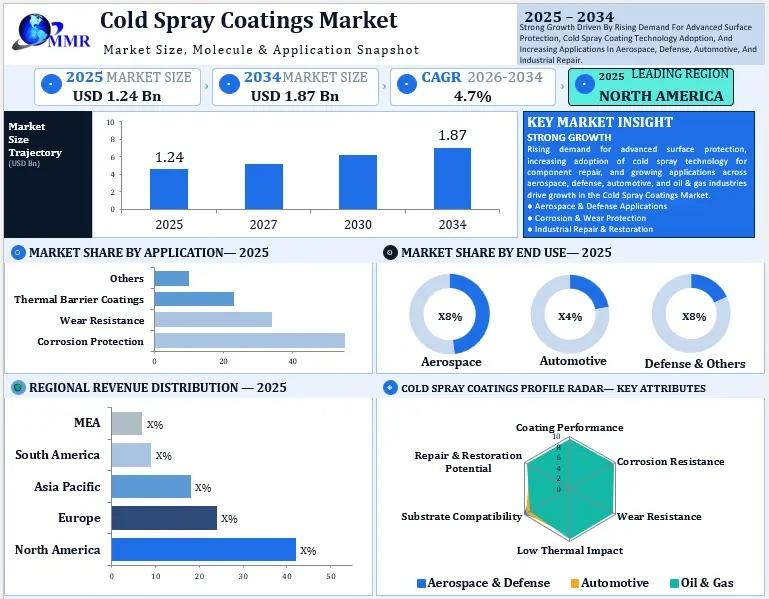
    The global Cold Spray Coatings Market was valued at USD 1.24 billion in 2025 and is projected to reach USD 1.87 billion by 2034, expanding at a CAGR of 4.7% during 2026–2034, according to Maximize Market Research. Increasing demand for advanced surface protection, industrial component restoration, and lightweight manufacturing technologies is supporting market growth.

    The Cold Spray Coatings Market utilizes high-velocity powder deposition technology to create protective metallic and composite coatings without melting the feedstock materials. This solid-state process minimizes thermal distortion and preserves material properties, making it valuable for aerospace components, defense equipment, automotive parts, and industrial machinery.

    Download a Free Sample Report Today:

    https://www.maximizemarketresearch.com/request-sample/195190/
    Cold Spray Coatings Market Revenue Forecast to Hit USD 1.87 Billion by 2034 Overview: The global Cold Spray Coatings Market was valued at USD 1.24 billion in 2025 and is projected to reach USD 1.87 billion by 2034, expanding at a CAGR of 4.7% during 2026–2034, according to Maximize Market Research. Increasing demand for advanced surface protection, industrial component restoration, and lightweight manufacturing technologies is supporting market growth. The Cold Spray Coatings Market utilizes high-velocity powder deposition technology to create protective metallic and composite coatings without melting the feedstock materials. This solid-state process minimizes thermal distortion and preserves material properties, making it valuable for aerospace components, defense equipment, automotive parts, and industrial machinery. Download a Free Sample Report Today: https://www.maximizemarketresearch.com/request-sample/195190/
    0 Comments ·0 Shares ·137 Views
  • Tetrahydrofuran Market Growth Trends: Rising Spandex Consumption Drives USD 8.81 Billion Forecast by 2034
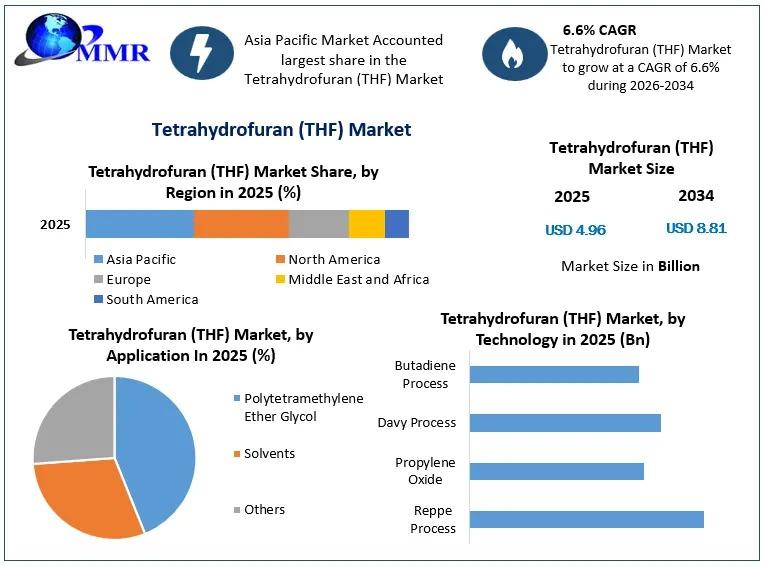
    The Tetrahydrofuran Market is driven by rising demand for spandex fibers, polyurethane elastomers, and high-performance polymers across textile, automotive, and industrial applications. Increasing use of tetrahydrofuran (THF) in pharmaceutical manufacturing, specialty chemicals, coatings, and adhesives is further supporting market expansion. Growing PTMEG production, advancements in bio-based THF technologies, and investments in sustainable chemical manufacturing are expected to drive the market at a CAGR of 6.6% from 2026 to 2034, reaching USD 8.81 billion by 2034.
    Tetrahydrofuran Market Growth Trends: Rising Spandex Consumption Drives USD 8.81 Billion Forecast by 2034 The Tetrahydrofuran Market is driven by rising demand for spandex fibers, polyurethane elastomers, and high-performance polymers across textile, automotive, and industrial applications. Increasing use of tetrahydrofuran (THF) in pharmaceutical manufacturing, specialty chemicals, coatings, and adhesives is further supporting market expansion. Growing PTMEG production, advancements in bio-based THF technologies, and investments in sustainable chemical manufacturing are expected to drive the market at a CAGR of 6.6% from 2026 to 2034, reaching USD 8.81 billion by 2034.
    0 Comments ·0 Shares ·120 Views
  • Propylene Oxide Market Demand, Growth Drivers, and Future Outlook Report by MMR

    Propylene Oxide Market to Reach USD 36.04 Billion by 2034, Driven by Polyurethane Demand and Industrial Applications

    Market Overview

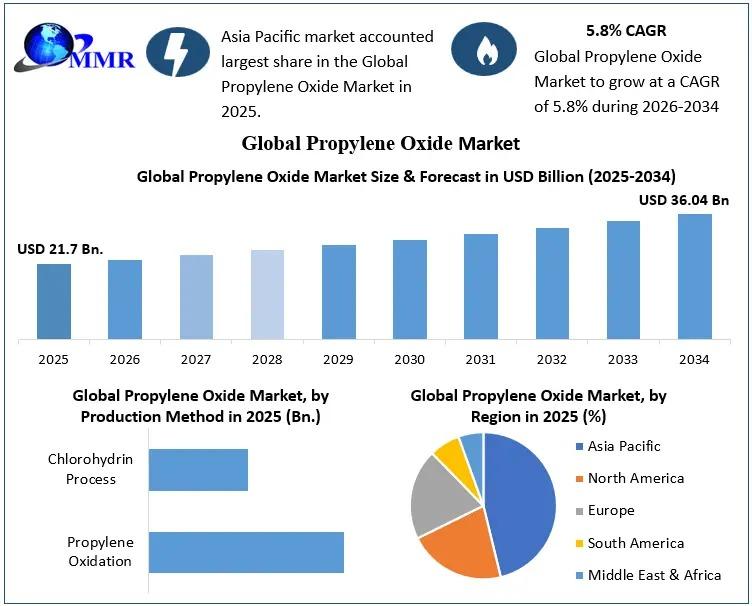
    The Propylene Oxide Market was valued at USD 21.7 billion in 2025 and is projected to reach USD 36.04 billion by 2034, registering a compound annual growth rate (CAGR) of 5.8% during the forecast period from 2026 to 2034. Increasing demand for polyurethane foams, expanding automotive production, infrastructure development, and the growing use of propylene oxide derivatives across industrial applications are supporting market expansion. Manufacturers are also focusing on production efficiency, supply chain optimization, and advanced chemical processing technologies to strengthen their competitive positions.

    Market Estimation, Growth Drivers, and Opportunities

    Propylene oxide is an important chemical intermediate used to manufacture polyether polyols, propylene glycol, glycol ethers, and specialty surfactants. These derivatives serve multiple industries, including automotive, construction, packaging, furniture and bedding, electronics, pharmaceuticals, and personal care.

    The market's growth is primarily driven by rising demand for polyurethane materials. Polyether polyols, produced using propylene oxide, are essential ingredients in flexible and rigid polyurethane foams used in mattresses, furniture, automotive seating, building insulation, and refrigeration systems. Increasing construction activity and demand for energy-efficient buildings are creating additional opportunities for polyurethane-based insulation materials.

    The expansion of electric vehicle manufacturing also supports market development. Polyurethane materials are used in vehicle interiors, cushioning, adhesives, coatings, and selected battery-related applications. Furthermore, propylene glycol is widely used in pharmaceutical formulations, cosmetics, food processing, and industrial fluids, creating opportunities across diverse downstream markets.

    Get a Sample Insight Report Now : https://www.maximizemarketresearch.com/request-sample/2515/

    United States Market Trends and Investment Outlook

    The United States remains an important market because of its established petrochemical infrastructure, integrated feedstock supply chains, and demand from automotive, construction, and industrial manufacturing sectors. In March 2025, LyondellBasell announced an investment to expand propylene production capacity at its Channelview Complex near Houston.
    Propylene Oxide Market Demand, Growth Drivers, and Future Outlook Report by MMR Propylene Oxide Market to Reach USD 36.04 Billion by 2034, Driven by Polyurethane Demand and Industrial Applications Market Overview The Propylene Oxide Market was valued at USD 21.7 billion in 2025 and is projected to reach USD 36.04 billion by 2034, registering a compound annual growth rate (CAGR) of 5.8% during the forecast period from 2026 to 2034. Increasing demand for polyurethane foams, expanding automotive production, infrastructure development, and the growing use of propylene oxide derivatives across industrial applications are supporting market expansion. Manufacturers are also focusing on production efficiency, supply chain optimization, and advanced chemical processing technologies to strengthen their competitive positions. Market Estimation, Growth Drivers, and Opportunities Propylene oxide is an important chemical intermediate used to manufacture polyether polyols, propylene glycol, glycol ethers, and specialty surfactants. These derivatives serve multiple industries, including automotive, construction, packaging, furniture and bedding, electronics, pharmaceuticals, and personal care. The market's growth is primarily driven by rising demand for polyurethane materials. Polyether polyols, produced using propylene oxide, are essential ingredients in flexible and rigid polyurethane foams used in mattresses, furniture, automotive seating, building insulation, and refrigeration systems. Increasing construction activity and demand for energy-efficient buildings are creating additional opportunities for polyurethane-based insulation materials. The expansion of electric vehicle manufacturing also supports market development. Polyurethane materials are used in vehicle interiors, cushioning, adhesives, coatings, and selected battery-related applications. Furthermore, propylene glycol is widely used in pharmaceutical formulations, cosmetics, food processing, and industrial fluids, creating opportunities across diverse downstream markets. Get a Sample Insight Report Now : https://www.maximizemarketresearch.com/request-sample/2515/ United States Market Trends and Investment Outlook The United States remains an important market because of its established petrochemical infrastructure, integrated feedstock supply chains, and demand from automotive, construction, and industrial manufacturing sectors. In March 2025, LyondellBasell announced an investment to expand propylene production capacity at its Channelview Complex near Houston.
    0 Comments ·0 Shares ·446 Views
  • Stellar Market Research has released a comprehensive global intelligence report on the Construction Glass Market, providing critical strategic insights into the structural transformation of the architectural materials industry. As global real estate developers and municipal planners race toward zero-emission building frameworks, advanced construction glass has transitioned from a basic structural envelope to a core technology for thermal insulation, daylight harvesting, and urban energy efficiency.

    The global construction glass sector is undergoing a profound paradigm shift driven by stringent decarbonization policies and a surge in sustainable urban megaprojects. Traditional, energy-inefficient float glass is rapidly losing ground to high-performance, multifunctional coated glass products like Low-E (low-emissivity) and electrochromic smart glass. Urbanization and green building certifications (such as LEED and BREEAM) are forcing commercial and residential developers to mandate high-spec glazing solutions that minimize HVAC loads. This pivot represents a major value-creation window for chemical manufacturers, glass processors, and architectural engineering firms capable of scaling advanced solar-control and photovoltaic-integrated glass (BIPV) systems.

    Key Findings from the Report
    Global Market Trajectory: The global construction glass market is projected to expand at a steady compound annual growth rate (CAGR) throughout the 2024–2030 forecast period, fueled by post-pandemic infrastructure investments and strict energy conservation building codes.

    Dominant Segment: Annealed and float glass retain the highest volume share due to cost efficiencies and widespread application in conventional residential framing, though their market dominance is increasingly challenged by value-added treated alternatives.

    Fastest-Growing Segment: Coated and Low-E glass represent the fastest-growing product segments, driven by consumer and regulatory demand for superior thermal insulation and UV radiation blocking in commercial high-rises.

    Application Breakdown: Commercial construction leads overall revenue generation, propelled by corporate sustainability targets and the proliferation of glass-façade skyscrapers across metropolitan hubs.

    Regional Powerhouse: Asia-Pacific dominates regional demand, anchored by massive urbanization waves, smart city initiatives, and high-rise construction surges across emerging economies like India, China, and Southeast Asia.

    Emerging Hotspot: North America and Europe exhibit accelerated adoption of smart and electrochromic glass systems, supported by rigorous green-building mandates and net-zero carbon building retrofits.

    Supply-Demand Dynamics: Raw material price volatility (specifically soda ash, silica sand, and energy inputs) has triggered regional supply chain localization, pushing manufacturers to invest in localized high-tech melting furnaces.

    For further information, click the following link:https://www.stellarmr.com/report/req_sample/construction-glass-market/2649
    Market Drivers and Restraints
    Driver 1: Stringent Building Energy Regulations: Global governments are enacting rigorous carbon-emission standards (such as the EU Energy Performance of Buildings Directive), compelling real estate developers to install high-performance thermal insulation glass.

    Driver 2: Escalating Commercial and Urban Infrastructure Growth: Rapid urbanization and the proliferation of high-rise commercial complexes in developing markets continuously fuel bulk volume requirements for architectural glass.

    Driver 3: Technological Advancements in Smart and BIPV Glass: Innovations in switchable electrochromic and building-integrated photovoltaic (BIPV) glass transform passive facades into active energy-generating assets, attracting forward-thinking investors.

    Restraint 1: High Initial Capital and Processing Costs: The manufacturing and installation expenses associated with premium Low-E, vacuum, and smart dynamic glass systems deter budget-constrained residential developers.

    Restraint 2: Vulnerability to Raw Material and Energy Price Volatility: Glass manufacturing is highly energy-intensive; fluctuations in natural gas, electricity, and raw mineral prices compress processor profit margins.

    Technology, Regulation, and Sustainability Trends
    The construction glass landscape is fundamentally reshaped by environmental, social, and governance (ESG) imperatives. Technological breakthroughs in pyrolytic and magnetron sputtering deposition have enabled ultra-thin metallic coatings that maximize visible light transmittance while drastically blocking infrared solar heat. Regulatory frameworks worldwide are phasing out inefficient single-pane glazing in favor of mandatory double- and triple-glazed insulated glass units (IGUs). Furthermore, sustainability initiatives are driving closed-loop recycling programs, allowing manufacturers to remelt post-consumer architectural glass Cullet, significantly lowering embodied carbon footprints across the supply chain.

    Regional Insights
    Asia-Pacific: Securing the leading market share, APAC is fueled by aggressive governmental housing programs, commercial real estate booms in India and China, and rising disposable incomes driving aesthetic architectural preferences.

    North America: Exhibiting steady demand anchored by institutional retrofitting projects aimed at meeting net-zero carbon operational goals by 2050.

    Europe: Positioned as a regulatory trailblazer, Europe demonstrates the highest penetration of premium Low-E and triple-glazed insulating systems driven by strict EU directives on nearly zero-energy buildings (NZEB).

    Middle East & Africa: Emerging as a lucrative regional pocket, the GCC region is investing heavily in mega-scale futuristic smart cities requiring specialized solar-control glass capable of withstanding extreme desert thermal loads.

    Recent Industry Developments
    AGC Inc. (2025): Launched advanced exterior Low-E glass variants featuring enhanced solar heat gain coefficients, contributing to a 15% reduction in commercial HVAC cooling energy expenditure.

    Saint-Gobain (2025): Completed the acquisition of a regional specialty glass processor in North America, expanding its high-performance architectural laminating capacity and strengthening localized supply chains.

    Guardian Glass (2024): Partnered with major European architectural engineering firms to deploy next-generation acoustic and thermal insulation glazing solutions for sustainable urban rail and transit hubs.

    NSG Group (2024): Commissioned a state-of-the-art low-carbon float glass production line utilizing hydrogen-fuel technology, achieving a 20% reduction in direct manufacturing greenhouse gas emissions.

    Sisecam (2025): Expanded operational capacity at its specialized coated glass manufacturing facility to support the escalating regional demand for commercial solar-control architectural envelopes.

    Competitive Landscape
    The global construction glass market features a consolidated yet fiercely competitive landscape dominated by multinational conglomerates, including Saint-Gobain, AGC Inc., Guardian Glass, NSG Group, and Sisecam Group. Leading market players are actively pursuing horizontal integration, strategic cross-border acquisitions, and joint ventures to secure proprietary coating technologies and expand regional manufacturing footprints. Differentiation increasingly hinges on portfolio diversification toward eco-friendly, energy-saving, and digitally integrated smart glass solutions that appeal to institutional ESG investors.

    Analyst Commentary
    "The construction glass market has crossed a critical threshold where thermal efficiency and carbon compliance take precedence over basic aesthetic considerations," said a Senior Research Analyst at Stellar Market Research. "As urban building codes tighten globally, the competitive edge will belong to manufacturers who can successfully scale high-performance, low-carbon coated glass without prohibitive cost barriers."

    Future Outlook
    Through the remainder of the decade, demand for construction glass is projected to bifurcate toward high-value, functionalized architectural solutions. Investment capital will increasingly flow toward manufacturers pioneering automated smart glass, dynamic tinting, and circular-economy glass recycling infrastructure. While macroeconomic headwinds and energy inflation pose near-term hurdles, regulatory pressures toward net-zero buildings will cement construction glass as an indispensable component of sustainable global infrastructure.

    For further information, click the following link:https://www.stellarmr.com/report/req_sample/construction-glass-market/2649
    About Stellar Market Research
    Stellar Market Research is a multifaceted market research and consulting company with professionals from several industries. Some of the industries we cover include medical devices, pharmaceutical manufacturers, science and engineering, electronic components, industrial equipment, technology and communication, cars and automobiles, chemical products and substances, general merchandise, beverages, personal care, and automated systems. To mention a few, we provide market-verified industry estimations, technical trend analysis, crucial market research, strategic advice, competition analysis, production and demand analysis, and client impact studies.

    Address
    Phase 3, Navale IT Zone, S.No. 51/2A/2, Office No. 202, 2nd floor, Near, Navale Brg, Narhe, Pune, Maharashtra 411041

    Email
    [email protected]

    Mobile
    +91 9607365656

    Stellar Market Research has released a comprehensive global intelligence report on the Construction Glass Market, providing critical strategic insights into the structural transformation of the architectural materials industry. As global real estate developers and municipal planners race toward zero-emission building frameworks, advanced construction glass has transitioned from a basic structural envelope to a core technology for thermal insulation, daylight harvesting, and urban energy efficiency. The global construction glass sector is undergoing a profound paradigm shift driven by stringent decarbonization policies and a surge in sustainable urban megaprojects. Traditional, energy-inefficient float glass is rapidly losing ground to high-performance, multifunctional coated glass products like Low-E (low-emissivity) and electrochromic smart glass. Urbanization and green building certifications (such as LEED and BREEAM) are forcing commercial and residential developers to mandate high-spec glazing solutions that minimize HVAC loads. This pivot represents a major value-creation window for chemical manufacturers, glass processors, and architectural engineering firms capable of scaling advanced solar-control and photovoltaic-integrated glass (BIPV) systems. Key Findings from the Report Global Market Trajectory: The global construction glass market is projected to expand at a steady compound annual growth rate (CAGR) throughout the 2024–2030 forecast period, fueled by post-pandemic infrastructure investments and strict energy conservation building codes. Dominant Segment: Annealed and float glass retain the highest volume share due to cost efficiencies and widespread application in conventional residential framing, though their market dominance is increasingly challenged by value-added treated alternatives. Fastest-Growing Segment: Coated and Low-E glass represent the fastest-growing product segments, driven by consumer and regulatory demand for superior thermal insulation and UV radiation blocking in commercial high-rises. Application Breakdown: Commercial construction leads overall revenue generation, propelled by corporate sustainability targets and the proliferation of glass-façade skyscrapers across metropolitan hubs. Regional Powerhouse: Asia-Pacific dominates regional demand, anchored by massive urbanization waves, smart city initiatives, and high-rise construction surges across emerging economies like India, China, and Southeast Asia. Emerging Hotspot: North America and Europe exhibit accelerated adoption of smart and electrochromic glass systems, supported by rigorous green-building mandates and net-zero carbon building retrofits. Supply-Demand Dynamics: Raw material price volatility (specifically soda ash, silica sand, and energy inputs) has triggered regional supply chain localization, pushing manufacturers to invest in localized high-tech melting furnaces. For further information, click the following link:https://www.stellarmr.com/report/req_sample/construction-glass-market/2649 Market Drivers and Restraints Driver 1: Stringent Building Energy Regulations: Global governments are enacting rigorous carbon-emission standards (such as the EU Energy Performance of Buildings Directive), compelling real estate developers to install high-performance thermal insulation glass. Driver 2: Escalating Commercial and Urban Infrastructure Growth: Rapid urbanization and the proliferation of high-rise commercial complexes in developing markets continuously fuel bulk volume requirements for architectural glass. Driver 3: Technological Advancements in Smart and BIPV Glass: Innovations in switchable electrochromic and building-integrated photovoltaic (BIPV) glass transform passive facades into active energy-generating assets, attracting forward-thinking investors. Restraint 1: High Initial Capital and Processing Costs: The manufacturing and installation expenses associated with premium Low-E, vacuum, and smart dynamic glass systems deter budget-constrained residential developers. Restraint 2: Vulnerability to Raw Material and Energy Price Volatility: Glass manufacturing is highly energy-intensive; fluctuations in natural gas, electricity, and raw mineral prices compress processor profit margins. Technology, Regulation, and Sustainability Trends The construction glass landscape is fundamentally reshaped by environmental, social, and governance (ESG) imperatives. Technological breakthroughs in pyrolytic and magnetron sputtering deposition have enabled ultra-thin metallic coatings that maximize visible light transmittance while drastically blocking infrared solar heat. Regulatory frameworks worldwide are phasing out inefficient single-pane glazing in favor of mandatory double- and triple-glazed insulated glass units (IGUs). Furthermore, sustainability initiatives are driving closed-loop recycling programs, allowing manufacturers to remelt post-consumer architectural glass Cullet, significantly lowering embodied carbon footprints across the supply chain. Regional Insights Asia-Pacific: Securing the leading market share, APAC is fueled by aggressive governmental housing programs, commercial real estate booms in India and China, and rising disposable incomes driving aesthetic architectural preferences. North America: Exhibiting steady demand anchored by institutional retrofitting projects aimed at meeting net-zero carbon operational goals by 2050. Europe: Positioned as a regulatory trailblazer, Europe demonstrates the highest penetration of premium Low-E and triple-glazed insulating systems driven by strict EU directives on nearly zero-energy buildings (NZEB). Middle East & Africa: Emerging as a lucrative regional pocket, the GCC region is investing heavily in mega-scale futuristic smart cities requiring specialized solar-control glass capable of withstanding extreme desert thermal loads. Recent Industry Developments AGC Inc. (2025): Launched advanced exterior Low-E glass variants featuring enhanced solar heat gain coefficients, contributing to a 15% reduction in commercial HVAC cooling energy expenditure. Saint-Gobain (2025): Completed the acquisition of a regional specialty glass processor in North America, expanding its high-performance architectural laminating capacity and strengthening localized supply chains. Guardian Glass (2024): Partnered with major European architectural engineering firms to deploy next-generation acoustic and thermal insulation glazing solutions for sustainable urban rail and transit hubs. NSG Group (2024): Commissioned a state-of-the-art low-carbon float glass production line utilizing hydrogen-fuel technology, achieving a 20% reduction in direct manufacturing greenhouse gas emissions. Sisecam (2025): Expanded operational capacity at its specialized coated glass manufacturing facility to support the escalating regional demand for commercial solar-control architectural envelopes. Competitive Landscape The global construction glass market features a consolidated yet fiercely competitive landscape dominated by multinational conglomerates, including Saint-Gobain, AGC Inc., Guardian Glass, NSG Group, and Sisecam Group. Leading market players are actively pursuing horizontal integration, strategic cross-border acquisitions, and joint ventures to secure proprietary coating technologies and expand regional manufacturing footprints. Differentiation increasingly hinges on portfolio diversification toward eco-friendly, energy-saving, and digitally integrated smart glass solutions that appeal to institutional ESG investors. Analyst Commentary "The construction glass market has crossed a critical threshold where thermal efficiency and carbon compliance take precedence over basic aesthetic considerations," said a Senior Research Analyst at Stellar Market Research. "As urban building codes tighten globally, the competitive edge will belong to manufacturers who can successfully scale high-performance, low-carbon coated glass without prohibitive cost barriers." Future Outlook Through the remainder of the decade, demand for construction glass is projected to bifurcate toward high-value, functionalized architectural solutions. Investment capital will increasingly flow toward manufacturers pioneering automated smart glass, dynamic tinting, and circular-economy glass recycling infrastructure. While macroeconomic headwinds and energy inflation pose near-term hurdles, regulatory pressures toward net-zero buildings will cement construction glass as an indispensable component of sustainable global infrastructure. For further information, click the following link:https://www.stellarmr.com/report/req_sample/construction-glass-market/2649 About Stellar Market Research Stellar Market Research is a multifaceted market research and consulting company with professionals from several industries. Some of the industries we cover include medical devices, pharmaceutical manufacturers, science and engineering, electronic components, industrial equipment, technology and communication, cars and automobiles, chemical products and substances, general merchandise, beverages, personal care, and automated systems. To mention a few, we provide market-verified industry estimations, technical trend analysis, crucial market research, strategic advice, competition analysis, production and demand analysis, and client impact studies. Address Phase 3, Navale IT Zone, S.No. 51/2A/2, Office No. 202, 2nd floor, Near, Navale Brg, Narhe, Pune, Maharashtra 411041 Email [email protected] Mobile +91 9607365656

    0 Comments ·0 Shares ·344 Views
  • Acetaldehyde Market Demands and Projected Industry Growth with 6.5% CAGR Forecast Report by MMR

    Acetaldehyde Market to Reach USD 4.03 Billion by 2034, Driven by Chemical Manufacturing and Industrial Demand

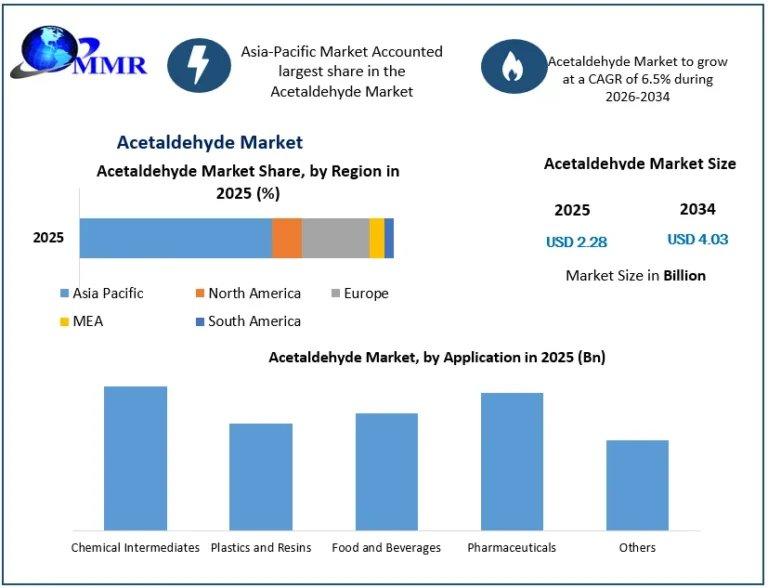
    The Acetaldehyde Market is witnessing steady growth, supported by increasing demand for intermediate chemicals, pharmaceutical ingredients, agrochemicals, and specialty chemical production. According to Maximize Market Research, the market was valued at USD 2.28 billion in 2025 and is projected to reach nearly USD 4.03 billion by 2034, growing at a compound annual growth rate (CAGR) of 6.5% during the forecast period from 2026 to 2034. Expanding industrial applications, technological improvements in chemical processing, and investments in manufacturing infrastructure are expected to create new opportunities for market participants.

    Market Estimation, Growth Drivers, and Opportunities

    The Acetaldehyde Market is benefiting from its importance as a chemical intermediate used in producing acetic acid derivatives, pentaerythritol, pyridine and pyridine derivatives, and other industrial chemicals. These downstream products serve diverse industries, including pharmaceuticals, agriculture, paints and coatings, plastics, adhesives, and specialty chemicals. Growing industrial production and the need for reliable chemical feedstocks are strengthening demand across established and emerging manufacturing economies.

    The market's expansion is also supported by increasing consumption of agrochemicals, pharmaceutical compounds, and performance-oriented materials. Acetaldehyde plays an important role in synthesizing chemicals used in agricultural formulations and industrial manufacturing. As manufacturers seek consistent product quality, operational efficiency, and dependable raw material supplies, investments in production optimization and process control are creating additional opportunities.

    However, fluctuating feedstock prices, stringent environmental regulations, occupational exposure concerns, and the need for safe handling and storage can challenge market development. Manufacturers that improve process efficiency, reduce emissions, strengthen workplace safety, and optimize resource utilization will be better positioned to capture long-term growth. The projected increase from USD 2.28 billion in 2025 to USD 4.03 billion by 2034 highlights the commercial potential of the industry.

    Get a Sample Insight Report Now : https://www.maximizemarketresearch.com/request-sample/6262/

    US Market Trends and Investment Outlook

    The United States remains an important market for acetaldehyde because of its established chemical manufacturing infrastructure, advanced industrial capabilities, and demand for downstream chemical products. In 2025, investment priorities across the American chemical industry continued to emphasize manufacturing efficiency, supply-chain resilience, energy management, and lower-emission production technologies.
    Acetaldehyde Market Demands and Projected Industry Growth with 6.5% CAGR Forecast Report by MMR Acetaldehyde Market to Reach USD 4.03 Billion by 2034, Driven by Chemical Manufacturing and Industrial Demand The Acetaldehyde Market is witnessing steady growth, supported by increasing demand for intermediate chemicals, pharmaceutical ingredients, agrochemicals, and specialty chemical production. According to Maximize Market Research, the market was valued at USD 2.28 billion in 2025 and is projected to reach nearly USD 4.03 billion by 2034, growing at a compound annual growth rate (CAGR) of 6.5% during the forecast period from 2026 to 2034. Expanding industrial applications, technological improvements in chemical processing, and investments in manufacturing infrastructure are expected to create new opportunities for market participants. Market Estimation, Growth Drivers, and Opportunities The Acetaldehyde Market is benefiting from its importance as a chemical intermediate used in producing acetic acid derivatives, pentaerythritol, pyridine and pyridine derivatives, and other industrial chemicals. These downstream products serve diverse industries, including pharmaceuticals, agriculture, paints and coatings, plastics, adhesives, and specialty chemicals. Growing industrial production and the need for reliable chemical feedstocks are strengthening demand across established and emerging manufacturing economies. The market's expansion is also supported by increasing consumption of agrochemicals, pharmaceutical compounds, and performance-oriented materials. Acetaldehyde plays an important role in synthesizing chemicals used in agricultural formulations and industrial manufacturing. As manufacturers seek consistent product quality, operational efficiency, and dependable raw material supplies, investments in production optimization and process control are creating additional opportunities. However, fluctuating feedstock prices, stringent environmental regulations, occupational exposure concerns, and the need for safe handling and storage can challenge market development. Manufacturers that improve process efficiency, reduce emissions, strengthen workplace safety, and optimize resource utilization will be better positioned to capture long-term growth. The projected increase from USD 2.28 billion in 2025 to USD 4.03 billion by 2034 highlights the commercial potential of the industry. Get a Sample Insight Report Now : https://www.maximizemarketresearch.com/request-sample/6262/ US Market Trends and Investment Outlook The United States remains an important market for acetaldehyde because of its established chemical manufacturing infrastructure, advanced industrial capabilities, and demand for downstream chemical products. In 2025, investment priorities across the American chemical industry continued to emphasize manufacturing efficiency, supply-chain resilience, energy management, and lower-emission production technologies.
    0 Comments ·0 Shares ·394 Views
  • Laser Cladding Market Development Driven by Innovations in Laser Processing

    Market Estimation & Definition

    The global Laser Cladding Market is gaining momentum as industries increasingly adopt advanced surface-treatment technologies to improve component durability, repair worn parts, and extend equipment operating life. According to Stellar Market Research, the market was valued at USD 763.81 million in 2025 and is projected to reach USD 1,450.97 million by 2032, expanding at a CAGR of 9.6% during 2026–2032. The report uses 2025 as the base year and covers historical data from 2020 to 2025.

    Laser cladding is a surface-engineering process in which a coating material and a thin layer of the substrate are melted using a high-powered laser beam. The process produces a strongly bonded surface layer with limited chemical dilution and can improve resistance to wear and other forms of surface degradation. Its applications extend across automotive, oil and gas, aerospace, defense, power generation, and mining industries.

    Download Free PDF Brochure: https://www.stellarmr.com/report/req_sample/Laser-Cladding-Market/1171

    Market Growth Drivers & Opportunity

    The automotive and machinery industries are important contributors to laser cladding demand. Manufacturers increasingly require technologies capable of treating high-strength materials while improving component performance and controlling production costs. Laser cladding can also be used to repair and refurbish expensive components, creating opportunities to extend asset life rather than replace complete parts.

    The growing requirement for rapid manufacturing is another market opportunity. Laser cladding can support surface finishing, restoration of worn components, development of specialized alloys, and other manufacturing applications. The technology therefore provides value across both new production and maintenance activities.

    Advances in laser technology are further expanding the addressable market. Fiber lasers and high-power diode lasers are increasingly relevant to industrial applications, while developments combining wire- and powder-based processes are opening additional possibilities in additive manufacturing and surface modification.

    What Lies Ahead: Emerging Trends Shaping the Future

    The future of laser cladding is closely linked to the development of high-power lasers, additive manufacturing, automated processing, and advanced surface engineering. Improvements in laser systems are allowing the technology to address a wider range of industrial applications, including aerospace, defense, medical technology, electronics, and heavy machinery.

    The integration of laser cladding with additive manufacturing is another emerging trend. Hybrid approaches can combine different material-deposition techniques to produce wear-resistant and resource-efficient coatings. Such developments could expand the use of laser cladding for component repair, tooling, and specialized manufacturing.

    Despite these opportunities, the industry faces challenges including a shortage of skilled welders and engineers, particularly in the United States. The use of certain hazardous or carcinogenic materials in some applications also presents an operational consideration for market participants.

    Get More Report Details: https://www.stellarmr.com/report/Laser-Cladding-Market/1171

    Segmentation Analysis

    According to Stellar Market Research, the Laser Cladding Market is segmented by Type, Revenue, End-User Industry, and Region. By Type, the market includes Fiber Laser, Diode Laser, YAG Laser, CO2 Laser, and Others. The Diode Laser segment is expected to hold the largest market share during the forecast period, supported by the energy-saving characteristics of high-power diode lasers compared with conventional CO2 and YAG technologies.

    By Revenue, the market is divided into Laser Revenue and System Revenue. Laser Revenue is expected to develop at the fastest CAGR during the forecast period, supported by demand for different laser technologies used across aerospace and defense, automotive, and mining applications.

    By End-User Industry, the market covers Oil & Gas, Aerospace & Defense, Automotive, Power Generation, and Mining. Aerospace & Defense is expected to be the fastest-growing segment, supported by the use of laser cladding for critical aircraft-engine components and the industry's adoption of advanced manufacturing technologies.

    Country-Level Analysis: USA and Germany

    The United States is included within North America and is expected to lead the regional country-level market, supported by demand for laser cladding in automotive, security and defense, and semiconductor-related applications. The report also identifies the need for laser cladding to improve, repair, and strengthen metal-component surfaces as an important application area.

    Germany is a particularly important market within Europe. Stellar Market Research expects Germany to be among Europe's leading markets due to demand from the automotive, machinery, and semiconductor-equipment industries. Germany also has a strong presence in the competitive landscape through companies such as TRUMPF, Jenoptik, Laserline, and NUTECH.

    Competitive Analysis

    The competitive landscape comprises global laser technology manufacturers and specialized surface-engineering companies. Key players identified by Stellar Market Research include TRUMPF, OC Oerlikon Management AG, Coherent, Inc., IPG Photonics Corporation, Han's Laser Technology Industry Group, Höganäs AB, Lumibird, Lumentum Operations, Curtiss-Wright Corporation, Jenoptik, Laserline GmbH, NUTECH Gesellschaft für Lasertechnik und Materialprüfung mbH, Titanova Inc., Hardchrome Engineering, LaserBond Ltd, Praxair S.T. Technology, Alabama Specialty Products, and YANMAR HOLDINGS.

    Competition is increasingly shaped by laser-source development, process efficiency, application expertise, advanced manufacturing capabilities, and expansion into industrial end-use sectors.

    Download Free PDF Brochure: https://www.stellarmr.com/report/req_sample/Laser-Cladding-Market/1171

    Press Release Conclusion

    The global Laser Cladding Market is entering a period of strong expansion as manufacturers seek efficient technologies for surface enhancement, component repair, and advanced production. With the market projected to rise from USD 763.81 million in 2025 to USD 1,450.97 million by 2032, demand from automotive, aerospace and defense, oil and gas, power generation, and mining is expected to create new opportunities. Europe is projected to remain a major market, while the United States and Germany continue to represent important country-level markets. Advances in diode lasers, fiber lasers, additive manufacturing, and rapid manufacturing processes are expected to remain central to the industry's development through 2032.

    About Stellar Market Research:

    Stellar Market Research is a multifaceted market research and consulting company with professionals from several industries. Some of the industries we cover include medical devices, pharmaceutical manufacturers, science and engineering, electronic components, industrial equipment, technology and communication, cars and automobiles, chemical products and substances, general merchandise, beverages, personal care, and automated systems. To mention a few, we provide market-verified industry estimations, technical trend analysis, crucial market research, strategic advice, competition analysis, production and demand analysis, and client impact studies.

    Contact Stellar Market Research:

    3rd Floor, Navale IT Park, Phase 2

    Pune Banglore Highway, Narhe,

    Pune, Maharashtra 411041, India

    [email protected]

    +91 20 6630 3320 | +91 9607365656
    Laser Cladding Market Development Driven by Innovations in Laser Processing Market Estimation & Definition The global Laser Cladding Market is gaining momentum as industries increasingly adopt advanced surface-treatment technologies to improve component durability, repair worn parts, and extend equipment operating life. According to Stellar Market Research, the market was valued at USD 763.81 million in 2025 and is projected to reach USD 1,450.97 million by 2032, expanding at a CAGR of 9.6% during 2026–2032. The report uses 2025 as the base year and covers historical data from 2020 to 2025. Laser cladding is a surface-engineering process in which a coating material and a thin layer of the substrate are melted using a high-powered laser beam. The process produces a strongly bonded surface layer with limited chemical dilution and can improve resistance to wear and other forms of surface degradation. Its applications extend across automotive, oil and gas, aerospace, defense, power generation, and mining industries. Download Free PDF Brochure: https://www.stellarmr.com/report/req_sample/Laser-Cladding-Market/1171 Market Growth Drivers & Opportunity The automotive and machinery industries are important contributors to laser cladding demand. Manufacturers increasingly require technologies capable of treating high-strength materials while improving component performance and controlling production costs. Laser cladding can also be used to repair and refurbish expensive components, creating opportunities to extend asset life rather than replace complete parts. The growing requirement for rapid manufacturing is another market opportunity. Laser cladding can support surface finishing, restoration of worn components, development of specialized alloys, and other manufacturing applications. The technology therefore provides value across both new production and maintenance activities. Advances in laser technology are further expanding the addressable market. Fiber lasers and high-power diode lasers are increasingly relevant to industrial applications, while developments combining wire- and powder-based processes are opening additional possibilities in additive manufacturing and surface modification. What Lies Ahead: Emerging Trends Shaping the Future The future of laser cladding is closely linked to the development of high-power lasers, additive manufacturing, automated processing, and advanced surface engineering. Improvements in laser systems are allowing the technology to address a wider range of industrial applications, including aerospace, defense, medical technology, electronics, and heavy machinery. The integration of laser cladding with additive manufacturing is another emerging trend. Hybrid approaches can combine different material-deposition techniques to produce wear-resistant and resource-efficient coatings. Such developments could expand the use of laser cladding for component repair, tooling, and specialized manufacturing. Despite these opportunities, the industry faces challenges including a shortage of skilled welders and engineers, particularly in the United States. The use of certain hazardous or carcinogenic materials in some applications also presents an operational consideration for market participants. Get More Report Details: https://www.stellarmr.com/report/Laser-Cladding-Market/1171 Segmentation Analysis According to Stellar Market Research, the Laser Cladding Market is segmented by Type, Revenue, End-User Industry, and Region. By Type, the market includes Fiber Laser, Diode Laser, YAG Laser, CO2 Laser, and Others. The Diode Laser segment is expected to hold the largest market share during the forecast period, supported by the energy-saving characteristics of high-power diode lasers compared with conventional CO2 and YAG technologies. By Revenue, the market is divided into Laser Revenue and System Revenue. Laser Revenue is expected to develop at the fastest CAGR during the forecast period, supported by demand for different laser technologies used across aerospace and defense, automotive, and mining applications. By End-User Industry, the market covers Oil & Gas, Aerospace & Defense, Automotive, Power Generation, and Mining. Aerospace & Defense is expected to be the fastest-growing segment, supported by the use of laser cladding for critical aircraft-engine components and the industry's adoption of advanced manufacturing technologies. Country-Level Analysis: USA and Germany The United States is included within North America and is expected to lead the regional country-level market, supported by demand for laser cladding in automotive, security and defense, and semiconductor-related applications. The report also identifies the need for laser cladding to improve, repair, and strengthen metal-component surfaces as an important application area. Germany is a particularly important market within Europe. Stellar Market Research expects Germany to be among Europe's leading markets due to demand from the automotive, machinery, and semiconductor-equipment industries. Germany also has a strong presence in the competitive landscape through companies such as TRUMPF, Jenoptik, Laserline, and NUTECH. Competitive Analysis The competitive landscape comprises global laser technology manufacturers and specialized surface-engineering companies. Key players identified by Stellar Market Research include TRUMPF, OC Oerlikon Management AG, Coherent, Inc., IPG Photonics Corporation, Han's Laser Technology Industry Group, Höganäs AB, Lumibird, Lumentum Operations, Curtiss-Wright Corporation, Jenoptik, Laserline GmbH, NUTECH Gesellschaft für Lasertechnik und Materialprüfung mbH, Titanova Inc., Hardchrome Engineering, LaserBond Ltd, Praxair S.T. Technology, Alabama Specialty Products, and YANMAR HOLDINGS. Competition is increasingly shaped by laser-source development, process efficiency, application expertise, advanced manufacturing capabilities, and expansion into industrial end-use sectors. Download Free PDF Brochure: https://www.stellarmr.com/report/req_sample/Laser-Cladding-Market/1171 Press Release Conclusion The global Laser Cladding Market is entering a period of strong expansion as manufacturers seek efficient technologies for surface enhancement, component repair, and advanced production. With the market projected to rise from USD 763.81 million in 2025 to USD 1,450.97 million by 2032, demand from automotive, aerospace and defense, oil and gas, power generation, and mining is expected to create new opportunities. Europe is projected to remain a major market, while the United States and Germany continue to represent important country-level markets. Advances in diode lasers, fiber lasers, additive manufacturing, and rapid manufacturing processes are expected to remain central to the industry's development through 2032. About Stellar Market Research: Stellar Market Research is a multifaceted market research and consulting company with professionals from several industries. Some of the industries we cover include medical devices, pharmaceutical manufacturers, science and engineering, electronic components, industrial equipment, technology and communication, cars and automobiles, chemical products and substances, general merchandise, beverages, personal care, and automated systems. To mention a few, we provide market-verified industry estimations, technical trend analysis, crucial market research, strategic advice, competition analysis, production and demand analysis, and client impact studies. Contact Stellar Market Research: 3rd Floor, Navale IT Park, Phase 2 Pune Banglore Highway, Narhe, Pune, Maharashtra 411041, India [email protected] +91 20 6630 3320 | +91 9607365656
    0 Comments ·0 Shares ·209 Views
  • Sustainable Packaging Demand Drives Fiber Drums Market at 8.1% CAGR
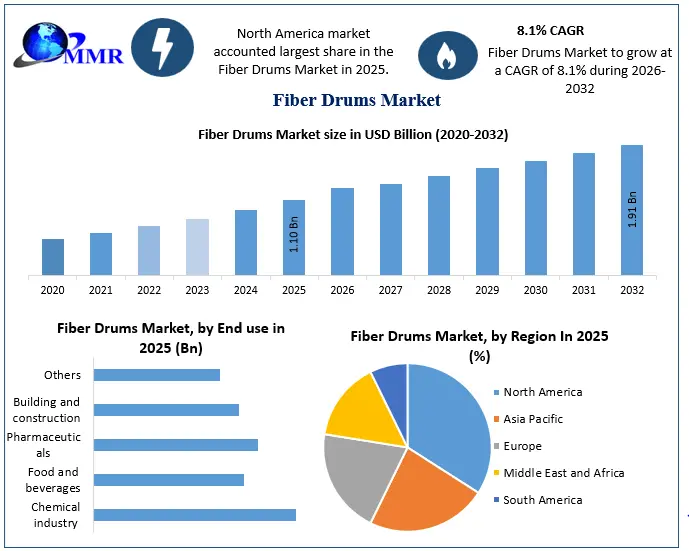
    Growing environmental awareness and demand for recyclable packaging are key factors driving the Fiber Drums Market. Lightweight construction and compatibility with different coatings and liners further expand their applications and support an 8.1% CAGR through 2032.
    Sustainable Packaging Demand Drives Fiber Drums Market at 8.1% CAGR Growing environmental awareness and demand for recyclable packaging are key factors driving the Fiber Drums Market. Lightweight construction and compatibility with different coatings and liners further expand their applications and support an 8.1% CAGR through 2032.
    Fiber Drums Market: Preference for Lightweight Bulk Containers with Eco-friendliness and Recyclability to Fuel the Market Growth over the Forecast Period
    www.maximizemarketresearch.com
    The Global Fiber Drums Market size was valued at USD 1.10 Bn in 2025 and is expected to reach USD 1.91 Bn by 2032, at a CAGR of 8.1 %.
    0 Comments ·0 Shares ·100 Views
  • Propylene Oxide Market Size, Share, Growth Drivers, and Future Growth

    Global Propylene Oxide Market to Reach USD 36.04 Billion by 2034, Driven by Polyurethane, EV and Sustainable Production Demand

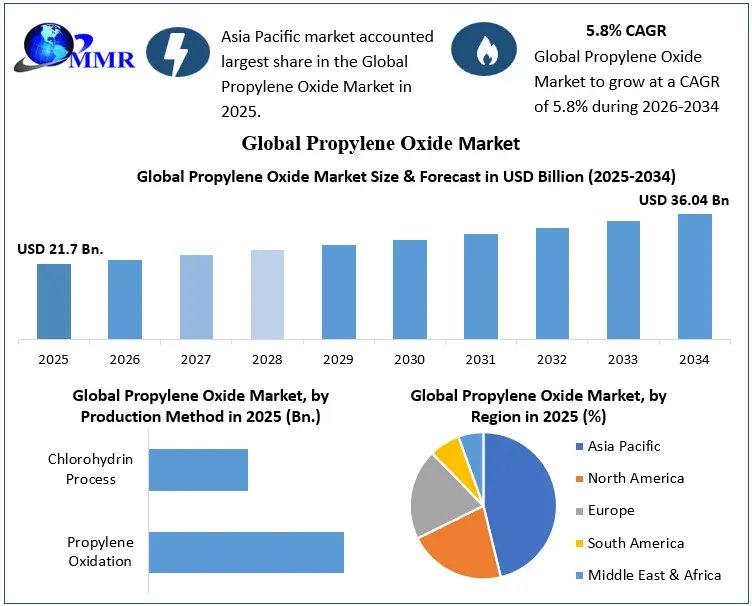
    The Propylene Oxide Market was valued at USD 21.7 billion in 2025 and is projected to reach USD 36.04 billion by 2034, expanding at a CAGR of 5.8% during 2026–2034. Propylene oxide is a critical chemical intermediate used to manufacture polyether polyols, propylene glycol, glycol ethers and specialty surfactants. Increasing demand for polyurethane foams across automotive, construction, furniture, insulation and packaging is strengthening consumption, while electric vehicle production is creating new opportunities for polyurethane-based battery encapsulation, thermal management, adhesives and interior applications.

    Market Estimation, Growth Drivers and Opportunities

    The market outlook is supported by industrialization, urbanization and rising demand for lightweight, energy-efficient materials. Automotive manufacturers use polyurethane-derived materials for seating, insulation, vibration damping and interiors, while electric vehicles create additional demand for polyurethane-based battery thermal management and encapsulation. Construction is another major growth engine because rigid polyurethane foams support building insulation and energy efficiency.

    Propylene glycol also expands opportunities in pharmaceuticals, food processing, cosmetics and personal care, while glycol ethers and specialty surfactants serve coatings, cleaning products and inks. Sustainable manufacturing is creating opportunities for hydrogen peroxide to propylene oxide (HPPO) technology. However, volatile propylene feedstock prices and higher production costs remain important challenges for producers and investors.

    U.S. Market Trends and Investment

    The United States remains a strategically important propylene oxide market because of its integrated petrochemical infrastructure, strong automotive and construction industries, and established polyurethane value chain. In 2025, industry activity highlighted a shift toward supply optimization and feedstock security. LyondellBasell approved an investment to expand propylene production at its Channelview Complex near Houston, with approximately 400,000 metric tons per year of additional capacity planned and startup targeted for 2028. The project is expected to strengthen propylene availability and reduce exposure to feedstock volatility, supporting downstream opportunities including propylene oxide. At the same time, Dow permanently shut down a higher-cost propylene oxide unit at Freeport, Texas, rationalizing approximately 20% of North American PO industry capacity. These developments show U.S. producers balancing capacity rationalization with targeted feedstock investment.

    Request a Sample of the Full Market Report : https://www.maximizemarketresearch.com/request-sample/2515/

    Market Segmentation: Largest Share

    By application, Polyether Polyols hold the largest share of the global Propylene Oxide Market. Their extensive use in flexible and rigid polyurethane foams for furniture, bedding, automotive seats, construction insulation and related applications makes them the leading consumption outlet for propylene oxide. By end user, Automotive and Construction are the dominant segments, supported by continued demand for polyurethane foams, coatings, adhesives and insulation. By region, Asia Pacific held the largest market share at 46.2% in 2025, reflecting rapid industrialization, urbanization and strong manufacturing activity across China, India and Southeast Asia.

    Propylene Oxide Market Size, Share, Growth Drivers, and Future Growth Global Propylene Oxide Market to Reach USD 36.04 Billion by 2034, Driven by Polyurethane, EV and Sustainable Production Demand The Propylene Oxide Market was valued at USD 21.7 billion in 2025 and is projected to reach USD 36.04 billion by 2034, expanding at a CAGR of 5.8% during 2026–2034. Propylene oxide is a critical chemical intermediate used to manufacture polyether polyols, propylene glycol, glycol ethers and specialty surfactants. Increasing demand for polyurethane foams across automotive, construction, furniture, insulation and packaging is strengthening consumption, while electric vehicle production is creating new opportunities for polyurethane-based battery encapsulation, thermal management, adhesives and interior applications. Market Estimation, Growth Drivers and Opportunities The market outlook is supported by industrialization, urbanization and rising demand for lightweight, energy-efficient materials. Automotive manufacturers use polyurethane-derived materials for seating, insulation, vibration damping and interiors, while electric vehicles create additional demand for polyurethane-based battery thermal management and encapsulation. Construction is another major growth engine because rigid polyurethane foams support building insulation and energy efficiency. Propylene glycol also expands opportunities in pharmaceuticals, food processing, cosmetics and personal care, while glycol ethers and specialty surfactants serve coatings, cleaning products and inks. Sustainable manufacturing is creating opportunities for hydrogen peroxide to propylene oxide (HPPO) technology. However, volatile propylene feedstock prices and higher production costs remain important challenges for producers and investors. U.S. Market Trends and Investment The United States remains a strategically important propylene oxide market because of its integrated petrochemical infrastructure, strong automotive and construction industries, and established polyurethane value chain. In 2025, industry activity highlighted a shift toward supply optimization and feedstock security. LyondellBasell approved an investment to expand propylene production at its Channelview Complex near Houston, with approximately 400,000 metric tons per year of additional capacity planned and startup targeted for 2028. The project is expected to strengthen propylene availability and reduce exposure to feedstock volatility, supporting downstream opportunities including propylene oxide. At the same time, Dow permanently shut down a higher-cost propylene oxide unit at Freeport, Texas, rationalizing approximately 20% of North American PO industry capacity. These developments show U.S. producers balancing capacity rationalization with targeted feedstock investment. Request a Sample of the Full Market Report : https://www.maximizemarketresearch.com/request-sample/2515/ Market Segmentation: Largest Share By application, Polyether Polyols hold the largest share of the global Propylene Oxide Market. Their extensive use in flexible and rigid polyurethane foams for furniture, bedding, automotive seats, construction insulation and related applications makes them the leading consumption outlet for propylene oxide. By end user, Automotive and Construction are the dominant segments, supported by continued demand for polyurethane foams, coatings, adhesives and insulation. By region, Asia Pacific held the largest market share at 46.2% in 2025, reflecting rapid industrialization, urbanization and strong manufacturing activity across China, India and Southeast Asia.
    0 Comments ·0 Shares ·280 Views
  • Automotive Suspension System Market: Transforming Vehicle Dynamics with Intelligent Suspension Technologies Through 2034

    Automotive Suspension System Market Overview

    The Automotive Suspension System Market report provides an in-depth analysis that is required to make informed industry decisions and develop strategic growth plans. Regardless of the production method or cost structures, the Automotive Suspension System market report provides a full understanding of advanced tactics and plans.

    Automotive Suspension System Market Forecast

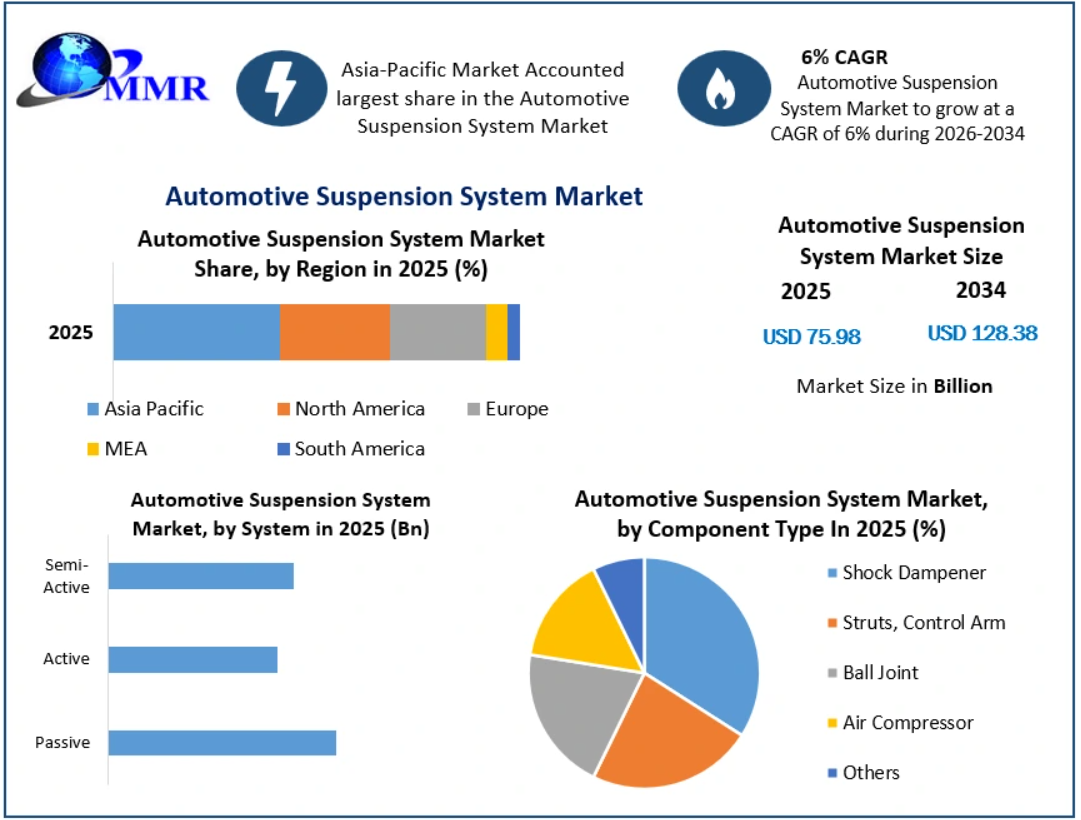
    Automotive Suspension System Market was valued at USD 75.98 Bn. in 2025. Automotive Suspension System Market size is expected to grow at a CAGR of 6% through the forecast period.

    Please connect with our representative, who will ensure you to get a report sample here @https://www.maximizemarketresearch.com/request-sample/145858/

    Automotive Suspension System Market Report Scope and Research Methodology

    The report offers an extensive examination of top players' strategies within the Automotive Suspension System industry, coupled with an in-depth analysis of market segments and regional dynamics. In-depth insights into market dynamics, encompassing drivers, restraints, opportunities, and challenges, are provided both on a regional and segmental basis within the Automotive Suspension System Market report. Additionally, the report presents import/export consumption, supply and demand, pricing, costs, revenue, and gross margins data, serving as an invaluable guide for investors.

    The data for the Automotive Suspension System Market report was meticulously gathered through a combination of primary and secondary research methods, ensuring its authenticity. Primary research methods employed encompassed questionnaire distribution, surveys, and telephone interviews with Automotive Suspension System industry experts, market leaders, marketing professionals, and entrepreneurs. The report's estimates of global and regional Automotive Suspension System market size were derived using a bottom-up approach. Furthermore, the strengths and weaknesses of Automotive Suspension System key players within the industry are outlined using SWOT analysis.

    Automotive Suspension System Market Regional Insights

    The report delves into the Automotive Suspension System business in great depth, segmenting it into numerous locations. North America, South America, Europe, Asia Pacific (APAC), Africa, and the Middle East are evaluated by region and country in the study. In the Automotive Suspension System market report, regional markets are thoroughly investigated in order to uncover regional market trends, restrictions, and possible prospects.

    Automotive Suspension System Market Segmentation

    by System

    Passive
    Active
    Semi-Active

    by Component Type

    Shock Dampener
    Struts, Control Arm
    Ball Joint
    Air Compressor
    Others

    by Suspension Type

    Hydraulic Suspension
    Air Suspension
    Leaf Spring

    by Vehicle Type

    Two Wheelers
    Passengers Cars
    Commercial Vehicles

    Request Free Sample Copy:https://www.maximizemarketresearch.com/request-sample/145858/

    Automotive Suspension System Market Key Players

    1. Continental AG
    2. FOX Factory, Inc.
    3. Gabriel India Limited
    4. Hendrickson USA, LLC
    5. KYB Corporation
    6. Mando Corporation
    7. Sogefi SpA
    8. Tenneco Inc.
    9. WABCO
    10.ZF TR
    11.Thyssenkrupp AG
    12.NHK Spring
    13.Schaeffler AG
    14.Benteler

    Key Offerings:

    A detailed market overview
    Market Share, Size & Forecast by Revenue | 2026−2034
    Market Dynamics – Growth Drivers, Restraints, Investment Opportunities, and Key Trends
    Market Segmentation – A detailed analysis by segments and sub-segments
    Regional Insights
    Competitive Landscape – Top Key Vendors and Other Prominent Vendors
    More Trending From MMR:

    Global Fencing material Market https://www.maximizemarketresearch.com/market-report/global-fencing-material-market/97560/
    Global Polyimide Coatings Market https://www.maximizemarketresearch.com/market-report/global-polyimide-coatings-market/91459/
    Polyimide Fibers Market https://www.maximizemarketresearch.com/market-report/polyimide-fibers-market-global-market/128296/

    About Maximize Market Research:

    Maximize Market Research is a multifaceted market research and consulting company with professionals from several industries. Some of the industries we cover include medical devices, pharmaceutical manufacturers, science and engineering, electronic components, industrial equipment, technology and communication, cars and automobiles, chemical products and substances, general merchandise, beverages, personal care, and automated systems. To mention a few, we provide market-verified industry estimations, technical trend analysis, crucial market research, strategic advice, competition analysis, production and demand analysis, and client impact studies.

    Contact Maximize Market Research:

    3rd Floor, Naval IT Park, Phase 2

    Pune Banglore Highway, Narhe

    Pune, Maharashtra 411041, India

    [email protected]

    +91 96071 95908, +91 9607365656
    Automotive Suspension System Market: Transforming Vehicle Dynamics with Intelligent Suspension Technologies Through 2034 Automotive Suspension System Market Overview The Automotive Suspension System Market report provides an in-depth analysis that is required to make informed industry decisions and develop strategic growth plans. Regardless of the production method or cost structures, the Automotive Suspension System market report provides a full understanding of advanced tactics and plans. Automotive Suspension System Market Forecast Automotive Suspension System Market was valued at USD 75.98 Bn. in 2025. Automotive Suspension System Market size is expected to grow at a CAGR of 6% through the forecast period. Please connect with our representative, who will ensure you to get a report sample here @https://www.maximizemarketresearch.com/request-sample/145858/ Automotive Suspension System Market Report Scope and Research Methodology The report offers an extensive examination of top players' strategies within the Automotive Suspension System industry, coupled with an in-depth analysis of market segments and regional dynamics. In-depth insights into market dynamics, encompassing drivers, restraints, opportunities, and challenges, are provided both on a regional and segmental basis within the Automotive Suspension System Market report. Additionally, the report presents import/export consumption, supply and demand, pricing, costs, revenue, and gross margins data, serving as an invaluable guide for investors. The data for the Automotive Suspension System Market report was meticulously gathered through a combination of primary and secondary research methods, ensuring its authenticity. Primary research methods employed encompassed questionnaire distribution, surveys, and telephone interviews with Automotive Suspension System industry experts, market leaders, marketing professionals, and entrepreneurs. The report's estimates of global and regional Automotive Suspension System market size were derived using a bottom-up approach. Furthermore, the strengths and weaknesses of Automotive Suspension System key players within the industry are outlined using SWOT analysis. Automotive Suspension System Market Regional Insights The report delves into the Automotive Suspension System business in great depth, segmenting it into numerous locations. North America, South America, Europe, Asia Pacific (APAC), Africa, and the Middle East are evaluated by region and country in the study. In the Automotive Suspension System market report, regional markets are thoroughly investigated in order to uncover regional market trends, restrictions, and possible prospects. Automotive Suspension System Market Segmentation by System Passive Active Semi-Active by Component Type Shock Dampener Struts, Control Arm Ball Joint Air Compressor Others by Suspension Type Hydraulic Suspension Air Suspension Leaf Spring by Vehicle Type Two Wheelers Passengers Cars Commercial Vehicles Request Free Sample Copy:https://www.maximizemarketresearch.com/request-sample/145858/ Automotive Suspension System Market Key Players 1. Continental AG 2. FOX Factory, Inc. 3. Gabriel India Limited 4. Hendrickson USA, LLC 5. KYB Corporation 6. Mando Corporation 7. Sogefi SpA 8. Tenneco Inc. 9. WABCO 10.ZF TR 11.Thyssenkrupp AG 12.NHK Spring 13.Schaeffler AG 14.Benteler Key Offerings: A detailed market overview Market Share, Size & Forecast by Revenue | 2026−2034 Market Dynamics – Growth Drivers, Restraints, Investment Opportunities, and Key Trends Market Segmentation – A detailed analysis by segments and sub-segments Regional Insights Competitive Landscape – Top Key Vendors and Other Prominent Vendors More Trending From MMR: Global Fencing material Market https://www.maximizemarketresearch.com/market-report/global-fencing-material-market/97560/ Global Polyimide Coatings Market https://www.maximizemarketresearch.com/market-report/global-polyimide-coatings-market/91459/ Polyimide Fibers Market https://www.maximizemarketresearch.com/market-report/polyimide-fibers-market-global-market/128296/ About Maximize Market Research: Maximize Market Research is a multifaceted market research and consulting company with professionals from several industries. Some of the industries we cover include medical devices, pharmaceutical manufacturers, science and engineering, electronic components, industrial equipment, technology and communication, cars and automobiles, chemical products and substances, general merchandise, beverages, personal care, and automated systems. To mention a few, we provide market-verified industry estimations, technical trend analysis, crucial market research, strategic advice, competition analysis, production and demand analysis, and client impact studies. Contact Maximize Market Research: 3rd Floor, Naval IT Park, Phase 2 Pune Banglore Highway, Narhe Pune, Maharashtra 411041, India [email protected] +91 96071 95908, +91 9607365656
    0 Comments ·0 Shares ·510 Views
  • Bio-Based Paints and Coatings Market: Renewable Materials Reshape Formulations

    Description:
    Bio-based paints and coatings are gaining attention as manufacturers use renewable materials such as plant oils, sugars, starches, lignin, and cellulose in coating formulations. The shift is supported by sustainability goals, lower fossil-fuel dependence, VOC reduction, and demand for environmentally responsible products.

    According to MarkNtel Advisors, the bio-based paints and coatings market was valued at USD 12.11 billion in 2025 and is projected to reach USD 19.28 billion by 2032, growing at a CAGR of 6.3% during 2026–2032. Europe holds a significant market share, while architectural coatings remain a major application area.

    Read the Full Bio-Based Paints & Coatings Market Report:
    https://www.marknteladvisors.com/research-library/bio-based-paints-coatings-market.html
    Bio-Based Paints and Coatings Market: Renewable Materials Reshape Formulations Description: Bio-based paints and coatings are gaining attention as manufacturers use renewable materials such as plant oils, sugars, starches, lignin, and cellulose in coating formulations. The shift is supported by sustainability goals, lower fossil-fuel dependence, VOC reduction, and demand for environmentally responsible products. According to MarkNtel Advisors, the bio-based paints and coatings market was valued at USD 12.11 billion in 2025 and is projected to reach USD 19.28 billion by 2032, growing at a CAGR of 6.3% during 2026–2032. Europe holds a significant market share, while architectural coatings remain a major application area. 👉 Read the Full Bio-Based Paints & Coatings Market Report: https://www.marknteladvisors.com/research-library/bio-based-paints-coatings-market.html
    Bio-based Paints and Coatings Market Growth Analysis 2032
    www.marknteladvisors.com
    Bio-based Paints and Coatings Market to reach USD 19.28 billion by 2032 at a 6.3% CAGR. Discover Europe-led trends, growth drivers and forecasts.
    0 Comments ·0 Shares ·452 Views
  • Isobutanol Market Growth, Demand and Future Industry Outlook

    Isobutanol Market Set to Reach USD 1.47 Billion by 2032, Driven by Growing Demand for Solvents, Chemical Intermediates and Sustainable Fuels

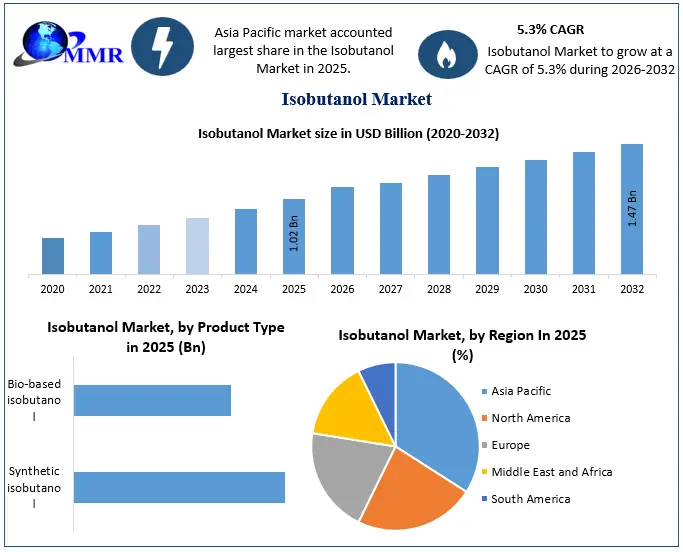
    The Isobutanol Market is entering a period of steady expansion as manufacturers across chemicals, coatings, oil & gas, pharmaceuticals and related industries increase their use of isobutanol as a versatile solvent and chemical intermediate. According to Maximize Market Research, the global Isobutanol Market size was valued at USD 1.02 billion in 2025 and is expected to grow at a CAGR of 5.3% from 2026 to 2032, reaching nearly USD 1.47 billion by 2032. Increasing industrial production, expanding applications in paints and coatings, demand for specialty chemical intermediates and growing interest in bio-based production technologies are expected to create attractive opportunities for market participants. Isobutanol's functional properties make it valuable in solvent formulations, coatings, chemical synthesis and fuel-related applications.

    U.S. Isobutanol Market Gains Momentum Through Industrial Demand and Low-Carbon Investment

    The United States remains an important market for isobutanol because of its large chemical manufacturing base, established refining infrastructure and expanding interest in renewable fuels. During 2025, industry activity highlighted both pricing pressure and investment in low-carbon technologies. Eastman announced a USD 0.05-per-pound increase on its N-Isobutyl Alcohol and selected Oxo products in North America and Latin America effective February 15, 2025, citing higher operating costs, particularly raw-material expenses. At the same time, Gevo completed its USD 210 million acquisition of Red Trail Energy's ethanol and carbon-capture assets in North Dakota in January 2025. The investment strengthens the company's low-carbon alcohol and renewable-fuels platform and creates an opportunity to develop additional alcohol-to-jet and related projects. Such developments demonstrate how U.S. producers are combining established alcohol infrastructure with carbon capture, renewable feedstocks and advanced conversion technologies. This trend can support longer-term opportunities for bio-based isobutanol and other renewable chemical products.

    Get a Free Sample Market Report Link : https://www.maximizemarketresearch.com/request-sample/56743/

    Synthetic Isobutanol Holds the Largest Market Share

    Based on the segmentation covered in the Maximize Market Research study, the market is analyzed according to Type, Application and Region. Among the segments, Synthetic Isobutanol represents the leading product category, supported by its established industrial manufacturing base, reliable availability and broad use in chemical and solvent applications. Synthetic production continues to benefit from mature production technologies and its ability to supply large-volume industrial requirements.

    Competitive Landscape: Companies Invest in Capacity, Sustainability and Advanced Chemistry

    The global Isobutanol Market remains competitive, with major chemical producers focusing on production reliability, downstream integration, product quality and technological development.

    Eastman Chemical Company maintains a significant position through its established Oxo alcohol portfolio and broad industrial customer base. In 2025, the company implemented a price increase for N-Isobutyl Alcohol in North America and Latin America because of elevated raw-material and operating costs. Its broad specialty-materials platform and application-development capabilities provide opportunities to optimize isobutanol-based products for coatings, construction, transportation and other markets.

    OQ Chemicals is strengthening its position through its extensive Oxo alcohol production network. Its Bay City, Texas operations are particularly important to the North American supply chain. Expansion of isobutanol production capacity in the United States is aligned with increasing demand from coatings, printing inks and chemical-intermediate manufacturers. Greater production capability can improve supply security while supporting downstream growth.

    BASF SE benefits from its global chemical manufacturing infrastructure and integrated approach to solvents, intermediates and performance chemicals. Continued investment in process efficiency, sustainable chemistry and specialty chemical applications can create additional opportunities for isobutanol-based formulations.

    Sasol Limited participates across the chemicals and solvents value chain, with its integrated production capabilities supporting industrial customers. The company's focus on operational efficiency and specialty chemical applications provides a platform for serving markets where performance solvents and chemical intermediates are required.

    Gevo Inc. represents an important emerging force in renewable alcohol and low-carbon chemical technologies. Its 2025 acquisition of Red Trail Energy for approximately USD 210 million added ethanol production and carbon-capture assets to its portfolio. The acquired site provides a platform for future sustainable aviation fuel and renewable-chemical projects, demonstrating how low-carbon alcohol technologies can become increasingly interconnected with the broader isobutanol and renewable chemicals ecosystem.

    Regional Analysis: United States, Germany, France, UK, Japan and China

    United States: The U.S. benefits from a strong petrochemical and chemical manufacturing ecosystem, extensive downstream solvent demand and growing investment in renewable fuels. Federal incentives supporting carbon reduction and renewable fuel production can encourage investment in low-carbon alcohol technologies.

    China: China offers substantial growth potential because of its large chemical manufacturing sector, expanding coatings industry and increasing demand for chemical intermediates. Domestic investment in integrated chemical complexes and downstream manufacturing is strengthening the country's role in global isobutanol supply.

    Germany: Germany's advanced chemical industry and emphasis on resource efficiency and sustainable manufacturing support demand for high-performance solvents and intermediates. European decarbonization initiatives can further encourage lower-carbon production routes.

    France: France is supported by its diversified chemical, coatings, automotive and industrial manufacturing industries. Increasing attention to sustainable chemistry and reduced-emission production can create opportunities for bio-based and advanced isobutanol technologies.

    United Kingdom: The UK market benefits from demand from specialty chemicals, coatings and industrial applications. Sustainability objectives and research into renewable chemicals may support the gradual adoption of bio-based alternatives.

    Japan: Japan's technologically advanced chemical and manufacturing industries create demand for high-purity and performance-oriented chemical materials. Applications in coatings, specialty chemicals and industrial formulations are expected to sustain demand for isobutanol.

    Key Players

    Key companies operating in the global Isobutanol Market include Eastman Chemical Company, OQ Chemicals, BASF SE, Sasol Limited and Gevo Inc. These companies compete through manufacturing capacity, product quality, technological innovation, supply-chain capabilities, sustainability initiatives and downstream application development.
    Isobutanol Market Growth, Demand and Future Industry Outlook Isobutanol Market Set to Reach USD 1.47 Billion by 2032, Driven by Growing Demand for Solvents, Chemical Intermediates and Sustainable Fuels The Isobutanol Market is entering a period of steady expansion as manufacturers across chemicals, coatings, oil & gas, pharmaceuticals and related industries increase their use of isobutanol as a versatile solvent and chemical intermediate. According to Maximize Market Research, the global Isobutanol Market size was valued at USD 1.02 billion in 2025 and is expected to grow at a CAGR of 5.3% from 2026 to 2032, reaching nearly USD 1.47 billion by 2032. Increasing industrial production, expanding applications in paints and coatings, demand for specialty chemical intermediates and growing interest in bio-based production technologies are expected to create attractive opportunities for market participants. Isobutanol's functional properties make it valuable in solvent formulations, coatings, chemical synthesis and fuel-related applications. U.S. Isobutanol Market Gains Momentum Through Industrial Demand and Low-Carbon Investment The United States remains an important market for isobutanol because of its large chemical manufacturing base, established refining infrastructure and expanding interest in renewable fuels. During 2025, industry activity highlighted both pricing pressure and investment in low-carbon technologies. Eastman announced a USD 0.05-per-pound increase on its N-Isobutyl Alcohol and selected Oxo products in North America and Latin America effective February 15, 2025, citing higher operating costs, particularly raw-material expenses. At the same time, Gevo completed its USD 210 million acquisition of Red Trail Energy's ethanol and carbon-capture assets in North Dakota in January 2025. The investment strengthens the company's low-carbon alcohol and renewable-fuels platform and creates an opportunity to develop additional alcohol-to-jet and related projects. Such developments demonstrate how U.S. producers are combining established alcohol infrastructure with carbon capture, renewable feedstocks and advanced conversion technologies. This trend can support longer-term opportunities for bio-based isobutanol and other renewable chemical products. Get a Free Sample Market Report Link : https://www.maximizemarketresearch.com/request-sample/56743/ Synthetic Isobutanol Holds the Largest Market Share Based on the segmentation covered in the Maximize Market Research study, the market is analyzed according to Type, Application and Region. Among the segments, Synthetic Isobutanol represents the leading product category, supported by its established industrial manufacturing base, reliable availability and broad use in chemical and solvent applications. Synthetic production continues to benefit from mature production technologies and its ability to supply large-volume industrial requirements. Competitive Landscape: Companies Invest in Capacity, Sustainability and Advanced Chemistry The global Isobutanol Market remains competitive, with major chemical producers focusing on production reliability, downstream integration, product quality and technological development. Eastman Chemical Company maintains a significant position through its established Oxo alcohol portfolio and broad industrial customer base. In 2025, the company implemented a price increase for N-Isobutyl Alcohol in North America and Latin America because of elevated raw-material and operating costs. Its broad specialty-materials platform and application-development capabilities provide opportunities to optimize isobutanol-based products for coatings, construction, transportation and other markets. OQ Chemicals is strengthening its position through its extensive Oxo alcohol production network. Its Bay City, Texas operations are particularly important to the North American supply chain. Expansion of isobutanol production capacity in the United States is aligned with increasing demand from coatings, printing inks and chemical-intermediate manufacturers. Greater production capability can improve supply security while supporting downstream growth. BASF SE benefits from its global chemical manufacturing infrastructure and integrated approach to solvents, intermediates and performance chemicals. Continued investment in process efficiency, sustainable chemistry and specialty chemical applications can create additional opportunities for isobutanol-based formulations. Sasol Limited participates across the chemicals and solvents value chain, with its integrated production capabilities supporting industrial customers. The company's focus on operational efficiency and specialty chemical applications provides a platform for serving markets where performance solvents and chemical intermediates are required. Gevo Inc. represents an important emerging force in renewable alcohol and low-carbon chemical technologies. Its 2025 acquisition of Red Trail Energy for approximately USD 210 million added ethanol production and carbon-capture assets to its portfolio. The acquired site provides a platform for future sustainable aviation fuel and renewable-chemical projects, demonstrating how low-carbon alcohol technologies can become increasingly interconnected with the broader isobutanol and renewable chemicals ecosystem. Regional Analysis: United States, Germany, France, UK, Japan and China United States: The U.S. benefits from a strong petrochemical and chemical manufacturing ecosystem, extensive downstream solvent demand and growing investment in renewable fuels. Federal incentives supporting carbon reduction and renewable fuel production can encourage investment in low-carbon alcohol technologies. China: China offers substantial growth potential because of its large chemical manufacturing sector, expanding coatings industry and increasing demand for chemical intermediates. Domestic investment in integrated chemical complexes and downstream manufacturing is strengthening the country's role in global isobutanol supply. Germany: Germany's advanced chemical industry and emphasis on resource efficiency and sustainable manufacturing support demand for high-performance solvents and intermediates. European decarbonization initiatives can further encourage lower-carbon production routes. France: France is supported by its diversified chemical, coatings, automotive and industrial manufacturing industries. Increasing attention to sustainable chemistry and reduced-emission production can create opportunities for bio-based and advanced isobutanol technologies. United Kingdom: The UK market benefits from demand from specialty chemicals, coatings and industrial applications. Sustainability objectives and research into renewable chemicals may support the gradual adoption of bio-based alternatives. Japan: Japan's technologically advanced chemical and manufacturing industries create demand for high-purity and performance-oriented chemical materials. Applications in coatings, specialty chemicals and industrial formulations are expected to sustain demand for isobutanol. Key Players Key companies operating in the global Isobutanol Market include Eastman Chemical Company, OQ Chemicals, BASF SE, Sasol Limited and Gevo Inc. These companies compete through manufacturing capacity, product quality, technological innovation, supply-chain capabilities, sustainability initiatives and downstream application development.
    0 Comments ·0 Shares ·734 Views
  • Flock Adhesives Market Trends, Opportunities and Growth Forecast

    Key Highlights

    Valued at USD 2.10 billion in 2024, creating a base for suppliers.
    Expected to reach nearly USD 3.30 billion by 2032, expanding commercial opportunities.
    Forecast to grow at a 5.8% CAGR from 2025 to 2032, indicating sustained expansion.
    Asia Pacific held the highest share in 2024, strengthening its strategic importance.
    Automotive, textiles, paper and packaging, and paints and coatings are key applications.

    Market Overview

    The Flock Adhesives Market was valued at USD 2.10 billion in 2024. This scale matters because flock adhesives enable small fiber particles to be placed on surfaces, enhancing aesthetics, tactile sensation, appearance and color. For manufacturers competing on both function and presentation, flocking can add value to finished products.

    Revenue is projected to reach nearly USD 3.30 billion by 2032. That increase gives suppliers an incentive to strengthen product portfolios, production capabilities and distribution networks. The Flock Adhesives Market is becoming a broader industrial opportunity rather than a narrow material segment.

    Why This Market Matters Now

    Automotive and packaging demand is a major driver because flock adhesives support high-efficiency applications. Textile demand, including flocking for garments and furniture, widens the customer base. For procurement teams, this diversification makes consistent performance and dependable supply increasingly important in the Flock Adhesives Market.

    Research and development and new product launches in developing economies are also supporting expansion. The Flock Adhesives Market therefore presents opportunities for companies that can adapt products to application needs while establishing stronger positions in emerging markets.

    Access a Free Sample Report Copy : https://www.maximizemarketresearch.com/request-sample/322/

    Key Trends Driving Growth

    Product performance is influencing purchasing decisions. Washability and flame retardance are highlighted as important opportunity areas, giving suppliers ways to differentiate formulations.

    Application diversification is another trend. Automotive, textiles, paper and packaging, and paints and coatings are covered as major application categories.

    Flock Adhesives Market Trends, Opportunities and Growth Forecast Key Highlights Valued at USD 2.10 billion in 2024, creating a base for suppliers. Expected to reach nearly USD 3.30 billion by 2032, expanding commercial opportunities. Forecast to grow at a 5.8% CAGR from 2025 to 2032, indicating sustained expansion. Asia Pacific held the highest share in 2024, strengthening its strategic importance. Automotive, textiles, paper and packaging, and paints and coatings are key applications. Market Overview The Flock Adhesives Market was valued at USD 2.10 billion in 2024. This scale matters because flock adhesives enable small fiber particles to be placed on surfaces, enhancing aesthetics, tactile sensation, appearance and color. For manufacturers competing on both function and presentation, flocking can add value to finished products. Revenue is projected to reach nearly USD 3.30 billion by 2032. That increase gives suppliers an incentive to strengthen product portfolios, production capabilities and distribution networks. The Flock Adhesives Market is becoming a broader industrial opportunity rather than a narrow material segment. Why This Market Matters Now Automotive and packaging demand is a major driver because flock adhesives support high-efficiency applications. Textile demand, including flocking for garments and furniture, widens the customer base. For procurement teams, this diversification makes consistent performance and dependable supply increasingly important in the Flock Adhesives Market. Research and development and new product launches in developing economies are also supporting expansion. The Flock Adhesives Market therefore presents opportunities for companies that can adapt products to application needs while establishing stronger positions in emerging markets. Access a Free Sample Report Copy : https://www.maximizemarketresearch.com/request-sample/322/ Key Trends Driving Growth Product performance is influencing purchasing decisions. Washability and flame retardance are highlighted as important opportunity areas, giving suppliers ways to differentiate formulations. Application diversification is another trend. Automotive, textiles, paper and packaging, and paints and coatings are covered as major application categories.
    Request Sample
    www.maximizemarketresearch.com
    for Request Sample fill the form
    0 Comments ·0 Shares ·543 Views
More Results