

Tin Market Size, Growth Drivers, Demand and Revenue Forecast
Tin Market to Reach USD 9.57 Billion by 2032 as Electronics, EVs, Renewable Energy, and Supply-Chain Diversification Accelerate Demand
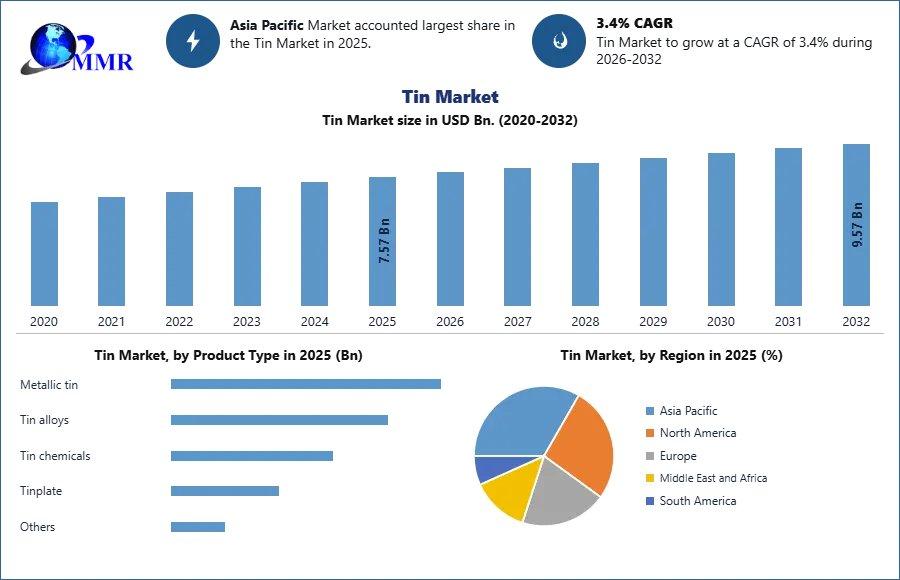
The Tin Market is entering a period of sustained expansion as demand for electronics, semiconductors, electric vehicles, renewable energy systems, advanced soldering materials, and tin-based chemicals continues to rise. According to Maximize Market Research, the global Tin Market was valued at USD 7.57 billion in 2025 and is projected to reach nearly USD 9.57 billion by 2032, expanding at a CAGR of 3.4% from 2026 to 2032.
Market Estimation, Growth Drivers and Opportunities
Tin has become an increasingly strategic industrial material because of its combination of electrical conductivity, corrosion resistance, malleability, and compatibility with advanced manufacturing processes. The strongest demand is coming from electronics and semiconductor manufacturing, where tin-based solder is essential for printed circuit boards, component assembly, power electronics, and miniaturized electronic devices.
The expansion of electric mobility is creating another important demand center. Tin-based materials are increasingly utilized in EV power electronics, battery-related components, thermal management systems, and precision soldering. At the same time, renewable-energy installations, including solar power systems, require tin-containing materials for electrical connections and soldering applications.
Supply-chain uncertainty is also changing the structure of the industry. Disruptions affecting major producing regions have encouraged manufacturers and governments to pursue diversified sourcing, recycling, traceability, and domestic processing capabilities. Recycled tin is therefore becoming strategically important, while electronic-waste recovery and urban mining technologies offer opportunities to improve secondary supply.
Material innovation represents another long-term opportunity. Tin-based battery anodes, lead-free solder alloys, advanced tin chemicals, and tin-based materials for next-generation solar technologies could expand the metal's role beyond traditional applications. AI-enabled smelting, automated ore sorting, digital grade monitoring, and blockchain-supported traceability can further improve efficiency and responsible sourcing.
Request Your Sample Report Now : https://www.maximizemarketresearch.com/request-sample/57921/
U.S. Market Trends and Investment Outlook
The United States is experiencing growing strategic interest in minerals and materials needed for electronics, semiconductors, energy technologies, and advanced manufacturing. During 2025, the U.S. government strengthened its focus on mineral supply-chain security, including measures intended to encourage domestic mineral production, processing, recycling, and investment. The U.S. Department of the Interior's draft 2025 Critical Minerals List was designed to guide federal strategy, investment, permitting, and resource-recovery decisions. Meanwhile, substantial private investment in the U.S. semiconductor ecosystem is increasing the country's need for reliable supplies of high-performance electronic materials. These developments create opportunities for tin suppliers, refiners, recyclers, and advanced solder-material manufacturers.
Market Segmentation: Leading Segments
Based on Product Type, Metallic Tin dominated the Tin Market in 2025, accounting for more than 55% of total market revenue. Its extensive use in solder production, tin plating, semiconductor assembly, automotive electronics, and high-purity industrial applications supports its leading position.
Based on Application, Soldering represented the largest segment in 2025, contributing more than 50% of global tin consumption. The segment benefits from expanding electronics production, semiconductor manufacturing, EV power electronics, PCB assembly, and solar-energy applications. The continued transition toward lead-free soldering is expected to reinforce demand for refined tin and specialized tin alloys.
Tin Market to Reach USD 9.57 Billion by 2032 as Electronics, EVs, Renewable Energy, and Supply-Chain Diversification Accelerate Demand
The Tin Market is entering a period of sustained expansion as demand for electronics, semiconductors, electric vehicles, renewable energy systems, advanced soldering materials, and tin-based chemicals continues to rise. According to Maximize Market Research, the global Tin Market was valued at USD 7.57 billion in 2025 and is projected to reach nearly USD 9.57 billion by 2032, expanding at a CAGR of 3.4% from 2026 to 2032.
Market Estimation, Growth Drivers and Opportunities
Tin has become an increasingly strategic industrial material because of its combination of electrical conductivity, corrosion resistance, malleability, and compatibility with advanced manufacturing processes. The strongest demand is coming from electronics and semiconductor manufacturing, where tin-based solder is essential for printed circuit boards, component assembly, power electronics, and miniaturized electronic devices.
The expansion of electric mobility is creating another important demand center. Tin-based materials are increasingly utilized in EV power electronics, battery-related components, thermal management systems, and precision soldering. At the same time, renewable-energy installations, including solar power systems, require tin-containing materials for electrical connections and soldering applications.
Supply-chain uncertainty is also changing the structure of the industry. Disruptions affecting major producing regions have encouraged manufacturers and governments to pursue diversified sourcing, recycling, traceability, and domestic processing capabilities. Recycled tin is therefore becoming strategically important, while electronic-waste recovery and urban mining technologies offer opportunities to improve secondary supply.
Material innovation represents another long-term opportunity. Tin-based battery anodes, lead-free solder alloys, advanced tin chemicals, and tin-based materials for next-generation solar technologies could expand the metal's role beyond traditional applications. AI-enabled smelting, automated ore sorting, digital grade monitoring, and blockchain-supported traceability can further improve efficiency and responsible sourcing.
Request Your Sample Report Now : https://www.maximizemarketresearch.com/request-sample/57921/
U.S. Market Trends and Investment Outlook
The United States is experiencing growing strategic interest in minerals and materials needed for electronics, semiconductors, energy technologies, and advanced manufacturing. During 2025, the U.S. government strengthened its focus on mineral supply-chain security, including measures intended to encourage domestic mineral production, processing, recycling, and investment. The U.S. Department of the Interior's draft 2025 Critical Minerals List was designed to guide federal strategy, investment, permitting, and resource-recovery decisions. Meanwhile, substantial private investment in the U.S. semiconductor ecosystem is increasing the country's need for reliable supplies of high-performance electronic materials. These developments create opportunities for tin suppliers, refiners, recyclers, and advanced solder-material manufacturers.
Market Segmentation: Leading Segments
Based on Product Type, Metallic Tin dominated the Tin Market in 2025, accounting for more than 55% of total market revenue. Its extensive use in solder production, tin plating, semiconductor assembly, automotive electronics, and high-purity industrial applications supports its leading position.
Based on Application, Soldering represented the largest segment in 2025, contributing more than 50% of global tin consumption. The segment benefits from expanding electronics production, semiconductor manufacturing, EV power electronics, PCB assembly, and solar-energy applications. The continued transition toward lead-free soldering is expected to reinforce demand for refined tin and specialized tin alloys.
Tin Market Size, Growth Drivers, Demand and Revenue Forecast
Tin Market to Reach USD 9.57 Billion by 2032 as Electronics, EVs, Renewable Energy, and Supply-Chain Diversification Accelerate Demand
The Tin Market is entering a period of sustained expansion as demand for electronics, semiconductors, electric vehicles, renewable energy systems, advanced soldering materials, and tin-based chemicals continues to rise. According to Maximize Market Research, the global Tin Market was valued at USD 7.57 billion in 2025 and is projected to reach nearly USD 9.57 billion by 2032, expanding at a CAGR of 3.4% from 2026 to 2032.
Market Estimation, Growth Drivers and Opportunities
Tin has become an increasingly strategic industrial material because of its combination of electrical conductivity, corrosion resistance, malleability, and compatibility with advanced manufacturing processes. The strongest demand is coming from electronics and semiconductor manufacturing, where tin-based solder is essential for printed circuit boards, component assembly, power electronics, and miniaturized electronic devices.
The expansion of electric mobility is creating another important demand center. Tin-based materials are increasingly utilized in EV power electronics, battery-related components, thermal management systems, and precision soldering. At the same time, renewable-energy installations, including solar power systems, require tin-containing materials for electrical connections and soldering applications.
Supply-chain uncertainty is also changing the structure of the industry. Disruptions affecting major producing regions have encouraged manufacturers and governments to pursue diversified sourcing, recycling, traceability, and domestic processing capabilities. Recycled tin is therefore becoming strategically important, while electronic-waste recovery and urban mining technologies offer opportunities to improve secondary supply.
Material innovation represents another long-term opportunity. Tin-based battery anodes, lead-free solder alloys, advanced tin chemicals, and tin-based materials for next-generation solar technologies could expand the metal's role beyond traditional applications. AI-enabled smelting, automated ore sorting, digital grade monitoring, and blockchain-supported traceability can further improve efficiency and responsible sourcing.
Request Your Sample Report Now : https://www.maximizemarketresearch.com/request-sample/57921/
U.S. Market Trends and Investment Outlook
The United States is experiencing growing strategic interest in minerals and materials needed for electronics, semiconductors, energy technologies, and advanced manufacturing. During 2025, the U.S. government strengthened its focus on mineral supply-chain security, including measures intended to encourage domestic mineral production, processing, recycling, and investment. The U.S. Department of the Interior's draft 2025 Critical Minerals List was designed to guide federal strategy, investment, permitting, and resource-recovery decisions. Meanwhile, substantial private investment in the U.S. semiconductor ecosystem is increasing the country's need for reliable supplies of high-performance electronic materials. These developments create opportunities for tin suppliers, refiners, recyclers, and advanced solder-material manufacturers.
Market Segmentation: Leading Segments
Based on Product Type, Metallic Tin dominated the Tin Market in 2025, accounting for more than 55% of total market revenue. Its extensive use in solder production, tin plating, semiconductor assembly, automotive electronics, and high-purity industrial applications supports its leading position.
Based on Application, Soldering represented the largest segment in 2025, contributing more than 50% of global tin consumption. The segment benefits from expanding electronics production, semiconductor manufacturing, EV power electronics, PCB assembly, and solar-energy applications. The continued transition toward lead-free soldering is expected to reinforce demand for refined tin and specialized tin alloys.
0 Comments
·0 Shares
·585 Views