

• Automotive Sensor Market Outlook, Industry Developments and Strategic Insights 2032 – Report by MMR

    Automotive Sensor Market Report Overview

    The forecasting process primarily hinges on the analysis of historical data alongside current trends in the Automotive Sensor Market. This comprehensive data collection employs a blend of primary and secondary research methodologies. The report encompasses vital components such as market size, share, regional analysis, dynamics, CAGR, and future trends. This holistic approach renders the report an invaluable guide for investors, as it offers an insightful and forward-looking perspective on the Automotive Sensor industry.

    Automotive Sensor Market Projection:

    Automotive Sensor Market was valued at USD 15.80 Bn. in 2025 and the total Global Automotive Sensor Market revenue is Expected to grow at a CAGR of 8.2% from 2026 to 2034 reaching nearly USD 32.13 Bn. by 2034.

    Please connect with our representative, who will ensure you to get a report sample here @https://www.maximizemarketresearch.com/request-sample/13878/

    Automotive Sensor Market Report Scope and Research Methodology

    The report presents historical data and forecasts on a global, regional, and country level, delivering an in-depth examination of Automotive Sensor market trends within each segment and their respective sub-segments . Maximize Market Research employs data triangulation as the primary research methodology, encompassing an evaluation of how data variables impact the Automotive Sensor market, data mining, and validation via primary sources such as industry experts.

    The analysis of complex Automotive Sensor industry data has been presented in straightforward language within the research report. SWOT analysis was leveraged to outline the strengths, weaknesses, opportunities, and threats for key players in the industry. To estimate the market size, a bottom-up approach was employed.

    Automotive Sensor Market Regional Analysis

    The report provides a detailed analysis of the Automotive Sensor market dynamics, Government initiatives and stringent rules and regulations influencing the market in each region. A detailed analysis of the market in North America, Asia Pacific, Europe, Middle East and Africa and South America are included in the report.

    Automotive Sensor Market Segmentation

    by Type

    Oxygen sensor
    Mass airflow sensor
    Radar sensors
    LiDAR
    Pressure sensors
    Engine speed sensor
    Others

    by Technology

    MEMS (Micro-Electro-Mechanical Systems)
    Hall-Effect
    Ultrasonic
    Infrared (IR)
    Radar
    LiDAR
    Others (Optical, Magnetic, Capacitive)

    by Application

    Powertrain
    Chassis
    Body Electronics
    Safety & Security
    Telematics
    Others

    by Sales Channel

    OEM (Original Equipment Manufacturer)
    Aftermarket

    Request Free Sample Copy:https://www.maximizemarketresearch.com/request-sample/13878/

    Automotive Sensor Key Players

    North America:
    1. Texas Instruments (United States)
    2. Sensata Technologies (United States)
    3. Delphi Technologies (United Kingdom)
    4. Allegro Microsystems (United States)
    5. Aptiv PLC (Ireland)
    6. Analog Devices, Inc. (United States)
    7. CTS Corporation (United States)
    8. Honeywell International Inc. (United States)
    9. 3M (United States)

    Europe:
    10. Bosch (Germany)
    11. Continental AG (Germany)
    12. STMicroelectronics (Switzerland)
    13. Melexis NV (Belgium)
    14. HELLA GmbH & Co. KGaA (Germany)
    15. ZF Friedrichshafen AG (Germany)
    16. Valeo SA (France)
    17. First Sensor AG (Germany)
    18. AMS AG (Austria)
    19. Elmos Semiconductor AG (Germany)
    20. Infineon Technologies AG (Germany)
    21. TE Connectivity (Switzerland)

    Asia Pacific:
    22. Denso Corporation (Japan)
    23. Panasonic Corporation (Japan)
    24. Murata Manufacturing Co., Ltd. (Japan)
    25. Renesas Electronics Corporation (Japan)
    26. ROHM Semiconductor (Japan)
    27. Omron Corporation (Japan)
    28. Nidec Corporation (Japan)
    29. Mitsubishi Electric Corporation (Japan)
    30. Aisin Seiki Co., Ltd. (Japan)

    Key Questions answered in the Automotive Sensor Market Report are:

    What is the expected CAGR of the Automotive Sensor market during the forecast period?
    What are the Automotive Sensor market segments?
    Which region of the Automotive Sensor market is expected to grow at a high rate during the forecast period?
    What is the expected CAGR of the Automotive Sensor market during the forecast period?
    What are the emerging trends in the Automotive Sensor market?
    What are the factors restraining the Automotive Sensor market growth?
    Key offerings:

    Market Share, Size, and Forecast by Revenue|2026-2034
    Market Dynamics- Growth drivers, Restraints, Investment Opportunities, and key trends
    Market Segmentation- A detailed analysis of each segment and their segments
    Competitive Landscape - Leading key players and other prominent key players.
    Trending Reports:

    Compact Spinning Machine Market https://www.maximizemarketresearch.com/market-report/compact-spinning-machine-market/76452/
    Global Automatic Tea Bag Packaging Equipment Market https://www.maximizemarketresearch.com/market-report/global-automatic-tea-bag-packaging-equipment-market/22079/
    Global Aircraft Underwater Location Beacon Market https://www.maximizemarketresearch.com/market-report/global-aircraft-underwater-location-beacon-market/81207/
    About Maximize Market Research:

    Maximize Market Research is a multifaceted market research and consulting company with professionals from several industries. Some of the industries we cover include medical devices, pharmaceutical manufacturers, science and engineering, electronic components, industrial equipment, technology and communication, cars and automobiles, chemical products and substances, general merchandise, beverages, personal care, and automated systems. To mention a few, we provide market-verified industry estimations, technical trend analysis, crucial market research, strategic advice, competition analysis, production and demand analysis, and client impact studies.

    Contact Maximize Market Research:

    3rd Floor, Navale IT Park, Phase 2

    Pune Banglore Highway, Narhe,

    Pune, Maharashtra 411041, India

    [email protected]

    +91 96071 95908, +91 9607365656

    Automotive Sensor Market Outlook, Industry Developments and Strategic Insights 2032 – Report by MMR Automotive Sensor Market Report Overview The forecasting process primarily hinges on the analysis of historical data alongside current trends in the Automotive Sensor Market. This comprehensive data collection employs a blend of primary and secondary research methodologies. The report encompasses vital components such as market size, share, regional analysis, dynamics, CAGR, and future trends. This holistic approach renders the report an invaluable guide for investors, as it offers an insightful and forward-looking perspective on the Automotive Sensor industry. Automotive Sensor Market Projection: Automotive Sensor Market was valued at USD 15.80 Bn. in 2025 and the total Global Automotive Sensor Market revenue is Expected to grow at a CAGR of 8.2% from 2026 to 2034 reaching nearly USD 32.13 Bn. by 2034. Please connect with our representative, who will ensure you to get a report sample here @https://www.maximizemarketresearch.com/request-sample/13878/ Automotive Sensor Market Report Scope and Research Methodology The report presents historical data and forecasts on a global, regional, and country level, delivering an in-depth examination of Automotive Sensor market trends within each segment and their respective sub-segments . Maximize Market Research employs data triangulation as the primary research methodology, encompassing an evaluation of how data variables impact the Automotive Sensor market, data mining, and validation via primary sources such as industry experts. The analysis of complex Automotive Sensor industry data has been presented in straightforward language within the research report. SWOT analysis was leveraged to outline the strengths, weaknesses, opportunities, and threats for key players in the industry. To estimate the market size, a bottom-up approach was employed. Automotive Sensor Market Regional Analysis The report provides a detailed analysis of the Automotive Sensor market dynamics, Government initiatives and stringent rules and regulations influencing the market in each region. A detailed analysis of the market in North America, Asia Pacific, Europe, Middle East and Africa and South America are included in the report. Automotive Sensor Market Segmentation by Type Oxygen sensor Mass airflow sensor Radar sensors LiDAR Pressure sensors Engine speed sensor Others by Technology MEMS (Micro-Electro-Mechanical Systems) Hall-Effect Ultrasonic Infrared (IR) Radar LiDAR Others (Optical, Magnetic, Capacitive) by Application Powertrain Chassis Body Electronics Safety & Security Telematics Others by Sales Channel OEM (Original Equipment Manufacturer) Aftermarket Request Free Sample Copy:https://www.maximizemarketresearch.com/request-sample/13878/ Automotive Sensor Key Players North America: 1. Texas Instruments (United States) 2. Sensata Technologies (United States) 3. Delphi Technologies (United Kingdom) 4. Allegro Microsystems (United States) 5. Aptiv PLC (Ireland) 6. Analog Devices, Inc. (United States) 7. CTS Corporation (United States) 8. Honeywell International Inc. (United States) 9. 3M (United States) Europe: 10. Bosch (Germany) 11. Continental AG (Germany) 12. STMicroelectronics (Switzerland) 13. Melexis NV (Belgium) 14. HELLA GmbH & Co. KGaA (Germany) 15. ZF Friedrichshafen AG (Germany) 16. Valeo SA (France) 17. First Sensor AG (Germany) 18. AMS AG (Austria) 19. Elmos Semiconductor AG (Germany) 20. Infineon Technologies AG (Germany) 21. TE Connectivity (Switzerland) Asia Pacific: 22. Denso Corporation (Japan) 23. Panasonic Corporation (Japan) 24. Murata Manufacturing Co., Ltd. (Japan) 25. Renesas Electronics Corporation (Japan) 26. ROHM Semiconductor (Japan) 27. Omron Corporation (Japan) 28. Nidec Corporation (Japan) 29. Mitsubishi Electric Corporation (Japan) 30. Aisin Seiki Co., Ltd. (Japan) Key Questions answered in the Automotive Sensor Market Report are: What is the expected CAGR of the Automotive Sensor market during the forecast period? What are the Automotive Sensor market segments? Which region of the Automotive Sensor market is expected to grow at a high rate during the forecast period? What is the expected CAGR of the Automotive Sensor market during the forecast period? What are the emerging trends in the Automotive Sensor market? What are the factors restraining the Automotive Sensor market growth? Key offerings: Market Share, Size, and Forecast by Revenue|2026-2034 Market Dynamics- Growth drivers, Restraints, Investment Opportunities, and key trends Market Segmentation- A detailed analysis of each segment and their segments Competitive Landscape - Leading key players and other prominent key players. Trending Reports: Compact Spinning Machine Market https://www.maximizemarketresearch.com/market-report/compact-spinning-machine-market/76452/ Global Automatic Tea Bag Packaging Equipment Market https://www.maximizemarketresearch.com/market-report/global-automatic-tea-bag-packaging-equipment-market/22079/ Global Aircraft Underwater Location Beacon Market https://www.maximizemarketresearch.com/market-report/global-aircraft-underwater-location-beacon-market/81207/ About Maximize Market Research: Maximize Market Research is a multifaceted market research and consulting company with professionals from several industries. Some of the industries we cover include medical devices, pharmaceutical manufacturers, science and engineering, electronic components, industrial equipment, technology and communication, cars and automobiles, chemical products and substances, general merchandise, beverages, personal care, and automated systems. To mention a few, we provide market-verified industry estimations, technical trend analysis, crucial market research, strategic advice, competition analysis, production and demand analysis, and client impact studies. Contact Maximize Market Research: 3rd Floor, Navale IT Park, Phase 2 Pune Banglore Highway, Narhe, Pune, Maharashtra 411041, India [email protected] +91 96071 95908, +91 9607365656
    0 Comments ·0 Shares ·109 Views
  • Oyster Farming Market Adoption Grows with Coastal Aquaculture Development

    Market Estimation & Definition

    The global Oyster Farming Market is entering a period of steady expansion as demand for seafood, bivalve aquaculture, and nutritious marine food products continues to increase. According to Stellar Market Research, the market was valued at USD 8.74 billion in 2025 and is projected to reach USD 11.11 billion by 2032, growing at a CAGR of 3.49% during 2026–2032. The report uses 2025 as the base year and covers historical data from 2020 to 2025.

    Oyster farming refers to the cultivation of oysters in marine or saltwater environments for food and other applications. Oysters are valued for nutrients including omega-3 fatty acids, minerals, zinc, copper, and vitamins. The industry includes different oyster varieties and farming approaches designed to support commercial production and supply.

    Download Free PDF Brochure: https://www.stellarmr.com/report/req_sample/oyster-farming-market/2508

    Market Growth Drivers & Opportunity

    Increasing seafood consumption is a major factor supporting the oyster farming industry. Growing consumer interest in bivalves and diverse seafood products is encouraging commercial aquaculture activities across coastal markets. The report also identifies changing eating habits and increasing interest in seafood as factors contributing to demand.

    Advancements in oyster farming and sales systems are creating additional opportunities. Producers are adopting controlled and artificial sea-like environments to support production and respond to consumer demand. Improvements in systems for handling fresh oysters, canned products, and ice-based distribution are also supporting market development.

    The growing focus on protein-rich and environmentally conscious seafood products is another market opportunity. Government support for aquaculture and increased awareness of seafood's nutritional attributes are contributing to the expansion of oyster cultivation and consumption.

    What Lies Ahead: Emerging Trends Shaping the Future

    The future of oyster farming is expected to be influenced by improvements in cultivation techniques, hatchery production, distribution infrastructure, and digital sales channels. The report notes two commonly used farming approaches: release methods and bag-based cultivation. Bag and rack systems can provide greater protection from predators, although they can involve higher costs.

    The expansion of online channels is also creating new routes to consumers. At the same time, supermarkets, hypermarkets, convenience stores, and specialty outlets remain important distribution channels. Increasing investment in aquaculture technologies and improved production practices may help producers address supply requirements while maintaining product quality.

    Segmentation Analysis

    According to the Stellar Market Research report, the Oyster Farming Market is segmented by Type, End User, Distribution Channel, and Region. By type, the market is divided into Cupped Oyster and Flat Oyster. By end user, it covers the Food Industry and Pharmaceuticals. Distribution channels include Supermarkets & Hypermarkets, Convenience Stores, Specialty Outlets, and Online Channels. Regional coverage includes North America, Europe, Asia Pacific, the Middle East and Africa, and South America.

    Cupped oysters account for the major share of global oyster production, with Pacific oysters representing a key variety. Flat oysters represent a smaller production category but include species that can command higher food value. The food industry remains an important application area, while pharmaceutical uses and dietary supplements provide an additional avenue for industry development.

    Country-Level Analysis: USA and Germany

    The United States is specifically covered in the North American market analysis. Stellar Market Research identifies the United States among the world's major oyster-producing countries, with reported production of 153,909 tonnes in the cited production data. The country analysis covers cupped and flat oysters, food and pharmaceutical applications, and all four distribution channels included in the report.

    Germany is included in the European market assessment. The report provides Germany-specific analysis across oyster type, end user, and distribution channel, covering cupped and flat oysters, food and pharmaceutical applications, and supermarkets and hypermarkets, convenience stores, specialty outlets, and online channels.

    Competitive Analysis

    The competitive landscape includes regional oyster farmers, seafood companies, and specialized aquaculture businesses. Key players identified by Stellar Market Research include Chatham Shellfish Company, JM Clayton Seafood Company, Weifang-based Green Life Foods, France Naissain, Hog Island Oyster Company, Fujian Jiatian Agricultural Development Co., Hoopers Island Oyster Company, Huitres Favier Earl, Huîtres Hélie, Pengcheng Marine Products Company, Morro Bay Oyster Company, Mere Point Oyster, Westcott Bay Shellfish, Fanny Bay Oyster, and Farm Suzuki.

    Competition is shaped by production capacity, product quality, cultivation methods, distribution networks, and the ability to supply fresh and processed oyster products. The report also includes competitive benchmarking, market structure, company analysis, and assessments of emerging and established participants.

    Download Free PDF Brochure: https://www.stellarmr.com/report/req_sample/oyster-farming-market/2508

    Press Release Conclusion

    The global Oyster Farming Market is projected to grow from USD 8.74 billion in 2025 to USD 11.11 billion by 2032, reflecting the continued development of bivalve aquaculture and global seafood demand. Growth opportunities are emerging across food applications, pharmaceutical research, modern farming methods, retail distribution, and online channels.

    With production expanding across major oyster-producing markets and aquaculture receiving increasing attention, the industry is expected to remain an important component of the global seafood supply chain. Continued improvements in cultivation, distribution, and product commercialization will shape the market through 2032.

    About Stellar Market Research:

    Stellar Market Research is a multifaceted market research and consulting company with professionals from several industries. Some of the industries we cover include medical devices, pharmaceutical manufacturers, science and engineering, electronic components, industrial equipment, technology and communication, cars and automobiles, chemical products and substances, general merchandise, beverages, personal care, and automated systems. To mention a few, we provide market-verified industry estimations, technical trend analysis, crucial market research, strategic advice, competition analysis, production and demand analysis, and client impact studies.

    Contact Stellar Market Research:

    3rd Floor, Navale IT Park, Phase 2

    Pune Banglore Highway, Narhe,

    Pune, Maharashtra 411041, India

    [email protected]

    +91 20 6630 3320 | +91 9607365656
    Oyster Farming Market Adoption Grows with Coastal Aquaculture Development Market Estimation & Definition The global Oyster Farming Market is entering a period of steady expansion as demand for seafood, bivalve aquaculture, and nutritious marine food products continues to increase. According to Stellar Market Research, the market was valued at USD 8.74 billion in 2025 and is projected to reach USD 11.11 billion by 2032, growing at a CAGR of 3.49% during 2026–2032. The report uses 2025 as the base year and covers historical data from 2020 to 2025. Oyster farming refers to the cultivation of oysters in marine or saltwater environments for food and other applications. Oysters are valued for nutrients including omega-3 fatty acids, minerals, zinc, copper, and vitamins. The industry includes different oyster varieties and farming approaches designed to support commercial production and supply. Download Free PDF Brochure: https://www.stellarmr.com/report/req_sample/oyster-farming-market/2508 Market Growth Drivers & Opportunity Increasing seafood consumption is a major factor supporting the oyster farming industry. Growing consumer interest in bivalves and diverse seafood products is encouraging commercial aquaculture activities across coastal markets. The report also identifies changing eating habits and increasing interest in seafood as factors contributing to demand. Advancements in oyster farming and sales systems are creating additional opportunities. Producers are adopting controlled and artificial sea-like environments to support production and respond to consumer demand. Improvements in systems for handling fresh oysters, canned products, and ice-based distribution are also supporting market development. The growing focus on protein-rich and environmentally conscious seafood products is another market opportunity. Government support for aquaculture and increased awareness of seafood's nutritional attributes are contributing to the expansion of oyster cultivation and consumption. What Lies Ahead: Emerging Trends Shaping the Future The future of oyster farming is expected to be influenced by improvements in cultivation techniques, hatchery production, distribution infrastructure, and digital sales channels. The report notes two commonly used farming approaches: release methods and bag-based cultivation. Bag and rack systems can provide greater protection from predators, although they can involve higher costs. The expansion of online channels is also creating new routes to consumers. At the same time, supermarkets, hypermarkets, convenience stores, and specialty outlets remain important distribution channels. Increasing investment in aquaculture technologies and improved production practices may help producers address supply requirements while maintaining product quality. Segmentation Analysis According to the Stellar Market Research report, the Oyster Farming Market is segmented by Type, End User, Distribution Channel, and Region. By type, the market is divided into Cupped Oyster and Flat Oyster. By end user, it covers the Food Industry and Pharmaceuticals. Distribution channels include Supermarkets & Hypermarkets, Convenience Stores, Specialty Outlets, and Online Channels. Regional coverage includes North America, Europe, Asia Pacific, the Middle East and Africa, and South America. Cupped oysters account for the major share of global oyster production, with Pacific oysters representing a key variety. Flat oysters represent a smaller production category but include species that can command higher food value. The food industry remains an important application area, while pharmaceutical uses and dietary supplements provide an additional avenue for industry development. Country-Level Analysis: USA and Germany The United States is specifically covered in the North American market analysis. Stellar Market Research identifies the United States among the world's major oyster-producing countries, with reported production of 153,909 tonnes in the cited production data. The country analysis covers cupped and flat oysters, food and pharmaceutical applications, and all four distribution channels included in the report. Germany is included in the European market assessment. The report provides Germany-specific analysis across oyster type, end user, and distribution channel, covering cupped and flat oysters, food and pharmaceutical applications, and supermarkets and hypermarkets, convenience stores, specialty outlets, and online channels. Competitive Analysis The competitive landscape includes regional oyster farmers, seafood companies, and specialized aquaculture businesses. Key players identified by Stellar Market Research include Chatham Shellfish Company, JM Clayton Seafood Company, Weifang-based Green Life Foods, France Naissain, Hog Island Oyster Company, Fujian Jiatian Agricultural Development Co., Hoopers Island Oyster Company, Huitres Favier Earl, Huîtres Hélie, Pengcheng Marine Products Company, Morro Bay Oyster Company, Mere Point Oyster, Westcott Bay Shellfish, Fanny Bay Oyster, and Farm Suzuki. Competition is shaped by production capacity, product quality, cultivation methods, distribution networks, and the ability to supply fresh and processed oyster products. The report also includes competitive benchmarking, market structure, company analysis, and assessments of emerging and established participants. Download Free PDF Brochure: https://www.stellarmr.com/report/req_sample/oyster-farming-market/2508 Press Release Conclusion The global Oyster Farming Market is projected to grow from USD 8.74 billion in 2025 to USD 11.11 billion by 2032, reflecting the continued development of bivalve aquaculture and global seafood demand. Growth opportunities are emerging across food applications, pharmaceutical research, modern farming methods, retail distribution, and online channels. With production expanding across major oyster-producing markets and aquaculture receiving increasing attention, the industry is expected to remain an important component of the global seafood supply chain. Continued improvements in cultivation, distribution, and product commercialization will shape the market through 2032. About Stellar Market Research: Stellar Market Research is a multifaceted market research and consulting company with professionals from several industries. Some of the industries we cover include medical devices, pharmaceutical manufacturers, science and engineering, electronic components, industrial equipment, technology and communication, cars and automobiles, chemical products and substances, general merchandise, beverages, personal care, and automated systems. To mention a few, we provide market-verified industry estimations, technical trend analysis, crucial market research, strategic advice, competition analysis, production and demand analysis, and client impact studies. Contact Stellar Market Research: 3rd Floor, Navale IT Park, Phase 2 Pune Banglore Highway, Narhe, Pune, Maharashtra 411041, India [email protected] +91 20 6630 3320 | +91 9607365656
    0 Comments ·0 Shares ·114 Views
  • Bathroom Taps Market Gains Momentum from Contemporary Interior Design Preferences

    Market Estimation & Definition

    The global Bathroom Taps Market is experiencing significant development as consumers increasingly invest in modern bathroom fixtures, home renovation and water-efficient technologies. According to Stellar Market Research, the market was valued at USD 31.27 billion in 2025 and is projected to reach USD 96.13 billion by 2032, registering a compound annual growth rate (CAGR) of 17.4% during the 2026–2032 forecast period. The report identifies 2025 as the base year, with historical data covering 2020–2025.

    Bathroom taps are plumbing fixtures that regulate water flow and temperature in bathrooms, including washbasins, showers and bathtubs. Available designs range from traditional pillar taps and mixers to thermostatic and sensor-operated models. These products serve residential and commercial environments, including homes, hotels, offices, hospitals and other public facilities.

    Download Free PDF Brochure: https://www.stellarmr.com/report/req_sample/Bathroom-Taps-Market/1371

    Market Growth Drivers & Opportunity

    Rising consumer disposable income and increased spending on home improvement are important factors supporting market growth. Homeowners are increasingly selecting bathroom fixtures that combine functional performance with contemporary design. Renovation projects, new residential construction and commercial building development create demand for a broad range of taps and fittings.

    Growing awareness of water conservation and hygiene is also encouraging interest in sensor-based bathroom taps. These products can activate water flow when a user is detected and automatically stop when the user moves away, helping reduce unnecessary water consumption. Touchless operation is particularly relevant in commercial environments where hygiene and efficient water use are priorities.

    Urbanisation and infrastructure development provide further opportunities for manufacturers. Residential construction, hospitality projects and modern commercial facilities require reliable plumbing fixtures that complement current interior designs. Retailers and manufacturers can also reach consumers through online distribution channels, offering broader product selections and easier product comparisons.

    However, smart taps can involve higher installation and maintenance costs than conventional products. Sensor-based models may also depend on electrical power or batteries, creating additional considerations for buyers. Manufacturers that balance advanced functionality with affordability, durability and straightforward installation can appeal to a wider customer base.

    What Lies Ahead: Emerging Trends Shaping the Future

    Smart bathroom technology is expected to remain an important trend. Sensor-operated and electronic taps provide touchless functionality and can help users manage water consumption. Improvements in sensor performance, product reliability and ease of installation may support adoption across residential and commercial applications.

    Water-efficient product development is another emerging opportunity. Manufacturers are exploring designs that support controlled water flow while maintaining a satisfactory user experience. Sustainability considerations are increasingly relevant to consumers, property developers and commercial building operators.

    Design innovation is also shaping purchasing decisions. Minimalist finishes, contemporary styles and fixtures that complement premium bathroom interiors are encouraging product differentiation. Digital retail channels allow buyers to compare product specifications, styles and prices before making purchasing decisions.

    As smart homes and connected building systems become more common, bathroom taps are likely to form part of wider efforts to improve convenience, hygiene and resource efficiency. Manufacturers that combine attractive design, reliable performance and water-saving features may be well positioned to respond to changing customer expectations.

    Get More Report Details: https://www.stellarmr.com/report/Bathroom-Taps-Market/1371

    Segmentation Analysis

    Stellar Market Research segments the Bathroom Taps Market by type, application, distribution channel and region.

    By Type

    Wall Mounted
    Floor Mounted
    Mixer
    Pillar
    Shower Mixer
    Sensor
    Thermostatic
    Others
    By Application

    Residential
    Commercial
    The residential segment dominated the market and is expected to continue growing, supported by home renovation, new housing development and demand for modern bathroom fixtures.

    By Distribution Channel

    Online
    Offline
    Online distribution is expected to make the largest contribution, supported by digital retail expansion, promotional activity and the availability of a broad range of products.

    By Region

    North America
    Europe
    Asia Pacific
    Middle East and Africa
    South America
    North America is expected to hold the highest regional share, supported by residential bathroom remodelling and commercial construction activity.

    Country-Level Analysis: USA and Germany

    United States: The USA is an important market for bathroom taps, supported by residential renovation, commercial construction and demand for contemporary plumbing fixtures. Consumers increasingly consider design, durability, ease of use and water efficiency when selecting bathroom products. Established brands such as Delta Faucet Company, Moen Incorporated and American Standard serve different price points and customer requirements. Demand from housing renovation and hospitality projects provides opportunities for manufacturers and distributors.

    Germany: Germany is an important European market, supported by its established sanitaryware and bathroom technology sector. Consumers and commercial property developers place value on product quality, functional design and water-efficient solutions. German-associated bathroom brands and wider European manufacturers compete through engineering, design and product innovation. The report does not provide separate market-size estimates for the USA or Germany, so individual country growth rates should not be inferred from the global forecast.

    Competitive Analysis

    The Bathroom Taps Market includes established sanitaryware companies, plumbing fixture manufacturers and specialist faucet brands. Key players identified by Stellar Market Research include Kraus, American Standard Brands, Grohe America Inc., Pfister, Delta Faucet Company, Moen Incorporated and Aqua Source Faucet. The broader report also identifies companies such as CERA Sanitaryware Limited, Jaquar Group, Kohler Co., LIXIL Corporation, Masco Corporation, ROCA Sanitario S.A. and Eczacibasi Group (VitrA).

    Competition is shaped by product design, reliability, water efficiency, price, distribution reach and brand reputation. Manufacturers are investing in product development, digital marketing, strategic partnerships and broader product portfolios. Companies that offer dependable products across different budgets while responding to demand for smart and sustainable bathroom fixtures can strengthen their market position.

    Download Free PDF Brochure: https://www.stellarmr.com/report/req_sample/Bathroom-Taps-Market/1371

    Press Release Conclusion

    The Bathroom Taps Market is projected to reach USD 96.13 billion by 2032, supported by home renovation, construction activity and growing interest in smart bathroom technology. Sensor-operated taps, water-saving designs and online retail channels are creating opportunities for manufacturers and distributors. Although installation costs and technical requirements may limit adoption of some advanced products, continued design innovation and demand for functional, attractive bathroom fixtures are expected to shape the industry's development.

    About Stellar Market Research:

    Stellar Market Research is a multifaceted market research and consulting company with professionals from several industries. Some of the industries we cover include medical devices, pharmaceutical manufacturers, science and engineering, electronic components, industrial equipment, technology and communication, cars and automobiles, chemical products and substances, general merchandise, beverages, personal care, and automated systems. To mention a few, we provide market-verified industry estimations, technical trend analysis, crucial market research, strategic advice, competition analysis, production and demand analysis, and client impact studies.

    Contact Stellar Market Research:

    3rd Floor, Navale IT Park, Phase 2

    Pune Banglore Highway, Narhe,

    Pune, Maharashtra 411041, India

    [email protected]

    +91 20 6630 3320 | +91 9607365656
    Bathroom Taps Market Gains Momentum from Contemporary Interior Design Preferences Market Estimation & Definition The global Bathroom Taps Market is experiencing significant development as consumers increasingly invest in modern bathroom fixtures, home renovation and water-efficient technologies. According to Stellar Market Research, the market was valued at USD 31.27 billion in 2025 and is projected to reach USD 96.13 billion by 2032, registering a compound annual growth rate (CAGR) of 17.4% during the 2026–2032 forecast period. The report identifies 2025 as the base year, with historical data covering 2020–2025. Bathroom taps are plumbing fixtures that regulate water flow and temperature in bathrooms, including washbasins, showers and bathtubs. Available designs range from traditional pillar taps and mixers to thermostatic and sensor-operated models. These products serve residential and commercial environments, including homes, hotels, offices, hospitals and other public facilities. Download Free PDF Brochure: https://www.stellarmr.com/report/req_sample/Bathroom-Taps-Market/1371 Market Growth Drivers & Opportunity Rising consumer disposable income and increased spending on home improvement are important factors supporting market growth. Homeowners are increasingly selecting bathroom fixtures that combine functional performance with contemporary design. Renovation projects, new residential construction and commercial building development create demand for a broad range of taps and fittings. Growing awareness of water conservation and hygiene is also encouraging interest in sensor-based bathroom taps. These products can activate water flow when a user is detected and automatically stop when the user moves away, helping reduce unnecessary water consumption. Touchless operation is particularly relevant in commercial environments where hygiene and efficient water use are priorities. Urbanisation and infrastructure development provide further opportunities for manufacturers. Residential construction, hospitality projects and modern commercial facilities require reliable plumbing fixtures that complement current interior designs. Retailers and manufacturers can also reach consumers through online distribution channels, offering broader product selections and easier product comparisons. However, smart taps can involve higher installation and maintenance costs than conventional products. Sensor-based models may also depend on electrical power or batteries, creating additional considerations for buyers. Manufacturers that balance advanced functionality with affordability, durability and straightforward installation can appeal to a wider customer base. What Lies Ahead: Emerging Trends Shaping the Future Smart bathroom technology is expected to remain an important trend. Sensor-operated and electronic taps provide touchless functionality and can help users manage water consumption. Improvements in sensor performance, product reliability and ease of installation may support adoption across residential and commercial applications. Water-efficient product development is another emerging opportunity. Manufacturers are exploring designs that support controlled water flow while maintaining a satisfactory user experience. Sustainability considerations are increasingly relevant to consumers, property developers and commercial building operators. Design innovation is also shaping purchasing decisions. Minimalist finishes, contemporary styles and fixtures that complement premium bathroom interiors are encouraging product differentiation. Digital retail channels allow buyers to compare product specifications, styles and prices before making purchasing decisions. As smart homes and connected building systems become more common, bathroom taps are likely to form part of wider efforts to improve convenience, hygiene and resource efficiency. Manufacturers that combine attractive design, reliable performance and water-saving features may be well positioned to respond to changing customer expectations. Get More Report Details: https://www.stellarmr.com/report/Bathroom-Taps-Market/1371 Segmentation Analysis Stellar Market Research segments the Bathroom Taps Market by type, application, distribution channel and region. By Type Wall Mounted Floor Mounted Mixer Pillar Shower Mixer Sensor Thermostatic Others By Application Residential Commercial The residential segment dominated the market and is expected to continue growing, supported by home renovation, new housing development and demand for modern bathroom fixtures. By Distribution Channel Online Offline Online distribution is expected to make the largest contribution, supported by digital retail expansion, promotional activity and the availability of a broad range of products. By Region North America Europe Asia Pacific Middle East and Africa South America North America is expected to hold the highest regional share, supported by residential bathroom remodelling and commercial construction activity. Country-Level Analysis: USA and Germany United States: The USA is an important market for bathroom taps, supported by residential renovation, commercial construction and demand for contemporary plumbing fixtures. Consumers increasingly consider design, durability, ease of use and water efficiency when selecting bathroom products. Established brands such as Delta Faucet Company, Moen Incorporated and American Standard serve different price points and customer requirements. Demand from housing renovation and hospitality projects provides opportunities for manufacturers and distributors. Germany: Germany is an important European market, supported by its established sanitaryware and bathroom technology sector. Consumers and commercial property developers place value on product quality, functional design and water-efficient solutions. German-associated bathroom brands and wider European manufacturers compete through engineering, design and product innovation. The report does not provide separate market-size estimates for the USA or Germany, so individual country growth rates should not be inferred from the global forecast. Competitive Analysis The Bathroom Taps Market includes established sanitaryware companies, plumbing fixture manufacturers and specialist faucet brands. Key players identified by Stellar Market Research include Kraus, American Standard Brands, Grohe America Inc., Pfister, Delta Faucet Company, Moen Incorporated and Aqua Source Faucet. The broader report also identifies companies such as CERA Sanitaryware Limited, Jaquar Group, Kohler Co., LIXIL Corporation, Masco Corporation, ROCA Sanitario S.A. and Eczacibasi Group (VitrA). Competition is shaped by product design, reliability, water efficiency, price, distribution reach and brand reputation. Manufacturers are investing in product development, digital marketing, strategic partnerships and broader product portfolios. Companies that offer dependable products across different budgets while responding to demand for smart and sustainable bathroom fixtures can strengthen their market position. Download Free PDF Brochure: https://www.stellarmr.com/report/req_sample/Bathroom-Taps-Market/1371 Press Release Conclusion The Bathroom Taps Market is projected to reach USD 96.13 billion by 2032, supported by home renovation, construction activity and growing interest in smart bathroom technology. Sensor-operated taps, water-saving designs and online retail channels are creating opportunities for manufacturers and distributors. Although installation costs and technical requirements may limit adoption of some advanced products, continued design innovation and demand for functional, attractive bathroom fixtures are expected to shape the industry's development. About Stellar Market Research: Stellar Market Research is a multifaceted market research and consulting company with professionals from several industries. Some of the industries we cover include medical devices, pharmaceutical manufacturers, science and engineering, electronic components, industrial equipment, technology and communication, cars and automobiles, chemical products and substances, general merchandise, beverages, personal care, and automated systems. To mention a few, we provide market-verified industry estimations, technical trend analysis, crucial market research, strategic advice, competition analysis, production and demand analysis, and client impact studies. Contact Stellar Market Research: 3rd Floor, Navale IT Park, Phase 2 Pune Banglore Highway, Narhe, Pune, Maharashtra 411041, India [email protected] +91 20 6630 3320 | +91 9607365656
    0 Comments ·0 Shares ·368 Views
  • Digital Marketing Software Market: Voice Search Optimization and AI-Powered Discovery Strategies – Report by MMR

    Digital Marketing Software Market Report Overview

    The forecasting process primarily hinges on the analysis of historical data alongside current trends in the Digital Marketing Software Market. This comprehensive data collection employs a blend of primary and secondary research methodologies. The report encompasses vital components such as market size, share, regional analysis, dynamics, CAGR, and future trends. This holistic approach renders the report an invaluable guide for investors, as it offers an insightful and forward-looking perspective on the Digital Marketing Software industry.

    Digital Marketing Software Market Projection:

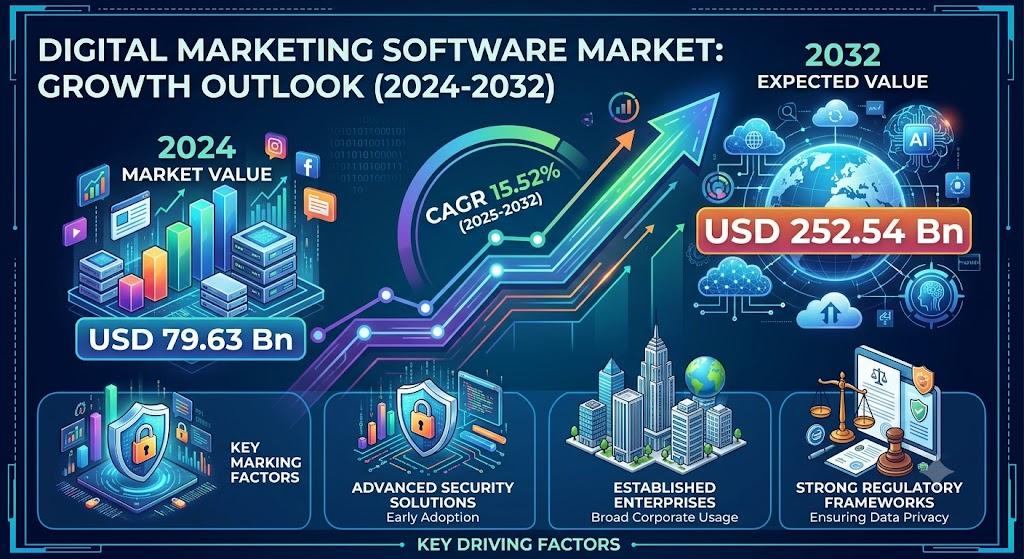
    The Digital Marketing Software Market was valued at USD 79.63 Bn in 2024, and the total revenue of the Digital Marketing Software Market is expected to grow at a CAGR of 15.52% from 2025 to 2032, reaching nearly USD 252.54 Bn by 2032, driven by early adoption of advanced security solutions, established enterprises, and strong regulatory frameworks.

    Please connect with our representative, who will ensure you to get a report sample here @https://www.maximizemarketresearch.com/request-sample/20799/

    Digital Marketing Software Market Report Scope and Research Methodology

    The report presents historical data and forecasts on a global, regional, and country level, delivering an in-depth examination of Digital Marketing Software market trends within each segment and their respective sub-segments . Maximize Market Research employs data triangulation as the primary research methodology, encompassing an evaluation of how data variables impact the Digital Marketing Software market, data mining, and validation via primary sources such as industry experts.

    The analysis of complex Digital Marketing Software industry data has been presented in straightforward language within the research report. SWOT analysis was leveraged to outline the strengths, weaknesses, opportunities, and threats for key players in the industry. To estimate the market size, a bottom-up approach was employed.

    Digital Marketing Software Market Regional Analysis

    The report provides a detailed analysis of the Digital Marketing Software market dynamics, Government initiatives and stringent rules and regulations influencing the market in each region. A detailed analysis of the market in North America, Asia Pacific, Europe, Middle East and Africa and South America are included in the report.

    Digital Marketing Software Market Segmentation

    by Deployment Type

    On-Premise
    Cloud-Based

    by Service

    Professional Services
    Managed Services

    by Solution Provided

    CRM Software
    Email Marketing
    Social Media Marketing
    Search Marketing
    Marketing Automation
    Campaign management
    Others

    by Organisation Size

    Large Enterprises
    SMEs

    by Industry Vertical

    Retail & E-commerce
    BFSI
    IT & Telecom
    Healthcare & Pharma
    Travel & Hospitality
    Media & Entertainment
    Others

    Request Free Sample Copy:https://www.maximizemarketresearch.com/request-sample/20799/

    Digital Marketing Software Key Players

    1. Sailthru
    2. Vivial Connect
    3. Keap
    4. IBM
    5. SAP SE
    6. Microsoft
    7. SimplyCast
    8. Act-On Software
    9. Infor
    10. Yesware
    11. ThriveHive
    12. Demandbase
    13. WordStream
    14. CAKE
    15. Chetu
    16. Adobe
    17. Oracle
    18. HubSpot
    19. SAS Institute
    20. HP Development

    Key Questions answered in the Digital Marketing Software Market Report are:

    What is the expected CAGR of the Digital Marketing Software market during the forecast period?
    What are the Digital Marketing Software market segments?
    Which region of the Digital Marketing Software market is expected to grow at a high rate during the forecast period?
    What is the expected CAGR of the Digital Marketing Software market during the forecast period?
    What are the emerging trends in the Digital Marketing Software market?
    What are the factors restraining the Digital Marketing Software market growth?
    Key offerings:

    Market Share, Size, and Forecast by Revenue|2026-2034
    Market Dynamics- Growth drivers, Restraints, Investment Opportunities, and key trends
    Market Segmentation- A detailed analysis of each segment and their segments
    Competitive Landscape - Leading key players and other prominent key players.
    Trending Reports:

    Global Automatic High-Beam Control Marke https://www.maximizemarketresearch.com/market-report/global-automatic-high-beam-control-market/64702/
    Overhead Conveyor Market https://www.maximizemarketresearch.com/market-report/overhead-conveyor-market/188065/
    Global Water Automation and Instrumentation Market https://www.maximizemarketresearch.com/market-report/global-water-automation-and-instrumentation-market/21350/

    About Maximize Market Research:

    Maximize Market Research is a multifaceted market research and consulting company with professionals from several industries. Some of the industries we cover include medical devices, pharmaceutical manufacturers, science and engineering, electronic components, industrial equipment, technology and communication, cars and automobiles, chemical products and substances, general merchandise, beverages, personal care, and automated systems. To mention a few, we provide market-verified industry estimations, technical trend analysis, crucial market research, strategic advice, competition analysis, production and demand analysis, and client impact studies.

    Contact Maximize Market Research:

    3rd Floor, Navale IT Park, Phase 2

    Pune Banglore Highway, Narhe,

    Pune, Maharashtra 411041, India

    [email protected]

    +91 96071 95908, +91 9607365656
    Digital Marketing Software Market: Voice Search Optimization and AI-Powered Discovery Strategies – Report by MMR Digital Marketing Software Market Report Overview The forecasting process primarily hinges on the analysis of historical data alongside current trends in the Digital Marketing Software Market. This comprehensive data collection employs a blend of primary and secondary research methodologies. The report encompasses vital components such as market size, share, regional analysis, dynamics, CAGR, and future trends. This holistic approach renders the report an invaluable guide for investors, as it offers an insightful and forward-looking perspective on the Digital Marketing Software industry. Digital Marketing Software Market Projection: The Digital Marketing Software Market was valued at USD 79.63 Bn in 2024, and the total revenue of the Digital Marketing Software Market is expected to grow at a CAGR of 15.52% from 2025 to 2032, reaching nearly USD 252.54 Bn by 2032, driven by early adoption of advanced security solutions, established enterprises, and strong regulatory frameworks. Please connect with our representative, who will ensure you to get a report sample here @https://www.maximizemarketresearch.com/request-sample/20799/ Digital Marketing Software Market Report Scope and Research Methodology The report presents historical data and forecasts on a global, regional, and country level, delivering an in-depth examination of Digital Marketing Software market trends within each segment and their respective sub-segments . Maximize Market Research employs data triangulation as the primary research methodology, encompassing an evaluation of how data variables impact the Digital Marketing Software market, data mining, and validation via primary sources such as industry experts. The analysis of complex Digital Marketing Software industry data has been presented in straightforward language within the research report. SWOT analysis was leveraged to outline the strengths, weaknesses, opportunities, and threats for key players in the industry. To estimate the market size, a bottom-up approach was employed. Digital Marketing Software Market Regional Analysis The report provides a detailed analysis of the Digital Marketing Software market dynamics, Government initiatives and stringent rules and regulations influencing the market in each region. A detailed analysis of the market in North America, Asia Pacific, Europe, Middle East and Africa and South America are included in the report. Digital Marketing Software Market Segmentation by Deployment Type On-Premise Cloud-Based by Service Professional Services Managed Services by Solution Provided CRM Software Email Marketing Social Media Marketing Search Marketing Marketing Automation Campaign management Others by Organisation Size Large Enterprises SMEs by Industry Vertical Retail & E-commerce BFSI IT & Telecom Healthcare & Pharma Travel & Hospitality Media & Entertainment Others Request Free Sample Copy:https://www.maximizemarketresearch.com/request-sample/20799/ Digital Marketing Software Key Players 1. Sailthru 2. Vivial Connect 3. Keap 4. IBM 5. SAP SE 6. Microsoft 7. SimplyCast 8. Act-On Software 9. Infor 10. Yesware 11. ThriveHive 12. Demandbase 13. WordStream 14. CAKE 15. Chetu 16. Adobe 17. Oracle 18. HubSpot 19. SAS Institute 20. HP Development Key Questions answered in the Digital Marketing Software Market Report are: What is the expected CAGR of the Digital Marketing Software market during the forecast period? What are the Digital Marketing Software market segments? Which region of the Digital Marketing Software market is expected to grow at a high rate during the forecast period? What is the expected CAGR of the Digital Marketing Software market during the forecast period? What are the emerging trends in the Digital Marketing Software market? What are the factors restraining the Digital Marketing Software market growth? Key offerings: Market Share, Size, and Forecast by Revenue|2026-2034 Market Dynamics- Growth drivers, Restraints, Investment Opportunities, and key trends Market Segmentation- A detailed analysis of each segment and their segments Competitive Landscape - Leading key players and other prominent key players. Trending Reports: Global Automatic High-Beam Control Marke https://www.maximizemarketresearch.com/market-report/global-automatic-high-beam-control-market/64702/ Overhead Conveyor Market https://www.maximizemarketresearch.com/market-report/overhead-conveyor-market/188065/ Global Water Automation and Instrumentation Market https://www.maximizemarketresearch.com/market-report/global-water-automation-and-instrumentation-market/21350/ About Maximize Market Research: Maximize Market Research is a multifaceted market research and consulting company with professionals from several industries. Some of the industries we cover include medical devices, pharmaceutical manufacturers, science and engineering, electronic components, industrial equipment, technology and communication, cars and automobiles, chemical products and substances, general merchandise, beverages, personal care, and automated systems. To mention a few, we provide market-verified industry estimations, technical trend analysis, crucial market research, strategic advice, competition analysis, production and demand analysis, and client impact studies. Contact Maximize Market Research: 3rd Floor, Navale IT Park, Phase 2 Pune Banglore Highway, Narhe, Pune, Maharashtra 411041, India [email protected] +91 96071 95908, +91 9607365656
    0 Comments ·0 Shares ·134 Views
  • Commercial Satellite Launch Service Market Research and Industry Insights – Report by MMR

    Commercial Satellite Launch Service Market Overview

    The Commercial Satellite Launch Service Market report provides an in-depth analysis that is required to make informed industry decisions and develop strategic growth plans. Regardless of the production method or cost structures, the Commercial Satellite Launch Service market report provides a comprehensive understanding of advanced tactics and strategies.

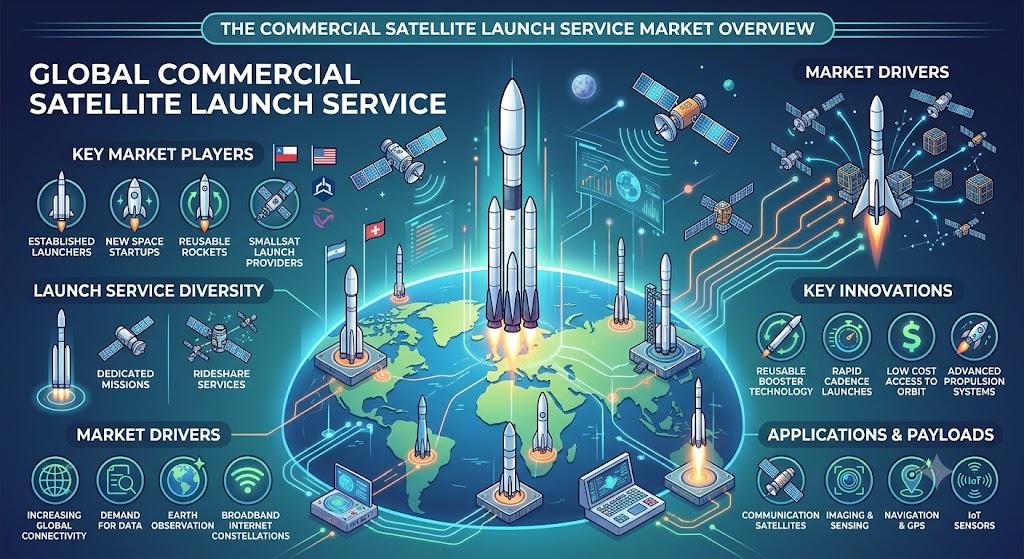
    The Commercial Satellite Launch Service Market size was valued at USD 7.84 Bn in 2025 and the total Commercial Satellite Launch Service revenue is expected to grow at a CAGR of 5.67% from 2026 to 2034, reaching nearly USD 12.89 Bn.

    Please connect with our representative, who will ensure you to get a report sample here @https://www.maximizemarketresearch.com/request-sample/11777/

    Commercial Satellite Launch Service Market Report Scope and Research Methodology

    The report offers an extensive examination of top players' strategies within the Commercial Satellite Launch Service industry, coupled with an in-depth analysis of market segments and regional dynamics. In-depth insights into market dynamics, encompassing drivers, restraints, opportunities, and challenges, are provided both on a regional and segmental basis within the Commercial Satellite Launch Service Market report. Additionally, the report presents import/export consumption, supply and demand, pricing, costs, revenue, and gross margins data, serving as an invaluable guide for investors.

    The data for the Commercial Satellite Launch Service Market report was meticulously gathered through a combination of primary and secondary research methods, ensuring its authenticity. Primary research methods employed encompassed questionnaire distribution, surveys, and telephone interviews with Commercial Satellite Launch Service industry experts, market leaders, marketing professionals, and entrepreneurs. The report's estimates of global and regional Commercial Satellite Launch Service market size were derived using a bottom-up approach. Furthermore, the strengths and weaknesses of Commercial Satellite Launch Service key players within the industry are outlined using SWOT analysis.

    Commercial Satellite Launch Service Market Regional Insights

    The report delves into the Commercial Satellite Launch Service business in great depth, segmenting it into numerous locations. North America, South America, Europe, Asia Pacific (APAC), Africa, and the Middle East are evaluated by region and country in the study. In the Commercial Satellite Launch Service market report, regional markets are thoroughly investigated in order to uncover regional market trends, restrictions, and possible prospects.

    Commercial Satellite Launch Service Market Segmentation

    by Launch Services

    Pre-launch Service
    Post-launch operations Service

    by Satellite Type

    Small Satellites (Mini, Micro, Nano, Pico)
    Medium Satellites
    Large Satellites

    by Orbit Type

    Low Earth Orbit (LEO)
    Medium Earth Orbit (MEO)
    Geostationary Orbit (GEO)
    Sun-Synchronous Orbit (SSO)

    by End-User

    Commercial
    Government & Defense
    Civil
    Others

    Request Free Sample Copy:https://www.maximizemarketresearch.com/request-sample/11777/

    Commercial Satellite Launch Service Market Key Players

    1. SpaceX (Space Exploration Technologies Corp.)
    2. Arianespace
    3. Blue Origin
    4. United Launch Alliance (ULA)
    5. Rocket Lab
    6. Northrop Grumman
    7. China National Space Administration (CNSA)
    8. Roscosmos (Russian Federal Space Agency)
    9. Indian Space Research Organisation (ISRO)
    10. Virgin Orbit
    11. Mitsubishi Heavy Industries
    12. OneWeb
    13. SSL (Space Systems Loral)
    14. Sierra Nevada Corporation (SNC)
    15. ISRO Propulsion Complex (IPRC)
    16. Northrop Grumman Innovation Systems (formerly Orbital ATK)
    17. .Gilmour Space Technologies
    18. Relativity Space
    19. AST & Science
    20. ExPace Technology Corporation

    Key Offerings:

    A detailed market overview
    Market Share, Size & Forecast by Revenue | 2026−2034
    Market Dynamics – Growth Drivers, Restraints, Investment Opportunities, and Key Trends
    Market Segmentation – A detailed analysis by segments and sub-segments
    Regional Insights
    Competitive Landscape – Top Key Vendors and Other Prominent Vendors
    More Trending From MMR:

    Global Waterbased Adhesive Market https://www.maximizemarketresearch.com/market-report/global-water-based-adhesive-market/25151/
    Halide Minerals Market https://www.maximizemarketresearch.com/market-report/halide-minerals-market/214740/
    Global Diphenylmethane Diisocyanate Market https://www.maximizemarketresearch.com/market-report/global-diphenylmethane-diisocyanate-market/113843/

    About Maximize Market Research:

    Maximize Market Research is a multifaceted market research and consulting company with professionals from several industries. Some of the industries we cover include medical devices, pharmaceutical manufacturers, science and engineering, electronic components, industrial equipment, technology and communication, cars and automobiles, chemical products and substances, general merchandise, beverages, personal care, and automated systems. To mention a few, we provide market-verified industry estimations, technical trend analysis, crucial market research, strategic advice, competition analysis, production and demand analysis, and client impact studies.

    Contact Maximize Market Research:

    3rd Floor, Naval IT Park, Phase 2

    Pune Banglore Highway, Narhe

    Pune, Maharashtra 411041, India

    [email protected]

    +91 96071 95908, +91 9607365656
    Commercial Satellite Launch Service Market Research and Industry Insights – Report by MMR Commercial Satellite Launch Service Market Overview The Commercial Satellite Launch Service Market report provides an in-depth analysis that is required to make informed industry decisions and develop strategic growth plans. Regardless of the production method or cost structures, the Commercial Satellite Launch Service market report provides a comprehensive understanding of advanced tactics and strategies. The Commercial Satellite Launch Service Market size was valued at USD 7.84 Bn in 2025 and the total Commercial Satellite Launch Service revenue is expected to grow at a CAGR of 5.67% from 2026 to 2034, reaching nearly USD 12.89 Bn. Please connect with our representative, who will ensure you to get a report sample here @https://www.maximizemarketresearch.com/request-sample/11777/ Commercial Satellite Launch Service Market Report Scope and Research Methodology The report offers an extensive examination of top players' strategies within the Commercial Satellite Launch Service industry, coupled with an in-depth analysis of market segments and regional dynamics. In-depth insights into market dynamics, encompassing drivers, restraints, opportunities, and challenges, are provided both on a regional and segmental basis within the Commercial Satellite Launch Service Market report. Additionally, the report presents import/export consumption, supply and demand, pricing, costs, revenue, and gross margins data, serving as an invaluable guide for investors. The data for the Commercial Satellite Launch Service Market report was meticulously gathered through a combination of primary and secondary research methods, ensuring its authenticity. Primary research methods employed encompassed questionnaire distribution, surveys, and telephone interviews with Commercial Satellite Launch Service industry experts, market leaders, marketing professionals, and entrepreneurs. The report's estimates of global and regional Commercial Satellite Launch Service market size were derived using a bottom-up approach. Furthermore, the strengths and weaknesses of Commercial Satellite Launch Service key players within the industry are outlined using SWOT analysis. Commercial Satellite Launch Service Market Regional Insights The report delves into the Commercial Satellite Launch Service business in great depth, segmenting it into numerous locations. North America, South America, Europe, Asia Pacific (APAC), Africa, and the Middle East are evaluated by region and country in the study. In the Commercial Satellite Launch Service market report, regional markets are thoroughly investigated in order to uncover regional market trends, restrictions, and possible prospects. Commercial Satellite Launch Service Market Segmentation by Launch Services Pre-launch Service Post-launch operations Service by Satellite Type Small Satellites (Mini, Micro, Nano, Pico) Medium Satellites Large Satellites by Orbit Type Low Earth Orbit (LEO) Medium Earth Orbit (MEO) Geostationary Orbit (GEO) Sun-Synchronous Orbit (SSO) by End-User Commercial Government & Defense Civil Others Request Free Sample Copy:https://www.maximizemarketresearch.com/request-sample/11777/ Commercial Satellite Launch Service Market Key Players 1. SpaceX (Space Exploration Technologies Corp.) 2. Arianespace 3. Blue Origin 4. United Launch Alliance (ULA) 5. Rocket Lab 6. Northrop Grumman 7. China National Space Administration (CNSA) 8. Roscosmos (Russian Federal Space Agency) 9. Indian Space Research Organisation (ISRO) 10. Virgin Orbit 11. Mitsubishi Heavy Industries 12. OneWeb 13. SSL (Space Systems Loral) 14. Sierra Nevada Corporation (SNC) 15. ISRO Propulsion Complex (IPRC) 16. Northrop Grumman Innovation Systems (formerly Orbital ATK) 17. .Gilmour Space Technologies 18. Relativity Space 19. AST & Science 20. ExPace Technology Corporation Key Offerings: A detailed market overview Market Share, Size & Forecast by Revenue | 2026−2034 Market Dynamics – Growth Drivers, Restraints, Investment Opportunities, and Key Trends Market Segmentation – A detailed analysis by segments and sub-segments Regional Insights Competitive Landscape – Top Key Vendors and Other Prominent Vendors More Trending From MMR: Global Waterbased Adhesive Market https://www.maximizemarketresearch.com/market-report/global-water-based-adhesive-market/25151/ Halide Minerals Market https://www.maximizemarketresearch.com/market-report/halide-minerals-market/214740/ Global Diphenylmethane Diisocyanate Market https://www.maximizemarketresearch.com/market-report/global-diphenylmethane-diisocyanate-market/113843/ About Maximize Market Research: Maximize Market Research is a multifaceted market research and consulting company with professionals from several industries. Some of the industries we cover include medical devices, pharmaceutical manufacturers, science and engineering, electronic components, industrial equipment, technology and communication, cars and automobiles, chemical products and substances, general merchandise, beverages, personal care, and automated systems. To mention a few, we provide market-verified industry estimations, technical trend analysis, crucial market research, strategic advice, competition analysis, production and demand analysis, and client impact studies. Contact Maximize Market Research: 3rd Floor, Naval IT Park, Phase 2 Pune Banglore Highway, Narhe Pune, Maharashtra 411041, India [email protected] +91 96071 95908, +91 9607365656
    0 Comments ·0 Shares ·164 Views
  • Best Homeopathic Medicines for Poultry

    Healthy growth, proper digestion, and good nutrition are essential for raising healthy poultry. Poultry farmers may face challenges such as slow chick growth, poor appetite, uneven feeding, and digestive issues. Proper nutrition, clean drinking water, good farm hygiene, and regular veterinary care help maintain flock health. If you are looking for the best homeopathic medicine for poultry growth, explore available formulations and learn about responsible poultry care.

    Excel Pharma offers E-Poul Gro Drops (E-VET No. 26), a homeopathic formulation for poultry. It contains Alfalfa 30C, Calcarea Phosphorica 30C, Ferrum Phosphoricum 30C, Cinchona Officinalis 30C, and Kali Phosphoricum 30C. This product is intended to support healthy growth, digestion, and natural immunity in chicks and poultry. Explore the product details, ingredients, dosage instructions, and precautions before use. Homeopathy has not been scientifically proven to improve poultry growth or prevent disease. Consult a qualified veterinarian for appropriate flock health management, vaccination, and treatment. Do not replace prescribed veterinary medicines or vaccines with homeopathic drops.

    For consultation, call +91 98155 67678. For product details and orders, WhatsApp +91 7347341717.

    Visit us: https://www.excelpharma.co.in/product/e-poul-gro-drops-homeopathy-medicine-for-poultry/

    #BestHomeopathicMedicineForPoultry #PoultryHomeopathicMedicine #EPoulGroDrops #EVET26 #ExcelPharma #PoultryFarming #PoultryHealth #PoultryGrowth #ChickenCare #BroilerFarming #LayerFarming #PoultryFarmers
    Best Homeopathic Medicines for Poultry Healthy growth, proper digestion, and good nutrition are essential for raising healthy poultry. Poultry farmers may face challenges such as slow chick growth, poor appetite, uneven feeding, and digestive issues. Proper nutrition, clean drinking water, good farm hygiene, and regular veterinary care help maintain flock health. If you are looking for the best homeopathic medicine for poultry growth, explore available formulations and learn about responsible poultry care. Excel Pharma offers E-Poul Gro Drops (E-VET No. 26), a homeopathic formulation for poultry. It contains Alfalfa 30C, Calcarea Phosphorica 30C, Ferrum Phosphoricum 30C, Cinchona Officinalis 30C, and Kali Phosphoricum 30C. This product is intended to support healthy growth, digestion, and natural immunity in chicks and poultry. Explore the product details, ingredients, dosage instructions, and precautions before use. Homeopathy has not been scientifically proven to improve poultry growth or prevent disease. Consult a qualified veterinarian for appropriate flock health management, vaccination, and treatment. Do not replace prescribed veterinary medicines or vaccines with homeopathic drops. For consultation, call +91 98155 67678. For product details and orders, WhatsApp +91 7347341717. Visit us: https://www.excelpharma.co.in/product/e-poul-gro-drops-homeopathy-medicine-for-poultry/ #BestHomeopathicMedicineForPoultry #PoultryHomeopathicMedicine #EPoulGroDrops #EVET26 #ExcelPharma #PoultryFarming #PoultryHealth #PoultryGrowth #ChickenCare #BroilerFarming #LayerFarming #PoultryFarmers
    0 Comments ·0 Shares ·220 Views ·0 Views
  • The Industrial Boiler Market, projecting explosive valuation milestones through the next decade. According to the report, the market was valued at USD 17.12 billion in 2025 and is poised to scale up to USD 24.01 billion by 2032, expanding at a compound annual growth rate (CAGR) of 4.07%. This strategic growth trajectory underscores the critical role of high-efficiency thermal energy systems in enabling global industrial decarbonization, chemical processing, and smart manufacturing transformations.

    The global industrial landscape is undergoing a profound structural pivot. Driven by aggressive net-zero commitments and escalating carbon taxation, heavy industries are moving away from legacy, carbon-heavy coal-fired infrastructure toward advanced hybrid, hydrogen-ready, and ultra-efficient natural gas boilers. Simultaneously, the deployment of IoT-enabled automated combustion controls is redefining plant operations, turning traditional boilers from mere energy units into intelligent data nodes that optimize fuel efficiency and minimize downtime. This dual transition toward sustainability and digitization is opening lucrative avenues for equipment retrofitting, greenfield manufacturing expansions, and integrated smart-boiler services worldwide.

    Key Findings from the Report
    Valuation Milestone: The industrial boiler market reached a baseline valuation of USD 17.12 billion in 2025.

    Growth Trajectory: The market is projected to expand steadily at a 4.07% CAGR throughout the forecast period from 2026 to 2032.

    Dominant Segment (Type/Capacity): Water-tube and package boilers command the largest revenue shares, backed by high thermal efficiency and rapid steam generation capabilities required in heavy continuous-duty applications.

    Leading Application: The chemicals and petrochemicals sector remains the dominant end-user vertical, accounting for over one-third of total thermal energy equipment demand.

    Fuel Preferences: Natural gas continues to capture primary adoption share due to tightening emissions legislation, though biomass and hydrogen-compatible systems are registering the fastest incremental traction.

    Regional Dominance: The Asia-Pacific region leads global consumption, powered by expansive chemical hubs, textile manufacturing, and heavy industrialization in China and India.

    Investment Relevance: Capital expenditure is heavily skewed toward energy-efficient retrofits, IoT sensor integration, and low-emission boiler replacements.

    For further information, click the following link:https://www.stellarmr.com/report/req_sample/Industrial-Boiler-Market/339
    Market Drivers and Restraints
    Drivers
    Stringent Environmental Regulations: Global mandates capping greenhouse gas emissions force legacy plants to upgrade or replace high-polluting subcritical boilers with advanced low-NOx and low-CO2 alternatives.

    Industrial Expansion in Emerging Economies: Rapid manufacturing build-outs across Asia-Pacific and Latin America amplify the baseline demand for stable, high-capacity industrial steam generation.

    Rise of Energy-Efficient & Smart Technologies: Integration of IoT, predictive maintenance algorithms, and real-time fuel-to-steam efficiency monitoring drives widespread commercial adoption.

    Restraints
    High Initial Capital Outlay: The substantial upfront capital expenditure required for premium, low-emission boilers and auxiliary retrofitting can deter small and medium-scale enterprises (SMEs).

    Supply Chain Bottlenecks for Specialized Materials: Constraints in acquiring high-grade heat-resistant alloys and specialized automation components can cause project deployment delays.

    Technology, Regulation, and Sustainability Trends
    The industrial boiler ecosystem is experiencing an unprecedented convergence of digital technology and environmental compliance. Modern units are increasingly equipped with digital twins and IoT-enabled telemetry, allowing operators to monitor thermal efficiency, predict tube failures, and automate air-fuel ratios in real time. On the regulatory front, compliance frameworks such as the European Union’s Industrial Emissions Directive (IED) and stringent regional pollution control standards are penalizing high-emission operations, accelerating the phase-out of traditional coal units. Consequently, sustainability has shifted from a corporate PR objective to a core engineering requirement, with manufacturers prioritizing hydrogen-blended combustion capabilities and biomass co-firing.

    Regional Insights
    Asia-Pacific (Leading Region): APAC maintains its crown as the dominant and fastest-growing regional market. Accelerated by massive chemical corridor expansions in India, China, and Southeast Asia, local industries are aggressively modernizing legacy thermal infrastructure to match surging domestic manufacturing output.

    North America: Driven by rigorous EPA standards and widespread availability of affordable shale gas, North American industries are prioritizing high-efficiency package boilers and smart-grid integrated thermal systems.

    Europe: Europe spearheads the sustainability charge, focusing heavily on hydrogen-ready boilers, waste-heat recovery systems, and strict compliance with ultra-low carbon frameworks.

    Recent Industry Developments
    Thermax Ltd. (2025): Launched a new line of hybrid electric-steam industrial boilers designed to help chemical plants utilize surplus renewable energy, cutting direct fossil fuel consumption by up to 30%.

    Babcock & Wilcox (2025): Secured a major multi-million dollar contract to supply advanced, low-emission biomass-fired boilers for a municipal-industrial energy project in Europe, expanding its green-energy footprint.

    Siemens AG (2026): Partnered with leading boiler manufacturers to integrate industrial IoT edge controllers, delivering real-time thermodynamic efficiency optimization across heavy manufacturing lines.

    Cleaver-Brooks (2025): Expanded its North American manufacturing capacity with a specialized production line dedicated to ultra-low NOx packaged firetube boilers to meet strict regional clean air standards.

    Mitsubishi Heavy Industries (2026): Achieved successful commercial validation of its 100% hydrogen-ready combustion burner technology for industrial utility boilers, marking a critical milestone for net-zero heavy industry.

    Competitive Landscape
    The global industrial boiler market features a consolidated yet fiercely competitive landscape characterized by major engineering conglomerates and specialized thermal tech providers. Key players include Thermax Ltd., Siemens AG, Bharat Heavy Electricals Ltd. (BHEL), Mitsubishi Heavy Industries, Cleaver-Brooks, and Babcock & Wilcox. Leading corporations are focusing heavily on strategic mergers, acquisitions, and joint ventures to expand their geographic footprint and enhance their green-energy portfolios. Product differentiation is increasingly anchored around digital control integration, aftermarket servicing efficiency, and hydrogen fuel adaptability.

    Analyst Commentary
    "The industrial boiler market is no longer driven purely by basic steam generation capacity; it is undergoing a fundamental technological realignment centered around decarbonization and intelligence," said a Senior Research Analyst at Stellar Market Research. "As regulatory frameworks tighten globally, plant operators are moving past short-term cost-cutting. They are heavily investing in smart, fuel-flexible, and hydrogen-ready systems that future-proof their operations against both carbon taxation and volatile fuel pricing."

    Future Outlook
    Through the forecast horizon, the industrial boiler market will experience accelerated convergence between traditional heavy manufacturing and digital automation. Demand will increasingly pivot toward modular, scalable, and multi-fuel-capable systems that can seamlessly transition between natural gas, biomass, and green hydrogen. With emerging economies continuing to build out robust industrial infrastructure and developed nations prioritizing deep decarbonization retrofits, market participants that successfully embed advanced IoT diagnostics and carbon-neutral technologies into their core portfolios will capture dominant long-term market share.

    For further information, click the following link:https://www.stellarmr.com/report/req_sample/Industrial-Boiler-Market/339
    About Stellar Market Research
    Stellar Market Research is a multifaceted market research and consulting company with professionals from several industries. Some of the industries we cover include medical devices, pharmaceutical manufacturers, science and engineering, electronic components, industrial equipment, technology and communication, cars and automobiles, chemical products and substances, general merchandise, beverages, personal care, and automated systems. To mention a few, we provide market-verified industry estimations, technical trend analysis, crucial market research, strategic advice, competition analysis, production and demand analysis, and client impact studies.

    Address
    Phase 3, Navale IT Zone, S.No. 51/2A/2, Office No. 202, 2nd floor, Near, Navale Brg, Narhe, Pune, Maharashtra 411041

    Email
    [email protected]

    Mobile
    +91 9607365656
    The Industrial Boiler Market, projecting explosive valuation milestones through the next decade. According to the report, the market was valued at USD 17.12 billion in 2025 and is poised to scale up to USD 24.01 billion by 2032, expanding at a compound annual growth rate (CAGR) of 4.07%. This strategic growth trajectory underscores the critical role of high-efficiency thermal energy systems in enabling global industrial decarbonization, chemical processing, and smart manufacturing transformations. The global industrial landscape is undergoing a profound structural pivot. Driven by aggressive net-zero commitments and escalating carbon taxation, heavy industries are moving away from legacy, carbon-heavy coal-fired infrastructure toward advanced hybrid, hydrogen-ready, and ultra-efficient natural gas boilers. Simultaneously, the deployment of IoT-enabled automated combustion controls is redefining plant operations, turning traditional boilers from mere energy units into intelligent data nodes that optimize fuel efficiency and minimize downtime. This dual transition toward sustainability and digitization is opening lucrative avenues for equipment retrofitting, greenfield manufacturing expansions, and integrated smart-boiler services worldwide. Key Findings from the Report Valuation Milestone: The industrial boiler market reached a baseline valuation of USD 17.12 billion in 2025. Growth Trajectory: The market is projected to expand steadily at a 4.07% CAGR throughout the forecast period from 2026 to 2032. Dominant Segment (Type/Capacity): Water-tube and package boilers command the largest revenue shares, backed by high thermal efficiency and rapid steam generation capabilities required in heavy continuous-duty applications. Leading Application: The chemicals and petrochemicals sector remains the dominant end-user vertical, accounting for over one-third of total thermal energy equipment demand. Fuel Preferences: Natural gas continues to capture primary adoption share due to tightening emissions legislation, though biomass and hydrogen-compatible systems are registering the fastest incremental traction. Regional Dominance: The Asia-Pacific region leads global consumption, powered by expansive chemical hubs, textile manufacturing, and heavy industrialization in China and India. Investment Relevance: Capital expenditure is heavily skewed toward energy-efficient retrofits, IoT sensor integration, and low-emission boiler replacements. For further information, click the following link:https://www.stellarmr.com/report/req_sample/Industrial-Boiler-Market/339 Market Drivers and Restraints Drivers Stringent Environmental Regulations: Global mandates capping greenhouse gas emissions force legacy plants to upgrade or replace high-polluting subcritical boilers with advanced low-NOx and low-CO2 alternatives. Industrial Expansion in Emerging Economies: Rapid manufacturing build-outs across Asia-Pacific and Latin America amplify the baseline demand for stable, high-capacity industrial steam generation. Rise of Energy-Efficient & Smart Technologies: Integration of IoT, predictive maintenance algorithms, and real-time fuel-to-steam efficiency monitoring drives widespread commercial adoption. Restraints High Initial Capital Outlay: The substantial upfront capital expenditure required for premium, low-emission boilers and auxiliary retrofitting can deter small and medium-scale enterprises (SMEs). Supply Chain Bottlenecks for Specialized Materials: Constraints in acquiring high-grade heat-resistant alloys and specialized automation components can cause project deployment delays. Technology, Regulation, and Sustainability Trends The industrial boiler ecosystem is experiencing an unprecedented convergence of digital technology and environmental compliance. Modern units are increasingly equipped with digital twins and IoT-enabled telemetry, allowing operators to monitor thermal efficiency, predict tube failures, and automate air-fuel ratios in real time. On the regulatory front, compliance frameworks such as the European Union’s Industrial Emissions Directive (IED) and stringent regional pollution control standards are penalizing high-emission operations, accelerating the phase-out of traditional coal units. Consequently, sustainability has shifted from a corporate PR objective to a core engineering requirement, with manufacturers prioritizing hydrogen-blended combustion capabilities and biomass co-firing. Regional Insights Asia-Pacific (Leading Region): APAC maintains its crown as the dominant and fastest-growing regional market. Accelerated by massive chemical corridor expansions in India, China, and Southeast Asia, local industries are aggressively modernizing legacy thermal infrastructure to match surging domestic manufacturing output. North America: Driven by rigorous EPA standards and widespread availability of affordable shale gas, North American industries are prioritizing high-efficiency package boilers and smart-grid integrated thermal systems. Europe: Europe spearheads the sustainability charge, focusing heavily on hydrogen-ready boilers, waste-heat recovery systems, and strict compliance with ultra-low carbon frameworks. Recent Industry Developments Thermax Ltd. (2025): Launched a new line of hybrid electric-steam industrial boilers designed to help chemical plants utilize surplus renewable energy, cutting direct fossil fuel consumption by up to 30%. Babcock & Wilcox (2025): Secured a major multi-million dollar contract to supply advanced, low-emission biomass-fired boilers for a municipal-industrial energy project in Europe, expanding its green-energy footprint. Siemens AG (2026): Partnered with leading boiler manufacturers to integrate industrial IoT edge controllers, delivering real-time thermodynamic efficiency optimization across heavy manufacturing lines. Cleaver-Brooks (2025): Expanded its North American manufacturing capacity with a specialized production line dedicated to ultra-low NOx packaged firetube boilers to meet strict regional clean air standards. Mitsubishi Heavy Industries (2026): Achieved successful commercial validation of its 100% hydrogen-ready combustion burner technology for industrial utility boilers, marking a critical milestone for net-zero heavy industry. Competitive Landscape The global industrial boiler market features a consolidated yet fiercely competitive landscape characterized by major engineering conglomerates and specialized thermal tech providers. Key players include Thermax Ltd., Siemens AG, Bharat Heavy Electricals Ltd. (BHEL), Mitsubishi Heavy Industries, Cleaver-Brooks, and Babcock & Wilcox. Leading corporations are focusing heavily on strategic mergers, acquisitions, and joint ventures to expand their geographic footprint and enhance their green-energy portfolios. Product differentiation is increasingly anchored around digital control integration, aftermarket servicing efficiency, and hydrogen fuel adaptability. Analyst Commentary "The industrial boiler market is no longer driven purely by basic steam generation capacity; it is undergoing a fundamental technological realignment centered around decarbonization and intelligence," said a Senior Research Analyst at Stellar Market Research. "As regulatory frameworks tighten globally, plant operators are moving past short-term cost-cutting. They are heavily investing in smart, fuel-flexible, and hydrogen-ready systems that future-proof their operations against both carbon taxation and volatile fuel pricing." Future Outlook Through the forecast horizon, the industrial boiler market will experience accelerated convergence between traditional heavy manufacturing and digital automation. Demand will increasingly pivot toward modular, scalable, and multi-fuel-capable systems that can seamlessly transition between natural gas, biomass, and green hydrogen. With emerging economies continuing to build out robust industrial infrastructure and developed nations prioritizing deep decarbonization retrofits, market participants that successfully embed advanced IoT diagnostics and carbon-neutral technologies into their core portfolios will capture dominant long-term market share. For further information, click the following link:https://www.stellarmr.com/report/req_sample/Industrial-Boiler-Market/339 About Stellar Market Research Stellar Market Research is a multifaceted market research and consulting company with professionals from several industries. Some of the industries we cover include medical devices, pharmaceutical manufacturers, science and engineering, electronic components, industrial equipment, technology and communication, cars and automobiles, chemical products and substances, general merchandise, beverages, personal care, and automated systems. To mention a few, we provide market-verified industry estimations, technical trend analysis, crucial market research, strategic advice, competition analysis, production and demand analysis, and client impact studies. Address Phase 3, Navale IT Zone, S.No. 51/2A/2, Office No. 202, 2nd floor, Near, Navale Brg, Narhe, Pune, Maharashtra 411041 Email [email protected] Mobile +91 9607365656
    0 Comments ·0 Shares ·420 Views
  • Stellar Market Research has released an exhaustive strategic report on the Utility Markers Market, valuing the global industry at USD 488.37 million in 2025. As urban centers accelerate subterranean utility upgrades, smart grid rollouts, and fiber-optic network deployments, the market is experiencing an unprecedented digital transformation. Driven by stringent damage-prevention regulations and the critical need to safeguard underground assets, the sector is projected to expand robustly at a compound annual growth rate (CAGR) of 7.1%, reaching USD 789.37 million by 2032.

    Modernization of underground infrastructure has shifted from a secondary maintenance task to an urgent national security and economic imperative. Subsurface congestion involving telecommunications, gas pipelines, electrical grids, and water supply networks has heightened the risk of costly utility strikes during civil excavation. The integration of electronic marker systems (EMS) equipped with radio-frequency identification (RFID) technology represents a paradigm shift from passive asset identification to active, data-rich underground mapping. This transformation enables utilities to reduce asset location times, minimize service outages, and integrate physical infrastructure seamlessly with GIS (Geographic Information System) databases.

    Key Findings from the Report
    Valuation Milestone: The global Utility Markers Market stands at USD 488.37 million in 2025 and is forecasted to hit USD 789.37 million by 2032.

    Growth Trajectory: The market will advance at a steady CAGR of 7.1% throughout the 2026–2032 forecast period.

    Dominant Technology Segment: Electronic marker systems (EMS) capture the largest revenue share, driven by their superior reliability and frequency-specific programming capabilities.

    Fastest-Growing Segment: RFID-enabled smart utility markers are exhibiting the highest growth rate due to soaring demand for precise depth measurement and data storage directly on the marker.

    Leading Regional Hub: North America dominates the global landscape, underpinned by aggressive smart city investments and rigorous "Call Before You Dig" regulations.

    Emerging Growth Frontier: Asia-Pacific is registering the fastest regional growth, propelled by massive urbanization sweeps and smart grid initiatives in emerging economies.

    Investment Relevance: Utility asset owners and telecom operators are increasing capital expenditures on sub-surface visibility solutions to mitigate high financial liabilities associated with accidental infrastructure damage.

    For further information, click the following link:https://www.stellarmr.com/report/req_sample/utility-markers-market/2850

    Market Drivers and Restraints
    Driver 1: Strict Excavation Safety Regulations and Compliance Mandates. Governments worldwide are enforcing zero-tolerance policies for accidental utility line strikes, compelling contractors and utility providers to install certified underground markers.

    Driver 2: Rapid Expansion of Smart Grid and Fiber-Optic Networks. The large-scale rollout of 5G infrastructure, smart electricity meters, and fiber-to-the-home (FTTH) networks requires foolproof subterranean mapping to prevent service disruptions.

    Driver 3: Technological Advancements in RFID and GPS Integration. Modern markers now feature unique identification numbers and GIS coordinate compatibility, drastically cutting asset retrieval times.

    Restraint 1: High Initial Deployment and Retrofitting Costs. Upgrading legacy utility networks with advanced electronic and RFID markers involves substantial upfront capital expenditure.

    Restraint 2: Standardisation and Interoperability Hurdles. Varying regional frequencies and lack of uniform global interoperability standards across multi-utility corridors can slow down large-scale deployments.

    Technology, Regulation, and Sustainability Trends
    The industry is experiencing a massive wave of technological convergence, merging traditional physical marking with cloud-connected GIS platforms. Regulatory frameworks such as the European Union’s digital infrastructure directives and North America’s Common Ground Alliance (CGA) guidelines are tightening compliance, making sub-surface asset traceability mandatory. From an ESG standpoint, utility markers contribute to sustainability by preventing accidental ruptures of hazardous gas lines, water leaks, and power outages, thereby reducing emergency excavation carbon footprints and ecological degradation.

    Regional Insights
    North America commands the leading revenue share, anchored by advanced utility grids across the United States and Canada, coupled with rigorous enforcement of damage prevention laws. Meanwhile, the Asia-Pacific region represents the most dynamic emerging market, led by rapid urban development in India, China, and Southeast Asia. Massive government-backed smart city projects and nationwide fiber-optic expansions across APAC are driving unprecedented adoption volumes.

    Recent Industry Developments
    3M Company (2025): Expanded its portfolio of ID Electronic Marker System (EMS) products by integrating enhanced high-frequency RFID chips, reducing asset identification error rates by 18% across major municipal projects.

    Tempo Communications (2025): Partnered with a leading European utility provider to deploy next-generation programmable utility markers, cutting sub-surface tracing time by 30% in congested urban zones.

    Plainfield Precision (2024): Invested $12 million to expand manufacturing capacity for eco-friendly, biodegradable utility marker housings, supporting corporate net-zero supply chain initiatives.

    Vivax-Metrotech (2024): Launched an advanced utility locator compatible with multi-frequency markers, driving a 22% increase in sales across North American telecommunication networks.

    Radiodetection (2024): Secured a major framework agreement with a national UK telecom operator to supply smart marker solutions, reinforcing digital mapping compliance across urban broadband rollouts.

    Competitive Landscape
    The global utility markers market features a consolidated yet fiercely competitive ecosystem. Key market participants include 3M Company, Tempo Communications, Radiodetection Ltd., Vivax-Metrotech Corporation, and Pro-Line Safety Products. Leading players are focusing on strategic acquisitions, technological integration of RFID with cloud GIS, and expanding manufacturing footprints in emerging economies to capture rising infrastructural spend.

    Analyst Commentary
    "The utility markers sector is undergoing a quiet revolution," notes a Senior Research Analyst at Stellar Market Research. "As underground space becomes increasingly crowded with overlapping telecom, power, and water conduits, passive marking is no longer sufficient. The market pivot toward RFID-enabled and GIS-integrated smart markers is transforming underground asset management from a compliance checkbox into a core pillar of digital infrastructure resilience."

    Future Outlook
    Through 2032, the utility markers market will witness sustained expansion fueled by the global transition toward smart cities and automated utility management. Demand will increasingly shift from basic color-coded physical stakes to intelligent, programmable electronic markers. As regulatory frameworks tighten and infrastructure investments scale globally, market players offering seamless cloud-integrated asset tracking will capture dominant competitive advantages.

    For further information, click the following link:https://www.stellarmr.com/report/req_sample/utility-markers-market/2850
    About Stellar Market Research
    Stellar Market Research is a multifaceted market research and consulting company with professionals from several industries. Some of the industries we cover include medical devices, pharmaceutical manufacturers, science and engineering, electronic components, industrial equipment, technology and communication, cars and automobiles, chemical products and substances, general merchandise, beverages, personal care, and automated systems. To mention a few, we provide market-verified industry estimations, technical trend analysis, crucial market research, strategic advice, competition analysis, production and demand analysis, and client impact studies.

    Address
    Phase 3, Navale IT Zone, S.No. 51/2A/2, Office No. 202, 2nd floor, Near, Navale Brg, Narhe, Pune, Maharashtra 411041

    Email
    [email protected]

    Mobile
    +91 9607365656
    Stellar Market Research has released an exhaustive strategic report on the Utility Markers Market, valuing the global industry at USD 488.37 million in 2025. As urban centers accelerate subterranean utility upgrades, smart grid rollouts, and fiber-optic network deployments, the market is experiencing an unprecedented digital transformation. Driven by stringent damage-prevention regulations and the critical need to safeguard underground assets, the sector is projected to expand robustly at a compound annual growth rate (CAGR) of 7.1%, reaching USD 789.37 million by 2032. Modernization of underground infrastructure has shifted from a secondary maintenance task to an urgent national security and economic imperative. Subsurface congestion involving telecommunications, gas pipelines, electrical grids, and water supply networks has heightened the risk of costly utility strikes during civil excavation. The integration of electronic marker systems (EMS) equipped with radio-frequency identification (RFID) technology represents a paradigm shift from passive asset identification to active, data-rich underground mapping. This transformation enables utilities to reduce asset location times, minimize service outages, and integrate physical infrastructure seamlessly with GIS (Geographic Information System) databases. Key Findings from the Report Valuation Milestone: The global Utility Markers Market stands at USD 488.37 million in 2025 and is forecasted to hit USD 789.37 million by 2032. Growth Trajectory: The market will advance at a steady CAGR of 7.1% throughout the 2026–2032 forecast period. Dominant Technology Segment: Electronic marker systems (EMS) capture the largest revenue share, driven by their superior reliability and frequency-specific programming capabilities. Fastest-Growing Segment: RFID-enabled smart utility markers are exhibiting the highest growth rate due to soaring demand for precise depth measurement and data storage directly on the marker. Leading Regional Hub: North America dominates the global landscape, underpinned by aggressive smart city investments and rigorous "Call Before You Dig" regulations. Emerging Growth Frontier: Asia-Pacific is registering the fastest regional growth, propelled by massive urbanization sweeps and smart grid initiatives in emerging economies. Investment Relevance: Utility asset owners and telecom operators are increasing capital expenditures on sub-surface visibility solutions to mitigate high financial liabilities associated with accidental infrastructure damage. For further information, click the following link:https://www.stellarmr.com/report/req_sample/utility-markers-market/2850 Market Drivers and Restraints Driver 1: Strict Excavation Safety Regulations and Compliance Mandates. Governments worldwide are enforcing zero-tolerance policies for accidental utility line strikes, compelling contractors and utility providers to install certified underground markers. Driver 2: Rapid Expansion of Smart Grid and Fiber-Optic Networks. The large-scale rollout of 5G infrastructure, smart electricity meters, and fiber-to-the-home (FTTH) networks requires foolproof subterranean mapping to prevent service disruptions. Driver 3: Technological Advancements in RFID and GPS Integration. Modern markers now feature unique identification numbers and GIS coordinate compatibility, drastically cutting asset retrieval times. Restraint 1: High Initial Deployment and Retrofitting Costs. Upgrading legacy utility networks with advanced electronic and RFID markers involves substantial upfront capital expenditure. Restraint 2: Standardisation and Interoperability Hurdles. Varying regional frequencies and lack of uniform global interoperability standards across multi-utility corridors can slow down large-scale deployments. Technology, Regulation, and Sustainability Trends The industry is experiencing a massive wave of technological convergence, merging traditional physical marking with cloud-connected GIS platforms. Regulatory frameworks such as the European Union’s digital infrastructure directives and North America’s Common Ground Alliance (CGA) guidelines are tightening compliance, making sub-surface asset traceability mandatory. From an ESG standpoint, utility markers contribute to sustainability by preventing accidental ruptures of hazardous gas lines, water leaks, and power outages, thereby reducing emergency excavation carbon footprints and ecological degradation. Regional Insights North America commands the leading revenue share, anchored by advanced utility grids across the United States and Canada, coupled with rigorous enforcement of damage prevention laws. Meanwhile, the Asia-Pacific region represents the most dynamic emerging market, led by rapid urban development in India, China, and Southeast Asia. Massive government-backed smart city projects and nationwide fiber-optic expansions across APAC are driving unprecedented adoption volumes. Recent Industry Developments 3M Company (2025): Expanded its portfolio of ID Electronic Marker System (EMS) products by integrating enhanced high-frequency RFID chips, reducing asset identification error rates by 18% across major municipal projects. Tempo Communications (2025): Partnered with a leading European utility provider to deploy next-generation programmable utility markers, cutting sub-surface tracing time by 30% in congested urban zones. Plainfield Precision (2024): Invested $12 million to expand manufacturing capacity for eco-friendly, biodegradable utility marker housings, supporting corporate net-zero supply chain initiatives. Vivax-Metrotech (2024): Launched an advanced utility locator compatible with multi-frequency markers, driving a 22% increase in sales across North American telecommunication networks. Radiodetection (2024): Secured a major framework agreement with a national UK telecom operator to supply smart marker solutions, reinforcing digital mapping compliance across urban broadband rollouts. Competitive Landscape The global utility markers market features a consolidated yet fiercely competitive ecosystem. Key market participants include 3M Company, Tempo Communications, Radiodetection Ltd., Vivax-Metrotech Corporation, and Pro-Line Safety Products. Leading players are focusing on strategic acquisitions, technological integration of RFID with cloud GIS, and expanding manufacturing footprints in emerging economies to capture rising infrastructural spend. Analyst Commentary "The utility markers sector is undergoing a quiet revolution," notes a Senior Research Analyst at Stellar Market Research. "As underground space becomes increasingly crowded with overlapping telecom, power, and water conduits, passive marking is no longer sufficient. The market pivot toward RFID-enabled and GIS-integrated smart markers is transforming underground asset management from a compliance checkbox into a core pillar of digital infrastructure resilience." Future Outlook Through 2032, the utility markers market will witness sustained expansion fueled by the global transition toward smart cities and automated utility management. Demand will increasingly shift from basic color-coded physical stakes to intelligent, programmable electronic markers. As regulatory frameworks tighten and infrastructure investments scale globally, market players offering seamless cloud-integrated asset tracking will capture dominant competitive advantages. For further information, click the following link:https://www.stellarmr.com/report/req_sample/utility-markers-market/2850 About Stellar Market Research Stellar Market Research is a multifaceted market research and consulting company with professionals from several industries. Some of the industries we cover include medical devices, pharmaceutical manufacturers, science and engineering, electronic components, industrial equipment, technology and communication, cars and automobiles, chemical products and substances, general merchandise, beverages, personal care, and automated systems. To mention a few, we provide market-verified industry estimations, technical trend analysis, crucial market research, strategic advice, competition analysis, production and demand analysis, and client impact studies. Address Phase 3, Navale IT Zone, S.No. 51/2A/2, Office No. 202, 2nd floor, Near, Navale Brg, Narhe, Pune, Maharashtra 411041 Email [email protected] Mobile +91 9607365656
    0 Comments ·0 Shares ·416 Views
  • Magnesium Sulphate Market Industry Analysis, Demand, and Revenue Forecast Report by MMR

    Magnesium Sulphate Market to Reach USD 1,054.27 Million by 2032, Driven by Agricultural Demand and Pharmaceutical Applications

    The Magnesium Sulphate Market is witnessing steady growth, supported by rising agricultural productivity requirements, expanding pharmaceutical applications, and increasing demand from industrial manufacturing. According to Maximize Market Research, the market was valued at USD 708.16 million in 2024 and is projected to reach approximately USD 1,054.27 million by 2032, growing at a compound annual growth rate (CAGR) of 5.1% from 2025 to 2032. Increasing interest in efficient nutrient management, specialty chemicals, and high-quality pharmaceutical formulations is expected to create new opportunities for manufacturers and investors.

    Market Estimation, Growth Drivers and Opportunities

    Magnesium sulphate, commonly known as Epsom salt in certain applications, is an important inorganic compound used across agriculture, healthcare, food processing, personal care, water treatment, paints, textiles, and chemical manufacturing. Its versatility makes it a valuable ingredient for industries seeking reliable magnesium and sulphur sources.

    Agriculture remains a major growth driver because magnesium supports chlorophyll formation, photosynthesis, and plant development, while sulphur contributes to essential plant functions. Growing food requirements, soil nutrient deficiencies, and the adoption of balanced fertilization practices are increasing demand for magnesium sulphate-based fertilizers. Farmers are increasingly interested in improving crop yields and nutrient-use efficiency, creating opportunities for agricultural-grade products.

    Pharmaceutical demand also supports market expansion. Magnesium sulphate is used in clinical settings, including the management of pre-eclampsia and eclampsia, subject to appropriate medical supervision. Demand for dependable pharmaceutical ingredients and ready-to-use injectable formulations creates opportunities for manufacturers that can meet stringent quality and regulatory requirements.

    Get a Sample Insight Report Now : https://www.maximizemarketresearch.com/request-sample/148167/

    Magnesium Sulphate Market Industry Analysis, Demand, and Revenue Forecast Report by MMR Magnesium Sulphate Market to Reach USD 1,054.27 Million by 2032, Driven by Agricultural Demand and Pharmaceutical Applications The Magnesium Sulphate Market is witnessing steady growth, supported by rising agricultural productivity requirements, expanding pharmaceutical applications, and increasing demand from industrial manufacturing. According to Maximize Market Research, the market was valued at USD 708.16 million in 2024 and is projected to reach approximately USD 1,054.27 million by 2032, growing at a compound annual growth rate (CAGR) of 5.1% from 2025 to 2032. Increasing interest in efficient nutrient management, specialty chemicals, and high-quality pharmaceutical formulations is expected to create new opportunities for manufacturers and investors. Market Estimation, Growth Drivers and Opportunities Magnesium sulphate, commonly known as Epsom salt in certain applications, is an important inorganic compound used across agriculture, healthcare, food processing, personal care, water treatment, paints, textiles, and chemical manufacturing. Its versatility makes it a valuable ingredient for industries seeking reliable magnesium and sulphur sources. Agriculture remains a major growth driver because magnesium supports chlorophyll formation, photosynthesis, and plant development, while sulphur contributes to essential plant functions. Growing food requirements, soil nutrient deficiencies, and the adoption of balanced fertilization practices are increasing demand for magnesium sulphate-based fertilizers. Farmers are increasingly interested in improving crop yields and nutrient-use efficiency, creating opportunities for agricultural-grade products. Pharmaceutical demand also supports market expansion. Magnesium sulphate is used in clinical settings, including the management of pre-eclampsia and eclampsia, subject to appropriate medical supervision. Demand for dependable pharmaceutical ingredients and ready-to-use injectable formulations creates opportunities for manufacturers that can meet stringent quality and regulatory requirements. Get a Sample Insight Report Now : https://www.maximizemarketresearch.com/request-sample/148167/
    0 Comments ·0 Shares ·198 Views
  • Water Meter Market Smart Metering and Digitalization Trends Report by MMR

    Unveiling the Latest Trends in the Water Meter Market

    Maximize Market Research, a leading business consultancy firm, has released a comprehensive analysis of the Water Meter Market. The report offers valuable business insights, including demand and pricing analysis, as well as an overview of the competitive landscape. It provides a detailed examination of the current state of the Water Meter market, with projections extending through 2032

    Unlock more insights—request a free sample report now :https://www.maximizemarketresearch.com/request-sample/6469/

    Defining the Water Meter Market Scope Through Comprehensive Research

    The Water Meter market research delivers an in-depth analysis of key factors influencing industry growth, along with potential challenges that may arise. It provides stakeholders with a comprehensive understanding of the competitive landscape, including insights into leading companies, their product offerings, and emerging investment opportunities within the market. The report integrates both qualitative and quantitative insights, offering a well-rounded perspective on the industry’s current and future trajectory. Additionally, the MMR report includes a detailed competitive analysis, examining market players, their strategies, and key trends shaping the industry. The research is based on a blend of primary and secondary data sources, such as government publications, company websites, annual reports, and expert opinions from industry professionals and academics. Furthermore, the report identifies new market demands and trends, providing a thorough explanation of their impact on the Water Meter market’s evolution. By addressing consumer preferences, regulatory frameworks, and technological advancements, the study equips businesses with actionable insights to navigate the industry’s dynamic landscape effectively.

    Explore Regional Insights and Market Dynamics in the Water Meter Industry

    This report provides an in-depth regional analysis, covering essential aspects such as market size, growth rate, and trade activities, including imports and exports across different regions. By examining the geographic distribution of the Water Meter market, the study offers a clear understanding of industry trends and market conditions in various countries.

    The Water Meter market spans across North America, Europe, Asia Pacific, Latin America, Africa, and the Middle East, with each region presenting unique opportunities and challenges. This comprehensive analysis helps businesses identify regional growth potential, competitive landscapes, and key market drivers, enabling strategic decision-making in a dynamic global market

    Unlock the Key Market Segments Powering Water Meter Industry Growth :

    Water Meter Market size was valued at US$ 21.84 Bn. in 2023 and the total revenue is expected to grow at 4.20 % through 2024 to 2030, reaching nearly US$ 29.13 Bn.

    Gain more details with a free sample report. Inquire now :https://www.maximizemarketresearch.com/request-sample/6469/

    Breaking Down the Water Meter Market: Key Segments Shaping the Industry


    by Product Type

    Mechanical Water Meter
    Smart Water Meter

    by Component

    Meters and Accessories
    Communication
    IT Solutions

    by Applications

    Building & Construction
    Residential
    Commercial
    Industrial

    Meet the Industry Leaders Revolutionizing the Water Meter Market

    1. Diehl Stiftung & Co. KG
    2.Azbil Kimmon Co., Ltd.
    3. Badger Meter, Inc.
    4. Elster Group GmbH
    5. Neptune Technology Group Inc.
    6. G. Gioanola S.R.L.
    7. Aichi Tokei Denki Co., Ltd
    8. Apator SA
    9. Arad Group
    10. Fedrel Meter
    11. B Meter
    12. Itron Inc.
    13. Master Meter, Inc.
    14. Maddalena Spa
    15. Kamstrup A/S
    16. Sensus (Xylem Inc.)
    17. ZENNER International GmbH & Co. KG
    18. Mueller Systems, LLC.
    19. Plata Meter Co., Ltd
    20. NINGBO WATER METER CO.,LTD.
    21. Jiaxing Eastron Electronic Instruments Co., Ltd.

    Uncover Key Insights Answering the Biggest Questions in the Water Meter Market

    What is Water Meter ?
    What is the growth rate of the Water Meter Market?
    Which are the factors expected to drive the Water Meter market growth?
    What is the CAGR at which the Water Meter market will grow during the forecast period?
    What are the different segments of the Water Meter Market?
    Which is the fastest growing region in the Water Meter market?
    What growth strategies are the players considering to increase their presence in Water Meter ?
    What are the upcoming opportunities and trends for the Water Meter Market?
    What are the recent industry trends that can be implemented to generate additional revenue streams for the Water Meter Market?
    Who are the leading companies and what are their portfolios in Water Meter Market?
    What segments are covered in the Water Meter Market?
    Who are the key players in the Water Meter market?
    Gain a Competitive Edge – Access Market Insights Through the Sample Link @https://www.maximizemarketresearch.com/market-report/global-water-meter-market/6469/

    Explore the Revolutionary Products Powering Market Success

    Past Size and Competitive Landscape
    Past Pricing and price curve by region
    Size, Share, Size Forecast by different segment
    Dynamics Growth Drivers, Restraints, Opportunities, and Key Trends by Region
    Segmentation A detailed analysis by segment with their sub-segments and Region
    Competitive Landscape Profiles of selected key players by region from a strategic perspective
    Explore Our Trending Reports to Stay Ahead of Industry Shifts :

    Scalp Massager Market https://www.maximizemarketresearch.com/market-report/scalp-massager-market/220772/
    Auger Drilling Market https://www.maximizemarketresearch.com/market-report/global-auger-drilling-market/22199/
    Global Transportation and Security System Market https://www.maximizemarketresearch.com/market-report/global-transportation-and-security-system-market/29836/

    Connect with Maximize Market Research for Expert Insights In-Depth Analysis :

    +91 9607365656

    [email protected]
    Water Meter Market Smart Metering and Digitalization Trends Report by MMR Unveiling the Latest Trends in the Water Meter Market Maximize Market Research, a leading business consultancy firm, has released a comprehensive analysis of the Water Meter Market. The report offers valuable business insights, including demand and pricing analysis, as well as an overview of the competitive landscape. It provides a detailed examination of the current state of the Water Meter market, with projections extending through 2032 Unlock more insights—request a free sample report now :https://www.maximizemarketresearch.com/request-sample/6469/ Defining the Water Meter Market Scope Through Comprehensive Research The Water Meter market research delivers an in-depth analysis of key factors influencing industry growth, along with potential challenges that may arise. It provides stakeholders with a comprehensive understanding of the competitive landscape, including insights into leading companies, their product offerings, and emerging investment opportunities within the market. The report integrates both qualitative and quantitative insights, offering a well-rounded perspective on the industry’s current and future trajectory. Additionally, the MMR report includes a detailed competitive analysis, examining market players, their strategies, and key trends shaping the industry. The research is based on a blend of primary and secondary data sources, such as government publications, company websites, annual reports, and expert opinions from industry professionals and academics. Furthermore, the report identifies new market demands and trends, providing a thorough explanation of their impact on the Water Meter market’s evolution. By addressing consumer preferences, regulatory frameworks, and technological advancements, the study equips businesses with actionable insights to navigate the industry’s dynamic landscape effectively. Explore Regional Insights and Market Dynamics in the Water Meter Industry This report provides an in-depth regional analysis, covering essential aspects such as market size, growth rate, and trade activities, including imports and exports across different regions. By examining the geographic distribution of the Water Meter market, the study offers a clear understanding of industry trends and market conditions in various countries. The Water Meter market spans across North America, Europe, Asia Pacific, Latin America, Africa, and the Middle East, with each region presenting unique opportunities and challenges. This comprehensive analysis helps businesses identify regional growth potential, competitive landscapes, and key market drivers, enabling strategic decision-making in a dynamic global market Unlock the Key Market Segments Powering Water Meter Industry Growth : Water Meter Market size was valued at US$ 21.84 Bn. in 2023 and the total revenue is expected to grow at 4.20 % through 2024 to 2030, reaching nearly US$ 29.13 Bn. Gain more details with a free sample report. Inquire now :https://www.maximizemarketresearch.com/request-sample/6469/ Breaking Down the Water Meter Market: Key Segments Shaping the Industry by Product Type Mechanical Water Meter Smart Water Meter by Component Meters and Accessories Communication IT Solutions by Applications Building & Construction Residential Commercial Industrial Meet the Industry Leaders Revolutionizing the Water Meter Market 1. Diehl Stiftung & Co. KG 2.Azbil Kimmon Co., Ltd. 3. Badger Meter, Inc. 4. Elster Group GmbH 5. Neptune Technology Group Inc. 6. G. Gioanola S.R.L. 7. Aichi Tokei Denki Co., Ltd 8. Apator SA 9. Arad Group 10. Fedrel Meter 11. B Meter 12. Itron Inc. 13. Master Meter, Inc. 14. Maddalena Spa 15. Kamstrup A/S 16. Sensus (Xylem Inc.) 17. ZENNER International GmbH & Co. KG 18. Mueller Systems, LLC. 19. Plata Meter Co., Ltd 20. NINGBO WATER METER CO.,LTD. 21. Jiaxing Eastron Electronic Instruments Co., Ltd. Uncover Key Insights Answering the Biggest Questions in the Water Meter Market What is Water Meter ? What is the growth rate of the Water Meter Market? Which are the factors expected to drive the Water Meter market growth? What is the CAGR at which the Water Meter market will grow during the forecast period? What are the different segments of the Water Meter Market? Which is the fastest growing region in the Water Meter market? What growth strategies are the players considering to increase their presence in Water Meter ? What are the upcoming opportunities and trends for the Water Meter Market? What are the recent industry trends that can be implemented to generate additional revenue streams for the Water Meter Market? Who are the leading companies and what are their portfolios in Water Meter Market? What segments are covered in the Water Meter Market? Who are the key players in the Water Meter market? Gain a Competitive Edge – Access Market Insights Through the Sample Link @https://www.maximizemarketresearch.com/market-report/global-water-meter-market/6469/ Explore the Revolutionary Products Powering Market Success Past Size and Competitive Landscape Past Pricing and price curve by region Size, Share, Size Forecast by different segment Dynamics Growth Drivers, Restraints, Opportunities, and Key Trends by Region Segmentation A detailed analysis by segment with their sub-segments and Region Competitive Landscape Profiles of selected key players by region from a strategic perspective Explore Our Trending Reports to Stay Ahead of Industry Shifts : Scalp Massager Market https://www.maximizemarketresearch.com/market-report/scalp-massager-market/220772/ Auger Drilling Market https://www.maximizemarketresearch.com/market-report/global-auger-drilling-market/22199/ Global Transportation and Security System Market https://www.maximizemarketresearch.com/market-report/global-transportation-and-security-system-market/29836/ Connect with Maximize Market Research for Expert Insights In-Depth Analysis : +91 9607365656 [email protected]
    0 Comments ·0 Shares ·135 Views
  • The Guar Gum Market is projected to achieve monumental growth. According to a comprehensive market intelligence report published by Stellar Market Research, the global market size was valued at USD 1.11 billion in 2025 and is poised to expand at a robust compound annual growth rate (CAGR) of 7.4% from 2026 to 2034, reaching nearly USD 2.1 billion by the end of the forecast period.

    The global guar gum landscape is undergoing a structural pivot defined by dual-engine demand: high-performance energy extraction and health-conscious consumerism. Processed primarily from the endosperm of the cluster bean (Cyamopsis tetragonoloba), guar gum’s unique ability to form hydrogen bonds with water molecules makes it an irreplaceable natural hydrocolloid.

    Key Findings from the Report
    Valuation & Growth Trajectory: The global guar gum market reached USD 1.11 billion in 2025 and is projected to scale to USD 2.1 billion by 2034, registering a 7.4% CAGR.

    Grade Segment Dominance: The Food grade segment held the leading market share in 2025, propelled by surging demand for clean-label, low-fat, and convenience foods.

    Application Segment Insights: The Oil & Gas application segment captured the largest market share (37.62%) in 2025, heavily driven by North American shale gas extraction and global drilling projects.

    Functional Insights: Stabilizers and emulsifiers dominated functional segments with a 54.38% market share in 2025, expanding at a projected 6.9% CAGR due to widespread utility in dairy, confectionery, and personal care.

    Geographical Leadership: North America commanded a 43.2% market share in 2025, underpinned by extensive shale operations and robust processed food consumption.

    Production Hub: Asia-Pacific—led by India, which accounts for approximately 65% to 78% of global exports and production—remains the indispensable agricultural backbone of the supply chain.

    Investment Relevance: Rising trade volumes (such as India exporting over 417,000 metric tons valued at USD 541.65 million) highlight immense investment opportunities in seed quality, processing efficiency, and supply chain logistics.

    For further information, click the following link:https://www.stellarmr.com/report/req_sample/guar-gum-market/2828

    Market Drivers and Restraints
    Drivers:
    Shale Gas Exploration and Drilling Expansion: The rapid expansion of hydraulic fracturing in North America and emerging regions requires high-viscosity friction reducers, cementing guar gum's critical role in energy extraction.

    Explosion of Clean-Label and Convenience Foods: Changing lifestyles, urban work hours, and rising disposable incomes have elevated convenience food consumption, driving demand for natural stabilizers in soups, sauces, bakery items, and frozen desserts.

    Nutritional and Health Benefits: Heightened consumer focus on functional foods that improve glucose tolerance, reduce serum LDL cholesterol, and provide soluble dietary fiber is accelerating plant hydrocolloid utilization.

    Restraints:
    Raw Material Price Volatility: Unpredictable weather patterns, monsoon variability, and fluctuating crop yields in key agricultural belts cause sharp raw material price swings.

    Limited R&D and Infrastructure Deficits: A historical lack of specialized research facilities, certified seed breeding programs, and modernized processing machinery in primary producing regions constrains yield optimization and technological upgrading.

    Technology, Regulation, and Sustainability Trends
    The guar gum industry is undergoing rapid modernization driven by evolving compliance standards and technological integration. Regulatory bodies like the U.S. Food and Drug Administration (FDA) recognize guar gum as safe (GRAS) within specified limits, fostering consumer trust.

    On the operational front, processors are adopting advanced thermal-mechanical processing techniques to enhance powder solubility, lower microbial loads, and tailor viscosity profiles for specialized industrial uses. Furthermore, sustainability and ESG considerations are taking center stage; agricultural stakeholders are promoting climate-resilient cluster bean farming, micro-irrigation, and certified seed adoption to reduce environmental footprints and stabilize farmer incomes against climate shocks.

    Regional Insights
    North America: Dominating the global landscape with a 43.2% market share in 2025, North America's leadership is anchored by extensive shale oil and gas operations in Texas and widespread adoption of functional, low-calorie convenience foods. The U.S. alone accounts for over 41% of global guar gum imports.

    Asia-Pacific: Serving as the world's primary cultivation hub, India and Pakistan drive global supply. India contributes roughly 65% to 78% of global exports, with robust export growth heading into Western markets. Domestic cultivation is also expanding in response to international demand.

    Europe & Emerging Markets: Europe maintains steady demand driven by stringent clean-label food standards and pharmaceutical binder applications, while emerging markets in the Middle East and Latin America show rising promise in water treatment and mining sectors.

    Recent Industry Developments
    VedaOils (2025): Expanded its organic cosmetic-grade guar gum powder portfolio, capturing a wider footprint in natural personal care formulations and increasing eco-friendly product output by 15%.

    Sunita Hydrocolloids (2024): Invested in upgraded hydro-thermal processing units at its Rajasthan facility, boosting high-viscosity industrial-grade production capacity by 20% to meet North American oilfield demands.

    APEDA & Indian Exporters Consortium (2025): Implemented streamlined agricultural export quality certification protocols, stabilizing outbound shipments which crossed 417,000 metric tons valued at over USD 541 million.

    Global Hydrocolloids (2024): Formed a strategic supply partnership with major North American oilfield service providers, securing long-term delivery contracts for frac-grade fracturing guar.

    Agricultural Universities of Rajasthan & Gujarat (2024): Launched collaborative drought-resistant cluster bean seed development initiatives, improving agricultural yields by 8–10% for participating regional farmers.

    Competitive Landscape
    The global guar gum market features a consolidated yet competitive landscape characterized by integrated processors, specialized refiners, and multinational ingredient suppliers. Leading players are focusing on backward integration, strategic export partnerships, and customized grade formulations for pharmaceutical and oilfield applications.

    Key market participants profiled in the report include Sunita Hydrocolloids, Vikas WSP Ltd., Hindustan Gum & Chemicals Ltd., Cargill, Inc., Ashland Global Holdings Inc., Kerry Group, and Lotus Gums & Chemicals. These companies actively deploy capacity expansions, joint ventures, and customized bio-polymer innovations to reinforce their market positioning.

    Analyst Commentary
    "The guar gum market has evolved far beyond traditional food stabilization into a high-tech biopolymer essential for modern energy extraction and advanced pharmaceutical drug delivery," said a Senior Research Analyst at Stellar Market Research. "While agricultural volatility and processing infrastructure bottlenecks remain challenges, the pivot toward sustainable, plant-based hydrocolloids and enhanced shale exploration guarantees a lucrative pathway for stakeholders willing to invest in R&D and supply chain transparency through 2034."

    Future Outlook
    Looking toward 2034, the guar gum market is set for sustained evolution. Demand will increasingly favor high-purity, enzymatically modified, and sustainably sourced derivatives. Investment will concentrate on digitalizing agricultural supply chains, establishing dedicated R&D institutes for cluster bean genetics, and optimizing eco-friendly extraction technologies. As regulatory frameworks tighten around synthetic additives, natural hydrocolloids like guar gum will secure an irreplaceable strategic role across industrial ecosystems worldwide.

    For further information, click the following link:https://www.stellarmr.com/report/req_sample/guar-gum-market/2828

    About Stellar Market Research

    Stellar Market Research is a multifaceted market research and consulting company with professionals from several industries. Some of the industries we cover include medical devices, pharmaceutical manufacturers, science and engineering, electronic components, industrial equipment, technology and communication, cars and automobiles, chemical products and substances, general merchandise, beverages, personal care, and automated systems. To mention a few, we provide market-verified industry estimations, technical trend analysis, crucial market research, strategic advice, competition analysis, production and demand analysis, and client impact studies.

    Address
    Phase 3, Navale IT Zone, S.No. 51/2A/2, Office No. 202, 2nd floor, Near, Navale Brg, Narhe, Pune, Maharashtra 411041

    Email
    [email protected]

    Mobile
    +91 9607365656
    The Guar Gum Market is projected to achieve monumental growth. According to a comprehensive market intelligence report published by Stellar Market Research, the global market size was valued at USD 1.11 billion in 2025 and is poised to expand at a robust compound annual growth rate (CAGR) of 7.4% from 2026 to 2034, reaching nearly USD 2.1 billion by the end of the forecast period. The global guar gum landscape is undergoing a structural pivot defined by dual-engine demand: high-performance energy extraction and health-conscious consumerism. Processed primarily from the endosperm of the cluster bean (Cyamopsis tetragonoloba), guar gum’s unique ability to form hydrogen bonds with water molecules makes it an irreplaceable natural hydrocolloid. Key Findings from the Report Valuation & Growth Trajectory: The global guar gum market reached USD 1.11 billion in 2025 and is projected to scale to USD 2.1 billion by 2034, registering a 7.4% CAGR. Grade Segment Dominance: The Food grade segment held the leading market share in 2025, propelled by surging demand for clean-label, low-fat, and convenience foods. Application Segment Insights: The Oil & Gas application segment captured the largest market share (37.62%) in 2025, heavily driven by North American shale gas extraction and global drilling projects. Functional Insights: Stabilizers and emulsifiers dominated functional segments with a 54.38% market share in 2025, expanding at a projected 6.9% CAGR due to widespread utility in dairy, confectionery, and personal care. Geographical Leadership: North America commanded a 43.2% market share in 2025, underpinned by extensive shale operations and robust processed food consumption. Production Hub: Asia-Pacific—led by India, which accounts for approximately 65% to 78% of global exports and production—remains the indispensable agricultural backbone of the supply chain. Investment Relevance: Rising trade volumes (such as India exporting over 417,000 metric tons valued at USD 541.65 million) highlight immense investment opportunities in seed quality, processing efficiency, and supply chain logistics. For further information, click the following link:https://www.stellarmr.com/report/req_sample/guar-gum-market/2828 Market Drivers and Restraints Drivers: Shale Gas Exploration and Drilling Expansion: The rapid expansion of hydraulic fracturing in North America and emerging regions requires high-viscosity friction reducers, cementing guar gum's critical role in energy extraction. Explosion of Clean-Label and Convenience Foods: Changing lifestyles, urban work hours, and rising disposable incomes have elevated convenience food consumption, driving demand for natural stabilizers in soups, sauces, bakery items, and frozen desserts. Nutritional and Health Benefits: Heightened consumer focus on functional foods that improve glucose tolerance, reduce serum LDL cholesterol, and provide soluble dietary fiber is accelerating plant hydrocolloid utilization. Restraints: Raw Material Price Volatility: Unpredictable weather patterns, monsoon variability, and fluctuating crop yields in key agricultural belts cause sharp raw material price swings. Limited R&D and Infrastructure Deficits: A historical lack of specialized research facilities, certified seed breeding programs, and modernized processing machinery in primary producing regions constrains yield optimization and technological upgrading. Technology, Regulation, and Sustainability Trends The guar gum industry is undergoing rapid modernization driven by evolving compliance standards and technological integration. Regulatory bodies like the U.S. Food and Drug Administration (FDA) recognize guar gum as safe (GRAS) within specified limits, fostering consumer trust. On the operational front, processors are adopting advanced thermal-mechanical processing techniques to enhance powder solubility, lower microbial loads, and tailor viscosity profiles for specialized industrial uses. Furthermore, sustainability and ESG considerations are taking center stage; agricultural stakeholders are promoting climate-resilient cluster bean farming, micro-irrigation, and certified seed adoption to reduce environmental footprints and stabilize farmer incomes against climate shocks. Regional Insights North America: Dominating the global landscape with a 43.2% market share in 2025, North America's leadership is anchored by extensive shale oil and gas operations in Texas and widespread adoption of functional, low-calorie convenience foods. The U.S. alone accounts for over 41% of global guar gum imports. Asia-Pacific: Serving as the world's primary cultivation hub, India and Pakistan drive global supply. India contributes roughly 65% to 78% of global exports, with robust export growth heading into Western markets. Domestic cultivation is also expanding in response to international demand. Europe & Emerging Markets: Europe maintains steady demand driven by stringent clean-label food standards and pharmaceutical binder applications, while emerging markets in the Middle East and Latin America show rising promise in water treatment and mining sectors. Recent Industry Developments VedaOils (2025): Expanded its organic cosmetic-grade guar gum powder portfolio, capturing a wider footprint in natural personal care formulations and increasing eco-friendly product output by 15%. Sunita Hydrocolloids (2024): Invested in upgraded hydro-thermal processing units at its Rajasthan facility, boosting high-viscosity industrial-grade production capacity by 20% to meet North American oilfield demands. APEDA & Indian Exporters Consortium (2025): Implemented streamlined agricultural export quality certification protocols, stabilizing outbound shipments which crossed 417,000 metric tons valued at over USD 541 million. Global Hydrocolloids (2024): Formed a strategic supply partnership with major North American oilfield service providers, securing long-term delivery contracts for frac-grade fracturing guar. Agricultural Universities of Rajasthan & Gujarat (2024): Launched collaborative drought-resistant cluster bean seed development initiatives, improving agricultural yields by 8–10% for participating regional farmers. Competitive Landscape The global guar gum market features a consolidated yet competitive landscape characterized by integrated processors, specialized refiners, and multinational ingredient suppliers. Leading players are focusing on backward integration, strategic export partnerships, and customized grade formulations for pharmaceutical and oilfield applications. Key market participants profiled in the report include Sunita Hydrocolloids, Vikas WSP Ltd., Hindustan Gum & Chemicals Ltd., Cargill, Inc., Ashland Global Holdings Inc., Kerry Group, and Lotus Gums & Chemicals. These companies actively deploy capacity expansions, joint ventures, and customized bio-polymer innovations to reinforce their market positioning. Analyst Commentary "The guar gum market has evolved far beyond traditional food stabilization into a high-tech biopolymer essential for modern energy extraction and advanced pharmaceutical drug delivery," said a Senior Research Analyst at Stellar Market Research. "While agricultural volatility and processing infrastructure bottlenecks remain challenges, the pivot toward sustainable, plant-based hydrocolloids and enhanced shale exploration guarantees a lucrative pathway for stakeholders willing to invest in R&D and supply chain transparency through 2034." Future Outlook Looking toward 2034, the guar gum market is set for sustained evolution. Demand will increasingly favor high-purity, enzymatically modified, and sustainably sourced derivatives. Investment will concentrate on digitalizing agricultural supply chains, establishing dedicated R&D institutes for cluster bean genetics, and optimizing eco-friendly extraction technologies. As regulatory frameworks tighten around synthetic additives, natural hydrocolloids like guar gum will secure an irreplaceable strategic role across industrial ecosystems worldwide. For further information, click the following link:https://www.stellarmr.com/report/req_sample/guar-gum-market/2828 About Stellar Market Research Stellar Market Research is a multifaceted market research and consulting company with professionals from several industries. Some of the industries we cover include medical devices, pharmaceutical manufacturers, science and engineering, electronic components, industrial equipment, technology and communication, cars and automobiles, chemical products and substances, general merchandise, beverages, personal care, and automated systems. To mention a few, we provide market-verified industry estimations, technical trend analysis, crucial market research, strategic advice, competition analysis, production and demand analysis, and client impact studies. Address Phase 3, Navale IT Zone, S.No. 51/2A/2, Office No. 202, 2nd floor, Near, Navale Brg, Narhe, Pune, Maharashtra 411041 Email [email protected] Mobile +91 9607365656
    0 Comments ·0 Shares ·1K Views
  • Coffee Production Market Expands with Increasing Demand for Specialty Coffee

    Coffee Production Market size was valued at US$ 505.43 Bn. in 2025 and the total revenue is expected to grow at 4.28% through 2026 to 2032, reaching nearly US$ 677.75 Bn. by 2032.

    Coffee is one of the world's most widely consumed beverages, supporting millions of livelihoods and driving a global industry that spans farming, processing, trading, roasting, and retail. As consumer preferences continue to evolve and demand for premium, sustainably sourced coffee grows, the coffee production market is undergoing significant transformation. Advances in agricultural technology, climate-resilient farming practices, and growing investments in sustainable production are reshaping the future of the industry.

    Download Free PDF Brochure: https://www.stellarmr.com/report/req_sample/Coffee-Production-Market/667

    Understanding the Coffee Production Market

    The coffee production market encompasses the cultivation, harvesting, processing, and distribution of coffee beans for commercial use. The industry involves a complex supply chain that begins with coffee farmers and extends to processors, exporters, manufacturers, retailers, and foodservice providers.

    Coffee is primarily cultivated in tropical regions across Latin America, Africa, and Asia-Pacific, where climatic conditions support the growth of Arabica and Robusta coffee varieties. Increasing global consumption, expanding café culture, and the popularity of specialty coffee continue to fuel demand across both developed and emerging economies.

    Today, coffee production is no longer focused solely on increasing output. Producers are placing greater emphasis on quality improvement, sustainable farming methods, traceability, and environmental responsibility to meet changing consumer expectations.

    Key Factors Driving Market Growth

    Several factors are contributing to the steady expansion of the coffee production market.

    One of the primary growth drivers is the rising global consumption of coffee. Increasing urbanization, changing lifestyles, and growing disposable incomes have encouraged consumers to include coffee as part of their daily routine. Younger consumers, in particular, are exploring premium coffee experiences, specialty blends, and artisanal brewing methods.

    The rapid expansion of coffee shop chains and independent cafés has further strengthened demand for high-quality coffee beans. Specialty coffee has become a major trend, encouraging producers to focus on superior bean quality, unique flavor profiles, and sustainable sourcing practices.

    Technological advancements are also improving production efficiency. Precision agriculture, drone-based farm monitoring, satellite imaging, and data-driven irrigation systems are helping farmers optimize yields while reducing resource consumption. These innovations support better crop management and improve resilience against changing weather conditions.

    Sustainability Becomes a Competitive Advantage

    Sustainability has become one of the defining characteristics of modern coffee production.

    Consumers increasingly want to know where their coffee comes from and whether it has been produced responsibly. As a result, coffee growers and manufacturers are adopting environmentally friendly farming techniques, reducing chemical usage, conserving water resources, and promoting biodiversity.

    Certification programs focusing on sustainable agriculture and ethical sourcing are becoming more common across the global coffee supply chain. Companies are also investing in carbon reduction initiatives and regenerative farming practices to strengthen long-term environmental sustainability.

    Climate change remains one of the industry's biggest challenges. Rising temperatures, unpredictable rainfall patterns, and increasing pest infestations threaten coffee-producing regions worldwide. Consequently, research institutions and agricultural organizations are developing climate-resilient coffee varieties capable of maintaining productivity under changing environmental conditions.

    Emerging Trends Shaping the Coffee Production Industry

    Several emerging trends are expected to redefine the coffee production market over the next decade.

    Premiumization continues to influence purchasing behavior, with consumers increasingly seeking single-origin coffee, organic products, and specialty blends that offer distinctive taste experiences. This trend encourages farmers to prioritize quality over volume.

    Digital technologies are transforming coffee farming through precision agriculture and artificial intelligence. Smart sensors, automated irrigation systems, and predictive weather analytics enable producers to improve efficiency while reducing production costs.

    Supply chain transparency is another important trend. Blockchain technology and digital traceability systems allow consumers and businesses to verify the origin of coffee beans, strengthening trust and supporting responsible sourcing initiatives.

    Demand for sustainable packaging is also increasing as companies seek environmentally friendly alternatives to conventional materials. Recyclable, biodegradable, and compostable packaging solutions are becoming increasingly important for coffee brands looking to reduce their environmental footprint.

    Market Segmentation Overview

    The coffee production market can be broadly segmented based on product type, production method, distribution channel, and end use.

    By product type, Arabica coffee continues to dominate due to its superior flavor profile and widespread popularity in premium coffee products. Robusta coffee remains an important segment because of its higher caffeine content, disease resistance, and extensive use in instant coffee production.

    Production methods include conventional and organic farming. Organic coffee production is witnessing increasing demand as consumers become more conscious of health and environmental sustainability.

    Distribution channels include direct trade, exporters, wholesalers, retailers, and online platforms. Digital commerce is expanding rapidly, providing producers with greater market access and improving supply chain efficiency.

    End users include coffee manufacturers, cafés, restaurants, hotels, institutional buyers, and household consumers, all contributing to consistent market demand.

    Regional Market Outlook

    Latin America continues to play a central role in global coffee production due to favorable climatic conditions and extensive cultivation areas. Countries in the region remain major exporters serving international markets.

    The Asia-Pacific region is emerging as both a major producer and consumer of coffee. Rising disposable incomes, expanding café culture, and increasing urbanization are driving regional demand while encouraging investments in domestic coffee production.

    Europe remains one of the world's largest coffee-consuming regions. Growing interest in premium coffee, specialty beverages, and ethically sourced products continues to support imports and long-term market growth.

    North America also represents a significant market characterized by strong demand for specialty coffee, ready-to-drink beverages, and premium roasting products.

    Challenges Facing the Industry

    Despite positive growth prospects, the coffee production market faces several challenges.

    Climate change poses ongoing risks to crop yields and production stability. Labor shortages in coffee-producing regions, fluctuating commodity prices, and supply chain disruptions also create uncertainty for producers.

    Maintaining profitability while meeting sustainability requirements requires significant investment in technology, training, and infrastructure. Smallholder farmers, who account for a large share of global coffee production, often require financial support and technical assistance to adopt modern agricultural practices.

    Competitive Landscape

    J.M. Smucker (United States)
    Eight O’ Clock (India)
    AMT (United Kingdom)
    Dulce Café (South Africa)
    Lavazza (Italy)
    Keurig Green Mountain (United States)
    Nestle SA (Switzerland)
    The Coca Cola Company (United States)
    JAB Holding Company (Luxembourg)
    Starbucks Coffee Company (United States)
    Download Free PDF Brochure: https://www.stellarmr.com/report/req_sample/Coffee-Production-Market/667

    Conclusion

    The global coffee production market is evolving rapidly as sustainability, technological innovation, and premium consumer preferences reshape the industry. Growing worldwide demand for high-quality coffee, combined with advances in precision agriculture and environmentally responsible farming, presents significant opportunities for producers across the value chain.

    While climate change and supply chain challenges remain important considerations, ongoing investments in resilient farming practices and digital technologies are helping secure the industry's future. As consumers continue to value quality, transparency, and sustainability, the coffee production market is well positioned for long-term growth and innovation, making it one of the most dynamic segments within the global food and beverage industry.

    About Stellar Market Research:

    Stellar Market Research is a multifaceted market research and consulting company with professionals from several industries. Some of the industries we cover include medical devices, pharmaceutical manufacturers, science and engineering, electronic components, industrial equipment, technology and communication, cars and automobiles, chemical products and substances, general merchandise, beverages, personal care, and automated systems. To mention a few, we provide market-verified industry estimations, technical trend analysis, crucial market research, strategic advice, competition analysis, production and demand analysis, and client impact studies.

    Contact Stellar Market Research:

    3rd Floor, Navale IT Park, Phase 2

    Pune Banglore Highway, Narhe,

    Pune, Maharashtra 411041, India

    [email protected]

    +91 20 6630 3320 | +91 9607365656

    Coffee Production Market Expands with Increasing Demand for Specialty Coffee Coffee Production Market size was valued at US$ 505.43 Bn. in 2025 and the total revenue is expected to grow at 4.28% through 2026 to 2032, reaching nearly US$ 677.75 Bn. by 2032. Coffee is one of the world's most widely consumed beverages, supporting millions of livelihoods and driving a global industry that spans farming, processing, trading, roasting, and retail. As consumer preferences continue to evolve and demand for premium, sustainably sourced coffee grows, the coffee production market is undergoing significant transformation. Advances in agricultural technology, climate-resilient farming practices, and growing investments in sustainable production are reshaping the future of the industry. Download Free PDF Brochure: https://www.stellarmr.com/report/req_sample/Coffee-Production-Market/667 Understanding the Coffee Production Market The coffee production market encompasses the cultivation, harvesting, processing, and distribution of coffee beans for commercial use. The industry involves a complex supply chain that begins with coffee farmers and extends to processors, exporters, manufacturers, retailers, and foodservice providers. Coffee is primarily cultivated in tropical regions across Latin America, Africa, and Asia-Pacific, where climatic conditions support the growth of Arabica and Robusta coffee varieties. Increasing global consumption, expanding café culture, and the popularity of specialty coffee continue to fuel demand across both developed and emerging economies. Today, coffee production is no longer focused solely on increasing output. Producers are placing greater emphasis on quality improvement, sustainable farming methods, traceability, and environmental responsibility to meet changing consumer expectations. Key Factors Driving Market Growth Several factors are contributing to the steady expansion of the coffee production market. One of the primary growth drivers is the rising global consumption of coffee. Increasing urbanization, changing lifestyles, and growing disposable incomes have encouraged consumers to include coffee as part of their daily routine. Younger consumers, in particular, are exploring premium coffee experiences, specialty blends, and artisanal brewing methods. The rapid expansion of coffee shop chains and independent cafés has further strengthened demand for high-quality coffee beans. Specialty coffee has become a major trend, encouraging producers to focus on superior bean quality, unique flavor profiles, and sustainable sourcing practices. Technological advancements are also improving production efficiency. Precision agriculture, drone-based farm monitoring, satellite imaging, and data-driven irrigation systems are helping farmers optimize yields while reducing resource consumption. These innovations support better crop management and improve resilience against changing weather conditions. Sustainability Becomes a Competitive Advantage Sustainability has become one of the defining characteristics of modern coffee production. Consumers increasingly want to know where their coffee comes from and whether it has been produced responsibly. As a result, coffee growers and manufacturers are adopting environmentally friendly farming techniques, reducing chemical usage, conserving water resources, and promoting biodiversity. Certification programs focusing on sustainable agriculture and ethical sourcing are becoming more common across the global coffee supply chain. Companies are also investing in carbon reduction initiatives and regenerative farming practices to strengthen long-term environmental sustainability. Climate change remains one of the industry's biggest challenges. Rising temperatures, unpredictable rainfall patterns, and increasing pest infestations threaten coffee-producing regions worldwide. Consequently, research institutions and agricultural organizations are developing climate-resilient coffee varieties capable of maintaining productivity under changing environmental conditions. Emerging Trends Shaping the Coffee Production Industry Several emerging trends are expected to redefine the coffee production market over the next decade. Premiumization continues to influence purchasing behavior, with consumers increasingly seeking single-origin coffee, organic products, and specialty blends that offer distinctive taste experiences. This trend encourages farmers to prioritize quality over volume. Digital technologies are transforming coffee farming through precision agriculture and artificial intelligence. Smart sensors, automated irrigation systems, and predictive weather analytics enable producers to improve efficiency while reducing production costs. Supply chain transparency is another important trend. Blockchain technology and digital traceability systems allow consumers and businesses to verify the origin of coffee beans, strengthening trust and supporting responsible sourcing initiatives. Demand for sustainable packaging is also increasing as companies seek environmentally friendly alternatives to conventional materials. Recyclable, biodegradable, and compostable packaging solutions are becoming increasingly important for coffee brands looking to reduce their environmental footprint. Market Segmentation Overview The coffee production market can be broadly segmented based on product type, production method, distribution channel, and end use. By product type, Arabica coffee continues to dominate due to its superior flavor profile and widespread popularity in premium coffee products. Robusta coffee remains an important segment because of its higher caffeine content, disease resistance, and extensive use in instant coffee production. Production methods include conventional and organic farming. Organic coffee production is witnessing increasing demand as consumers become more conscious of health and environmental sustainability. Distribution channels include direct trade, exporters, wholesalers, retailers, and online platforms. Digital commerce is expanding rapidly, providing producers with greater market access and improving supply chain efficiency. End users include coffee manufacturers, cafés, restaurants, hotels, institutional buyers, and household consumers, all contributing to consistent market demand. Regional Market Outlook Latin America continues to play a central role in global coffee production due to favorable climatic conditions and extensive cultivation areas. Countries in the region remain major exporters serving international markets. The Asia-Pacific region is emerging as both a major producer and consumer of coffee. Rising disposable incomes, expanding café culture, and increasing urbanization are driving regional demand while encouraging investments in domestic coffee production. Europe remains one of the world's largest coffee-consuming regions. Growing interest in premium coffee, specialty beverages, and ethically sourced products continues to support imports and long-term market growth. North America also represents a significant market characterized by strong demand for specialty coffee, ready-to-drink beverages, and premium roasting products. Challenges Facing the Industry Despite positive growth prospects, the coffee production market faces several challenges. Climate change poses ongoing risks to crop yields and production stability. Labor shortages in coffee-producing regions, fluctuating commodity prices, and supply chain disruptions also create uncertainty for producers. Maintaining profitability while meeting sustainability requirements requires significant investment in technology, training, and infrastructure. Smallholder farmers, who account for a large share of global coffee production, often require financial support and technical assistance to adopt modern agricultural practices. Competitive Landscape J.M. Smucker (United States) Eight O’ Clock (India) AMT (United Kingdom) Dulce Café (South Africa) Lavazza (Italy) Keurig Green Mountain (United States) Nestle SA (Switzerland) The Coca Cola Company (United States) JAB Holding Company (Luxembourg) Starbucks Coffee Company (United States) Download Free PDF Brochure: https://www.stellarmr.com/report/req_sample/Coffee-Production-Market/667 Conclusion The global coffee production market is evolving rapidly as sustainability, technological innovation, and premium consumer preferences reshape the industry. Growing worldwide demand for high-quality coffee, combined with advances in precision agriculture and environmentally responsible farming, presents significant opportunities for producers across the value chain. While climate change and supply chain challenges remain important considerations, ongoing investments in resilient farming practices and digital technologies are helping secure the industry's future. As consumers continue to value quality, transparency, and sustainability, the coffee production market is well positioned for long-term growth and innovation, making it one of the most dynamic segments within the global food and beverage industry. About Stellar Market Research: Stellar Market Research is a multifaceted market research and consulting company with professionals from several industries. Some of the industries we cover include medical devices, pharmaceutical manufacturers, science and engineering, electronic components, industrial equipment, technology and communication, cars and automobiles, chemical products and substances, general merchandise, beverages, personal care, and automated systems. To mention a few, we provide market-verified industry estimations, technical trend analysis, crucial market research, strategic advice, competition analysis, production and demand analysis, and client impact studies. Contact Stellar Market Research: 3rd Floor, Navale IT Park, Phase 2 Pune Banglore Highway, Narhe, Pune, Maharashtra 411041, India [email protected] +91 20 6630 3320 | +91 9607365656
    0 Comments ·0 Shares ·318 Views
More Results