


• The Tungsten Market was valued at USD 5.54 billion in 2025 and is projected to expand to USD 11.08 billion by 2034, registering a robust compound annual growth rate (CAGR) of 8% throughout the forecast period (2026–2034). The report highlights tungsten's irreplaceable role as a high-density, high-melting-point critical metal essential for next-generation defense systems, industrial automation, electronics, and aerospace components.

    The global tungsten market is undergoing a structural paradigm shift. Traditionally concentrated in a handful of mining jurisdictions, supply chains are now experiencing profound re-engineering catalyzed by international trade policies, geopolitical friction, and stringent import tariffs. In late 2025, trade authorities imposed major tariffs on tungsten imports from primary Asian suppliers, instantly forcing Western manufacturers to rethink procurement strategies.

    Key Findings from the Report
    Valuation Baseline: The global tungsten market was valued at USD 5.54 billion in 2025, scaling up to an estimated USD 11.08 billion by 2034.

    Growth Trajectory: The market is poised to advance at a stellar CAGR of 8.0% across the 2026–2034 forecast period.

    Dominant Product Segment: Tungsten carbide dominates the market by product type, fueled by its unmatched hardness and widespread utility in heavy-duty cutting tools, wear-resistant machine parts, and precision surgical instruments.

    Fastest-Growing Application: The aerospace and defense sector represents the fastest-growing end-user segment, driven by surging production of aircraft turbine blades, inertial navigation systems, missile components, and kinetic energy penetrators.

    Form Factor Insights: Specialized material formats—including tungsten wires, foils, tubes, and ribbons—are witnessing accelerated adoption within high-precision semiconductor fabrication and advanced electronics.

    Regional Dominance: Asia-Pacific retained its position as the dominant regional market in 2025, backed by extensive mining operations, robust industrial manufacturing bases, and heavy state-backed infrastructure investments in China and India.

    Investment Relevance: Heightened supply vulnerability is unlocking lucrative venture capital and private equity opportunities in closed-loop recycling technologies, scrap-processing facilities, and regional stockpile joint ventures.

    For further information, click the following link:https://www.stellarmr.com/report/req_sample/Tungsten-Market/2788
    Market Drivers and Restraints
    Drivers
    Surging Aerospace and Defense Modernization: Accelerated global defense spending and the post-pandemic recovery of commercial aviation are driving intense demand for heat-resistant superalloys, turbine components, and aircraft balancing weights.

    Expansion of Industrial Automation and Robotics: High-speed machining, precision cutting tools, and modern automated assembly lines rely heavily on tungsten carbide tooling to maintain operational efficiency and minimize downtime.

    Electrification and Energy Sector Growth: The energy, mining, and automotive sectors increasingly depend on tungsten-infused components to withstand harsh drilling environments, high-stress mechanical friction, and thermal fatigue.

    Restraints
    High Production and Processing Complexities: Extracting tungsten from low-concentration ores and refining it into high-purity powders or carbides requires intensive energy consumption and sophisticated pyrometallurgical processing infrastructure.

    Raw Material Scarcity and Trade Restrictions: Geopolitical trade barriers, export quotas, and heavy import tariffs limit open-market access, creating severe supply bottlenecks and escalating input costs for downstream manufacturers.

    Technology, Regulation, and Sustainability Trends
    Operational transformation in the tungsten sector is heavily anchored in ESG compliance and technological innovation. Environmental, Social, and Governance (ESG) pressures are compelling primary producers to transition away from carbon-heavy extraction methods toward green mining equipment and hydrometallurgical recycling.

    On the regulatory front, sweeping trade policies—such as the imposition of multi-percentage tariffs on imported tungsten oxides and carbides—have triggered aggressive compliance and localization mandates. Industrial consumers are actively adopting digital supply-chain traceability tools to verify conflict-free mineral sourcing. Furthermore, technological breakthroughs in additive manufacturing (3D printing) utilizing specialized tungsten powders are enabling the creation of complex, net-shape components, drastically reducing material waste in aerospace and medical engineering.

    Regional Insights
    Asia-Pacific (APAC): Dominating the global landscape, APAC is propelled by extensive upstream mining output in China, rapidly expanding manufacturing hubs in Southeast Asia, and robust technological integration across electronics and automotive sectors.

    North America: Experiencing aggressive market acceleration driven by strategic supply-chain legislation, domestic defense procurement mandates, and heavy private investments in regional tungsten oxide stockpiles and processing plants.

    Europe: Anchored by stringent environmental regulations and advanced manufacturing, Europe is heavily investing in closed-loop recycling capacities, led by major industrial recycling hubs in Germany and Austria.

    Middle East & Africa / South America: Emerging as vital secondary sourcing and mining frontiers, attracting foreign direct investment (FDI) aimed at diversifying the global mineral supply matrix.

    Recent Industry Developments
    H.C. Starck (2026): Announced an approximate EUR 50 million capital investment to scale up tungsten recycling capacity at its German processing plant, targeting an increase in scrap-processing capacity from 5,000 to 7,000 tonnes annually by 2028.

    Plansee & Manhattan Five Partners (2026): Entered a landmark framework agreement to establish a strategic tungsten oxide stockpile in the U.S. and expand regional processing output to 12,000 tonnes annually to fortify supply resilience.

    Mitsubishi Materials Corporation & Masan High-Tech Materials (2025): Finalized strategic equity and operational agreements regarding H.C. Starck GMBH holdings to vertically integrate advanced tungsten carbide manufacturing and secure stable international supply channels.

    United States Trade Regulatory Action (2025): Enacted a 25% tariff on specific incoming tungsten carbide and oxide shipments, instantly accelerating nearshoring initiatives and alternative supply-chain financing outside traditional dominant corridors.

    H.C. Starck & Nyobolt Collaboration (2022–2026): Advanced strategic financing and technological integration into tungsten-based ultra-fast-charging battery solutions, opening up high-growth commercial avenues in electric vehicle (EV) energy storage.

    Competitive Landscape
    The global tungsten market features a consolidated yet intensely competitive ecosystem characterized by vertical integration, strategic joint ventures, and rigorous R&D investments. Market leaders are actively prioritizing long-term supply agreements and secondary recycling capabilities to hedge against geopolitical volatility.

    Key players profiled in the Stellar Market Research report include Global Tungsten & Powders Corp., Kennametal Inc., Buffalo Tungsten Inc., Allegheny Technologies Inc., Elmet Technologies, Midwest Tungsten Service, Element Six, Specialty Metals Resources, H.C. Starck, and Xiamen Tungsten Co., Ltd.

    Analyst Commentary
    "The tungsten market is moving past the era of simple commodity extraction into an era of strategic national security and supply-chain resilience. With import tariffs and raw material scarcity squeezing traditional trade corridors, market participants can no longer rely on business-as-usual sourcing. Companies that successfully invest in secondary recycling, domestic stockpiling, and advanced metallurgical processing will capture outsized market share through 2034." — Senior Research Analyst, Stellar Market Research

    Future Outlook
    Through the remainder of the forecast period, the tungsten market will be defined by aggressive supply-chain diversification and technological upgrading. As aerospace defense modernization and industrial robotics accelerate, demand for ultra-pure tungsten powders and carbide components will outpace baseline economic growth. Long-term market success will increasingly hinge on closed-loop circular economy models, advanced recycling innovations, and agile regional partnerships designed to mitigate geopolitical risk.

    For further information, click the following link:https://www.stellarmr.com/report/req_sample/Tungsten-Market/2788
    About Stellar Market Research
    Stellar Market Research is a multifaceted market research and consulting company with professionals from several industries. Some of the industries we cover include medical devices, pharmaceutical manufacturers, science and engineering, electronic components, industrial equipment, technology and communication, cars and automobiles, chemical products and substances, general merchandise, beverages, personal care, and automated systems. To mention a few, we provide market-verified industry estimations, technical trend analysis, crucial market research, strategic advice, competition analysis, production and demand analysis, and client impact studies.

    Address
    Phase 3, Navale IT Zone, S.No. 51/2A/2, Office No. 202, 2nd floor, Near, Navale Brg, Narhe, Pune, Maharashtra 411041

    Email
    [email protected]

    Mobile
    +91 9607365656
    The Tungsten Market was valued at USD 5.54 billion in 2025 and is projected to expand to USD 11.08 billion by 2034, registering a robust compound annual growth rate (CAGR) of 8% throughout the forecast period (2026–2034). The report highlights tungsten's irreplaceable role as a high-density, high-melting-point critical metal essential for next-generation defense systems, industrial automation, electronics, and aerospace components. The global tungsten market is undergoing a structural paradigm shift. Traditionally concentrated in a handful of mining jurisdictions, supply chains are now experiencing profound re-engineering catalyzed by international trade policies, geopolitical friction, and stringent import tariffs. In late 2025, trade authorities imposed major tariffs on tungsten imports from primary Asian suppliers, instantly forcing Western manufacturers to rethink procurement strategies. Key Findings from the Report Valuation Baseline: The global tungsten market was valued at USD 5.54 billion in 2025, scaling up to an estimated USD 11.08 billion by 2034. Growth Trajectory: The market is poised to advance at a stellar CAGR of 8.0% across the 2026–2034 forecast period. Dominant Product Segment: Tungsten carbide dominates the market by product type, fueled by its unmatched hardness and widespread utility in heavy-duty cutting tools, wear-resistant machine parts, and precision surgical instruments. Fastest-Growing Application: The aerospace and defense sector represents the fastest-growing end-user segment, driven by surging production of aircraft turbine blades, inertial navigation systems, missile components, and kinetic energy penetrators. Form Factor Insights: Specialized material formats—including tungsten wires, foils, tubes, and ribbons—are witnessing accelerated adoption within high-precision semiconductor fabrication and advanced electronics. Regional Dominance: Asia-Pacific retained its position as the dominant regional market in 2025, backed by extensive mining operations, robust industrial manufacturing bases, and heavy state-backed infrastructure investments in China and India. Investment Relevance: Heightened supply vulnerability is unlocking lucrative venture capital and private equity opportunities in closed-loop recycling technologies, scrap-processing facilities, and regional stockpile joint ventures. For further information, click the following link:https://www.stellarmr.com/report/req_sample/Tungsten-Market/2788 Market Drivers and Restraints Drivers Surging Aerospace and Defense Modernization: Accelerated global defense spending and the post-pandemic recovery of commercial aviation are driving intense demand for heat-resistant superalloys, turbine components, and aircraft balancing weights. Expansion of Industrial Automation and Robotics: High-speed machining, precision cutting tools, and modern automated assembly lines rely heavily on tungsten carbide tooling to maintain operational efficiency and minimize downtime. Electrification and Energy Sector Growth: The energy, mining, and automotive sectors increasingly depend on tungsten-infused components to withstand harsh drilling environments, high-stress mechanical friction, and thermal fatigue. Restraints High Production and Processing Complexities: Extracting tungsten from low-concentration ores and refining it into high-purity powders or carbides requires intensive energy consumption and sophisticated pyrometallurgical processing infrastructure. Raw Material Scarcity and Trade Restrictions: Geopolitical trade barriers, export quotas, and heavy import tariffs limit open-market access, creating severe supply bottlenecks and escalating input costs for downstream manufacturers. Technology, Regulation, and Sustainability Trends Operational transformation in the tungsten sector is heavily anchored in ESG compliance and technological innovation. Environmental, Social, and Governance (ESG) pressures are compelling primary producers to transition away from carbon-heavy extraction methods toward green mining equipment and hydrometallurgical recycling. On the regulatory front, sweeping trade policies—such as the imposition of multi-percentage tariffs on imported tungsten oxides and carbides—have triggered aggressive compliance and localization mandates. Industrial consumers are actively adopting digital supply-chain traceability tools to verify conflict-free mineral sourcing. Furthermore, technological breakthroughs in additive manufacturing (3D printing) utilizing specialized tungsten powders are enabling the creation of complex, net-shape components, drastically reducing material waste in aerospace and medical engineering. Regional Insights Asia-Pacific (APAC): Dominating the global landscape, APAC is propelled by extensive upstream mining output in China, rapidly expanding manufacturing hubs in Southeast Asia, and robust technological integration across electronics and automotive sectors. North America: Experiencing aggressive market acceleration driven by strategic supply-chain legislation, domestic defense procurement mandates, and heavy private investments in regional tungsten oxide stockpiles and processing plants. Europe: Anchored by stringent environmental regulations and advanced manufacturing, Europe is heavily investing in closed-loop recycling capacities, led by major industrial recycling hubs in Germany and Austria. Middle East & Africa / South America: Emerging as vital secondary sourcing and mining frontiers, attracting foreign direct investment (FDI) aimed at diversifying the global mineral supply matrix. Recent Industry Developments H.C. Starck (2026): Announced an approximate EUR 50 million capital investment to scale up tungsten recycling capacity at its German processing plant, targeting an increase in scrap-processing capacity from 5,000 to 7,000 tonnes annually by 2028. Plansee & Manhattan Five Partners (2026): Entered a landmark framework agreement to establish a strategic tungsten oxide stockpile in the U.S. and expand regional processing output to 12,000 tonnes annually to fortify supply resilience. Mitsubishi Materials Corporation & Masan High-Tech Materials (2025): Finalized strategic equity and operational agreements regarding H.C. Starck GMBH holdings to vertically integrate advanced tungsten carbide manufacturing and secure stable international supply channels. United States Trade Regulatory Action (2025): Enacted a 25% tariff on specific incoming tungsten carbide and oxide shipments, instantly accelerating nearshoring initiatives and alternative supply-chain financing outside traditional dominant corridors. H.C. Starck & Nyobolt Collaboration (2022–2026): Advanced strategic financing and technological integration into tungsten-based ultra-fast-charging battery solutions, opening up high-growth commercial avenues in electric vehicle (EV) energy storage. Competitive Landscape The global tungsten market features a consolidated yet intensely competitive ecosystem characterized by vertical integration, strategic joint ventures, and rigorous R&D investments. Market leaders are actively prioritizing long-term supply agreements and secondary recycling capabilities to hedge against geopolitical volatility. Key players profiled in the Stellar Market Research report include Global Tungsten & Powders Corp., Kennametal Inc., Buffalo Tungsten Inc., Allegheny Technologies Inc., Elmet Technologies, Midwest Tungsten Service, Element Six, Specialty Metals Resources, H.C. Starck, and Xiamen Tungsten Co., Ltd. Analyst Commentary "The tungsten market is moving past the era of simple commodity extraction into an era of strategic national security and supply-chain resilience. With import tariffs and raw material scarcity squeezing traditional trade corridors, market participants can no longer rely on business-as-usual sourcing. Companies that successfully invest in secondary recycling, domestic stockpiling, and advanced metallurgical processing will capture outsized market share through 2034." — Senior Research Analyst, Stellar Market Research Future Outlook Through the remainder of the forecast period, the tungsten market will be defined by aggressive supply-chain diversification and technological upgrading. As aerospace defense modernization and industrial robotics accelerate, demand for ultra-pure tungsten powders and carbide components will outpace baseline economic growth. Long-term market success will increasingly hinge on closed-loop circular economy models, advanced recycling innovations, and agile regional partnerships designed to mitigate geopolitical risk. For further information, click the following link:https://www.stellarmr.com/report/req_sample/Tungsten-Market/2788 About Stellar Market Research Stellar Market Research is a multifaceted market research and consulting company with professionals from several industries. Some of the industries we cover include medical devices, pharmaceutical manufacturers, science and engineering, electronic components, industrial equipment, technology and communication, cars and automobiles, chemical products and substances, general merchandise, beverages, personal care, and automated systems. To mention a few, we provide market-verified industry estimations, technical trend analysis, crucial market research, strategic advice, competition analysis, production and demand analysis, and client impact studies. Address Phase 3, Navale IT Zone, S.No. 51/2A/2, Office No. 202, 2nd floor, Near, Navale Brg, Narhe, Pune, Maharashtra 411041 Email [email protected] Mobile +91 9607365656
    0 Comments ·0 Shares ·122 Views
  • The Vibration Monitoring Market was valued at USD 1.77 billion in 2025 and is projected to expand at a robust compound annual growth rate (CAGR) of 8.7% through the forecast period, driven by industrial IoT (IIoT) adoption, strict plant safety mandates, and the shift toward proactive asset health management.

    Modern heavy industries are undergoing a profound operational transformation, transitioning from traditional calendar-based maintenance and reactive breakdown repairs to continuous, cloud-connected predictive intelligence. Unexpected machinery failures in critical infrastructure—such as high-speed turbines, multi-stage compressors, and mega-pumps—can result in catastrophic downtime costing millions of dollars per hour.

    Key Findings from the Report
    Market Valuation & Trajectory: The global vibration monitoring market reached US$ 1.77 billion in 2025 and is scaling at a CAGR of 8.7% over the forecast horizon.

    Component Segmentation: Hardware components (accelerometers, velocity sensors, and proximity probes) maintain the leading revenue share, anchored by the necessity of physical sensing nodes in every industrial deployment.

    Service-Led Growth: Services and cloud-analytics subscriptions are accelerating at the fastest pace as asset-heavy operators outsource complex diagnostic data interpretation to specialized managed-service providers.

    Monitoring Process Dynamics: Online and continuous monitoring systems dominate safety-critical and high-speed environments where millisecond response times are mandatory to prevent catastrophic failures.

    Leading Application Vertical: The oil and gas sector retains its position as the largest end-user vertical, driven by strict regulatory mandates and high asset criticality across upstream and midstream operations.

    Regional Dominance: North America leads the global market footprint due to deep-seated investments in advanced automation, digital transformation, and legacy infrastructure retrofits.

    Investment Relevance: Capital deployment is increasingly favored toward scalable Software-as-a-Service (SaaS) and edge-computing solutions that eliminate high on-premise infrastructure overheads.

    For further information, click the following link:https://www.stellarmr.com/report/req_sample/Vibration-Monitoring-Market/411
    Market Drivers and Restraints
    Drivers
    Proliferation of Smart Manufacturing and IIoT: The rapid expansion of Industry 4.0 initiatives encourages factories to deploy interconnected wireless sensor networks for real-time asset visibility.

    Escalating Costs of Unplanned Downtime: As industrial plants run at higher capacities to meet global demand, the financial penalty of unexpected equipment failure makes predictive maintenance non-negotiable.

    Miniaturization and Cost Deflation of Sensors: Advances in MEMS technology and wireless protocols (such as Bluetooth Low Energy and ISA100) have drastically reduced the deployment cost of vibration monitoring nodes across secondary balance-of-plant assets.

    Restraints
    High Initial CapEx for Comprehensive Retrofits: Upgrading legacy plants with hardwired continuous monitoring infrastructure requires substantial upfront capital allocation.

    Scarcity of Skilled Diagnostic Personnel: Interpreting complex spectral data and vibration waveforms requires specialized domain expertise, presenting a bottleneck for smaller industrial enterprises.

    Technology, Regulation, and Sustainability Trends
    The convergence of operational technology (OT) and information technology (IT) is reshaping plant floors. Modern vibration systems leverage edge-AI algorithms to process raw vibration signals locally, transmitting only actionable anomaly alerts to enterprise cloud platforms. This reduces bandwidth overhead while ensuring immediate safety shutdowns.

    From an ESG and sustainability perspective, optimal machinery balancing and real-time vibration tracking significantly lower friction, minimize mechanical energy loss, and curb excess power consumption in heavy motors. Furthermore, preventing catastrophic equipment failures averts hazardous industrial leaks and environmental spills, aligning heavy industries with stringent global carbon-reduction and safety compliance frameworks.

    Regional Insights
    North America: Anchored by the United States and Canada, North America leads the global market share. The region's growth is supported by mature petrochemical, power generation, and aerospace sectors rapidly modernizing legacy assets with cloud-integrated predictive software.

    Asia-Pacific: Representing the fastest-growing regional frontier, Asia-Pacific is propelled by aggressive industrialization, smart-manufacturing incentives in China and India, and massive investments in automotive and heavy manufacturing plants across Southeast Asia.

    Europe: Driven by stringent industrial safety regulations and rigorous carbon-neutrality mandates across Germany, the UK, and France, focusing heavily on energy-efficient rotating machinery.

    Middle East & Africa: Growth is anchored by mega-infrastructure projects, ongoing downstream expansion by national oil companies, and heavy cement and fertilizer plant automation.

    Recent Industry Developments
    Emerson Electric (2025): Acquired specialized vibration analytics and wireless sensor portfolios, expanding its Plantweb digital ecosystem and boosting enterprise diagnostic capabilities by an estimated 18% across process industries.

    SKF (2025): Launched next-generation wireless rotating machine condition monitoring units designed for hazardous environments, cutting on-site inspection labor requirements by up to 35% for heavy manufacturing clients.

    Baker Hughes (2025): Formed a strategic partnership with a major cloud provider to integrate real-time turbomachinery vibration diagnostics into AI-driven digital twin platforms, improving fleet uptime predictability for global LNG operators.

    Analog Devices (2026): Introduced ultra-low-power, high-bandwidth MEMS accelerometers tailored for edge-computed vibration monitoring, reducing sensor node power consumption by 40%.

    Schneider Electric (2026): Expanded its industrial services division through targeted capacity investments in remote asset health centers, supporting over 2,000 industrial facilities globally with round-the-clock vibration monitoring subscriptions.

    Competitive Landscape
    The global vibration monitoring market features a highly competitive landscape populated by major automation conglomerates, specialized sensor manufacturers, and software analytics providers. Key market leaders—including Emerson Electric, SKF, Baker Hughes, Rockwell Automation, General Electric (Baker Hughes), and Parker Hannifin—are actively pursuing vertical integration through strategic mergers and acquisitions (M&A).

    Leading players differentiate their portfolios by moving away from standalone hardware sales toward comprehensive, recurring-revenue service models that bundle edge sensors, automated machine learning diagnostics, and expert engineering support.

    Analyst Commentary
    "The transition in industrial maintenance is no longer a futuristic concept; it is an economic necessity," said a Senior Research Analyst at Stellar Market Research. "As organizations face tightening profit margins and labor constraints, the ability to predict mechanical failure through continuous vibration analytics separates market leaders from laggards. Vendors who seamlessly integrate hardware reliability with scalable, cloud-based diagnostic software will capture the lion's share of future market value."

    Future Outlook
    Over the forecast period through 2032, demand for vibration monitoring systems is poised for sustained acceleration. As artificial intelligence and machine learning models become native features of industrial operating systems, false-positive alarms will diminish while autonomous corrective feedback loops expand.

    For further information, click the following link:https://www.stellarmr.com/report/req_sample/Vibration-Monitoring-Market/411
    About Stellar Market Research
    Stellar Market Research is a multifaceted market research and consulting company with professionals from several industries. Some of the industries we cover include medical devices, pharmaceutical manufacturers, science and engineering, electronic components, industrial equipment, technology and communication, cars and automobiles, chemical products and substances, general merchandise, beverages, personal care, and automated systems. To mention a few, we provide market-verified industry estimations, technical trend analysis, crucial market research, strategic advice, competition analysis, production and demand analysis, and client impact studies.

    Address
    Phase 3, Navale IT Zone, S.No. 51/2A/2, Office No. 202, 2nd floor, Near, Navale Brg, Narhe, Pune, Maharashtra 411041

    Email
    [email protected]

    Mobile
    +91 9607365656

    The Vibration Monitoring Market was valued at USD 1.77 billion in 2025 and is projected to expand at a robust compound annual growth rate (CAGR) of 8.7% through the forecast period, driven by industrial IoT (IIoT) adoption, strict plant safety mandates, and the shift toward proactive asset health management. Modern heavy industries are undergoing a profound operational transformation, transitioning from traditional calendar-based maintenance and reactive breakdown repairs to continuous, cloud-connected predictive intelligence. Unexpected machinery failures in critical infrastructure—such as high-speed turbines, multi-stage compressors, and mega-pumps—can result in catastrophic downtime costing millions of dollars per hour. Key Findings from the Report Market Valuation & Trajectory: The global vibration monitoring market reached US$ 1.77 billion in 2025 and is scaling at a CAGR of 8.7% over the forecast horizon. Component Segmentation: Hardware components (accelerometers, velocity sensors, and proximity probes) maintain the leading revenue share, anchored by the necessity of physical sensing nodes in every industrial deployment. Service-Led Growth: Services and cloud-analytics subscriptions are accelerating at the fastest pace as asset-heavy operators outsource complex diagnostic data interpretation to specialized managed-service providers. Monitoring Process Dynamics: Online and continuous monitoring systems dominate safety-critical and high-speed environments where millisecond response times are mandatory to prevent catastrophic failures. Leading Application Vertical: The oil and gas sector retains its position as the largest end-user vertical, driven by strict regulatory mandates and high asset criticality across upstream and midstream operations. Regional Dominance: North America leads the global market footprint due to deep-seated investments in advanced automation, digital transformation, and legacy infrastructure retrofits. Investment Relevance: Capital deployment is increasingly favored toward scalable Software-as-a-Service (SaaS) and edge-computing solutions that eliminate high on-premise infrastructure overheads. For further information, click the following link:https://www.stellarmr.com/report/req_sample/Vibration-Monitoring-Market/411 Market Drivers and Restraints Drivers Proliferation of Smart Manufacturing and IIoT: The rapid expansion of Industry 4.0 initiatives encourages factories to deploy interconnected wireless sensor networks for real-time asset visibility. Escalating Costs of Unplanned Downtime: As industrial plants run at higher capacities to meet global demand, the financial penalty of unexpected equipment failure makes predictive maintenance non-negotiable. Miniaturization and Cost Deflation of Sensors: Advances in MEMS technology and wireless protocols (such as Bluetooth Low Energy and ISA100) have drastically reduced the deployment cost of vibration monitoring nodes across secondary balance-of-plant assets. Restraints High Initial CapEx for Comprehensive Retrofits: Upgrading legacy plants with hardwired continuous monitoring infrastructure requires substantial upfront capital allocation. Scarcity of Skilled Diagnostic Personnel: Interpreting complex spectral data and vibration waveforms requires specialized domain expertise, presenting a bottleneck for smaller industrial enterprises. Technology, Regulation, and Sustainability Trends The convergence of operational technology (OT) and information technology (IT) is reshaping plant floors. Modern vibration systems leverage edge-AI algorithms to process raw vibration signals locally, transmitting only actionable anomaly alerts to enterprise cloud platforms. This reduces bandwidth overhead while ensuring immediate safety shutdowns. From an ESG and sustainability perspective, optimal machinery balancing and real-time vibration tracking significantly lower friction, minimize mechanical energy loss, and curb excess power consumption in heavy motors. Furthermore, preventing catastrophic equipment failures averts hazardous industrial leaks and environmental spills, aligning heavy industries with stringent global carbon-reduction and safety compliance frameworks. Regional Insights North America: Anchored by the United States and Canada, North America leads the global market share. The region's growth is supported by mature petrochemical, power generation, and aerospace sectors rapidly modernizing legacy assets with cloud-integrated predictive software. Asia-Pacific: Representing the fastest-growing regional frontier, Asia-Pacific is propelled by aggressive industrialization, smart-manufacturing incentives in China and India, and massive investments in automotive and heavy manufacturing plants across Southeast Asia. Europe: Driven by stringent industrial safety regulations and rigorous carbon-neutrality mandates across Germany, the UK, and France, focusing heavily on energy-efficient rotating machinery. Middle East & Africa: Growth is anchored by mega-infrastructure projects, ongoing downstream expansion by national oil companies, and heavy cement and fertilizer plant automation. Recent Industry Developments Emerson Electric (2025): Acquired specialized vibration analytics and wireless sensor portfolios, expanding its Plantweb digital ecosystem and boosting enterprise diagnostic capabilities by an estimated 18% across process industries. SKF (2025): Launched next-generation wireless rotating machine condition monitoring units designed for hazardous environments, cutting on-site inspection labor requirements by up to 35% for heavy manufacturing clients. Baker Hughes (2025): Formed a strategic partnership with a major cloud provider to integrate real-time turbomachinery vibration diagnostics into AI-driven digital twin platforms, improving fleet uptime predictability for global LNG operators. Analog Devices (2026): Introduced ultra-low-power, high-bandwidth MEMS accelerometers tailored for edge-computed vibration monitoring, reducing sensor node power consumption by 40%. Schneider Electric (2026): Expanded its industrial services division through targeted capacity investments in remote asset health centers, supporting over 2,000 industrial facilities globally with round-the-clock vibration monitoring subscriptions. Competitive Landscape The global vibration monitoring market features a highly competitive landscape populated by major automation conglomerates, specialized sensor manufacturers, and software analytics providers. Key market leaders—including Emerson Electric, SKF, Baker Hughes, Rockwell Automation, General Electric (Baker Hughes), and Parker Hannifin—are actively pursuing vertical integration through strategic mergers and acquisitions (M&A). Leading players differentiate their portfolios by moving away from standalone hardware sales toward comprehensive, recurring-revenue service models that bundle edge sensors, automated machine learning diagnostics, and expert engineering support. Analyst Commentary "The transition in industrial maintenance is no longer a futuristic concept; it is an economic necessity," said a Senior Research Analyst at Stellar Market Research. "As organizations face tightening profit margins and labor constraints, the ability to predict mechanical failure through continuous vibration analytics separates market leaders from laggards. Vendors who seamlessly integrate hardware reliability with scalable, cloud-based diagnostic software will capture the lion's share of future market value." Future Outlook Over the forecast period through 2032, demand for vibration monitoring systems is poised for sustained acceleration. As artificial intelligence and machine learning models become native features of industrial operating systems, false-positive alarms will diminish while autonomous corrective feedback loops expand. For further information, click the following link:https://www.stellarmr.com/report/req_sample/Vibration-Monitoring-Market/411 About Stellar Market Research Stellar Market Research is a multifaceted market research and consulting company with professionals from several industries. Some of the industries we cover include medical devices, pharmaceutical manufacturers, science and engineering, electronic components, industrial equipment, technology and communication, cars and automobiles, chemical products and substances, general merchandise, beverages, personal care, and automated systems. To mention a few, we provide market-verified industry estimations, technical trend analysis, crucial market research, strategic advice, competition analysis, production and demand analysis, and client impact studies. Address Phase 3, Navale IT Zone, S.No. 51/2A/2, Office No. 202, 2nd floor, Near, Navale Brg, Narhe, Pune, Maharashtra 411041 Email [email protected] Mobile +91 9607365656
    0 Comments ·0 Shares ·384 Views
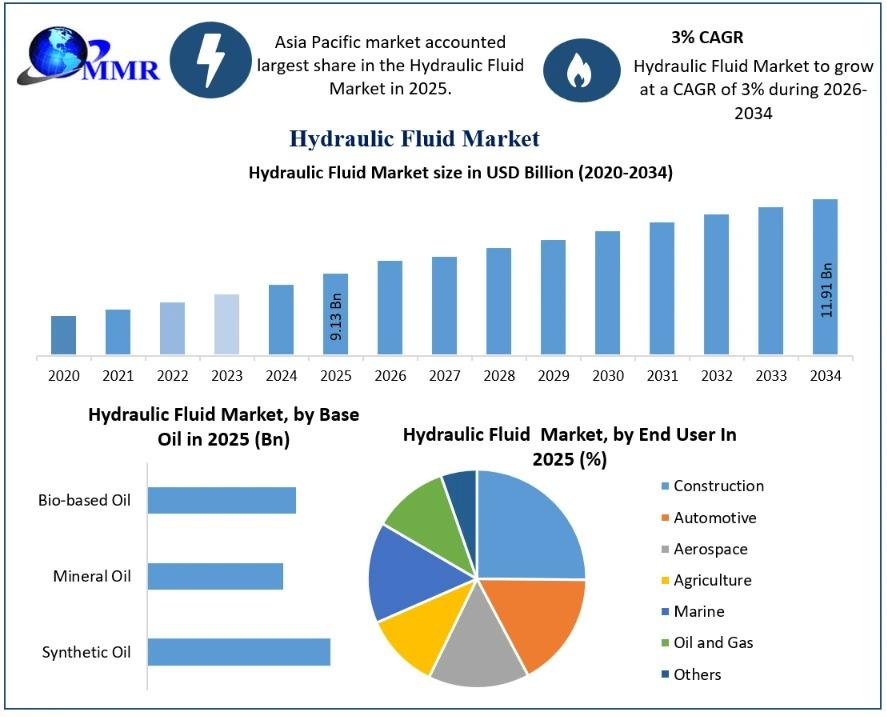
  • Hydraulic Fluid Market 2034 Outlook: USD 11.91 Billion Revenue Forecast at 3% CAGR
    Overview:

    The global Hydraulic Fluid Market was valued at USD 9.13 billion in 2025 and is projected to reach USD 11.91 billion by 2034, expanding at a CAGR of 3% during 2026–2034, according to Maximize Market Research. Increasing construction activities, industrial automation, agricultural mechanization, and demand for energy-efficient hydraulic systems are supporting industry expansion.

    The Hydraulic Fluid Market plays a critical role in transmitting power, reducing friction, controlling operating temperatures, and protecting hydraulic machinery from corrosion and wear. Hydraulic fluids are widely utilized in excavators, cranes, tractors, manufacturing equipment, marine machinery, and industrial power systems.

    Download a Free Sample Report Today:

    https://www.maximizemarketresearch.com/request-sample/32740/
    Hydraulic Fluid Market 2034 Outlook: USD 11.91 Billion Revenue Forecast at 3% CAGR Overview: The global Hydraulic Fluid Market was valued at USD 9.13 billion in 2025 and is projected to reach USD 11.91 billion by 2034, expanding at a CAGR of 3% during 2026–2034, according to Maximize Market Research. Increasing construction activities, industrial automation, agricultural mechanization, and demand for energy-efficient hydraulic systems are supporting industry expansion. The Hydraulic Fluid Market plays a critical role in transmitting power, reducing friction, controlling operating temperatures, and protecting hydraulic machinery from corrosion and wear. Hydraulic fluids are widely utilized in excavators, cranes, tractors, manufacturing equipment, marine machinery, and industrial power systems. Download a Free Sample Report Today: https://www.maximizemarketresearch.com/request-sample/32740/
    0 Comments ·0 Shares ·133 Views
  • The Carbon Capture, Utilization, and Storage (CCUS) Market According to the latest research insights from Stellar Market Research, the global CCUS market is experiencing a paradigm shift, crossing critical valuation milestones as heavy industries accelerate decarbonization roadmaps to comply with stringent global emission frameworks.

    The global industrial landscape is undergoing a massive structural transformation, shifting from voluntary carbon-reduction pledges to mandatory, compliance-driven decarbonization. As international regulatory bodies enforce tighter carbon pricing mechanisms—such as the European Union’s Emissions Trading System (ETS) and Carbon Border Adjustment Mechanism (CBAM)—heavy-emitting sectors like power generation, cement, steel, and chemicals can no longer treat carbon management as an afterthought.

    Key Findings from the Report
    Valuation & Growth Trajectory: The global Carbon Capture, Utilization, and Storage Market is projected to exceed USD 25.3 Billion by 2033, registering a compound annual growth rate (CAGR) of 23.8% from the base year.

    Dominant Segment: The Capture service segment commands the largest market share, serving as the essential upstream entry point for all downstream utilization and permanent geologic storage workflows.

    High-Growth Industrial End-Use: The Chemicals & Petrochemicals sector stands out as a leading end-use vertical, propelled by inherent high-concentration CO2 byproduct streams and direct integration into existing petrochemical gas-separation infrastructure.

    Regional Powerhouse: North America retains the leading regional market share, heavily supported by robust federal tax credits (such as the expanded 45Q tax incentives) and well-established pipeline networks.

    Emerging Growth Epicenter: Europe is recognized as the fastest-growing regional market, catalyzed by the EU Green Deal, cross-border infrastructure projects (like Northern Lights), and rigorous carbon pricing enforcement.

    Technology Adoption Shifts: Membrane and advanced solvent-based absorption technologies are gaining rapid commercial preference over legacy systems due to lower operational footprints and superior energy efficiency.

    Investment Relevance: Venture capital and institutional investments in CCUS infrastructure projects have surged past multi-billion-dollar thresholds, attracting major energy majors and sovereign wealth funds.

    For further information, click the following link:https://www.stellarmr.com/report/req_sample/carbon-capture-utilization-storage-market/2817
    Market Drivers and Restraints
    Drivers
    Stringent Environmental Regulations and Carbon Pricing: Global implementation of rigorous carbon taxes, net-zero mandates, and emission caps compel corporations to adopt CCUS to evade heavy financial penalties.

    Lucrative Government Subsidies and Tax Credits: Generous fiscal frameworks—most notably the U.S. 45Q tax credit and European green industrial funding—significantly improve project internal rates of return (IRR).

    Corporate Net-Zero Commitments and ESG Pressures: Institutional investors and consumer markets increasingly demand verified Scope 1 and Scope 2 emission reductions, compelling heavy industries to scale up carbon capture adoption.

    Restraints
    Prohibitive Capital Expenditure (CapEx): High upfront costs associated with engineering, designing, and constructing industrial-scale capture facilities and dedicated pipeline grids can deter mid-sized market participants.

    Complex Regulatory and Permitting Bottlenecks: Lengthy approval processes for underground CO2 storage sites and cross-border transport rights frequently cause project development delays.

    Technology, Regulation, and Sustainability Trends
    The evolution of the CCUS ecosystem is fundamentally anchored in next-generation technology and regulatory convergence. Innovations in modular, scalable solid sorbents and direct air capture (DAC) systems are driving down per-ton capture costs. Simultaneously, regulatory frameworks are evolving past simple emissions reporting into liability frameworks for permanent carbon storage, ensuring long-term environmental integrity. From an ESG standpoint, integrating CCUS into heavy industrial clusters is now viewed as the ultimate corporate safeguard against stranded assets, ensuring regulatory compliance while opening doors to green-certified product premiumization.

    Regional Insights
    North America: Dominates the global landscape, underpinned by proactive federal policies, abundant enhanced oil recovery (EOR) infrastructure, and deep-pocketed energy conglomerates accelerating commercial-scale hubs in the U.S. Gulf Coast and Western Canada.

    Europe: Serves as the fastest-growing market, led by aggressive decarbonization targets in the UK, Norway, the Netherlands, and Germany. The rapid development of North Sea offshore storage formations and cross-border transport agreements is establishing Europe as a global benchmark for industrial carbon management.

    Asia-Pacific: Exhibits substantial long-term potential, led by emerging industrial hubs in India, China, and Japan, where expanding manufacturing bases are gradually implementing early-stage CCUS feasibility pilots and national carbon-trading frameworks.

    Recent Industry Developments
    ExxonMobil (2025): Expanded its low-carbon solutions portfolio by securing major industrial carbon capture and offtake agreements along the U.S. Gulf Coast, scaling regional sequestration capacity by over 5 million metric tons per annum.

    Linde plc (2025): Partnered with key clean-energy developers to engineer modular carbon capture units for chemical processing plants, reducing customer retrofitting downtime by 30%.

    Mitsubishi Heavy Industries, Ltd. (2026): Deployed its proprietary advanced KS-21 solvent technology at a commercial waste-to-energy facility in Europe, achieving record-high CO2 recovery rates exceeding 98%.

    Shell Plc (2025): Advanced construction milestones on the Northern Lights offshore CO2 transport and storage project in Norway, successfully securing cross-border industrial storage contracts across multiple European manufacturing sectors.

    Aker Solutions (2026): Secured a major engineering contract for a large-scale cement plant decarbonization project, utilizing standardized carbon capture modules to slash lifecycle operational costs.

    Competitive Landscape
    The global CCUS market features a highly competitive ecosystem populated by major oil and gas multinationals, industrial gas giants, specialized clean-tech engineering firms, and oilfield service providers. Key market leaders—including Exxon Mobil Corporation, Fluor Corporation, Linde plc, Shell Plc, Mitsubishi Heavy Industries, Ltd., Schlumberger Limited, Aker Solutions, and Honeywell International—are actively expanding their market presence through strategic joint ventures, cross-border infrastructure partnerships, and aggressive intellectual property acquisitions. Competitors are heavily focusing on modular scalability and end-to-end service integration, offering turnkey solutions from point-source capture to secure underground storage.

    Analyst Commentary
    "The carbon capture, utilization, and storage market has decisively transitioned from experimental pilot testing to a multi-billion-dollar commercial asset class," said a Senior Research Analyst at Stellar Market Research. "As regulatory compliance costs rise and green premiums take hold, industrial players can no longer view decarbonization as a compliance cost center. The companies successfully navigating the next decade will be those that treat captured carbon not as waste, but as a strategic feedstock and a core pillar of sustainable industrial profitability."

    Future Outlook
    Through the forecast period, the CCUS market is poised for exponential expansion. Driven by declining technology costs, expanding shared pipeline networks, and tightening global emissions caps, adoption is expected to branch out from oil, gas, and chemicals into hard-to-abate sectors like maritime shipping, cement, and primary steelmaking. Public-private partnerships will remain instrumental in de-risking early-stage megaprojects, ultimately embedding CCUS as an indispensable structural pillar of the global low-carbon economy.

    For further information, click the following link:https://www.stellarmr.com/report/req_sample/carbon-capture-utilization-storage-market/2817
    About Stellar Market Research
    Stellar Market Research is a multifaceted market research and consulting company with professionals from several industries. Some of the industries we cover include medical devices, pharmaceutical manufacturers, science and engineering, electronic components, industrial equipment, technology and communication, cars and automobiles, chemical products and substances, general merchandise, beverages, personal care, and automated systems. To mention a few, we provide market-verified industry estimations, technical trend analysis, crucial market research, strategic advice, competition analysis, production and demand analysis, and client impact studies.

    Address
    Phase 3, Navale IT Zone, S.No. 51/2A/2, Office No. 202, 2nd floor, Near, Navale Brg, Narhe, Pune, Maharashtra 411041

    Email
    [email protected]

    Mobile
    +91 9607365656
    The Carbon Capture, Utilization, and Storage (CCUS) Market According to the latest research insights from Stellar Market Research, the global CCUS market is experiencing a paradigm shift, crossing critical valuation milestones as heavy industries accelerate decarbonization roadmaps to comply with stringent global emission frameworks. The global industrial landscape is undergoing a massive structural transformation, shifting from voluntary carbon-reduction pledges to mandatory, compliance-driven decarbonization. As international regulatory bodies enforce tighter carbon pricing mechanisms—such as the European Union’s Emissions Trading System (ETS) and Carbon Border Adjustment Mechanism (CBAM)—heavy-emitting sectors like power generation, cement, steel, and chemicals can no longer treat carbon management as an afterthought. Key Findings from the Report Valuation & Growth Trajectory: The global Carbon Capture, Utilization, and Storage Market is projected to exceed USD 25.3 Billion by 2033, registering a compound annual growth rate (CAGR) of 23.8% from the base year. Dominant Segment: The Capture service segment commands the largest market share, serving as the essential upstream entry point for all downstream utilization and permanent geologic storage workflows. High-Growth Industrial End-Use: The Chemicals & Petrochemicals sector stands out as a leading end-use vertical, propelled by inherent high-concentration CO2 byproduct streams and direct integration into existing petrochemical gas-separation infrastructure. Regional Powerhouse: North America retains the leading regional market share, heavily supported by robust federal tax credits (such as the expanded 45Q tax incentives) and well-established pipeline networks. Emerging Growth Epicenter: Europe is recognized as the fastest-growing regional market, catalyzed by the EU Green Deal, cross-border infrastructure projects (like Northern Lights), and rigorous carbon pricing enforcement. Technology Adoption Shifts: Membrane and advanced solvent-based absorption technologies are gaining rapid commercial preference over legacy systems due to lower operational footprints and superior energy efficiency. Investment Relevance: Venture capital and institutional investments in CCUS infrastructure projects have surged past multi-billion-dollar thresholds, attracting major energy majors and sovereign wealth funds. For further information, click the following link:https://www.stellarmr.com/report/req_sample/carbon-capture-utilization-storage-market/2817 Market Drivers and Restraints Drivers Stringent Environmental Regulations and Carbon Pricing: Global implementation of rigorous carbon taxes, net-zero mandates, and emission caps compel corporations to adopt CCUS to evade heavy financial penalties. Lucrative Government Subsidies and Tax Credits: Generous fiscal frameworks—most notably the U.S. 45Q tax credit and European green industrial funding—significantly improve project internal rates of return (IRR). Corporate Net-Zero Commitments and ESG Pressures: Institutional investors and consumer markets increasingly demand verified Scope 1 and Scope 2 emission reductions, compelling heavy industries to scale up carbon capture adoption. Restraints Prohibitive Capital Expenditure (CapEx): High upfront costs associated with engineering, designing, and constructing industrial-scale capture facilities and dedicated pipeline grids can deter mid-sized market participants. Complex Regulatory and Permitting Bottlenecks: Lengthy approval processes for underground CO2 storage sites and cross-border transport rights frequently cause project development delays. Technology, Regulation, and Sustainability Trends The evolution of the CCUS ecosystem is fundamentally anchored in next-generation technology and regulatory convergence. Innovations in modular, scalable solid sorbents and direct air capture (DAC) systems are driving down per-ton capture costs. Simultaneously, regulatory frameworks are evolving past simple emissions reporting into liability frameworks for permanent carbon storage, ensuring long-term environmental integrity. From an ESG standpoint, integrating CCUS into heavy industrial clusters is now viewed as the ultimate corporate safeguard against stranded assets, ensuring regulatory compliance while opening doors to green-certified product premiumization. Regional Insights North America: Dominates the global landscape, underpinned by proactive federal policies, abundant enhanced oil recovery (EOR) infrastructure, and deep-pocketed energy conglomerates accelerating commercial-scale hubs in the U.S. Gulf Coast and Western Canada. Europe: Serves as the fastest-growing market, led by aggressive decarbonization targets in the UK, Norway, the Netherlands, and Germany. The rapid development of North Sea offshore storage formations and cross-border transport agreements is establishing Europe as a global benchmark for industrial carbon management. Asia-Pacific: Exhibits substantial long-term potential, led by emerging industrial hubs in India, China, and Japan, where expanding manufacturing bases are gradually implementing early-stage CCUS feasibility pilots and national carbon-trading frameworks. Recent Industry Developments ExxonMobil (2025): Expanded its low-carbon solutions portfolio by securing major industrial carbon capture and offtake agreements along the U.S. Gulf Coast, scaling regional sequestration capacity by over 5 million metric tons per annum. Linde plc (2025): Partnered with key clean-energy developers to engineer modular carbon capture units for chemical processing plants, reducing customer retrofitting downtime by 30%. Mitsubishi Heavy Industries, Ltd. (2026): Deployed its proprietary advanced KS-21 solvent technology at a commercial waste-to-energy facility in Europe, achieving record-high CO2 recovery rates exceeding 98%. Shell Plc (2025): Advanced construction milestones on the Northern Lights offshore CO2 transport and storage project in Norway, successfully securing cross-border industrial storage contracts across multiple European manufacturing sectors. Aker Solutions (2026): Secured a major engineering contract for a large-scale cement plant decarbonization project, utilizing standardized carbon capture modules to slash lifecycle operational costs. Competitive Landscape The global CCUS market features a highly competitive ecosystem populated by major oil and gas multinationals, industrial gas giants, specialized clean-tech engineering firms, and oilfield service providers. Key market leaders—including Exxon Mobil Corporation, Fluor Corporation, Linde plc, Shell Plc, Mitsubishi Heavy Industries, Ltd., Schlumberger Limited, Aker Solutions, and Honeywell International—are actively expanding their market presence through strategic joint ventures, cross-border infrastructure partnerships, and aggressive intellectual property acquisitions. Competitors are heavily focusing on modular scalability and end-to-end service integration, offering turnkey solutions from point-source capture to secure underground storage. Analyst Commentary "The carbon capture, utilization, and storage market has decisively transitioned from experimental pilot testing to a multi-billion-dollar commercial asset class," said a Senior Research Analyst at Stellar Market Research. "As regulatory compliance costs rise and green premiums take hold, industrial players can no longer view decarbonization as a compliance cost center. The companies successfully navigating the next decade will be those that treat captured carbon not as waste, but as a strategic feedstock and a core pillar of sustainable industrial profitability." Future Outlook Through the forecast period, the CCUS market is poised for exponential expansion. Driven by declining technology costs, expanding shared pipeline networks, and tightening global emissions caps, adoption is expected to branch out from oil, gas, and chemicals into hard-to-abate sectors like maritime shipping, cement, and primary steelmaking. Public-private partnerships will remain instrumental in de-risking early-stage megaprojects, ultimately embedding CCUS as an indispensable structural pillar of the global low-carbon economy. For further information, click the following link:https://www.stellarmr.com/report/req_sample/carbon-capture-utilization-storage-market/2817 About Stellar Market Research Stellar Market Research is a multifaceted market research and consulting company with professionals from several industries. Some of the industries we cover include medical devices, pharmaceutical manufacturers, science and engineering, electronic components, industrial equipment, technology and communication, cars and automobiles, chemical products and substances, general merchandise, beverages, personal care, and automated systems. To mention a few, we provide market-verified industry estimations, technical trend analysis, crucial market research, strategic advice, competition analysis, production and demand analysis, and client impact studies. Address Phase 3, Navale IT Zone, S.No. 51/2A/2, Office No. 202, 2nd floor, Near, Navale Brg, Narhe, Pune, Maharashtra 411041 Email [email protected] Mobile +91 9607365656
    0 Comments ·0 Shares ·194 Views
  • The Industrial Boiler Market, projecting explosive valuation milestones through the next decade. According to the report, the market was valued at USD 17.12 billion in 2025 and is poised to scale up to USD 24.01 billion by 2032, expanding at a compound annual growth rate (CAGR) of 4.07%. This strategic growth trajectory underscores the critical role of high-efficiency thermal energy systems in enabling global industrial decarbonization, chemical processing, and smart manufacturing transformations.

    The global industrial landscape is undergoing a profound structural pivot. Driven by aggressive net-zero commitments and escalating carbon taxation, heavy industries are moving away from legacy, carbon-heavy coal-fired infrastructure toward advanced hybrid, hydrogen-ready, and ultra-efficient natural gas boilers. Simultaneously, the deployment of IoT-enabled automated combustion controls is redefining plant operations, turning traditional boilers from mere energy units into intelligent data nodes that optimize fuel efficiency and minimize downtime. This dual transition toward sustainability and digitization is opening lucrative avenues for equipment retrofitting, greenfield manufacturing expansions, and integrated smart-boiler services worldwide.

    Key Findings from the Report
    Valuation Milestone: The industrial boiler market reached a baseline valuation of USD 17.12 billion in 2025.

    Growth Trajectory: The market is projected to expand steadily at a 4.07% CAGR throughout the forecast period from 2026 to 2032.

    Dominant Segment (Type/Capacity): Water-tube and package boilers command the largest revenue shares, backed by high thermal efficiency and rapid steam generation capabilities required in heavy continuous-duty applications.

    Leading Application: The chemicals and petrochemicals sector remains the dominant end-user vertical, accounting for over one-third of total thermal energy equipment demand.

    Fuel Preferences: Natural gas continues to capture primary adoption share due to tightening emissions legislation, though biomass and hydrogen-compatible systems are registering the fastest incremental traction.

    Regional Dominance: The Asia-Pacific region leads global consumption, powered by expansive chemical hubs, textile manufacturing, and heavy industrialization in China and India.

    Investment Relevance: Capital expenditure is heavily skewed toward energy-efficient retrofits, IoT sensor integration, and low-emission boiler replacements.

    For further information, click the following link:https://www.stellarmr.com/report/req_sample/Industrial-Boiler-Market/339
    Market Drivers and Restraints
    Drivers
    Stringent Environmental Regulations: Global mandates capping greenhouse gas emissions force legacy plants to upgrade or replace high-polluting subcritical boilers with advanced low-NOx and low-CO2 alternatives.

    Industrial Expansion in Emerging Economies: Rapid manufacturing build-outs across Asia-Pacific and Latin America amplify the baseline demand for stable, high-capacity industrial steam generation.

    Rise of Energy-Efficient & Smart Technologies: Integration of IoT, predictive maintenance algorithms, and real-time fuel-to-steam efficiency monitoring drives widespread commercial adoption.

    Restraints
    High Initial Capital Outlay: The substantial upfront capital expenditure required for premium, low-emission boilers and auxiliary retrofitting can deter small and medium-scale enterprises (SMEs).

    Supply Chain Bottlenecks for Specialized Materials: Constraints in acquiring high-grade heat-resistant alloys and specialized automation components can cause project deployment delays.

    Technology, Regulation, and Sustainability Trends
    The industrial boiler ecosystem is experiencing an unprecedented convergence of digital technology and environmental compliance. Modern units are increasingly equipped with digital twins and IoT-enabled telemetry, allowing operators to monitor thermal efficiency, predict tube failures, and automate air-fuel ratios in real time. On the regulatory front, compliance frameworks such as the European Union’s Industrial Emissions Directive (IED) and stringent regional pollution control standards are penalizing high-emission operations, accelerating the phase-out of traditional coal units. Consequently, sustainability has shifted from a corporate PR objective to a core engineering requirement, with manufacturers prioritizing hydrogen-blended combustion capabilities and biomass co-firing.

    Regional Insights
    Asia-Pacific (Leading Region): APAC maintains its crown as the dominant and fastest-growing regional market. Accelerated by massive chemical corridor expansions in India, China, and Southeast Asia, local industries are aggressively modernizing legacy thermal infrastructure to match surging domestic manufacturing output.

    North America: Driven by rigorous EPA standards and widespread availability of affordable shale gas, North American industries are prioritizing high-efficiency package boilers and smart-grid integrated thermal systems.

    Europe: Europe spearheads the sustainability charge, focusing heavily on hydrogen-ready boilers, waste-heat recovery systems, and strict compliance with ultra-low carbon frameworks.

    Recent Industry Developments
    Thermax Ltd. (2025): Launched a new line of hybrid electric-steam industrial boilers designed to help chemical plants utilize surplus renewable energy, cutting direct fossil fuel consumption by up to 30%.

    Babcock & Wilcox (2025): Secured a major multi-million dollar contract to supply advanced, low-emission biomass-fired boilers for a municipal-industrial energy project in Europe, expanding its green-energy footprint.

    Siemens AG (2026): Partnered with leading boiler manufacturers to integrate industrial IoT edge controllers, delivering real-time thermodynamic efficiency optimization across heavy manufacturing lines.

    Cleaver-Brooks (2025): Expanded its North American manufacturing capacity with a specialized production line dedicated to ultra-low NOx packaged firetube boilers to meet strict regional clean air standards.

    Mitsubishi Heavy Industries (2026): Achieved successful commercial validation of its 100% hydrogen-ready combustion burner technology for industrial utility boilers, marking a critical milestone for net-zero heavy industry.

    Competitive Landscape
    The global industrial boiler market features a consolidated yet fiercely competitive landscape characterized by major engineering conglomerates and specialized thermal tech providers. Key players include Thermax Ltd., Siemens AG, Bharat Heavy Electricals Ltd. (BHEL), Mitsubishi Heavy Industries, Cleaver-Brooks, and Babcock & Wilcox. Leading corporations are focusing heavily on strategic mergers, acquisitions, and joint ventures to expand their geographic footprint and enhance their green-energy portfolios. Product differentiation is increasingly anchored around digital control integration, aftermarket servicing efficiency, and hydrogen fuel adaptability.

    Analyst Commentary
    "The industrial boiler market is no longer driven purely by basic steam generation capacity; it is undergoing a fundamental technological realignment centered around decarbonization and intelligence," said a Senior Research Analyst at Stellar Market Research. "As regulatory frameworks tighten globally, plant operators are moving past short-term cost-cutting. They are heavily investing in smart, fuel-flexible, and hydrogen-ready systems that future-proof their operations against both carbon taxation and volatile fuel pricing."

    Future Outlook
    Through the forecast horizon, the industrial boiler market will experience accelerated convergence between traditional heavy manufacturing and digital automation. Demand will increasingly pivot toward modular, scalable, and multi-fuel-capable systems that can seamlessly transition between natural gas, biomass, and green hydrogen. With emerging economies continuing to build out robust industrial infrastructure and developed nations prioritizing deep decarbonization retrofits, market participants that successfully embed advanced IoT diagnostics and carbon-neutral technologies into their core portfolios will capture dominant long-term market share.

    For further information, click the following link:https://www.stellarmr.com/report/req_sample/Industrial-Boiler-Market/339
    About Stellar Market Research
    Stellar Market Research is a multifaceted market research and consulting company with professionals from several industries. Some of the industries we cover include medical devices, pharmaceutical manufacturers, science and engineering, electronic components, industrial equipment, technology and communication, cars and automobiles, chemical products and substances, general merchandise, beverages, personal care, and automated systems. To mention a few, we provide market-verified industry estimations, technical trend analysis, crucial market research, strategic advice, competition analysis, production and demand analysis, and client impact studies.

    Address
    Phase 3, Navale IT Zone, S.No. 51/2A/2, Office No. 202, 2nd floor, Near, Navale Brg, Narhe, Pune, Maharashtra 411041

    Email
    [email protected]

    Mobile
    +91 9607365656
    The Industrial Boiler Market, projecting explosive valuation milestones through the next decade. According to the report, the market was valued at USD 17.12 billion in 2025 and is poised to scale up to USD 24.01 billion by 2032, expanding at a compound annual growth rate (CAGR) of 4.07%. This strategic growth trajectory underscores the critical role of high-efficiency thermal energy systems in enabling global industrial decarbonization, chemical processing, and smart manufacturing transformations. The global industrial landscape is undergoing a profound structural pivot. Driven by aggressive net-zero commitments and escalating carbon taxation, heavy industries are moving away from legacy, carbon-heavy coal-fired infrastructure toward advanced hybrid, hydrogen-ready, and ultra-efficient natural gas boilers. Simultaneously, the deployment of IoT-enabled automated combustion controls is redefining plant operations, turning traditional boilers from mere energy units into intelligent data nodes that optimize fuel efficiency and minimize downtime. This dual transition toward sustainability and digitization is opening lucrative avenues for equipment retrofitting, greenfield manufacturing expansions, and integrated smart-boiler services worldwide. Key Findings from the Report Valuation Milestone: The industrial boiler market reached a baseline valuation of USD 17.12 billion in 2025. Growth Trajectory: The market is projected to expand steadily at a 4.07% CAGR throughout the forecast period from 2026 to 2032. Dominant Segment (Type/Capacity): Water-tube and package boilers command the largest revenue shares, backed by high thermal efficiency and rapid steam generation capabilities required in heavy continuous-duty applications. Leading Application: The chemicals and petrochemicals sector remains the dominant end-user vertical, accounting for over one-third of total thermal energy equipment demand. Fuel Preferences: Natural gas continues to capture primary adoption share due to tightening emissions legislation, though biomass and hydrogen-compatible systems are registering the fastest incremental traction. Regional Dominance: The Asia-Pacific region leads global consumption, powered by expansive chemical hubs, textile manufacturing, and heavy industrialization in China and India. Investment Relevance: Capital expenditure is heavily skewed toward energy-efficient retrofits, IoT sensor integration, and low-emission boiler replacements. For further information, click the following link:https://www.stellarmr.com/report/req_sample/Industrial-Boiler-Market/339 Market Drivers and Restraints Drivers Stringent Environmental Regulations: Global mandates capping greenhouse gas emissions force legacy plants to upgrade or replace high-polluting subcritical boilers with advanced low-NOx and low-CO2 alternatives. Industrial Expansion in Emerging Economies: Rapid manufacturing build-outs across Asia-Pacific and Latin America amplify the baseline demand for stable, high-capacity industrial steam generation. Rise of Energy-Efficient & Smart Technologies: Integration of IoT, predictive maintenance algorithms, and real-time fuel-to-steam efficiency monitoring drives widespread commercial adoption. Restraints High Initial Capital Outlay: The substantial upfront capital expenditure required for premium, low-emission boilers and auxiliary retrofitting can deter small and medium-scale enterprises (SMEs). Supply Chain Bottlenecks for Specialized Materials: Constraints in acquiring high-grade heat-resistant alloys and specialized automation components can cause project deployment delays. Technology, Regulation, and Sustainability Trends The industrial boiler ecosystem is experiencing an unprecedented convergence of digital technology and environmental compliance. Modern units are increasingly equipped with digital twins and IoT-enabled telemetry, allowing operators to monitor thermal efficiency, predict tube failures, and automate air-fuel ratios in real time. On the regulatory front, compliance frameworks such as the European Union’s Industrial Emissions Directive (IED) and stringent regional pollution control standards are penalizing high-emission operations, accelerating the phase-out of traditional coal units. Consequently, sustainability has shifted from a corporate PR objective to a core engineering requirement, with manufacturers prioritizing hydrogen-blended combustion capabilities and biomass co-firing. Regional Insights Asia-Pacific (Leading Region): APAC maintains its crown as the dominant and fastest-growing regional market. Accelerated by massive chemical corridor expansions in India, China, and Southeast Asia, local industries are aggressively modernizing legacy thermal infrastructure to match surging domestic manufacturing output. North America: Driven by rigorous EPA standards and widespread availability of affordable shale gas, North American industries are prioritizing high-efficiency package boilers and smart-grid integrated thermal systems. Europe: Europe spearheads the sustainability charge, focusing heavily on hydrogen-ready boilers, waste-heat recovery systems, and strict compliance with ultra-low carbon frameworks. Recent Industry Developments Thermax Ltd. (2025): Launched a new line of hybrid electric-steam industrial boilers designed to help chemical plants utilize surplus renewable energy, cutting direct fossil fuel consumption by up to 30%. Babcock & Wilcox (2025): Secured a major multi-million dollar contract to supply advanced, low-emission biomass-fired boilers for a municipal-industrial energy project in Europe, expanding its green-energy footprint. Siemens AG (2026): Partnered with leading boiler manufacturers to integrate industrial IoT edge controllers, delivering real-time thermodynamic efficiency optimization across heavy manufacturing lines. Cleaver-Brooks (2025): Expanded its North American manufacturing capacity with a specialized production line dedicated to ultra-low NOx packaged firetube boilers to meet strict regional clean air standards. Mitsubishi Heavy Industries (2026): Achieved successful commercial validation of its 100% hydrogen-ready combustion burner technology for industrial utility boilers, marking a critical milestone for net-zero heavy industry. Competitive Landscape The global industrial boiler market features a consolidated yet fiercely competitive landscape characterized by major engineering conglomerates and specialized thermal tech providers. Key players include Thermax Ltd., Siemens AG, Bharat Heavy Electricals Ltd. (BHEL), Mitsubishi Heavy Industries, Cleaver-Brooks, and Babcock & Wilcox. Leading corporations are focusing heavily on strategic mergers, acquisitions, and joint ventures to expand their geographic footprint and enhance their green-energy portfolios. Product differentiation is increasingly anchored around digital control integration, aftermarket servicing efficiency, and hydrogen fuel adaptability. Analyst Commentary "The industrial boiler market is no longer driven purely by basic steam generation capacity; it is undergoing a fundamental technological realignment centered around decarbonization and intelligence," said a Senior Research Analyst at Stellar Market Research. "As regulatory frameworks tighten globally, plant operators are moving past short-term cost-cutting. They are heavily investing in smart, fuel-flexible, and hydrogen-ready systems that future-proof their operations against both carbon taxation and volatile fuel pricing." Future Outlook Through the forecast horizon, the industrial boiler market will experience accelerated convergence between traditional heavy manufacturing and digital automation. Demand will increasingly pivot toward modular, scalable, and multi-fuel-capable systems that can seamlessly transition between natural gas, biomass, and green hydrogen. With emerging economies continuing to build out robust industrial infrastructure and developed nations prioritizing deep decarbonization retrofits, market participants that successfully embed advanced IoT diagnostics and carbon-neutral technologies into their core portfolios will capture dominant long-term market share. For further information, click the following link:https://www.stellarmr.com/report/req_sample/Industrial-Boiler-Market/339 About Stellar Market Research Stellar Market Research is a multifaceted market research and consulting company with professionals from several industries. Some of the industries we cover include medical devices, pharmaceutical manufacturers, science and engineering, electronic components, industrial equipment, technology and communication, cars and automobiles, chemical products and substances, general merchandise, beverages, personal care, and automated systems. To mention a few, we provide market-verified industry estimations, technical trend analysis, crucial market research, strategic advice, competition analysis, production and demand analysis, and client impact studies. Address Phase 3, Navale IT Zone, S.No. 51/2A/2, Office No. 202, 2nd floor, Near, Navale Brg, Narhe, Pune, Maharashtra 411041 Email [email protected] Mobile +91 9607365656
    0 Comments ·0 Shares ·426 Views
  • Asia Pacific UPS Battery Market Trends Highlight Advanced Battery Technologies

    Market Estimation & Definition

    The Asia Pacific UPS Battery Market is expected to expand as businesses invest in digital infrastructure, data centers, telecommunications, and reliable power backup systems. According to Stellar Market Research, the market was valued at USD 412.18 million in 2025 and is projected to reach USD 917.63 million by 2035 , registering a compound annual growth rate (CAGR) of 9.3% during 2026–2035 .

    An uninterruptible power supply (UPS) battery provides backup electricity when the main power source fails or experiences a disruption. These batteries protect critical equipment, including servers, networking devices, industrial machinery, communication systems, and financial infrastructure. By maintaining power continuity, UPS batteries help prevent data loss, equipment damage, and costly operational interruptions. Their importance is increasing as businesses across Asia Pacific become more dependent on digital services and connected infrastructure.

    Download Free PDF Brochure: https://www.stellarmr.com/report/req_sample/Asia-Pacific-UPS-Battery-Market/136

    Market Growth Drivers & Opportunity

    The rapid expansion of data centers is a major driver of the Asia Pacific UPS Battery Market. Cloud computing, online transactions, artificial intelligence infrastructure, and enterprise digitalization are increasing the need for uninterrupted power. Data centers require dependable backup systems to protect servers and maintain service availability during electrical disturbances.

    Telecommunications development is another important growth factor. The expansion of 5G networks and edge computing infrastructure is creating demand for reliable backup power at communication facilities. Banking, financial services, and insurance companies also depend on UPS systems to maintain ATMs, transaction platforms, and data-processing operations.

    Government initiatives supporting smart cities, digital public services, and modern electricity infrastructure are creating additional opportunities. However, high initial investment, battery replacement costs, maintenance requirements, and differences in infrastructure development across the region can influence adoption. Suppliers that offer reliable products, efficient battery management, and competitive lifecycle costs may be better positioned to meet demand.

    What Lies Ahead: Emerging Trends Shaping the Future

    Lithium-ion technology is expected to play an increasingly important role in UPS battery applications. Compared with traditional lead-acid batteries, lithium-ion batteries can offer lower weight, a compact footprint, faster charging, and longer service life under suitable operating conditions. These characteristics make them attractive for data centers and facilities where space efficiency and reliability are priorities.

    Modular UPS systems are also gaining attention as businesses seek scalable power protection. Modular configurations can allow facilities to expand capacity as requirements increase, helping operators manage investment and operational needs.

    The development of smart grids, cloud services, and connected industrial systems will further support demand for advanced backup solutions. Battery monitoring and management technologies can help operators track battery health, identify potential failures, and plan maintenance more effectively. Manufacturers will need to balance performance, safety, affordability, and environmental considerations as battery deployment increases.

    Get More Report Details: https://www.stellarmr.com/report/Asia-Pacific-UPS-Battery-Market/136

    Segmentation Analysis

    According to Stellar Market Research, the Asia Pacific UPS Battery Market is segmented by topology, product type, and application.

    By Topology: Online, Standby, Line Interactive.
    By Product Type: Lead-acid, Lithium-Ion, Nickel Cadmium, Others.
    By Application: Residential, Commercial, Data Center, Industrial.
    Online UPS systems provide continuous power conditioning and are suitable for equipment requiring high levels of protection. Standby and line-interactive systems offer alternatives for applications with different power protection requirements.

    Within product types, lithium-ion batteries are projected to register strong growth because of their compact design, charging performance, and potential service-life advantages. By application, data centers represent a significant opportunity as cloud computing and digital services increase demand for dependable power infrastructure. The report identifies China as the leading country in the regional market, supported by its substantial digital infrastructure and investment in technology.

    Country-Level Analysis: USA and Germany

    United States: The United States is outside the geographic scope of this Asia Pacific report, but US-based companies participate in the broader UPS battery industry. Eaton Corporation and Vertiv Group Corporation are among the key players identified by Stellar Market Research. Their power management and critical-infrastructure solutions illustrate the importance of reliable backup power for data centers and industrial facilities.

    Germany: Germany is also outside the report's geographic scope. The study does not provide a separate German market valuation or forecast. For European industry context, the report identifies international suppliers operating in the wider power protection ecosystem, including Schneider Electric, although the company is headquartered in France rather than Germany. The market analysis therefore remains focused on Asia Pacific, where China, India, Japan, South Korea, Australia, ASEAN, and the rest of the region form the report's country coverage.

    Competitive Analysis

    The Asia Pacific UPS Battery Market features established battery manufacturers, electrical equipment suppliers, and power management companies. Key players identified by Stellar Market Research include CSB Battery Co., Ltd., East Penn Manufacturing Company, Eaton Corporation plc, Exide Industries Limited, FIAMM Energy Technology SpA, GS Yuasa International Ltd., Leoch International Technology Limited Inc., Schneider Electric SE, and Vertiv Group Corporation .

    Competition is shaped by battery performance, reliability, service life, safety, pricing, and compatibility with UPS systems. Companies investing in lithium-ion technology, intelligent monitoring, and scalable backup solutions may strengthen their position as data center and industrial power requirements grow.

    Download Free PDF Brochure: https://www.stellarmr.com/report/req_sample/Asia-Pacific-UPS-Battery-Market/136

    Press Release Conclusion

    The Asia Pacific UPS Battery Market is projected to reach USD 917.63 million by 2034 as digital infrastructure, data center development, telecommunications expansion, and industrial automation increase demand for dependable backup power.

    Although cost and maintenance considerations remain important, lithium-ion batteries, modular UPS systems, and advanced monitoring technologies are creating new opportunities. Manufacturers that combine reliability, efficiency, and competitive lifecycle costs will be well positioned to support the region's growing need for uninterrupted electricity.

    About Stellar Market Research:

    Stellar Market Research is a multifaceted market research and consulting company with professionals from several industries. Some of the industries we cover include medical devices, pharmaceutical manufacturers, science and engineering, electronic components, industrial equipment, technology and communication, cars and automobiles, chemical products and substances, general merchandise, beverages, personal care, and automated systems. To mention a few, we provide market-verified industry estimations, technical trend analysis, crucial market research, strategic advice, competition analysis, production and demand analysis, and client impact studies.

    Contact Stellar Market Research:

    3rd Floor, Navale IT Park, Phase 2

    Pune Banglore Highway, Narhe,

    Pune, Maharashtra 411041, India

    [email protected]

    +91 20 6630 3320 | +91 9607365656
    Asia Pacific UPS Battery Market Trends Highlight Advanced Battery Technologies Market Estimation & Definition The Asia Pacific UPS Battery Market is expected to expand as businesses invest in digital infrastructure, data centers, telecommunications, and reliable power backup systems. According to Stellar Market Research, the market was valued at USD 412.18 million in 2025 and is projected to reach USD 917.63 million by 2035 , registering a compound annual growth rate (CAGR) of 9.3% during 2026–2035 . An uninterruptible power supply (UPS) battery provides backup electricity when the main power source fails or experiences a disruption. These batteries protect critical equipment, including servers, networking devices, industrial machinery, communication systems, and financial infrastructure. By maintaining power continuity, UPS batteries help prevent data loss, equipment damage, and costly operational interruptions. Their importance is increasing as businesses across Asia Pacific become more dependent on digital services and connected infrastructure. Download Free PDF Brochure: https://www.stellarmr.com/report/req_sample/Asia-Pacific-UPS-Battery-Market/136 Market Growth Drivers & Opportunity The rapid expansion of data centers is a major driver of the Asia Pacific UPS Battery Market. Cloud computing, online transactions, artificial intelligence infrastructure, and enterprise digitalization are increasing the need for uninterrupted power. Data centers require dependable backup systems to protect servers and maintain service availability during electrical disturbances. Telecommunications development is another important growth factor. The expansion of 5G networks and edge computing infrastructure is creating demand for reliable backup power at communication facilities. Banking, financial services, and insurance companies also depend on UPS systems to maintain ATMs, transaction platforms, and data-processing operations. Government initiatives supporting smart cities, digital public services, and modern electricity infrastructure are creating additional opportunities. However, high initial investment, battery replacement costs, maintenance requirements, and differences in infrastructure development across the region can influence adoption. Suppliers that offer reliable products, efficient battery management, and competitive lifecycle costs may be better positioned to meet demand. What Lies Ahead: Emerging Trends Shaping the Future Lithium-ion technology is expected to play an increasingly important role in UPS battery applications. Compared with traditional lead-acid batteries, lithium-ion batteries can offer lower weight, a compact footprint, faster charging, and longer service life under suitable operating conditions. These characteristics make them attractive for data centers and facilities where space efficiency and reliability are priorities. Modular UPS systems are also gaining attention as businesses seek scalable power protection. Modular configurations can allow facilities to expand capacity as requirements increase, helping operators manage investment and operational needs. The development of smart grids, cloud services, and connected industrial systems will further support demand for advanced backup solutions. Battery monitoring and management technologies can help operators track battery health, identify potential failures, and plan maintenance more effectively. Manufacturers will need to balance performance, safety, affordability, and environmental considerations as battery deployment increases. Get More Report Details: https://www.stellarmr.com/report/Asia-Pacific-UPS-Battery-Market/136 Segmentation Analysis According to Stellar Market Research, the Asia Pacific UPS Battery Market is segmented by topology, product type, and application. By Topology: Online, Standby, Line Interactive. By Product Type: Lead-acid, Lithium-Ion, Nickel Cadmium, Others. By Application: Residential, Commercial, Data Center, Industrial. Online UPS systems provide continuous power conditioning and are suitable for equipment requiring high levels of protection. Standby and line-interactive systems offer alternatives for applications with different power protection requirements. Within product types, lithium-ion batteries are projected to register strong growth because of their compact design, charging performance, and potential service-life advantages. By application, data centers represent a significant opportunity as cloud computing and digital services increase demand for dependable power infrastructure. The report identifies China as the leading country in the regional market, supported by its substantial digital infrastructure and investment in technology. Country-Level Analysis: USA and Germany United States: The United States is outside the geographic scope of this Asia Pacific report, but US-based companies participate in the broader UPS battery industry. Eaton Corporation and Vertiv Group Corporation are among the key players identified by Stellar Market Research. Their power management and critical-infrastructure solutions illustrate the importance of reliable backup power for data centers and industrial facilities. Germany: Germany is also outside the report's geographic scope. The study does not provide a separate German market valuation or forecast. For European industry context, the report identifies international suppliers operating in the wider power protection ecosystem, including Schneider Electric, although the company is headquartered in France rather than Germany. The market analysis therefore remains focused on Asia Pacific, where China, India, Japan, South Korea, Australia, ASEAN, and the rest of the region form the report's country coverage. Competitive Analysis The Asia Pacific UPS Battery Market features established battery manufacturers, electrical equipment suppliers, and power management companies. Key players identified by Stellar Market Research include CSB Battery Co., Ltd., East Penn Manufacturing Company, Eaton Corporation plc, Exide Industries Limited, FIAMM Energy Technology SpA, GS Yuasa International Ltd., Leoch International Technology Limited Inc., Schneider Electric SE, and Vertiv Group Corporation . Competition is shaped by battery performance, reliability, service life, safety, pricing, and compatibility with UPS systems. Companies investing in lithium-ion technology, intelligent monitoring, and scalable backup solutions may strengthen their position as data center and industrial power requirements grow. Download Free PDF Brochure: https://www.stellarmr.com/report/req_sample/Asia-Pacific-UPS-Battery-Market/136 Press Release Conclusion The Asia Pacific UPS Battery Market is projected to reach USD 917.63 million by 2034 as digital infrastructure, data center development, telecommunications expansion, and industrial automation increase demand for dependable backup power. Although cost and maintenance considerations remain important, lithium-ion batteries, modular UPS systems, and advanced monitoring technologies are creating new opportunities. Manufacturers that combine reliability, efficiency, and competitive lifecycle costs will be well positioned to support the region's growing need for uninterrupted electricity. About Stellar Market Research: Stellar Market Research is a multifaceted market research and consulting company with professionals from several industries. Some of the industries we cover include medical devices, pharmaceutical manufacturers, science and engineering, electronic components, industrial equipment, technology and communication, cars and automobiles, chemical products and substances, general merchandise, beverages, personal care, and automated systems. To mention a few, we provide market-verified industry estimations, technical trend analysis, crucial market research, strategic advice, competition analysis, production and demand analysis, and client impact studies. Contact Stellar Market Research: 3rd Floor, Navale IT Park, Phase 2 Pune Banglore Highway, Narhe, Pune, Maharashtra 411041, India [email protected] +91 20 6630 3320 | +91 9607365656
    0 Comments ·0 Shares ·473 Views
  • Stellar Market Research has released an exhaustive strategic report on the Utility Markers Market, valuing the global industry at USD 488.37 million in 2025. As urban centers accelerate subterranean utility upgrades, smart grid rollouts, and fiber-optic network deployments, the market is experiencing an unprecedented digital transformation. Driven by stringent damage-prevention regulations and the critical need to safeguard underground assets, the sector is projected to expand robustly at a compound annual growth rate (CAGR) of 7.1%, reaching USD 789.37 million by 2032.

    Modernization of underground infrastructure has shifted from a secondary maintenance task to an urgent national security and economic imperative. Subsurface congestion involving telecommunications, gas pipelines, electrical grids, and water supply networks has heightened the risk of costly utility strikes during civil excavation. The integration of electronic marker systems (EMS) equipped with radio-frequency identification (RFID) technology represents a paradigm shift from passive asset identification to active, data-rich underground mapping. This transformation enables utilities to reduce asset location times, minimize service outages, and integrate physical infrastructure seamlessly with GIS (Geographic Information System) databases.

    Key Findings from the Report
    Valuation Milestone: The global Utility Markers Market stands at USD 488.37 million in 2025 and is forecasted to hit USD 789.37 million by 2032.

    Growth Trajectory: The market will advance at a steady CAGR of 7.1% throughout the 2026–2032 forecast period.

    Dominant Technology Segment: Electronic marker systems (EMS) capture the largest revenue share, driven by their superior reliability and frequency-specific programming capabilities.

    Fastest-Growing Segment: RFID-enabled smart utility markers are exhibiting the highest growth rate due to soaring demand for precise depth measurement and data storage directly on the marker.

    Leading Regional Hub: North America dominates the global landscape, underpinned by aggressive smart city investments and rigorous "Call Before You Dig" regulations.

    Emerging Growth Frontier: Asia-Pacific is registering the fastest regional growth, propelled by massive urbanization sweeps and smart grid initiatives in emerging economies.

    Investment Relevance: Utility asset owners and telecom operators are increasing capital expenditures on sub-surface visibility solutions to mitigate high financial liabilities associated with accidental infrastructure damage.

    For further information, click the following link:https://www.stellarmr.com/report/req_sample/utility-markers-market/2850

    Market Drivers and Restraints
    Driver 1: Strict Excavation Safety Regulations and Compliance Mandates. Governments worldwide are enforcing zero-tolerance policies for accidental utility line strikes, compelling contractors and utility providers to install certified underground markers.

    Driver 2: Rapid Expansion of Smart Grid and Fiber-Optic Networks. The large-scale rollout of 5G infrastructure, smart electricity meters, and fiber-to-the-home (FTTH) networks requires foolproof subterranean mapping to prevent service disruptions.

    Driver 3: Technological Advancements in RFID and GPS Integration. Modern markers now feature unique identification numbers and GIS coordinate compatibility, drastically cutting asset retrieval times.

    Restraint 1: High Initial Deployment and Retrofitting Costs. Upgrading legacy utility networks with advanced electronic and RFID markers involves substantial upfront capital expenditure.

    Restraint 2: Standardisation and Interoperability Hurdles. Varying regional frequencies and lack of uniform global interoperability standards across multi-utility corridors can slow down large-scale deployments.

    Technology, Regulation, and Sustainability Trends
    The industry is experiencing a massive wave of technological convergence, merging traditional physical marking with cloud-connected GIS platforms. Regulatory frameworks such as the European Union’s digital infrastructure directives and North America’s Common Ground Alliance (CGA) guidelines are tightening compliance, making sub-surface asset traceability mandatory. From an ESG standpoint, utility markers contribute to sustainability by preventing accidental ruptures of hazardous gas lines, water leaks, and power outages, thereby reducing emergency excavation carbon footprints and ecological degradation.

    Regional Insights
    North America commands the leading revenue share, anchored by advanced utility grids across the United States and Canada, coupled with rigorous enforcement of damage prevention laws. Meanwhile, the Asia-Pacific region represents the most dynamic emerging market, led by rapid urban development in India, China, and Southeast Asia. Massive government-backed smart city projects and nationwide fiber-optic expansions across APAC are driving unprecedented adoption volumes.

    Recent Industry Developments
    3M Company (2025): Expanded its portfolio of ID Electronic Marker System (EMS) products by integrating enhanced high-frequency RFID chips, reducing asset identification error rates by 18% across major municipal projects.

    Tempo Communications (2025): Partnered with a leading European utility provider to deploy next-generation programmable utility markers, cutting sub-surface tracing time by 30% in congested urban zones.

    Plainfield Precision (2024): Invested $12 million to expand manufacturing capacity for eco-friendly, biodegradable utility marker housings, supporting corporate net-zero supply chain initiatives.

    Vivax-Metrotech (2024): Launched an advanced utility locator compatible with multi-frequency markers, driving a 22% increase in sales across North American telecommunication networks.

    Radiodetection (2024): Secured a major framework agreement with a national UK telecom operator to supply smart marker solutions, reinforcing digital mapping compliance across urban broadband rollouts.

    Competitive Landscape
    The global utility markers market features a consolidated yet fiercely competitive ecosystem. Key market participants include 3M Company, Tempo Communications, Radiodetection Ltd., Vivax-Metrotech Corporation, and Pro-Line Safety Products. Leading players are focusing on strategic acquisitions, technological integration of RFID with cloud GIS, and expanding manufacturing footprints in emerging economies to capture rising infrastructural spend.

    Analyst Commentary
    "The utility markers sector is undergoing a quiet revolution," notes a Senior Research Analyst at Stellar Market Research. "As underground space becomes increasingly crowded with overlapping telecom, power, and water conduits, passive marking is no longer sufficient. The market pivot toward RFID-enabled and GIS-integrated smart markers is transforming underground asset management from a compliance checkbox into a core pillar of digital infrastructure resilience."

    Future Outlook
    Through 2032, the utility markers market will witness sustained expansion fueled by the global transition toward smart cities and automated utility management. Demand will increasingly shift from basic color-coded physical stakes to intelligent, programmable electronic markers. As regulatory frameworks tighten and infrastructure investments scale globally, market players offering seamless cloud-integrated asset tracking will capture dominant competitive advantages.

    For further information, click the following link:https://www.stellarmr.com/report/req_sample/utility-markers-market/2850
    About Stellar Market Research
    Stellar Market Research is a multifaceted market research and consulting company with professionals from several industries. Some of the industries we cover include medical devices, pharmaceutical manufacturers, science and engineering, electronic components, industrial equipment, technology and communication, cars and automobiles, chemical products and substances, general merchandise, beverages, personal care, and automated systems. To mention a few, we provide market-verified industry estimations, technical trend analysis, crucial market research, strategic advice, competition analysis, production and demand analysis, and client impact studies.

    Address
    Phase 3, Navale IT Zone, S.No. 51/2A/2, Office No. 202, 2nd floor, Near, Navale Brg, Narhe, Pune, Maharashtra 411041

    Email
    [email protected]

    Mobile
    +91 9607365656
    Stellar Market Research has released an exhaustive strategic report on the Utility Markers Market, valuing the global industry at USD 488.37 million in 2025. As urban centers accelerate subterranean utility upgrades, smart grid rollouts, and fiber-optic network deployments, the market is experiencing an unprecedented digital transformation. Driven by stringent damage-prevention regulations and the critical need to safeguard underground assets, the sector is projected to expand robustly at a compound annual growth rate (CAGR) of 7.1%, reaching USD 789.37 million by 2032. Modernization of underground infrastructure has shifted from a secondary maintenance task to an urgent national security and economic imperative. Subsurface congestion involving telecommunications, gas pipelines, electrical grids, and water supply networks has heightened the risk of costly utility strikes during civil excavation. The integration of electronic marker systems (EMS) equipped with radio-frequency identification (RFID) technology represents a paradigm shift from passive asset identification to active, data-rich underground mapping. This transformation enables utilities to reduce asset location times, minimize service outages, and integrate physical infrastructure seamlessly with GIS (Geographic Information System) databases. Key Findings from the Report Valuation Milestone: The global Utility Markers Market stands at USD 488.37 million in 2025 and is forecasted to hit USD 789.37 million by 2032. Growth Trajectory: The market will advance at a steady CAGR of 7.1% throughout the 2026–2032 forecast period. Dominant Technology Segment: Electronic marker systems (EMS) capture the largest revenue share, driven by their superior reliability and frequency-specific programming capabilities. Fastest-Growing Segment: RFID-enabled smart utility markers are exhibiting the highest growth rate due to soaring demand for precise depth measurement and data storage directly on the marker. Leading Regional Hub: North America dominates the global landscape, underpinned by aggressive smart city investments and rigorous "Call Before You Dig" regulations. Emerging Growth Frontier: Asia-Pacific is registering the fastest regional growth, propelled by massive urbanization sweeps and smart grid initiatives in emerging economies. Investment Relevance: Utility asset owners and telecom operators are increasing capital expenditures on sub-surface visibility solutions to mitigate high financial liabilities associated with accidental infrastructure damage. For further information, click the following link:https://www.stellarmr.com/report/req_sample/utility-markers-market/2850 Market Drivers and Restraints Driver 1: Strict Excavation Safety Regulations and Compliance Mandates. Governments worldwide are enforcing zero-tolerance policies for accidental utility line strikes, compelling contractors and utility providers to install certified underground markers. Driver 2: Rapid Expansion of Smart Grid and Fiber-Optic Networks. The large-scale rollout of 5G infrastructure, smart electricity meters, and fiber-to-the-home (FTTH) networks requires foolproof subterranean mapping to prevent service disruptions. Driver 3: Technological Advancements in RFID and GPS Integration. Modern markers now feature unique identification numbers and GIS coordinate compatibility, drastically cutting asset retrieval times. Restraint 1: High Initial Deployment and Retrofitting Costs. Upgrading legacy utility networks with advanced electronic and RFID markers involves substantial upfront capital expenditure. Restraint 2: Standardisation and Interoperability Hurdles. Varying regional frequencies and lack of uniform global interoperability standards across multi-utility corridors can slow down large-scale deployments. Technology, Regulation, and Sustainability Trends The industry is experiencing a massive wave of technological convergence, merging traditional physical marking with cloud-connected GIS platforms. Regulatory frameworks such as the European Union’s digital infrastructure directives and North America’s Common Ground Alliance (CGA) guidelines are tightening compliance, making sub-surface asset traceability mandatory. From an ESG standpoint, utility markers contribute to sustainability by preventing accidental ruptures of hazardous gas lines, water leaks, and power outages, thereby reducing emergency excavation carbon footprints and ecological degradation. Regional Insights North America commands the leading revenue share, anchored by advanced utility grids across the United States and Canada, coupled with rigorous enforcement of damage prevention laws. Meanwhile, the Asia-Pacific region represents the most dynamic emerging market, led by rapid urban development in India, China, and Southeast Asia. Massive government-backed smart city projects and nationwide fiber-optic expansions across APAC are driving unprecedented adoption volumes. Recent Industry Developments 3M Company (2025): Expanded its portfolio of ID Electronic Marker System (EMS) products by integrating enhanced high-frequency RFID chips, reducing asset identification error rates by 18% across major municipal projects. Tempo Communications (2025): Partnered with a leading European utility provider to deploy next-generation programmable utility markers, cutting sub-surface tracing time by 30% in congested urban zones. Plainfield Precision (2024): Invested $12 million to expand manufacturing capacity for eco-friendly, biodegradable utility marker housings, supporting corporate net-zero supply chain initiatives. Vivax-Metrotech (2024): Launched an advanced utility locator compatible with multi-frequency markers, driving a 22% increase in sales across North American telecommunication networks. Radiodetection (2024): Secured a major framework agreement with a national UK telecom operator to supply smart marker solutions, reinforcing digital mapping compliance across urban broadband rollouts. Competitive Landscape The global utility markers market features a consolidated yet fiercely competitive ecosystem. Key market participants include 3M Company, Tempo Communications, Radiodetection Ltd., Vivax-Metrotech Corporation, and Pro-Line Safety Products. Leading players are focusing on strategic acquisitions, technological integration of RFID with cloud GIS, and expanding manufacturing footprints in emerging economies to capture rising infrastructural spend. Analyst Commentary "The utility markers sector is undergoing a quiet revolution," notes a Senior Research Analyst at Stellar Market Research. "As underground space becomes increasingly crowded with overlapping telecom, power, and water conduits, passive marking is no longer sufficient. The market pivot toward RFID-enabled and GIS-integrated smart markers is transforming underground asset management from a compliance checkbox into a core pillar of digital infrastructure resilience." Future Outlook Through 2032, the utility markers market will witness sustained expansion fueled by the global transition toward smart cities and automated utility management. Demand will increasingly shift from basic color-coded physical stakes to intelligent, programmable electronic markers. As regulatory frameworks tighten and infrastructure investments scale globally, market players offering seamless cloud-integrated asset tracking will capture dominant competitive advantages. For further information, click the following link:https://www.stellarmr.com/report/req_sample/utility-markers-market/2850 About Stellar Market Research Stellar Market Research is a multifaceted market research and consulting company with professionals from several industries. Some of the industries we cover include medical devices, pharmaceutical manufacturers, science and engineering, electronic components, industrial equipment, technology and communication, cars and automobiles, chemical products and substances, general merchandise, beverages, personal care, and automated systems. To mention a few, we provide market-verified industry estimations, technical trend analysis, crucial market research, strategic advice, competition analysis, production and demand analysis, and client impact studies. Address Phase 3, Navale IT Zone, S.No. 51/2A/2, Office No. 202, 2nd floor, Near, Navale Brg, Narhe, Pune, Maharashtra 411041 Email [email protected] Mobile +91 9607365656
    0 Comments ·0 Shares ·419 Views
  • Stellar Market Research today announced the release of its comprehensive intelligence report on the Instrument Transformer Market, highlighting a pivotal industry transformation driven by smart grid investments, renewable integration, and high-voltage direct current (HVDC) transmission upgrades.

    Traditionally viewed as passive electrical components, instrument transformers are experiencing a profound technological renaissance. The rapid acceleration of smart grid deployments, industrial automation, and the proliferation of digital substations utilizing IEC 61850 communication standards are redefining the market. Utilities and heavy industrial operators are increasingly pivoting toward optical and non-conventional instrument transformers (NCITs) to eliminate saturation risks, enhance cyber-secure data transmission, and reduce environmental footprints by eliminating oil-insulated infrastructure. This report provides critical decision-makers, grid operators, and institutional investors with granular intelligence on how technological convergence and decarbonization mandates are reshaping capital allocation across transmission and distribution (T&D) networks globally.

    Key Findings from the Report
    Market Valuation & Growth Trajectory: The global Instrument Transformer Market is projected to expand at a robust compound annual growth rate (CAGR) of over 6.2% throughout the forecast period, transitioning from a robust base year valuation toward substantial multi-billion-dollar milestones by 2033.

    Dominant Product Segment: Potential/Voltage Transformers (VTs) maintain the dominant market share, anchored by their indispensable role in revenue metering, system protection, and precise voltage regulation across high-voltage transmission corridors.

    Fastest-Growing Segment: Non-conventional and optical instrument transformers (NCITs) represent the fastest-growing segment, driven by digital substation retrofits, immunity to electromagnetic interference (EMI), and enhanced personnel safety.

    Voltage Class Breakdown: High-voltage (HV) and ultra-high-voltage (UHV) applications account for the largest revenue share, fueled by cross-border interconnections and long-distance bulk power evacuation projects.

    Regional Dominance: Asia-Pacific leads the global market, propelled by massive grid expansion programs in India, China, and Southeast Asia to accommodate surging electrification and renewable capacity additions.

    Emerging Regional Pocket: North America and Europe emerge as vital high-growth pockets, driven by aggressive replacement cycles for aging grid infrastructure and stringent regulatory mandates for grid resilience.

    Investment & Capital Focus: Private equity and strategic venture capital are heavily targeting manufacturers specializing in eco-friendly gas-insulated switchgear (GIS) compatible units and IoT-enabled smart sensors.

    For further information, click the following link:https://www.stellarmr.com/report/req_sample/instrument-transformer-market/2839
    Market Drivers and Restraints
    Drivers
    Accelerating Global Smart Grid & Digital Substation Investments: Utilities worldwide are committing billions to modernize transmission networks, integrating IoT sensors, automated fault detection, and digital communication protocols that necessitate advanced instrument transformers.

    Massive Integration of Renewable Energy Sources: The exponential growth of utility-scale solar and offshore wind farms requires precise monitoring and high-accuracy measurement equipment to stabilize intermittent power generation and maintain grid frequency.

    Rigorous Grid Reliability and Safety Mandates: Strict regulatory frameworks enforced by bodies such as the Federal Energy Regulatory Commission (FERC) and international counterparts compel utilities to upgrade outmoded protection relays, minimizing catastrophic blackouts.

    Restraints
    High Capital Expenditure for Advanced Retrofits: The transition from conventional electromagnetic transformers to optical or digital NCIT systems entails substantial upfront capital investments, creating budgetary friction for smaller municipal utilities.

    Supply Chain Vulnerabilities in Raw Materials: Persistent market price volatility in critical raw materials—including electrical steel, copper winding, and specialized insulating resins—continues to compress manufacturer profit margins and extend lead times.

    Technology, Regulation, and Sustainability Trends
    The instrument transformer sector is experiencing a profound operational transformation catalyzed by evolving environmental and technological standards. The industry is rapidly phasing out sulfur hexafluoride (SF6)—a potent greenhouse gas historically used for insulation—in favor of eco-friendly, dry-type, or alternative gas-insulated technologies that align with global Environmental, Social, and Governance (ESG) mandates. Furthermore, the integration of fiber-optic sensing and IoT-enabled condition monitoring allows real-time thermal and electrical profiling, enabling predictive maintenance that drastically reduces unplanned downtime. On the regulatory front, compliance with IEC 61850 interoperability standards has become a non-negotiable benchmark for market entry, compelling manufacturers to embed advanced digital communication interfaces directly into their hardware architecture.

    Regional Insights
    Asia-Pacific (APAC): Dominating the global landscape, APAC’s growth is anchored by massive state-backed grid modernization initiatives, such as India's revamped distribution sector schemes and China's UHV transmission superhighways. Rapid industrialization and rural electrification continue to drive immense volume demand.

    North America: Characterized by brownfield modernization, North American utilities are prioritizing grid hardening against extreme weather events and cyber-physical threats, accelerating the adoption of high-accuracy optical measurement solutions.

    Europe: Driven by the European Green Deal and ambitious offshore wind buildouts in the North Sea, Europe stands out for its stringent sustainability requirements, heavily favoring SF6-free and recyclable instrument transformer designs.

    Latin America & Middle East & Africa (MEA): Emerging as high-potential growth regions, MEA and Latin America are expanding inter-regional grid interconnectors and upgrading urban distribution networks to curb technical losses and accommodate mining and industrial loads.

    Recent Industry Developments
    ABB (2025): Launched an eco-efficient portfolio of medium-voltage instrument transformers utilizing alternative insulation gases, achieving a 99% reduction in global warming potential (GWP) and helping European utilities meet strict corporate carbon-neutrality targets.

    Siemens Energy (2025): Expanded its digital substation manufacturing capacity in Nuremberg, Germany, integrating advanced optical sensor calibration lines to meet a 35% surge in European orders for IEC 61850-compliant non-conventional instrument transformers.

    Schneider Electric (2024): Formed a strategic partnership with a leading IoT analytics firm to embed real-time thermal monitoring software directly into outdoor high-voltage current transformers, boosting asset lifespan by an estimated 20%.

    GE Vernova (2024): Secured a major multi-year supply agreement with a primary North American transmission grid operator to deploy advanced fiber-optic current sensors, significantly improving fault-detection speed across critical interstate corridors.

    Mitsubishi Electric (2026): Completed a strategic production facility expansion in India, aiming to scale up domestic manufacturing of high-voltage instrument transformers to support rapid regional grid buildouts under the National Infrastructure Pipeline.

    Competitive Landscape
    The global Instrument Transformer Market features a consolidated yet fiercely competitive landscape characterized by major multinational electrical equipment manufacturers leveraging mergers, strategic joint ventures, and technological differentiation. Key market leaders—including ABB, Siemens Energy, Schneider Electric, GE Vernova, Mitsubishi Electric, Arteche, Ritz Instrument Transformers, and Eaton Corporation—are actively focusing on portfolio expansion toward digital, SF6-free, and smart-sensor-embedded solutions. Leading players are also strengthening their regional distribution networks and engaging in long-term supply agreements with transmission system operators (TSOs) to secure dominant market positioning.

    Analyst Commentary
    "The instrument transformer market is no longer defined merely by electrical accuracy; it is now the foundational nerve center of the digital grid," said a Senior Research Analyst at Stellar Market Research. "As utilities race to integrate decentralized renewables and deploy AI-driven grid management systems, the ability to deliver real-time, cyber-secure, and eco-friendly measurement data will separate market leaders from legacy laggards. Strategic investments in non-conventional and optical sensing technologies are paramount for capturing long-term value through 2033."

    Future Outlook
    Looking ahead through the forecast period, demand for instrument transformers will remain closely tied to global decarbonization trajectories and accelerated electrification. As artificial intelligence and machine learning permeate substation automation, instrument transformers will increasingly function as smart edge-computing nodes capable of autonomous anomaly detection. Investment flows are projected to heavily favor manufacturers providing modular, interoperable, and fully recyclable hardware solutions, ensuring resilient growth amidst shifting geopolitical and regulatory paradigms.

    For further information, click the following link:https://www.stellarmr.com/report/req_sample/instrument-transformer-market/2839
    About Stellar Market Research
    Stellar Market Research is a multifaceted market research and consulting company with professionals from several industries. Some of the industries we cover include medical devices, pharmaceutical manufacturers, science and engineering, electronic components, industrial equipment, technology and communication, cars and automobiles, chemical products and substances, general merchandise, beverages, personal care, and automated systems. To mention a few, we provide market-verified industry estimations, technical trend analysis, crucial market research, strategic advice, competition analysis, production and demand analysis, and client impact studies.

    Address
    Phase 3, Navale IT Zone, S.No. 51/2A/2, Office No. 202, 2nd floor, Near, Navale Brg, Narhe, Pune, Maharashtra 411041

    Email
    [email protected]

    Mobile
    +91 9607365656
    Stellar Market Research today announced the release of its comprehensive intelligence report on the Instrument Transformer Market, highlighting a pivotal industry transformation driven by smart grid investments, renewable integration, and high-voltage direct current (HVDC) transmission upgrades. Traditionally viewed as passive electrical components, instrument transformers are experiencing a profound technological renaissance. The rapid acceleration of smart grid deployments, industrial automation, and the proliferation of digital substations utilizing IEC 61850 communication standards are redefining the market. Utilities and heavy industrial operators are increasingly pivoting toward optical and non-conventional instrument transformers (NCITs) to eliminate saturation risks, enhance cyber-secure data transmission, and reduce environmental footprints by eliminating oil-insulated infrastructure. This report provides critical decision-makers, grid operators, and institutional investors with granular intelligence on how technological convergence and decarbonization mandates are reshaping capital allocation across transmission and distribution (T&D) networks globally. Key Findings from the Report Market Valuation & Growth Trajectory: The global Instrument Transformer Market is projected to expand at a robust compound annual growth rate (CAGR) of over 6.2% throughout the forecast period, transitioning from a robust base year valuation toward substantial multi-billion-dollar milestones by 2033. Dominant Product Segment: Potential/Voltage Transformers (VTs) maintain the dominant market share, anchored by their indispensable role in revenue metering, system protection, and precise voltage regulation across high-voltage transmission corridors. Fastest-Growing Segment: Non-conventional and optical instrument transformers (NCITs) represent the fastest-growing segment, driven by digital substation retrofits, immunity to electromagnetic interference (EMI), and enhanced personnel safety. Voltage Class Breakdown: High-voltage (HV) and ultra-high-voltage (UHV) applications account for the largest revenue share, fueled by cross-border interconnections and long-distance bulk power evacuation projects. Regional Dominance: Asia-Pacific leads the global market, propelled by massive grid expansion programs in India, China, and Southeast Asia to accommodate surging electrification and renewable capacity additions. Emerging Regional Pocket: North America and Europe emerge as vital high-growth pockets, driven by aggressive replacement cycles for aging grid infrastructure and stringent regulatory mandates for grid resilience. Investment & Capital Focus: Private equity and strategic venture capital are heavily targeting manufacturers specializing in eco-friendly gas-insulated switchgear (GIS) compatible units and IoT-enabled smart sensors. For further information, click the following link:https://www.stellarmr.com/report/req_sample/instrument-transformer-market/2839 Market Drivers and Restraints Drivers Accelerating Global Smart Grid & Digital Substation Investments: Utilities worldwide are committing billions to modernize transmission networks, integrating IoT sensors, automated fault detection, and digital communication protocols that necessitate advanced instrument transformers. Massive Integration of Renewable Energy Sources: The exponential growth of utility-scale solar and offshore wind farms requires precise monitoring and high-accuracy measurement equipment to stabilize intermittent power generation and maintain grid frequency. Rigorous Grid Reliability and Safety Mandates: Strict regulatory frameworks enforced by bodies such as the Federal Energy Regulatory Commission (FERC) and international counterparts compel utilities to upgrade outmoded protection relays, minimizing catastrophic blackouts. Restraints High Capital Expenditure for Advanced Retrofits: The transition from conventional electromagnetic transformers to optical or digital NCIT systems entails substantial upfront capital investments, creating budgetary friction for smaller municipal utilities. Supply Chain Vulnerabilities in Raw Materials: Persistent market price volatility in critical raw materials—including electrical steel, copper winding, and specialized insulating resins—continues to compress manufacturer profit margins and extend lead times. Technology, Regulation, and Sustainability Trends The instrument transformer sector is experiencing a profound operational transformation catalyzed by evolving environmental and technological standards. The industry is rapidly phasing out sulfur hexafluoride (SF6)—a potent greenhouse gas historically used for insulation—in favor of eco-friendly, dry-type, or alternative gas-insulated technologies that align with global Environmental, Social, and Governance (ESG) mandates. Furthermore, the integration of fiber-optic sensing and IoT-enabled condition monitoring allows real-time thermal and electrical profiling, enabling predictive maintenance that drastically reduces unplanned downtime. On the regulatory front, compliance with IEC 61850 interoperability standards has become a non-negotiable benchmark for market entry, compelling manufacturers to embed advanced digital communication interfaces directly into their hardware architecture. Regional Insights Asia-Pacific (APAC): Dominating the global landscape, APAC’s growth is anchored by massive state-backed grid modernization initiatives, such as India's revamped distribution sector schemes and China's UHV transmission superhighways. Rapid industrialization and rural electrification continue to drive immense volume demand. North America: Characterized by brownfield modernization, North American utilities are prioritizing grid hardening against extreme weather events and cyber-physical threats, accelerating the adoption of high-accuracy optical measurement solutions. Europe: Driven by the European Green Deal and ambitious offshore wind buildouts in the North Sea, Europe stands out for its stringent sustainability requirements, heavily favoring SF6-free and recyclable instrument transformer designs. Latin America & Middle East & Africa (MEA): Emerging as high-potential growth regions, MEA and Latin America are expanding inter-regional grid interconnectors and upgrading urban distribution networks to curb technical losses and accommodate mining and industrial loads. Recent Industry Developments ABB (2025): Launched an eco-efficient portfolio of medium-voltage instrument transformers utilizing alternative insulation gases, achieving a 99% reduction in global warming potential (GWP) and helping European utilities meet strict corporate carbon-neutrality targets. Siemens Energy (2025): Expanded its digital substation manufacturing capacity in Nuremberg, Germany, integrating advanced optical sensor calibration lines to meet a 35% surge in European orders for IEC 61850-compliant non-conventional instrument transformers. Schneider Electric (2024): Formed a strategic partnership with a leading IoT analytics firm to embed real-time thermal monitoring software directly into outdoor high-voltage current transformers, boosting asset lifespan by an estimated 20%. GE Vernova (2024): Secured a major multi-year supply agreement with a primary North American transmission grid operator to deploy advanced fiber-optic current sensors, significantly improving fault-detection speed across critical interstate corridors. Mitsubishi Electric (2026): Completed a strategic production facility expansion in India, aiming to scale up domestic manufacturing of high-voltage instrument transformers to support rapid regional grid buildouts under the National Infrastructure Pipeline. Competitive Landscape The global Instrument Transformer Market features a consolidated yet fiercely competitive landscape characterized by major multinational electrical equipment manufacturers leveraging mergers, strategic joint ventures, and technological differentiation. Key market leaders—including ABB, Siemens Energy, Schneider Electric, GE Vernova, Mitsubishi Electric, Arteche, Ritz Instrument Transformers, and Eaton Corporation—are actively focusing on portfolio expansion toward digital, SF6-free, and smart-sensor-embedded solutions. Leading players are also strengthening their regional distribution networks and engaging in long-term supply agreements with transmission system operators (TSOs) to secure dominant market positioning. Analyst Commentary "The instrument transformer market is no longer defined merely by electrical accuracy; it is now the foundational nerve center of the digital grid," said a Senior Research Analyst at Stellar Market Research. "As utilities race to integrate decentralized renewables and deploy AI-driven grid management systems, the ability to deliver real-time, cyber-secure, and eco-friendly measurement data will separate market leaders from legacy laggards. Strategic investments in non-conventional and optical sensing technologies are paramount for capturing long-term value through 2033." Future Outlook Looking ahead through the forecast period, demand for instrument transformers will remain closely tied to global decarbonization trajectories and accelerated electrification. As artificial intelligence and machine learning permeate substation automation, instrument transformers will increasingly function as smart edge-computing nodes capable of autonomous anomaly detection. Investment flows are projected to heavily favor manufacturers providing modular, interoperable, and fully recyclable hardware solutions, ensuring resilient growth amidst shifting geopolitical and regulatory paradigms. For further information, click the following link:https://www.stellarmr.com/report/req_sample/instrument-transformer-market/2839 About Stellar Market Research Stellar Market Research is a multifaceted market research and consulting company with professionals from several industries. Some of the industries we cover include medical devices, pharmaceutical manufacturers, science and engineering, electronic components, industrial equipment, technology and communication, cars and automobiles, chemical products and substances, general merchandise, beverages, personal care, and automated systems. To mention a few, we provide market-verified industry estimations, technical trend analysis, crucial market research, strategic advice, competition analysis, production and demand analysis, and client impact studies. Address Phase 3, Navale IT Zone, S.No. 51/2A/2, Office No. 202, 2nd floor, Near, Navale Brg, Narhe, Pune, Maharashtra 411041 Email [email protected] Mobile +91 9607365656
    0 Comments ·0 Shares ·460 Views
  • The Guar Gum Market is projected to achieve monumental growth. According to a comprehensive market intelligence report published by Stellar Market Research, the global market size was valued at USD 1.11 billion in 2025 and is poised to expand at a robust compound annual growth rate (CAGR) of 7.4% from 2026 to 2034, reaching nearly USD 2.1 billion by the end of the forecast period.

    The global guar gum landscape is undergoing a structural pivot defined by dual-engine demand: high-performance energy extraction and health-conscious consumerism. Processed primarily from the endosperm of the cluster bean (Cyamopsis tetragonoloba), guar gum’s unique ability to form hydrogen bonds with water molecules makes it an irreplaceable natural hydrocolloid.

    Key Findings from the Report
    Valuation & Growth Trajectory: The global guar gum market reached USD 1.11 billion in 2025 and is projected to scale to USD 2.1 billion by 2034, registering a 7.4% CAGR.

    Grade Segment Dominance: The Food grade segment held the leading market share in 2025, propelled by surging demand for clean-label, low-fat, and convenience foods.

    Application Segment Insights: The Oil & Gas application segment captured the largest market share (37.62%) in 2025, heavily driven by North American shale gas extraction and global drilling projects.

    Functional Insights: Stabilizers and emulsifiers dominated functional segments with a 54.38% market share in 2025, expanding at a projected 6.9% CAGR due to widespread utility in dairy, confectionery, and personal care.

    Geographical Leadership: North America commanded a 43.2% market share in 2025, underpinned by extensive shale operations and robust processed food consumption.

    Production Hub: Asia-Pacific—led by India, which accounts for approximately 65% to 78% of global exports and production—remains the indispensable agricultural backbone of the supply chain.

    Investment Relevance: Rising trade volumes (such as India exporting over 417,000 metric tons valued at USD 541.65 million) highlight immense investment opportunities in seed quality, processing efficiency, and supply chain logistics.

    For further information, click the following link:https://www.stellarmr.com/report/req_sample/guar-gum-market/2828

    Market Drivers and Restraints
    Drivers:
    Shale Gas Exploration and Drilling Expansion: The rapid expansion of hydraulic fracturing in North America and emerging regions requires high-viscosity friction reducers, cementing guar gum's critical role in energy extraction.

    Explosion of Clean-Label and Convenience Foods: Changing lifestyles, urban work hours, and rising disposable incomes have elevated convenience food consumption, driving demand for natural stabilizers in soups, sauces, bakery items, and frozen desserts.

    Nutritional and Health Benefits: Heightened consumer focus on functional foods that improve glucose tolerance, reduce serum LDL cholesterol, and provide soluble dietary fiber is accelerating plant hydrocolloid utilization.

    Restraints:
    Raw Material Price Volatility: Unpredictable weather patterns, monsoon variability, and fluctuating crop yields in key agricultural belts cause sharp raw material price swings.

    Limited R&D and Infrastructure Deficits: A historical lack of specialized research facilities, certified seed breeding programs, and modernized processing machinery in primary producing regions constrains yield optimization and technological upgrading.

    Technology, Regulation, and Sustainability Trends
    The guar gum industry is undergoing rapid modernization driven by evolving compliance standards and technological integration. Regulatory bodies like the U.S. Food and Drug Administration (FDA) recognize guar gum as safe (GRAS) within specified limits, fostering consumer trust.

    On the operational front, processors are adopting advanced thermal-mechanical processing techniques to enhance powder solubility, lower microbial loads, and tailor viscosity profiles for specialized industrial uses. Furthermore, sustainability and ESG considerations are taking center stage; agricultural stakeholders are promoting climate-resilient cluster bean farming, micro-irrigation, and certified seed adoption to reduce environmental footprints and stabilize farmer incomes against climate shocks.

    Regional Insights
    North America: Dominating the global landscape with a 43.2% market share in 2025, North America's leadership is anchored by extensive shale oil and gas operations in Texas and widespread adoption of functional, low-calorie convenience foods. The U.S. alone accounts for over 41% of global guar gum imports.

    Asia-Pacific: Serving as the world's primary cultivation hub, India and Pakistan drive global supply. India contributes roughly 65% to 78% of global exports, with robust export growth heading into Western markets. Domestic cultivation is also expanding in response to international demand.

    Europe & Emerging Markets: Europe maintains steady demand driven by stringent clean-label food standards and pharmaceutical binder applications, while emerging markets in the Middle East and Latin America show rising promise in water treatment and mining sectors.

    Recent Industry Developments
    VedaOils (2025): Expanded its organic cosmetic-grade guar gum powder portfolio, capturing a wider footprint in natural personal care formulations and increasing eco-friendly product output by 15%.

    Sunita Hydrocolloids (2024): Invested in upgraded hydro-thermal processing units at its Rajasthan facility, boosting high-viscosity industrial-grade production capacity by 20% to meet North American oilfield demands.

    APEDA & Indian Exporters Consortium (2025): Implemented streamlined agricultural export quality certification protocols, stabilizing outbound shipments which crossed 417,000 metric tons valued at over USD 541 million.

    Global Hydrocolloids (2024): Formed a strategic supply partnership with major North American oilfield service providers, securing long-term delivery contracts for frac-grade fracturing guar.

    Agricultural Universities of Rajasthan & Gujarat (2024): Launched collaborative drought-resistant cluster bean seed development initiatives, improving agricultural yields by 8–10% for participating regional farmers.

    Competitive Landscape
    The global guar gum market features a consolidated yet competitive landscape characterized by integrated processors, specialized refiners, and multinational ingredient suppliers. Leading players are focusing on backward integration, strategic export partnerships, and customized grade formulations for pharmaceutical and oilfield applications.

    Key market participants profiled in the report include Sunita Hydrocolloids, Vikas WSP Ltd., Hindustan Gum & Chemicals Ltd., Cargill, Inc., Ashland Global Holdings Inc., Kerry Group, and Lotus Gums & Chemicals. These companies actively deploy capacity expansions, joint ventures, and customized bio-polymer innovations to reinforce their market positioning.

    Analyst Commentary
    "The guar gum market has evolved far beyond traditional food stabilization into a high-tech biopolymer essential for modern energy extraction and advanced pharmaceutical drug delivery," said a Senior Research Analyst at Stellar Market Research. "While agricultural volatility and processing infrastructure bottlenecks remain challenges, the pivot toward sustainable, plant-based hydrocolloids and enhanced shale exploration guarantees a lucrative pathway for stakeholders willing to invest in R&D and supply chain transparency through 2034."

    Future Outlook
    Looking toward 2034, the guar gum market is set for sustained evolution. Demand will increasingly favor high-purity, enzymatically modified, and sustainably sourced derivatives. Investment will concentrate on digitalizing agricultural supply chains, establishing dedicated R&D institutes for cluster bean genetics, and optimizing eco-friendly extraction technologies. As regulatory frameworks tighten around synthetic additives, natural hydrocolloids like guar gum will secure an irreplaceable strategic role across industrial ecosystems worldwide.

    For further information, click the following link:https://www.stellarmr.com/report/req_sample/guar-gum-market/2828

    About Stellar Market Research

    Stellar Market Research is a multifaceted market research and consulting company with professionals from several industries. Some of the industries we cover include medical devices, pharmaceutical manufacturers, science and engineering, electronic components, industrial equipment, technology and communication, cars and automobiles, chemical products and substances, general merchandise, beverages, personal care, and automated systems. To mention a few, we provide market-verified industry estimations, technical trend analysis, crucial market research, strategic advice, competition analysis, production and demand analysis, and client impact studies.

    Address
    Phase 3, Navale IT Zone, S.No. 51/2A/2, Office No. 202, 2nd floor, Near, Navale Brg, Narhe, Pune, Maharashtra 411041

    Email
    [email protected]

    Mobile
    +91 9607365656
    The Guar Gum Market is projected to achieve monumental growth. According to a comprehensive market intelligence report published by Stellar Market Research, the global market size was valued at USD 1.11 billion in 2025 and is poised to expand at a robust compound annual growth rate (CAGR) of 7.4% from 2026 to 2034, reaching nearly USD 2.1 billion by the end of the forecast period. The global guar gum landscape is undergoing a structural pivot defined by dual-engine demand: high-performance energy extraction and health-conscious consumerism. Processed primarily from the endosperm of the cluster bean (Cyamopsis tetragonoloba), guar gum’s unique ability to form hydrogen bonds with water molecules makes it an irreplaceable natural hydrocolloid. Key Findings from the Report Valuation & Growth Trajectory: The global guar gum market reached USD 1.11 billion in 2025 and is projected to scale to USD 2.1 billion by 2034, registering a 7.4% CAGR. Grade Segment Dominance: The Food grade segment held the leading market share in 2025, propelled by surging demand for clean-label, low-fat, and convenience foods. Application Segment Insights: The Oil & Gas application segment captured the largest market share (37.62%) in 2025, heavily driven by North American shale gas extraction and global drilling projects. Functional Insights: Stabilizers and emulsifiers dominated functional segments with a 54.38% market share in 2025, expanding at a projected 6.9% CAGR due to widespread utility in dairy, confectionery, and personal care. Geographical Leadership: North America commanded a 43.2% market share in 2025, underpinned by extensive shale operations and robust processed food consumption. Production Hub: Asia-Pacific—led by India, which accounts for approximately 65% to 78% of global exports and production—remains the indispensable agricultural backbone of the supply chain. Investment Relevance: Rising trade volumes (such as India exporting over 417,000 metric tons valued at USD 541.65 million) highlight immense investment opportunities in seed quality, processing efficiency, and supply chain logistics. For further information, click the following link:https://www.stellarmr.com/report/req_sample/guar-gum-market/2828 Market Drivers and Restraints Drivers: Shale Gas Exploration and Drilling Expansion: The rapid expansion of hydraulic fracturing in North America and emerging regions requires high-viscosity friction reducers, cementing guar gum's critical role in energy extraction. Explosion of Clean-Label and Convenience Foods: Changing lifestyles, urban work hours, and rising disposable incomes have elevated convenience food consumption, driving demand for natural stabilizers in soups, sauces, bakery items, and frozen desserts. Nutritional and Health Benefits: Heightened consumer focus on functional foods that improve glucose tolerance, reduce serum LDL cholesterol, and provide soluble dietary fiber is accelerating plant hydrocolloid utilization. Restraints: Raw Material Price Volatility: Unpredictable weather patterns, monsoon variability, and fluctuating crop yields in key agricultural belts cause sharp raw material price swings. Limited R&D and Infrastructure Deficits: A historical lack of specialized research facilities, certified seed breeding programs, and modernized processing machinery in primary producing regions constrains yield optimization and technological upgrading. Technology, Regulation, and Sustainability Trends The guar gum industry is undergoing rapid modernization driven by evolving compliance standards and technological integration. Regulatory bodies like the U.S. Food and Drug Administration (FDA) recognize guar gum as safe (GRAS) within specified limits, fostering consumer trust. On the operational front, processors are adopting advanced thermal-mechanical processing techniques to enhance powder solubility, lower microbial loads, and tailor viscosity profiles for specialized industrial uses. Furthermore, sustainability and ESG considerations are taking center stage; agricultural stakeholders are promoting climate-resilient cluster bean farming, micro-irrigation, and certified seed adoption to reduce environmental footprints and stabilize farmer incomes against climate shocks. Regional Insights North America: Dominating the global landscape with a 43.2% market share in 2025, North America's leadership is anchored by extensive shale oil and gas operations in Texas and widespread adoption of functional, low-calorie convenience foods. The U.S. alone accounts for over 41% of global guar gum imports. Asia-Pacific: Serving as the world's primary cultivation hub, India and Pakistan drive global supply. India contributes roughly 65% to 78% of global exports, with robust export growth heading into Western markets. Domestic cultivation is also expanding in response to international demand. Europe & Emerging Markets: Europe maintains steady demand driven by stringent clean-label food standards and pharmaceutical binder applications, while emerging markets in the Middle East and Latin America show rising promise in water treatment and mining sectors. Recent Industry Developments VedaOils (2025): Expanded its organic cosmetic-grade guar gum powder portfolio, capturing a wider footprint in natural personal care formulations and increasing eco-friendly product output by 15%. Sunita Hydrocolloids (2024): Invested in upgraded hydro-thermal processing units at its Rajasthan facility, boosting high-viscosity industrial-grade production capacity by 20% to meet North American oilfield demands. APEDA & Indian Exporters Consortium (2025): Implemented streamlined agricultural export quality certification protocols, stabilizing outbound shipments which crossed 417,000 metric tons valued at over USD 541 million. Global Hydrocolloids (2024): Formed a strategic supply partnership with major North American oilfield service providers, securing long-term delivery contracts for frac-grade fracturing guar. Agricultural Universities of Rajasthan & Gujarat (2024): Launched collaborative drought-resistant cluster bean seed development initiatives, improving agricultural yields by 8–10% for participating regional farmers. Competitive Landscape The global guar gum market features a consolidated yet competitive landscape characterized by integrated processors, specialized refiners, and multinational ingredient suppliers. Leading players are focusing on backward integration, strategic export partnerships, and customized grade formulations for pharmaceutical and oilfield applications. Key market participants profiled in the report include Sunita Hydrocolloids, Vikas WSP Ltd., Hindustan Gum & Chemicals Ltd., Cargill, Inc., Ashland Global Holdings Inc., Kerry Group, and Lotus Gums & Chemicals. These companies actively deploy capacity expansions, joint ventures, and customized bio-polymer innovations to reinforce their market positioning. Analyst Commentary "The guar gum market has evolved far beyond traditional food stabilization into a high-tech biopolymer essential for modern energy extraction and advanced pharmaceutical drug delivery," said a Senior Research Analyst at Stellar Market Research. "While agricultural volatility and processing infrastructure bottlenecks remain challenges, the pivot toward sustainable, plant-based hydrocolloids and enhanced shale exploration guarantees a lucrative pathway for stakeholders willing to invest in R&D and supply chain transparency through 2034." Future Outlook Looking toward 2034, the guar gum market is set for sustained evolution. Demand will increasingly favor high-purity, enzymatically modified, and sustainably sourced derivatives. Investment will concentrate on digitalizing agricultural supply chains, establishing dedicated R&D institutes for cluster bean genetics, and optimizing eco-friendly extraction technologies. As regulatory frameworks tighten around synthetic additives, natural hydrocolloids like guar gum will secure an irreplaceable strategic role across industrial ecosystems worldwide. For further information, click the following link:https://www.stellarmr.com/report/req_sample/guar-gum-market/2828 About Stellar Market Research Stellar Market Research is a multifaceted market research and consulting company with professionals from several industries. Some of the industries we cover include medical devices, pharmaceutical manufacturers, science and engineering, electronic components, industrial equipment, technology and communication, cars and automobiles, chemical products and substances, general merchandise, beverages, personal care, and automated systems. To mention a few, we provide market-verified industry estimations, technical trend analysis, crucial market research, strategic advice, competition analysis, production and demand analysis, and client impact studies. Address Phase 3, Navale IT Zone, S.No. 51/2A/2, Office No. 202, 2nd floor, Near, Navale Brg, Narhe, Pune, Maharashtra 411041 Email [email protected] Mobile +91 9607365656
    0 Comments ·0 Shares ·1K Views
  • Stellar Market Research has released a comprehensive intelligence study on the Wood Chips Market, revealing that the industry is undergoing a structural evolution driven by global decarbonization mandates and renewable energy transitions. Valued at USD 12.11 Billion in 2025, the market is projected to reach USD 23.60 Billion by 2032, expanding at a remarkable compound annual growth rate (CAGR) of 10% during the forecast period. The report underscores the strategic importance of wood chips as a versatile biomass feedstock critical for meeting international climate targets while ensuring reliable industrial and residential heat generation.

    The global energy matrix is undergoing a profound paradigm shift, moving decisively away from fossil fuel reliance toward decentralized renewable alternatives. Within this transformation, the wood chips market has emerged as a linchpin for circular bioeconomy initiatives. Driven by tightening carbon emission policies and the necessity for secure, localized heat and power sources, commercial enterprises and municipal utilities are actively restructuring their fuel supply chains.

    Key Findings from the Report
    Market Valuation & Trajectory: The global Wood Chips Market reached USD 12.11 Billion in 2025 and is projected to expand to USD 23.60 Billion by 2032 at a 10% CAGR.

    Dominant Product Segment: The Softwood segment commanded the largest market share at 46% in 2025, primarily driven by widespread utilization in garden mulching, playground surfacing, and high-volume industrial applications.

    Leading Application Category: Residential Heating dominated application channels with a 38% market share in 2025, supported by widespread global adoption of eco-friendly home heating solutions.

    Regional Dominance: The Asia-Pacific region captured a leading 39% market share in 2025, heavily reinforced by government feed-in-tariff subsidy schemes and expanding biomass project pipelines in countries like Japan.

    High-Growth Regional Frontier: Europe is forecast to register steady, high-value growth at a 9.92% CAGR over the forecast period, anchored by decentralized small-scale combined heat and power (CHP) installations.

    Pulp & Paper Integration: The increasing demand for wood chips as a primary raw material in pulp mills continues to provide a stable industrial baseline for continuous market expansion.

    Investment & Diversification Potential: Emerging interest in advanced applications—such as utilizing nanocrystalline cellulose (NCC) extracted from wood pulp for next-generation flexible electronics—is unlocking new commercial horizons for market stakeholders.

    For further information, click the following link:https://www.stellarmr.com/report/req_sample/Wood-Chips-Market/485

    Market Drivers and Restraints
    Driver 1: Accelerated Transition to Renewable Biomass Energy: Escalating depletion of conventional fossil fuels and stringent international climate protocols are compelling governments and utility providers to scale up biomass solid fuel utilization.

    Driver 2: Surging Demand from the Pulp and Paper Sector: Continuous capacity expansions across global pulp mills require reliable, high-grade wood chip inputs to satisfy paper, packaging, and derivative product manufacturing needs.

    Driver 3: Proliferation of Eco-Friendly Landscaping and Composting: Rising consumer and municipal preference for organic soil amendments, playground safety surfacing, and sustainable garden mulch acts as a consistent secondary growth catalyst.

    Restraint 1: Intense Competition from Alternative Biofuels: The growing popularity and commercial scaling of wood pellets as an alternative dense fuel pose a competitive threat, particularly in commercial power generation segments.

    Restraint 2: Strict GHG Emissions Compliance and Certification Hurdles: Regulatory burdens regarding greenhouse gas emissions standards and the high cost of acquiring sustainability-related forestry certifications can impede rapid supply chain scaling.

    Technology, Regulation, and Sustainability Trends
    The industry is experiencing profound operational transformation through the adoption of advanced digital log loaders, automated de-wrapping stations, and precision chipping technology designed to minimize waste and optimize fiber recovery. Regulatory frameworks are increasingly prioritizing carbon accountability; policy instruments such as carbon pricing and strict sustainability compliance require market players to maintain transparent, traceable sourcing operations. Simultaneously, ESG (Environmental, Social, and Governance) imperatives are accelerating reforestation partnerships and waste-to-energy circularity, ensuring that wood chip harvesting actively balances ecological restoration with commercial output.

    Regional Insights
    Asia-Pacific: Securing a commanding 39% market share in 2025, Asia-Pacific represents the epicenter of global consumption. Japan continues to spearhead regional expansion by leveraging robust Feed-in-Tariff (FiT) subsidy mechanisms to construct extensive biomass energy generation pipelines, while major developing economies scale up domestic pulp production infrastructure.

    Europe: Europe is poised to record a stellar 9.92% CAGR through the forecast period. The region's growth is anchored by established small-scale (sub-20MW) combined heat and power (CHP) infrastructure that predominantly utilizes locally sourced wood, satisfying rigorous EU renewable energy directives.

    North America: Supported by well-established commercial forestry networks in the United States and Canada, North America remains a highly consolidated market focused on supply chain optimization, advanced wood processing technology, and export efficiency.

    Recent Industry Developments
    River City Fibre LP (2025): Deployed a USD 600,000 modernization investment backed by local public-private funding to integrate an electric log loader and de-wrapping station in Kamloops, boosting low-value pulp log processing efficiency while cutting operational emissions.

    Eternali (2024): Expanded its Brazilian operational footprint by acquiring 3.3 hectares of land in Moju, Pará, to construct a dedicated wood chip production facility designed to feed regional biomass energy demands using locally sourced sawmill residues.

    Ørsted A/S (2024): Announced strategic plans to expand its European biomass power generation portfolio, driving substantial long-term demand commitments for sustainable wood chip fuel supplies.

    Great Northern Timber (2024): Partnered with local ecological conservation groups to initiate structured reforestation projects in harvested timber tracts, establishing a verifiable precedent for balancing commercial wood chip harvesting with active ecosystem restoration.

    Drax Group (2024): Committed a USD 300 million capital investment toward the construction of advanced biomass power generation and renewable energy infrastructure in Scotland, driving long-term market demand for sustainably certified wood chips.

    Competitive Landscape
    The global wood chips market exhibits a semi-consolidated competitive structure characterized by the active participation of major forestry conglomerates, specialized biomass processors, and regional market players. Leading industry participants are actively pursuing strategic supply chain integration, technological modernization, and long-term municipal procurement partnerships. Key companies profiled in the market intelligence landscape include Enviva Inc., Drax Group, Weyerhaeuser Company, West Fraser Timber Co. Ltd., International Paper Company, St. Boniface Pallet Company Ltd., EVOWORLD GmbH, and American Wood Resources. Major players are increasingly emphasizing certified sustainable forestry practices and processing efficiency to capture high-margin supply agreements across European and Asian energy corridors.

    Analyst Commentary
    "The wood chips market has transitioned far beyond a conventional forestry byproduct sector into an essential pillar of the global bio-energy and bio-materials economy," said a Senior Research Analyst at Stellar Market Research. "As corporate sustainability mandates and government decarbonization targets tighten through 2032, market participants that invest in supply chain traceability, advanced fiber processing efficiency, and localized sourcing networks will capture outsized value. The ability to guarantee compliant, low-carbon biomass feedstocks will ultimately separate market leaders from legacy followers."

    Future Outlook
    Looking ahead through the 2026–2032 forecast horizon, the wood chips market is expected to experience sustained, high-value expansion. Demand dynamics will increasingly pivot toward high-efficiency combined heat and power (CHP) applications and innovative high-tech bio-refining avenues, such as nanocrystalline cellulose production. While regulatory frameworks and carbon accounting standards will grow more stringent, they will simultaneously reward forward-thinking operators who embrace certified sustainable forestry. Supported by robust infrastructure investments across Asia-Pacific and Europe, the market is well-positioned to cement its role as a cornerstone of the global green energy transition.

    For further information, click the following link:https://www.stellarmr.com/report/req_sample/Wood-Chips-Market/485 

    About Stellar Market Research

    Stellar Market Research is a multifaceted market research and consulting company with professionals from several industries. Some of the industries we cover include medical devices, pharmaceutical manufacturers, science and engineering, electronic components, industrial equipment, technology and communication, cars and automobiles, chemical products and substances, general merchandise, beverages, personal care, and automated systems. To mention a few, we provide market-verified industry estimations, technical trend analysis, crucial market research, strategic advice, competition analysis, production and demand analysis, and client impact studies.

    Address
    Phase 3, Navale IT Zone, S.No. 51/2A/2, Office No. 202, 2nd floor, Near, Navale Brg, Narhe, Pune, Maharashtra 411041

    Email
    [email protected]

    Mobile
    +91 9607365656 #APAC Wood Chips Market, Japan Biomass Feed-in-Tariff, Asia Pacific Renewable Energy, Wood Pulp Export Asia, Biomass Imports APAC, Forest Biomass Supply Chain, Sustainable Energy Asia
    Stellar Market Research has released a comprehensive intelligence study on the Wood Chips Market, revealing that the industry is undergoing a structural evolution driven by global decarbonization mandates and renewable energy transitions. Valued at USD 12.11 Billion in 2025, the market is projected to reach USD 23.60 Billion by 2032, expanding at a remarkable compound annual growth rate (CAGR) of 10% during the forecast period. The report underscores the strategic importance of wood chips as a versatile biomass feedstock critical for meeting international climate targets while ensuring reliable industrial and residential heat generation. The global energy matrix is undergoing a profound paradigm shift, moving decisively away from fossil fuel reliance toward decentralized renewable alternatives. Within this transformation, the wood chips market has emerged as a linchpin for circular bioeconomy initiatives. Driven by tightening carbon emission policies and the necessity for secure, localized heat and power sources, commercial enterprises and municipal utilities are actively restructuring their fuel supply chains. Key Findings from the Report Market Valuation & Trajectory: The global Wood Chips Market reached USD 12.11 Billion in 2025 and is projected to expand to USD 23.60 Billion by 2032 at a 10% CAGR. Dominant Product Segment: The Softwood segment commanded the largest market share at 46% in 2025, primarily driven by widespread utilization in garden mulching, playground surfacing, and high-volume industrial applications. Leading Application Category: Residential Heating dominated application channels with a 38% market share in 2025, supported by widespread global adoption of eco-friendly home heating solutions. Regional Dominance: The Asia-Pacific region captured a leading 39% market share in 2025, heavily reinforced by government feed-in-tariff subsidy schemes and expanding biomass project pipelines in countries like Japan. High-Growth Regional Frontier: Europe is forecast to register steady, high-value growth at a 9.92% CAGR over the forecast period, anchored by decentralized small-scale combined heat and power (CHP) installations. Pulp & Paper Integration: The increasing demand for wood chips as a primary raw material in pulp mills continues to provide a stable industrial baseline for continuous market expansion. Investment & Diversification Potential: Emerging interest in advanced applications—such as utilizing nanocrystalline cellulose (NCC) extracted from wood pulp for next-generation flexible electronics—is unlocking new commercial horizons for market stakeholders. For further information, click the following link:https://www.stellarmr.com/report/req_sample/Wood-Chips-Market/485 Market Drivers and Restraints Driver 1: Accelerated Transition to Renewable Biomass Energy: Escalating depletion of conventional fossil fuels and stringent international climate protocols are compelling governments and utility providers to scale up biomass solid fuel utilization. Driver 2: Surging Demand from the Pulp and Paper Sector: Continuous capacity expansions across global pulp mills require reliable, high-grade wood chip inputs to satisfy paper, packaging, and derivative product manufacturing needs. Driver 3: Proliferation of Eco-Friendly Landscaping and Composting: Rising consumer and municipal preference for organic soil amendments, playground safety surfacing, and sustainable garden mulch acts as a consistent secondary growth catalyst. Restraint 1: Intense Competition from Alternative Biofuels: The growing popularity and commercial scaling of wood pellets as an alternative dense fuel pose a competitive threat, particularly in commercial power generation segments. Restraint 2: Strict GHG Emissions Compliance and Certification Hurdles: Regulatory burdens regarding greenhouse gas emissions standards and the high cost of acquiring sustainability-related forestry certifications can impede rapid supply chain scaling. Technology, Regulation, and Sustainability Trends The industry is experiencing profound operational transformation through the adoption of advanced digital log loaders, automated de-wrapping stations, and precision chipping technology designed to minimize waste and optimize fiber recovery. Regulatory frameworks are increasingly prioritizing carbon accountability; policy instruments such as carbon pricing and strict sustainability compliance require market players to maintain transparent, traceable sourcing operations. Simultaneously, ESG (Environmental, Social, and Governance) imperatives are accelerating reforestation partnerships and waste-to-energy circularity, ensuring that wood chip harvesting actively balances ecological restoration with commercial output. Regional Insights Asia-Pacific: Securing a commanding 39% market share in 2025, Asia-Pacific represents the epicenter of global consumption. Japan continues to spearhead regional expansion by leveraging robust Feed-in-Tariff (FiT) subsidy mechanisms to construct extensive biomass energy generation pipelines, while major developing economies scale up domestic pulp production infrastructure. Europe: Europe is poised to record a stellar 9.92% CAGR through the forecast period. The region's growth is anchored by established small-scale (sub-20MW) combined heat and power (CHP) infrastructure that predominantly utilizes locally sourced wood, satisfying rigorous EU renewable energy directives. North America: Supported by well-established commercial forestry networks in the United States and Canada, North America remains a highly consolidated market focused on supply chain optimization, advanced wood processing technology, and export efficiency. Recent Industry Developments River City Fibre LP (2025): Deployed a USD 600,000 modernization investment backed by local public-private funding to integrate an electric log loader and de-wrapping station in Kamloops, boosting low-value pulp log processing efficiency while cutting operational emissions. Eternali (2024): Expanded its Brazilian operational footprint by acquiring 3.3 hectares of land in Moju, Pará, to construct a dedicated wood chip production facility designed to feed regional biomass energy demands using locally sourced sawmill residues. Ørsted A/S (2024): Announced strategic plans to expand its European biomass power generation portfolio, driving substantial long-term demand commitments for sustainable wood chip fuel supplies. Great Northern Timber (2024): Partnered with local ecological conservation groups to initiate structured reforestation projects in harvested timber tracts, establishing a verifiable precedent for balancing commercial wood chip harvesting with active ecosystem restoration. Drax Group (2024): Committed a USD 300 million capital investment toward the construction of advanced biomass power generation and renewable energy infrastructure in Scotland, driving long-term market demand for sustainably certified wood chips. Competitive Landscape The global wood chips market exhibits a semi-consolidated competitive structure characterized by the active participation of major forestry conglomerates, specialized biomass processors, and regional market players. Leading industry participants are actively pursuing strategic supply chain integration, technological modernization, and long-term municipal procurement partnerships. Key companies profiled in the market intelligence landscape include Enviva Inc., Drax Group, Weyerhaeuser Company, West Fraser Timber Co. Ltd., International Paper Company, St. Boniface Pallet Company Ltd., EVOWORLD GmbH, and American Wood Resources. Major players are increasingly emphasizing certified sustainable forestry practices and processing efficiency to capture high-margin supply agreements across European and Asian energy corridors. Analyst Commentary "The wood chips market has transitioned far beyond a conventional forestry byproduct sector into an essential pillar of the global bio-energy and bio-materials economy," said a Senior Research Analyst at Stellar Market Research. "As corporate sustainability mandates and government decarbonization targets tighten through 2032, market participants that invest in supply chain traceability, advanced fiber processing efficiency, and localized sourcing networks will capture outsized value. The ability to guarantee compliant, low-carbon biomass feedstocks will ultimately separate market leaders from legacy followers." Future Outlook Looking ahead through the 2026–2032 forecast horizon, the wood chips market is expected to experience sustained, high-value expansion. Demand dynamics will increasingly pivot toward high-efficiency combined heat and power (CHP) applications and innovative high-tech bio-refining avenues, such as nanocrystalline cellulose production. While regulatory frameworks and carbon accounting standards will grow more stringent, they will simultaneously reward forward-thinking operators who embrace certified sustainable forestry. Supported by robust infrastructure investments across Asia-Pacific and Europe, the market is well-positioned to cement its role as a cornerstone of the global green energy transition. For further information, click the following link:https://www.stellarmr.com/report/req_sample/Wood-Chips-Market/485  About Stellar Market Research Stellar Market Research is a multifaceted market research and consulting company with professionals from several industries. Some of the industries we cover include medical devices, pharmaceutical manufacturers, science and engineering, electronic components, industrial equipment, technology and communication, cars and automobiles, chemical products and substances, general merchandise, beverages, personal care, and automated systems. To mention a few, we provide market-verified industry estimations, technical trend analysis, crucial market research, strategic advice, competition analysis, production and demand analysis, and client impact studies. Address Phase 3, Navale IT Zone, S.No. 51/2A/2, Office No. 202, 2nd floor, Near, Navale Brg, Narhe, Pune, Maharashtra 411041 Email [email protected] Mobile +91 9607365656 #APAC Wood Chips Market, Japan Biomass Feed-in-Tariff, Asia Pacific Renewable Energy, Wood Pulp Export Asia, Biomass Imports APAC, Forest Biomass Supply Chain, Sustainable Energy Asia
    0 Comments ·0 Shares ·539 Views
  • The Prompt Engineering Market is undergoing an unprecedented expansion phase, according to a comprehensive intelligence study released by Stellar Market Research. Propelled by the rapid enterprise integration of large language models (LLMs) and multimodal artificial intelligence frameworks, the market is fundamentally altering how organizations interact with digital infrastructure. Strategic market analysis indicates that optimizing human-to-AI communication layers has transitioned from a niche technical workaround to a mission-critical operational pillar for modern enterprises seeking maximized ROI from automation investments.

    As generative artificial intelligence matures from a tech-sector novelty into the backbone of global enterprise digital transformation, companies face a distinct operational bottleneck: generic model outputs rarely align with specific business logic or regulatory mandates. This friction has unlocked a massive commercial opening for prompt engineering infrastructure, automated prompt lifecycle management, and enterprise-grade execution frameworks. Rather than investing heavily in retraining proprietary foundational models—a process fraught with high capital expenditure and heavy computational overhead—businesses are heavily pivoting toward sophisticated prompt architecture.

    Key Findings from the Report
    Market Valuation Trajectory: The global prompt engineering market is valued at USD 673.59 million, surging toward a projected valuation of USD 6,703.84 million by 2034.

    Growth Momentum: The market is advancing at an aggressive compound annual growth rate (CAGR) of 33.27% throughout the 2026–2034 forecast period.

    Component Dominance: The Software segment commands the largest market share, driven by surging enterprise demand for automated prompt generation, version control, and performance monitoring tools.

    Deployment Preference: Cloud-based deployment holds the leading market share due to its scalability, elasticity, and seamless integration capabilities with cloud-hosted foundational models.

    Leading Application: Content generation and conversational AI lead application segments, fueled by corporate demands for scaled marketing automation and intelligent customer service architectures.

    Regional Powerhouse: North America represents the leading regional market, capturing a dominant 40% revenue share backed by robust venture funding and early enterprise technology adoption.

    Investment Relevance: Venture capital and corporate IT budgets are increasingly prioritizing AI governance and workflow integration tools, driving high-value merger and acquisition activity across the sector.

    For further information, click the following link:https://www.stellarmr.com/report/req_sample/Prompt-Engineering-Market/2801

    Market Drivers and Restraints
    Drivers
    Rapid Enterprise Adoption of Generative AI: Organizations across BFSI, healthcare, retail, and IT services are scaling generative AI models to drive business automation, necessitating precise output control mechanisms.

    Cost Efficiency Over Model Retraining: Prompt engineering enables businesses to customize and optimize LLM outputs dynamically without incurring the massive capital outlays required to retrain base neural networks.

    Proliferation of Complex Multimodal Systems: The shift toward multimodal AI frameworks handling text, code, voice, and imagery requires sophisticated prompt structuring to maintain context and operational reliability.

    Restraints
    Lack of Standardized Skills and Prompt Governance: The market faces a shortage of unified frameworks and certified professionals, leading to inconsistent prompt performance and execution silos across legacy enterprises.

    Security, Compliance, and Data Vulnerabilities: Ineffectively structured prompts can expose organizations to data leakage, prompt injection vulnerabilities, and stringent regulatory non-compliance penalties.

    Technology, Regulation, and Sustainability Trends
    The prompt engineering landscape is heavily defined by convergence across advanced technology, evolving regulatory frameworks, and operational sustainability. Technologically, the integration of low-code prompt design interfaces and automated prompt optimization APIs is democratizing AI interaction for non-technical business units. From a regulatory standpoint, increasing governmental scrutiny regarding AI transparency—such as compliance mandates under emerging international frameworks—requires enterprises to maintain verifiable prompt audit trails. On the ESG front, prompt engineering champions operational sustainability; by optimizing query paths and reducing redundant model iterations, enterprises significantly lower the carbon footprint and electrical power consumption associated with heavy data center compute loads.

    Regional Insights
    North America: Leading the global ecosystem with a 40% market share, North America’s dominance is anchored in the United States. Heavy density of major tech conglomerates, early enterprise cloud adoption, and substantial federal and private investments in AI safety and research anchor the region's top-tier standing.

    Europe: Capturing roughly 27% of the global market, Europe exhibits strong growth driven by strict data sovereignty laws (such as the EU AI Act), compelling enterprises to adopt rigorous prompt governance and localized compliance software.

    Asia-Pacific: Emerging as a hyper-growth frontier, the Asia-Pacific region is propelled by rapid industrial digitalization, expanding IT sectors in India and Japan, and aggressive public-private digital initiatives aimed at sovereign AI capabilities.

    Recent Industry Developments
    Amazon Web Services (2023): Expanded its generative AI capabilities with Amazon Bedrock, incorporating automated prompt engineering features and managed APIs to streamline foundation model experimentation for enterprise users.

    Vocify Inc. / Vellum (2023): Launched production-grade APIs—Execute Prompt and Execute Prompt Stream—giving developers direct infrastructure tools for version-controlled prompt management and execution.

    OpenAI (2024): Introduced advanced developer tooling and structured prompt guidelines designed to minimize hallucination rates and improve deterministic output across enterprise API deployments.

    Microsoft (2025): Deepened its Azure AI ecosystem integration by embedding automated prompt optimization modules into corporate productivity suites, directly accelerating enterprise workflow automation.

    Google Cloud (2025): Rolled out enhanced Vertex AI prompt gallery features and evaluation toolkits, enabling cross-functional teams to test, benchmark, and deploy secure prompt templates at scale.

    Competitive Landscape
    The competitive matrix of the prompt engineering market features a dynamic blend of hyper-scale cloud providers, specialized AI infrastructure startups, and enterprise software incumbents. Leading market participants are focusing aggressively on platform interoperability, low-code interface expansion, and built-in security compliance. Strategic partnerships between cloud infrastructure giants and specialized LLM developers dominate current market maneuvers, with firms aiming to capture sticky, recurring enterprise revenue streams through comprehensive lifecycle management dashboards.

    Analyst Commentary
    "Prompt engineering has moved well beyond trial-and-error text manipulation; it is now the foundational syntax of the enterprise software stack. Organizations that treat prompt architecture as an afterthought will struggle with operational drift, security liabilities, and runaway compute costs. Our findings at Stellar Market Research indicate that the real winners of the next decade will be enterprises that institutionalize prompt governance as a core component of their digital asset management."

    — Senior Research Analyst, Stellar Market Research

    Future Outlook
    Throughout the forecast period, the prompt engineering market is set to transition toward hyper-automated, AI-driven prompt optimization. As foundational models become increasingly commoditized, competitive differentiation will shift toward proprietary prompt libraries, domain-specific tuning frameworks, and automated security guardrails. Regulatory compliance will tighten, forcing vendors to build auditable, transparent prompt workflows. Investment activity will pivot toward B2B software solutions that seamlessly bridge non-technical business logic with underlying machine learning architecture, cementing prompt engineering as an indispensable pillar of the global digital economy.

    For further information, click the following link:https://www.stellarmr.com/report/req_sample/Prompt-Engineering-Market/2801 
    About Stellar Market Research

    Stellar Market Research is a multifaceted market research and consulting company with professionals from several industries. Some of the industries we cover include medical devices, pharmaceutical manufacturers, science and engineering, electronic components, industrial equipment, technology and communication, cars and automobiles, chemical products and substances, general merchandise, beverages, personal care, and automated systems. To mention a few, we provide market-verified industry estimations, technical trend analysis, crucial market research, strategic advice, competition analysis, production and demand analysis, and client impact studies.

    Address
    Phase 3, Navale IT Zone, S.No. 51/2A/2, Office No. 202, 2nd floor, Near, Navale Brg, Narhe, Pune, Maharashtra 411041

    Email
    [email protected]

    Mobile
    +91 9607365656
    The Prompt Engineering Market is undergoing an unprecedented expansion phase, according to a comprehensive intelligence study released by Stellar Market Research. Propelled by the rapid enterprise integration of large language models (LLMs) and multimodal artificial intelligence frameworks, the market is fundamentally altering how organizations interact with digital infrastructure. Strategic market analysis indicates that optimizing human-to-AI communication layers has transitioned from a niche technical workaround to a mission-critical operational pillar for modern enterprises seeking maximized ROI from automation investments. As generative artificial intelligence matures from a tech-sector novelty into the backbone of global enterprise digital transformation, companies face a distinct operational bottleneck: generic model outputs rarely align with specific business logic or regulatory mandates. This friction has unlocked a massive commercial opening for prompt engineering infrastructure, automated prompt lifecycle management, and enterprise-grade execution frameworks. Rather than investing heavily in retraining proprietary foundational models—a process fraught with high capital expenditure and heavy computational overhead—businesses are heavily pivoting toward sophisticated prompt architecture. Key Findings from the Report Market Valuation Trajectory: The global prompt engineering market is valued at USD 673.59 million, surging toward a projected valuation of USD 6,703.84 million by 2034. Growth Momentum: The market is advancing at an aggressive compound annual growth rate (CAGR) of 33.27% throughout the 2026–2034 forecast period. Component Dominance: The Software segment commands the largest market share, driven by surging enterprise demand for automated prompt generation, version control, and performance monitoring tools. Deployment Preference: Cloud-based deployment holds the leading market share due to its scalability, elasticity, and seamless integration capabilities with cloud-hosted foundational models. Leading Application: Content generation and conversational AI lead application segments, fueled by corporate demands for scaled marketing automation and intelligent customer service architectures. Regional Powerhouse: North America represents the leading regional market, capturing a dominant 40% revenue share backed by robust venture funding and early enterprise technology adoption. Investment Relevance: Venture capital and corporate IT budgets are increasingly prioritizing AI governance and workflow integration tools, driving high-value merger and acquisition activity across the sector. For further information, click the following link:https://www.stellarmr.com/report/req_sample/Prompt-Engineering-Market/2801 Market Drivers and Restraints Drivers Rapid Enterprise Adoption of Generative AI: Organizations across BFSI, healthcare, retail, and IT services are scaling generative AI models to drive business automation, necessitating precise output control mechanisms. Cost Efficiency Over Model Retraining: Prompt engineering enables businesses to customize and optimize LLM outputs dynamically without incurring the massive capital outlays required to retrain base neural networks. Proliferation of Complex Multimodal Systems: The shift toward multimodal AI frameworks handling text, code, voice, and imagery requires sophisticated prompt structuring to maintain context and operational reliability. Restraints Lack of Standardized Skills and Prompt Governance: The market faces a shortage of unified frameworks and certified professionals, leading to inconsistent prompt performance and execution silos across legacy enterprises. Security, Compliance, and Data Vulnerabilities: Ineffectively structured prompts can expose organizations to data leakage, prompt injection vulnerabilities, and stringent regulatory non-compliance penalties. Technology, Regulation, and Sustainability Trends The prompt engineering landscape is heavily defined by convergence across advanced technology, evolving regulatory frameworks, and operational sustainability. Technologically, the integration of low-code prompt design interfaces and automated prompt optimization APIs is democratizing AI interaction for non-technical business units. From a regulatory standpoint, increasing governmental scrutiny regarding AI transparency—such as compliance mandates under emerging international frameworks—requires enterprises to maintain verifiable prompt audit trails. On the ESG front, prompt engineering champions operational sustainability; by optimizing query paths and reducing redundant model iterations, enterprises significantly lower the carbon footprint and electrical power consumption associated with heavy data center compute loads. Regional Insights North America: Leading the global ecosystem with a 40% market share, North America’s dominance is anchored in the United States. Heavy density of major tech conglomerates, early enterprise cloud adoption, and substantial federal and private investments in AI safety and research anchor the region's top-tier standing. Europe: Capturing roughly 27% of the global market, Europe exhibits strong growth driven by strict data sovereignty laws (such as the EU AI Act), compelling enterprises to adopt rigorous prompt governance and localized compliance software. Asia-Pacific: Emerging as a hyper-growth frontier, the Asia-Pacific region is propelled by rapid industrial digitalization, expanding IT sectors in India and Japan, and aggressive public-private digital initiatives aimed at sovereign AI capabilities. Recent Industry Developments Amazon Web Services (2023): Expanded its generative AI capabilities with Amazon Bedrock, incorporating automated prompt engineering features and managed APIs to streamline foundation model experimentation for enterprise users. Vocify Inc. / Vellum (2023): Launched production-grade APIs—Execute Prompt and Execute Prompt Stream—giving developers direct infrastructure tools for version-controlled prompt management and execution. OpenAI (2024): Introduced advanced developer tooling and structured prompt guidelines designed to minimize hallucination rates and improve deterministic output across enterprise API deployments. Microsoft (2025): Deepened its Azure AI ecosystem integration by embedding automated prompt optimization modules into corporate productivity suites, directly accelerating enterprise workflow automation. Google Cloud (2025): Rolled out enhanced Vertex AI prompt gallery features and evaluation toolkits, enabling cross-functional teams to test, benchmark, and deploy secure prompt templates at scale. Competitive Landscape The competitive matrix of the prompt engineering market features a dynamic blend of hyper-scale cloud providers, specialized AI infrastructure startups, and enterprise software incumbents. Leading market participants are focusing aggressively on platform interoperability, low-code interface expansion, and built-in security compliance. Strategic partnerships between cloud infrastructure giants and specialized LLM developers dominate current market maneuvers, with firms aiming to capture sticky, recurring enterprise revenue streams through comprehensive lifecycle management dashboards. Analyst Commentary "Prompt engineering has moved well beyond trial-and-error text manipulation; it is now the foundational syntax of the enterprise software stack. Organizations that treat prompt architecture as an afterthought will struggle with operational drift, security liabilities, and runaway compute costs. Our findings at Stellar Market Research indicate that the real winners of the next decade will be enterprises that institutionalize prompt governance as a core component of their digital asset management." — Senior Research Analyst, Stellar Market Research Future Outlook Throughout the forecast period, the prompt engineering market is set to transition toward hyper-automated, AI-driven prompt optimization. As foundational models become increasingly commoditized, competitive differentiation will shift toward proprietary prompt libraries, domain-specific tuning frameworks, and automated security guardrails. Regulatory compliance will tighten, forcing vendors to build auditable, transparent prompt workflows. Investment activity will pivot toward B2B software solutions that seamlessly bridge non-technical business logic with underlying machine learning architecture, cementing prompt engineering as an indispensable pillar of the global digital economy. For further information, click the following link:https://www.stellarmr.com/report/req_sample/Prompt-Engineering-Market/2801  About Stellar Market Research Stellar Market Research is a multifaceted market research and consulting company with professionals from several industries. Some of the industries we cover include medical devices, pharmaceutical manufacturers, science and engineering, electronic components, industrial equipment, technology and communication, cars and automobiles, chemical products and substances, general merchandise, beverages, personal care, and automated systems. To mention a few, we provide market-verified industry estimations, technical trend analysis, crucial market research, strategic advice, competition analysis, production and demand analysis, and client impact studies. Address Phase 3, Navale IT Zone, S.No. 51/2A/2, Office No. 202, 2nd floor, Near, Navale Brg, Narhe, Pune, Maharashtra 411041 Email [email protected] Mobile +91 9607365656
    0 Comments ·0 Shares ·490 Views
  • Stellar Market Research has released a comprehensive global intelligence report on the Construction Glass Market, providing critical strategic insights into the structural transformation of the architectural materials industry. As global real estate developers and municipal planners race toward zero-emission building frameworks, advanced construction glass has transitioned from a basic structural envelope to a core technology for thermal insulation, daylight harvesting, and urban energy efficiency.

    The global construction glass sector is undergoing a profound paradigm shift driven by stringent decarbonization policies and a surge in sustainable urban megaprojects. Traditional, energy-inefficient float glass is rapidly losing ground to high-performance, multifunctional coated glass products like Low-E (low-emissivity) and electrochromic smart glass. Urbanization and green building certifications (such as LEED and BREEAM) are forcing commercial and residential developers to mandate high-spec glazing solutions that minimize HVAC loads. This pivot represents a major value-creation window for chemical manufacturers, glass processors, and architectural engineering firms capable of scaling advanced solar-control and photovoltaic-integrated glass (BIPV) systems.

    Key Findings from the Report
    Global Market Trajectory: The global construction glass market is projected to expand at a steady compound annual growth rate (CAGR) throughout the 2024–2030 forecast period, fueled by post-pandemic infrastructure investments and strict energy conservation building codes.

    Dominant Segment: Annealed and float glass retain the highest volume share due to cost efficiencies and widespread application in conventional residential framing, though their market dominance is increasingly challenged by value-added treated alternatives.

    Fastest-Growing Segment: Coated and Low-E glass represent the fastest-growing product segments, driven by consumer and regulatory demand for superior thermal insulation and UV radiation blocking in commercial high-rises.

    Application Breakdown: Commercial construction leads overall revenue generation, propelled by corporate sustainability targets and the proliferation of glass-façade skyscrapers across metropolitan hubs.

    Regional Powerhouse: Asia-Pacific dominates regional demand, anchored by massive urbanization waves, smart city initiatives, and high-rise construction surges across emerging economies like India, China, and Southeast Asia.

    Emerging Hotspot: North America and Europe exhibit accelerated adoption of smart and electrochromic glass systems, supported by rigorous green-building mandates and net-zero carbon building retrofits.

    Supply-Demand Dynamics: Raw material price volatility (specifically soda ash, silica sand, and energy inputs) has triggered regional supply chain localization, pushing manufacturers to invest in localized high-tech melting furnaces.

    For further information, click the following link:https://www.stellarmr.com/report/req_sample/construction-glass-market/2649
    Market Drivers and Restraints
    Driver 1: Stringent Building Energy Regulations: Global governments are enacting rigorous carbon-emission standards (such as the EU Energy Performance of Buildings Directive), compelling real estate developers to install high-performance thermal insulation glass.

    Driver 2: Escalating Commercial and Urban Infrastructure Growth: Rapid urbanization and the proliferation of high-rise commercial complexes in developing markets continuously fuel bulk volume requirements for architectural glass.

    Driver 3: Technological Advancements in Smart and BIPV Glass: Innovations in switchable electrochromic and building-integrated photovoltaic (BIPV) glass transform passive facades into active energy-generating assets, attracting forward-thinking investors.

    Restraint 1: High Initial Capital and Processing Costs: The manufacturing and installation expenses associated with premium Low-E, vacuum, and smart dynamic glass systems deter budget-constrained residential developers.

    Restraint 2: Vulnerability to Raw Material and Energy Price Volatility: Glass manufacturing is highly energy-intensive; fluctuations in natural gas, electricity, and raw mineral prices compress processor profit margins.

    Technology, Regulation, and Sustainability Trends
    The construction glass landscape is fundamentally reshaped by environmental, social, and governance (ESG) imperatives. Technological breakthroughs in pyrolytic and magnetron sputtering deposition have enabled ultra-thin metallic coatings that maximize visible light transmittance while drastically blocking infrared solar heat. Regulatory frameworks worldwide are phasing out inefficient single-pane glazing in favor of mandatory double- and triple-glazed insulated glass units (IGUs). Furthermore, sustainability initiatives are driving closed-loop recycling programs, allowing manufacturers to remelt post-consumer architectural glass Cullet, significantly lowering embodied carbon footprints across the supply chain.

    Regional Insights
    Asia-Pacific: Securing the leading market share, APAC is fueled by aggressive governmental housing programs, commercial real estate booms in India and China, and rising disposable incomes driving aesthetic architectural preferences.

    North America: Exhibiting steady demand anchored by institutional retrofitting projects aimed at meeting net-zero carbon operational goals by 2050.

    Europe: Positioned as a regulatory trailblazer, Europe demonstrates the highest penetration of premium Low-E and triple-glazed insulating systems driven by strict EU directives on nearly zero-energy buildings (NZEB).

    Middle East & Africa: Emerging as a lucrative regional pocket, the GCC region is investing heavily in mega-scale futuristic smart cities requiring specialized solar-control glass capable of withstanding extreme desert thermal loads.

    Recent Industry Developments
    AGC Inc. (2025): Launched advanced exterior Low-E glass variants featuring enhanced solar heat gain coefficients, contributing to a 15% reduction in commercial HVAC cooling energy expenditure.

    Saint-Gobain (2025): Completed the acquisition of a regional specialty glass processor in North America, expanding its high-performance architectural laminating capacity and strengthening localized supply chains.

    Guardian Glass (2024): Partnered with major European architectural engineering firms to deploy next-generation acoustic and thermal insulation glazing solutions for sustainable urban rail and transit hubs.

    NSG Group (2024): Commissioned a state-of-the-art low-carbon float glass production line utilizing hydrogen-fuel technology, achieving a 20% reduction in direct manufacturing greenhouse gas emissions.

    Sisecam (2025): Expanded operational capacity at its specialized coated glass manufacturing facility to support the escalating regional demand for commercial solar-control architectural envelopes.

    Competitive Landscape
    The global construction glass market features a consolidated yet fiercely competitive landscape dominated by multinational conglomerates, including Saint-Gobain, AGC Inc., Guardian Glass, NSG Group, and Sisecam Group. Leading market players are actively pursuing horizontal integration, strategic cross-border acquisitions, and joint ventures to secure proprietary coating technologies and expand regional manufacturing footprints. Differentiation increasingly hinges on portfolio diversification toward eco-friendly, energy-saving, and digitally integrated smart glass solutions that appeal to institutional ESG investors.

    Analyst Commentary
    "The construction glass market has crossed a critical threshold where thermal efficiency and carbon compliance take precedence over basic aesthetic considerations," said a Senior Research Analyst at Stellar Market Research. "As urban building codes tighten globally, the competitive edge will belong to manufacturers who can successfully scale high-performance, low-carbon coated glass without prohibitive cost barriers."

    Future Outlook
    Through the remainder of the decade, demand for construction glass is projected to bifurcate toward high-value, functionalized architectural solutions. Investment capital will increasingly flow toward manufacturers pioneering automated smart glass, dynamic tinting, and circular-economy glass recycling infrastructure. While macroeconomic headwinds and energy inflation pose near-term hurdles, regulatory pressures toward net-zero buildings will cement construction glass as an indispensable component of sustainable global infrastructure.

    For further information, click the following link:https://www.stellarmr.com/report/req_sample/construction-glass-market/2649
    About Stellar Market Research
    Stellar Market Research is a multifaceted market research and consulting company with professionals from several industries. Some of the industries we cover include medical devices, pharmaceutical manufacturers, science and engineering, electronic components, industrial equipment, technology and communication, cars and automobiles, chemical products and substances, general merchandise, beverages, personal care, and automated systems. To mention a few, we provide market-verified industry estimations, technical trend analysis, crucial market research, strategic advice, competition analysis, production and demand analysis, and client impact studies.

    Address
    Phase 3, Navale IT Zone, S.No. 51/2A/2, Office No. 202, 2nd floor, Near, Navale Brg, Narhe, Pune, Maharashtra 411041

    Email
    [email protected]

    Mobile
    +91 9607365656
    Stellar Market Research has released a comprehensive global intelligence report on the Construction Glass Market, providing critical strategic insights into the structural transformation of the architectural materials industry. As global real estate developers and municipal planners race toward zero-emission building frameworks, advanced construction glass has transitioned from a basic structural envelope to a core technology for thermal insulation, daylight harvesting, and urban energy efficiency. The global construction glass sector is undergoing a profound paradigm shift driven by stringent decarbonization policies and a surge in sustainable urban megaprojects. Traditional, energy-inefficient float glass is rapidly losing ground to high-performance, multifunctional coated glass products like Low-E (low-emissivity) and electrochromic smart glass. Urbanization and green building certifications (such as LEED and BREEAM) are forcing commercial and residential developers to mandate high-spec glazing solutions that minimize HVAC loads. This pivot represents a major value-creation window for chemical manufacturers, glass processors, and architectural engineering firms capable of scaling advanced solar-control and photovoltaic-integrated glass (BIPV) systems. Key Findings from the Report Global Market Trajectory: The global construction glass market is projected to expand at a steady compound annual growth rate (CAGR) throughout the 2024–2030 forecast period, fueled by post-pandemic infrastructure investments and strict energy conservation building codes. Dominant Segment: Annealed and float glass retain the highest volume share due to cost efficiencies and widespread application in conventional residential framing, though their market dominance is increasingly challenged by value-added treated alternatives. Fastest-Growing Segment: Coated and Low-E glass represent the fastest-growing product segments, driven by consumer and regulatory demand for superior thermal insulation and UV radiation blocking in commercial high-rises. Application Breakdown: Commercial construction leads overall revenue generation, propelled by corporate sustainability targets and the proliferation of glass-façade skyscrapers across metropolitan hubs. Regional Powerhouse: Asia-Pacific dominates regional demand, anchored by massive urbanization waves, smart city initiatives, and high-rise construction surges across emerging economies like India, China, and Southeast Asia. Emerging Hotspot: North America and Europe exhibit accelerated adoption of smart and electrochromic glass systems, supported by rigorous green-building mandates and net-zero carbon building retrofits. Supply-Demand Dynamics: Raw material price volatility (specifically soda ash, silica sand, and energy inputs) has triggered regional supply chain localization, pushing manufacturers to invest in localized high-tech melting furnaces. For further information, click the following link:https://www.stellarmr.com/report/req_sample/construction-glass-market/2649 Market Drivers and Restraints Driver 1: Stringent Building Energy Regulations: Global governments are enacting rigorous carbon-emission standards (such as the EU Energy Performance of Buildings Directive), compelling real estate developers to install high-performance thermal insulation glass. Driver 2: Escalating Commercial and Urban Infrastructure Growth: Rapid urbanization and the proliferation of high-rise commercial complexes in developing markets continuously fuel bulk volume requirements for architectural glass. Driver 3: Technological Advancements in Smart and BIPV Glass: Innovations in switchable electrochromic and building-integrated photovoltaic (BIPV) glass transform passive facades into active energy-generating assets, attracting forward-thinking investors. Restraint 1: High Initial Capital and Processing Costs: The manufacturing and installation expenses associated with premium Low-E, vacuum, and smart dynamic glass systems deter budget-constrained residential developers. Restraint 2: Vulnerability to Raw Material and Energy Price Volatility: Glass manufacturing is highly energy-intensive; fluctuations in natural gas, electricity, and raw mineral prices compress processor profit margins. Technology, Regulation, and Sustainability Trends The construction glass landscape is fundamentally reshaped by environmental, social, and governance (ESG) imperatives. Technological breakthroughs in pyrolytic and magnetron sputtering deposition have enabled ultra-thin metallic coatings that maximize visible light transmittance while drastically blocking infrared solar heat. Regulatory frameworks worldwide are phasing out inefficient single-pane glazing in favor of mandatory double- and triple-glazed insulated glass units (IGUs). Furthermore, sustainability initiatives are driving closed-loop recycling programs, allowing manufacturers to remelt post-consumer architectural glass Cullet, significantly lowering embodied carbon footprints across the supply chain. Regional Insights Asia-Pacific: Securing the leading market share, APAC is fueled by aggressive governmental housing programs, commercial real estate booms in India and China, and rising disposable incomes driving aesthetic architectural preferences. North America: Exhibiting steady demand anchored by institutional retrofitting projects aimed at meeting net-zero carbon operational goals by 2050. Europe: Positioned as a regulatory trailblazer, Europe demonstrates the highest penetration of premium Low-E and triple-glazed insulating systems driven by strict EU directives on nearly zero-energy buildings (NZEB). Middle East & Africa: Emerging as a lucrative regional pocket, the GCC region is investing heavily in mega-scale futuristic smart cities requiring specialized solar-control glass capable of withstanding extreme desert thermal loads. Recent Industry Developments AGC Inc. (2025): Launched advanced exterior Low-E glass variants featuring enhanced solar heat gain coefficients, contributing to a 15% reduction in commercial HVAC cooling energy expenditure. Saint-Gobain (2025): Completed the acquisition of a regional specialty glass processor in North America, expanding its high-performance architectural laminating capacity and strengthening localized supply chains. Guardian Glass (2024): Partnered with major European architectural engineering firms to deploy next-generation acoustic and thermal insulation glazing solutions for sustainable urban rail and transit hubs. NSG Group (2024): Commissioned a state-of-the-art low-carbon float glass production line utilizing hydrogen-fuel technology, achieving a 20% reduction in direct manufacturing greenhouse gas emissions. Sisecam (2025): Expanded operational capacity at its specialized coated glass manufacturing facility to support the escalating regional demand for commercial solar-control architectural envelopes. Competitive Landscape The global construction glass market features a consolidated yet fiercely competitive landscape dominated by multinational conglomerates, including Saint-Gobain, AGC Inc., Guardian Glass, NSG Group, and Sisecam Group. Leading market players are actively pursuing horizontal integration, strategic cross-border acquisitions, and joint ventures to secure proprietary coating technologies and expand regional manufacturing footprints. Differentiation increasingly hinges on portfolio diversification toward eco-friendly, energy-saving, and digitally integrated smart glass solutions that appeal to institutional ESG investors. Analyst Commentary "The construction glass market has crossed a critical threshold where thermal efficiency and carbon compliance take precedence over basic aesthetic considerations," said a Senior Research Analyst at Stellar Market Research. "As urban building codes tighten globally, the competitive edge will belong to manufacturers who can successfully scale high-performance, low-carbon coated glass without prohibitive cost barriers." Future Outlook Through the remainder of the decade, demand for construction glass is projected to bifurcate toward high-value, functionalized architectural solutions. Investment capital will increasingly flow toward manufacturers pioneering automated smart glass, dynamic tinting, and circular-economy glass recycling infrastructure. While macroeconomic headwinds and energy inflation pose near-term hurdles, regulatory pressures toward net-zero buildings will cement construction glass as an indispensable component of sustainable global infrastructure. For further information, click the following link:https://www.stellarmr.com/report/req_sample/construction-glass-market/2649 About Stellar Market Research Stellar Market Research is a multifaceted market research and consulting company with professionals from several industries. Some of the industries we cover include medical devices, pharmaceutical manufacturers, science and engineering, electronic components, industrial equipment, technology and communication, cars and automobiles, chemical products and substances, general merchandise, beverages, personal care, and automated systems. To mention a few, we provide market-verified industry estimations, technical trend analysis, crucial market research, strategic advice, competition analysis, production and demand analysis, and client impact studies. Address Phase 3, Navale IT Zone, S.No. 51/2A/2, Office No. 202, 2nd floor, Near, Navale Brg, Narhe, Pune, Maharashtra 411041 Email [email protected] Mobile +91 9607365656
    0 Comments ·0 Shares ·346 Views
More Results