

• All-Terrain Vehicle (ATV) Market: Increasing Adoption Across Utility and Recreational Sectors – Report by MMR

    All-Terrain Vehicle (ATV) Market Report Overview

    The forecasting process primarily hinges on the analysis of historical data alongside current trends in the All-Terrain Vehicle (ATV) Market. This comprehensive data collection employs a blend of primary and secondary research methodologies. The report encompasses vital components such as market size, share, regional analysis, dynamics, CAGR, and future trends. This holistic approach renders the report an invaluable guide for investors, as it offers an insightful and forward-looking perspective on the All-Terrain Vehicle (ATV) industry.

    All-Terrain Vehicle (ATV) Market Projection:

    The All-Terrain Vehicle (ATV) Market size was valued at USD 6.12 Billion in 2025 and is expected to grow by 4.6% from 2026 to 2032, reaching nearly USD 8.37 billion in 2032.

    Please connect with our representative, who will ensure you to get a report sample here @https://www.maximizemarketresearch.com/request-sample/12678/

    All-Terrain Vehicle (ATV) Market Report Scope and Research Methodology

    The report presents historical data and forecasts on a global, regional, and country level, delivering an in-depth examination of All-Terrain Vehicle (ATV) market trends within each segment and their respective sub-segments . Maximize Market Research employs data triangulation as the primary research methodology, encompassing an evaluation of how data variables impact the All-Terrain Vehicle (ATV) market, data mining, and validation via primary sources such as industry experts.

    The analysis of complex All-Terrain Vehicle (ATV) industry data has been presented in straightforward language within the research report. SWOT analysis was leveraged to outline the strengths, weaknesses, opportunities, and threats for key players in the industry. To estimate the market size, a bottom-up approach was employed.

    All-Terrain Vehicle (ATV) Market Regional Analysis

    The report provides a detailed analysis of the All-Terrain Vehicle (ATV) market dynamics, Government initiatives and stringent rules and regulations influencing the market in each region. A detailed analysis of the market in North America, Asia Pacific, Europe, Middle East and Africa and South America are included in the report.

    All-Terrain Vehicle (ATV) Market Segmentation

    by Vehicle Type

    Utility ATV (UTV)
    Sport ATV
    Recreational ATV
    Youth ATV
    Others

    by Engine Capacity

    Below 400cc
    400–800cc
    Above 800cc

    by Fuel Type

    Gasoline
    Electric
    Diesel

    by Application

    Agriculture & Farming
    Forestry & Logging
    Military & Defense
    Recreational & Sports
    Hunting & Fishing
    Utility & Industrial
    Others

    Request Free Sample Copy:https://www.maximizemarketresearch.com/request-sample/12678/

    All-Terrain Vehicle (ATV) Key Players

    1. Polaris Inc.
    2. Honda Motor Co., Ltd.
    3. Yamaha Motor Co., Ltd.
    4. BRP Inc. (Can-Am)
    5. Kawasaki Heavy Industries, Ltd.
    6. Suzuki Motor Corporation
    7. Arctic Cat Inc.
    8. Textron Inc.
    9. CFMOTO
    10. KYMCO (Kwang Yang Motor Co., Ltd.)
    11. Hisun Motors Corp., USA
    12. Linhai Group
    13. Runtong Group
    14. Italika
    15. Tomcar USA
    16. JSW Sarbloh Motors
    17. Ace ATV Ltd
    18. Supacat Ltd
    19. Ineos Automotive
    20. Land Rover (Defender OCTA)
    21. Ford Motor Company (Raptor line)
    22. Jeep (Wrangler & Gladiator)
    23. Isuzu (D-Max AT35)
    24. Mercedes-Benz (G-Class)
    25. Toyota Motor Corporation (Land Cruiser)
    26. Rivian Automotive
    27. Brunswick Corporation
    28. Thor Industries
    29. Briggs & Stratton Corporation
    30. Honda Power Equipment

    Key Questions answered in the All-Terrain Vehicle (ATV) Market Report are:

    What is the expected CAGR of the All-Terrain Vehicle (ATV) market during the forecast period?
    What are the All-Terrain Vehicle (ATV) market segments?
    Which region of the All-Terrain Vehicle (ATV) market is expected to grow at a high rate during the forecast period?
    What is the expected CAGR of the All-Terrain Vehicle (ATV) market during the forecast period?
    What are the emerging trends in the All-Terrain Vehicle (ATV) market?
    What are the factors restraining the All-Terrain Vehicle (ATV) market growth?
    Key offerings:

    Market Share, Size, and Forecast by Revenue|2026-2034
    Market Dynamics- Growth drivers, Restraints, Investment Opportunities, and key trends
    Market Segmentation- A detailed analysis of each segment and their segments
    Competitive Landscape - Leading key players and other prominent key players.
    Trending Reports:

    Global Cosmetic Dentistry Market https://www.maximizemarketresearch.com/market-report/cosmetic-dentistry-market/148509/
    Customer Journey Analytics Market https://www.maximizemarketresearch.com/market-report/global-customer-journey-analytics-market/6437/
    Mobile TV Market https://www.maximizemarketresearch.com/market-report/global-mobile-tv-market/55574/

    About Maximize Market Research:

    Maximize Market Research is a multifaceted market research and consulting company with professionals from several industries. Some of the industries we cover include medical devices, pharmaceutical manufacturers, science and engineering, electronic components, industrial equipment, technology and communication, cars and automobiles, chemical products and substances, general merchandise, beverages, personal care, and automated systems. To mention a few, we provide market-verified industry estimations, technical trend analysis, crucial market research, strategic advice, competition analysis, production and demand analysis, and client impact studies.

    Contact Maximize Market Research:

    3rd Floor, Navale IT Park, Phase 2

    Pune Banglore Highway, Narhe,

    Pune, Maharashtra 411041, India

    [email protected]

    +91 96071 95908, +91 9607365656

    All-Terrain Vehicle (ATV) Market: Increasing Adoption Across Utility and Recreational Sectors – Report by MMR All-Terrain Vehicle (ATV) Market Report Overview The forecasting process primarily hinges on the analysis of historical data alongside current trends in the All-Terrain Vehicle (ATV) Market. This comprehensive data collection employs a blend of primary and secondary research methodologies. The report encompasses vital components such as market size, share, regional analysis, dynamics, CAGR, and future trends. This holistic approach renders the report an invaluable guide for investors, as it offers an insightful and forward-looking perspective on the All-Terrain Vehicle (ATV) industry. All-Terrain Vehicle (ATV) Market Projection: The All-Terrain Vehicle (ATV) Market size was valued at USD 6.12 Billion in 2025 and is expected to grow by 4.6% from 2026 to 2032, reaching nearly USD 8.37 billion in 2032. Please connect with our representative, who will ensure you to get a report sample here @https://www.maximizemarketresearch.com/request-sample/12678/ All-Terrain Vehicle (ATV) Market Report Scope and Research Methodology The report presents historical data and forecasts on a global, regional, and country level, delivering an in-depth examination of All-Terrain Vehicle (ATV) market trends within each segment and their respective sub-segments . Maximize Market Research employs data triangulation as the primary research methodology, encompassing an evaluation of how data variables impact the All-Terrain Vehicle (ATV) market, data mining, and validation via primary sources such as industry experts. The analysis of complex All-Terrain Vehicle (ATV) industry data has been presented in straightforward language within the research report. SWOT analysis was leveraged to outline the strengths, weaknesses, opportunities, and threats for key players in the industry. To estimate the market size, a bottom-up approach was employed. All-Terrain Vehicle (ATV) Market Regional Analysis The report provides a detailed analysis of the All-Terrain Vehicle (ATV) market dynamics, Government initiatives and stringent rules and regulations influencing the market in each region. A detailed analysis of the market in North America, Asia Pacific, Europe, Middle East and Africa and South America are included in the report. All-Terrain Vehicle (ATV) Market Segmentation by Vehicle Type Utility ATV (UTV) Sport ATV Recreational ATV Youth ATV Others by Engine Capacity Below 400cc 400–800cc Above 800cc by Fuel Type Gasoline Electric Diesel by Application Agriculture & Farming Forestry & Logging Military & Defense Recreational & Sports Hunting & Fishing Utility & Industrial Others Request Free Sample Copy:https://www.maximizemarketresearch.com/request-sample/12678/ All-Terrain Vehicle (ATV) Key Players 1. Polaris Inc. 2. Honda Motor Co., Ltd. 3. Yamaha Motor Co., Ltd. 4. BRP Inc. (Can-Am) 5. Kawasaki Heavy Industries, Ltd. 6. Suzuki Motor Corporation 7. Arctic Cat Inc. 8. Textron Inc. 9. CFMOTO 10. KYMCO (Kwang Yang Motor Co., Ltd.) 11. Hisun Motors Corp., USA 12. Linhai Group 13. Runtong Group 14. Italika 15. Tomcar USA 16. JSW Sarbloh Motors 17. Ace ATV Ltd 18. Supacat Ltd 19. Ineos Automotive 20. Land Rover (Defender OCTA) 21. Ford Motor Company (Raptor line) 22. Jeep (Wrangler & Gladiator) 23. Isuzu (D-Max AT35) 24. Mercedes-Benz (G-Class) 25. Toyota Motor Corporation (Land Cruiser) 26. Rivian Automotive 27. Brunswick Corporation 28. Thor Industries 29. Briggs & Stratton Corporation 30. Honda Power Equipment Key Questions answered in the All-Terrain Vehicle (ATV) Market Report are: What is the expected CAGR of the All-Terrain Vehicle (ATV) market during the forecast period? What are the All-Terrain Vehicle (ATV) market segments? Which region of the All-Terrain Vehicle (ATV) market is expected to grow at a high rate during the forecast period? What is the expected CAGR of the All-Terrain Vehicle (ATV) market during the forecast period? What are the emerging trends in the All-Terrain Vehicle (ATV) market? What are the factors restraining the All-Terrain Vehicle (ATV) market growth? Key offerings: Market Share, Size, and Forecast by Revenue|2026-2034 Market Dynamics- Growth drivers, Restraints, Investment Opportunities, and key trends Market Segmentation- A detailed analysis of each segment and their segments Competitive Landscape - Leading key players and other prominent key players. Trending Reports: Global Cosmetic Dentistry Market https://www.maximizemarketresearch.com/market-report/cosmetic-dentistry-market/148509/ Customer Journey Analytics Market https://www.maximizemarketresearch.com/market-report/global-customer-journey-analytics-market/6437/ Mobile TV Market https://www.maximizemarketresearch.com/market-report/global-mobile-tv-market/55574/ About Maximize Market Research: Maximize Market Research is a multifaceted market research and consulting company with professionals from several industries. Some of the industries we cover include medical devices, pharmaceutical manufacturers, science and engineering, electronic components, industrial equipment, technology and communication, cars and automobiles, chemical products and substances, general merchandise, beverages, personal care, and automated systems. To mention a few, we provide market-verified industry estimations, technical trend analysis, crucial market research, strategic advice, competition analysis, production and demand analysis, and client impact studies. Contact Maximize Market Research: 3rd Floor, Navale IT Park, Phase 2 Pune Banglore Highway, Narhe, Pune, Maharashtra 411041, India [email protected] +91 96071 95908, +91 9607365656
    0 Comments ·0 Shares ·156 Views
  • Magnesium Sulphate Market Industry Analysis, Demand, and Revenue Forecast Report by MMR

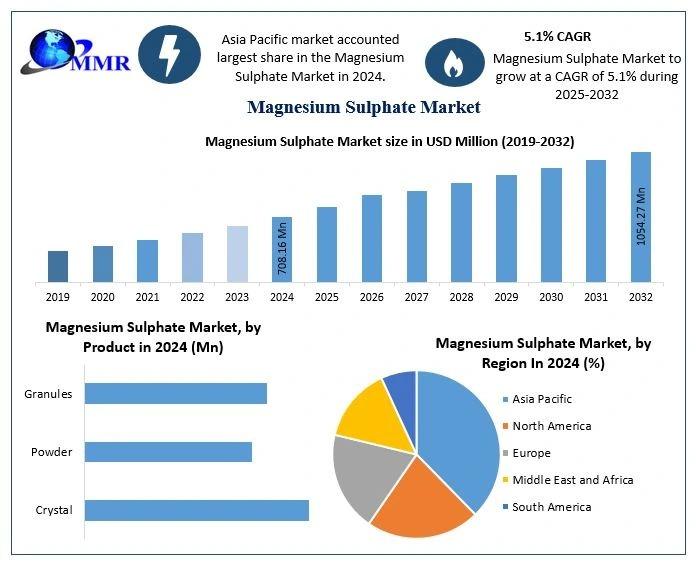
    Magnesium Sulphate Market to Reach USD 1,054.27 Million by 2032, Driven by Agricultural Demand and Pharmaceutical Applications

    The Magnesium Sulphate Market is witnessing steady growth, supported by rising agricultural productivity requirements, expanding pharmaceutical applications, and increasing demand from industrial manufacturing. According to Maximize Market Research, the market was valued at USD 708.16 million in 2024 and is projected to reach approximately USD 1,054.27 million by 2032, growing at a compound annual growth rate (CAGR) of 5.1% from 2025 to 2032. Increasing interest in efficient nutrient management, specialty chemicals, and high-quality pharmaceutical formulations is expected to create new opportunities for manufacturers and investors.

    Market Estimation, Growth Drivers and Opportunities

    Magnesium sulphate, commonly known as Epsom salt in certain applications, is an important inorganic compound used across agriculture, healthcare, food processing, personal care, water treatment, paints, textiles, and chemical manufacturing. Its versatility makes it a valuable ingredient for industries seeking reliable magnesium and sulphur sources.

    Agriculture remains a major growth driver because magnesium supports chlorophyll formation, photosynthesis, and plant development, while sulphur contributes to essential plant functions. Growing food requirements, soil nutrient deficiencies, and the adoption of balanced fertilization practices are increasing demand for magnesium sulphate-based fertilizers. Farmers are increasingly interested in improving crop yields and nutrient-use efficiency, creating opportunities for agricultural-grade products.

    Pharmaceutical demand also supports market expansion. Magnesium sulphate is used in clinical settings, including the management of pre-eclampsia and eclampsia, subject to appropriate medical supervision. Demand for dependable pharmaceutical ingredients and ready-to-use injectable formulations creates opportunities for manufacturers that can meet stringent quality and regulatory requirements.

    Get a Sample Insight Report Now : https://www.maximizemarketresearch.com/request-sample/148167/

    Magnesium Sulphate Market Industry Analysis, Demand, and Revenue Forecast Report by MMR Magnesium Sulphate Market to Reach USD 1,054.27 Million by 2032, Driven by Agricultural Demand and Pharmaceutical Applications The Magnesium Sulphate Market is witnessing steady growth, supported by rising agricultural productivity requirements, expanding pharmaceutical applications, and increasing demand from industrial manufacturing. According to Maximize Market Research, the market was valued at USD 708.16 million in 2024 and is projected to reach approximately USD 1,054.27 million by 2032, growing at a compound annual growth rate (CAGR) of 5.1% from 2025 to 2032. Increasing interest in efficient nutrient management, specialty chemicals, and high-quality pharmaceutical formulations is expected to create new opportunities for manufacturers and investors. Market Estimation, Growth Drivers and Opportunities Magnesium sulphate, commonly known as Epsom salt in certain applications, is an important inorganic compound used across agriculture, healthcare, food processing, personal care, water treatment, paints, textiles, and chemical manufacturing. Its versatility makes it a valuable ingredient for industries seeking reliable magnesium and sulphur sources. Agriculture remains a major growth driver because magnesium supports chlorophyll formation, photosynthesis, and plant development, while sulphur contributes to essential plant functions. Growing food requirements, soil nutrient deficiencies, and the adoption of balanced fertilization practices are increasing demand for magnesium sulphate-based fertilizers. Farmers are increasingly interested in improving crop yields and nutrient-use efficiency, creating opportunities for agricultural-grade products. Pharmaceutical demand also supports market expansion. Magnesium sulphate is used in clinical settings, including the management of pre-eclampsia and eclampsia, subject to appropriate medical supervision. Demand for dependable pharmaceutical ingredients and ready-to-use injectable formulations creates opportunities for manufacturers that can meet stringent quality and regulatory requirements. Get a Sample Insight Report Now : https://www.maximizemarketresearch.com/request-sample/148167/
    0 Comments ·0 Shares ·200 Views
  • Coffee Production Market Expands with Increasing Demand for Specialty Coffee

    Coffee Production Market size was valued at US$ 505.43 Bn. in 2025 and the total revenue is expected to grow at 4.28% through 2026 to 2032, reaching nearly US$ 677.75 Bn. by 2032.

    Coffee is one of the world's most widely consumed beverages, supporting millions of livelihoods and driving a global industry that spans farming, processing, trading, roasting, and retail. As consumer preferences continue to evolve and demand for premium, sustainably sourced coffee grows, the coffee production market is undergoing significant transformation. Advances in agricultural technology, climate-resilient farming practices, and growing investments in sustainable production are reshaping the future of the industry.

    Download Free PDF Brochure: https://www.stellarmr.com/report/req_sample/Coffee-Production-Market/667

    Understanding the Coffee Production Market

    The coffee production market encompasses the cultivation, harvesting, processing, and distribution of coffee beans for commercial use. The industry involves a complex supply chain that begins with coffee farmers and extends to processors, exporters, manufacturers, retailers, and foodservice providers.

    Coffee is primarily cultivated in tropical regions across Latin America, Africa, and Asia-Pacific, where climatic conditions support the growth of Arabica and Robusta coffee varieties. Increasing global consumption, expanding café culture, and the popularity of specialty coffee continue to fuel demand across both developed and emerging economies.

    Today, coffee production is no longer focused solely on increasing output. Producers are placing greater emphasis on quality improvement, sustainable farming methods, traceability, and environmental responsibility to meet changing consumer expectations.

    Key Factors Driving Market Growth

    Several factors are contributing to the steady expansion of the coffee production market.

    One of the primary growth drivers is the rising global consumption of coffee. Increasing urbanization, changing lifestyles, and growing disposable incomes have encouraged consumers to include coffee as part of their daily routine. Younger consumers, in particular, are exploring premium coffee experiences, specialty blends, and artisanal brewing methods.

    The rapid expansion of coffee shop chains and independent cafés has further strengthened demand for high-quality coffee beans. Specialty coffee has become a major trend, encouraging producers to focus on superior bean quality, unique flavor profiles, and sustainable sourcing practices.

    Technological advancements are also improving production efficiency. Precision agriculture, drone-based farm monitoring, satellite imaging, and data-driven irrigation systems are helping farmers optimize yields while reducing resource consumption. These innovations support better crop management and improve resilience against changing weather conditions.

    Sustainability Becomes a Competitive Advantage

    Sustainability has become one of the defining characteristics of modern coffee production.

    Consumers increasingly want to know where their coffee comes from and whether it has been produced responsibly. As a result, coffee growers and manufacturers are adopting environmentally friendly farming techniques, reducing chemical usage, conserving water resources, and promoting biodiversity.

    Certification programs focusing on sustainable agriculture and ethical sourcing are becoming more common across the global coffee supply chain. Companies are also investing in carbon reduction initiatives and regenerative farming practices to strengthen long-term environmental sustainability.

    Climate change remains one of the industry's biggest challenges. Rising temperatures, unpredictable rainfall patterns, and increasing pest infestations threaten coffee-producing regions worldwide. Consequently, research institutions and agricultural organizations are developing climate-resilient coffee varieties capable of maintaining productivity under changing environmental conditions.

    Emerging Trends Shaping the Coffee Production Industry

    Several emerging trends are expected to redefine the coffee production market over the next decade.

    Premiumization continues to influence purchasing behavior, with consumers increasingly seeking single-origin coffee, organic products, and specialty blends that offer distinctive taste experiences. This trend encourages farmers to prioritize quality over volume.

    Digital technologies are transforming coffee farming through precision agriculture and artificial intelligence. Smart sensors, automated irrigation systems, and predictive weather analytics enable producers to improve efficiency while reducing production costs.

    Supply chain transparency is another important trend. Blockchain technology and digital traceability systems allow consumers and businesses to verify the origin of coffee beans, strengthening trust and supporting responsible sourcing initiatives.

    Demand for sustainable packaging is also increasing as companies seek environmentally friendly alternatives to conventional materials. Recyclable, biodegradable, and compostable packaging solutions are becoming increasingly important for coffee brands looking to reduce their environmental footprint.

    Market Segmentation Overview

    The coffee production market can be broadly segmented based on product type, production method, distribution channel, and end use.

    By product type, Arabica coffee continues to dominate due to its superior flavor profile and widespread popularity in premium coffee products. Robusta coffee remains an important segment because of its higher caffeine content, disease resistance, and extensive use in instant coffee production.

    Production methods include conventional and organic farming. Organic coffee production is witnessing increasing demand as consumers become more conscious of health and environmental sustainability.

    Distribution channels include direct trade, exporters, wholesalers, retailers, and online platforms. Digital commerce is expanding rapidly, providing producers with greater market access and improving supply chain efficiency.

    End users include coffee manufacturers, cafés, restaurants, hotels, institutional buyers, and household consumers, all contributing to consistent market demand.

    Regional Market Outlook

    Latin America continues to play a central role in global coffee production due to favorable climatic conditions and extensive cultivation areas. Countries in the region remain major exporters serving international markets.

    The Asia-Pacific region is emerging as both a major producer and consumer of coffee. Rising disposable incomes, expanding café culture, and increasing urbanization are driving regional demand while encouraging investments in domestic coffee production.

    Europe remains one of the world's largest coffee-consuming regions. Growing interest in premium coffee, specialty beverages, and ethically sourced products continues to support imports and long-term market growth.

    North America also represents a significant market characterized by strong demand for specialty coffee, ready-to-drink beverages, and premium roasting products.

    Challenges Facing the Industry

    Despite positive growth prospects, the coffee production market faces several challenges.

    Climate change poses ongoing risks to crop yields and production stability. Labor shortages in coffee-producing regions, fluctuating commodity prices, and supply chain disruptions also create uncertainty for producers.

    Maintaining profitability while meeting sustainability requirements requires significant investment in technology, training, and infrastructure. Smallholder farmers, who account for a large share of global coffee production, often require financial support and technical assistance to adopt modern agricultural practices.

    Competitive Landscape

    J.M. Smucker (United States)
    Eight O’ Clock (India)
    AMT (United Kingdom)
    Dulce Café (South Africa)
    Lavazza (Italy)
    Keurig Green Mountain (United States)
    Nestle SA (Switzerland)
    The Coca Cola Company (United States)
    JAB Holding Company (Luxembourg)
    Starbucks Coffee Company (United States)
    Download Free PDF Brochure: https://www.stellarmr.com/report/req_sample/Coffee-Production-Market/667

    Conclusion

    The global coffee production market is evolving rapidly as sustainability, technological innovation, and premium consumer preferences reshape the industry. Growing worldwide demand for high-quality coffee, combined with advances in precision agriculture and environmentally responsible farming, presents significant opportunities for producers across the value chain.

    While climate change and supply chain challenges remain important considerations, ongoing investments in resilient farming practices and digital technologies are helping secure the industry's future. As consumers continue to value quality, transparency, and sustainability, the coffee production market is well positioned for long-term growth and innovation, making it one of the most dynamic segments within the global food and beverage industry.

    About Stellar Market Research:

    Stellar Market Research is a multifaceted market research and consulting company with professionals from several industries. Some of the industries we cover include medical devices, pharmaceutical manufacturers, science and engineering, electronic components, industrial equipment, technology and communication, cars and automobiles, chemical products and substances, general merchandise, beverages, personal care, and automated systems. To mention a few, we provide market-verified industry estimations, technical trend analysis, crucial market research, strategic advice, competition analysis, production and demand analysis, and client impact studies.

    Contact Stellar Market Research:

    3rd Floor, Navale IT Park, Phase 2

    Pune Banglore Highway, Narhe,

    Pune, Maharashtra 411041, India

    [email protected]

    +91 20 6630 3320 | +91 9607365656

    Coffee Production Market Expands with Increasing Demand for Specialty Coffee Coffee Production Market size was valued at US$ 505.43 Bn. in 2025 and the total revenue is expected to grow at 4.28% through 2026 to 2032, reaching nearly US$ 677.75 Bn. by 2032. Coffee is one of the world's most widely consumed beverages, supporting millions of livelihoods and driving a global industry that spans farming, processing, trading, roasting, and retail. As consumer preferences continue to evolve and demand for premium, sustainably sourced coffee grows, the coffee production market is undergoing significant transformation. Advances in agricultural technology, climate-resilient farming practices, and growing investments in sustainable production are reshaping the future of the industry. Download Free PDF Brochure: https://www.stellarmr.com/report/req_sample/Coffee-Production-Market/667 Understanding the Coffee Production Market The coffee production market encompasses the cultivation, harvesting, processing, and distribution of coffee beans for commercial use. The industry involves a complex supply chain that begins with coffee farmers and extends to processors, exporters, manufacturers, retailers, and foodservice providers. Coffee is primarily cultivated in tropical regions across Latin America, Africa, and Asia-Pacific, where climatic conditions support the growth of Arabica and Robusta coffee varieties. Increasing global consumption, expanding café culture, and the popularity of specialty coffee continue to fuel demand across both developed and emerging economies. Today, coffee production is no longer focused solely on increasing output. Producers are placing greater emphasis on quality improvement, sustainable farming methods, traceability, and environmental responsibility to meet changing consumer expectations. Key Factors Driving Market Growth Several factors are contributing to the steady expansion of the coffee production market. One of the primary growth drivers is the rising global consumption of coffee. Increasing urbanization, changing lifestyles, and growing disposable incomes have encouraged consumers to include coffee as part of their daily routine. Younger consumers, in particular, are exploring premium coffee experiences, specialty blends, and artisanal brewing methods. The rapid expansion of coffee shop chains and independent cafés has further strengthened demand for high-quality coffee beans. Specialty coffee has become a major trend, encouraging producers to focus on superior bean quality, unique flavor profiles, and sustainable sourcing practices. Technological advancements are also improving production efficiency. Precision agriculture, drone-based farm monitoring, satellite imaging, and data-driven irrigation systems are helping farmers optimize yields while reducing resource consumption. These innovations support better crop management and improve resilience against changing weather conditions. Sustainability Becomes a Competitive Advantage Sustainability has become one of the defining characteristics of modern coffee production. Consumers increasingly want to know where their coffee comes from and whether it has been produced responsibly. As a result, coffee growers and manufacturers are adopting environmentally friendly farming techniques, reducing chemical usage, conserving water resources, and promoting biodiversity. Certification programs focusing on sustainable agriculture and ethical sourcing are becoming more common across the global coffee supply chain. Companies are also investing in carbon reduction initiatives and regenerative farming practices to strengthen long-term environmental sustainability. Climate change remains one of the industry's biggest challenges. Rising temperatures, unpredictable rainfall patterns, and increasing pest infestations threaten coffee-producing regions worldwide. Consequently, research institutions and agricultural organizations are developing climate-resilient coffee varieties capable of maintaining productivity under changing environmental conditions. Emerging Trends Shaping the Coffee Production Industry Several emerging trends are expected to redefine the coffee production market over the next decade. Premiumization continues to influence purchasing behavior, with consumers increasingly seeking single-origin coffee, organic products, and specialty blends that offer distinctive taste experiences. This trend encourages farmers to prioritize quality over volume. Digital technologies are transforming coffee farming through precision agriculture and artificial intelligence. Smart sensors, automated irrigation systems, and predictive weather analytics enable producers to improve efficiency while reducing production costs. Supply chain transparency is another important trend. Blockchain technology and digital traceability systems allow consumers and businesses to verify the origin of coffee beans, strengthening trust and supporting responsible sourcing initiatives. Demand for sustainable packaging is also increasing as companies seek environmentally friendly alternatives to conventional materials. Recyclable, biodegradable, and compostable packaging solutions are becoming increasingly important for coffee brands looking to reduce their environmental footprint. Market Segmentation Overview The coffee production market can be broadly segmented based on product type, production method, distribution channel, and end use. By product type, Arabica coffee continues to dominate due to its superior flavor profile and widespread popularity in premium coffee products. Robusta coffee remains an important segment because of its higher caffeine content, disease resistance, and extensive use in instant coffee production. Production methods include conventional and organic farming. Organic coffee production is witnessing increasing demand as consumers become more conscious of health and environmental sustainability. Distribution channels include direct trade, exporters, wholesalers, retailers, and online platforms. Digital commerce is expanding rapidly, providing producers with greater market access and improving supply chain efficiency. End users include coffee manufacturers, cafés, restaurants, hotels, institutional buyers, and household consumers, all contributing to consistent market demand. Regional Market Outlook Latin America continues to play a central role in global coffee production due to favorable climatic conditions and extensive cultivation areas. Countries in the region remain major exporters serving international markets. The Asia-Pacific region is emerging as both a major producer and consumer of coffee. Rising disposable incomes, expanding café culture, and increasing urbanization are driving regional demand while encouraging investments in domestic coffee production. Europe remains one of the world's largest coffee-consuming regions. Growing interest in premium coffee, specialty beverages, and ethically sourced products continues to support imports and long-term market growth. North America also represents a significant market characterized by strong demand for specialty coffee, ready-to-drink beverages, and premium roasting products. Challenges Facing the Industry Despite positive growth prospects, the coffee production market faces several challenges. Climate change poses ongoing risks to crop yields and production stability. Labor shortages in coffee-producing regions, fluctuating commodity prices, and supply chain disruptions also create uncertainty for producers. Maintaining profitability while meeting sustainability requirements requires significant investment in technology, training, and infrastructure. Smallholder farmers, who account for a large share of global coffee production, often require financial support and technical assistance to adopt modern agricultural practices. Competitive Landscape J.M. Smucker (United States) Eight O’ Clock (India) AMT (United Kingdom) Dulce Café (South Africa) Lavazza (Italy) Keurig Green Mountain (United States) Nestle SA (Switzerland) The Coca Cola Company (United States) JAB Holding Company (Luxembourg) Starbucks Coffee Company (United States) Download Free PDF Brochure: https://www.stellarmr.com/report/req_sample/Coffee-Production-Market/667 Conclusion The global coffee production market is evolving rapidly as sustainability, technological innovation, and premium consumer preferences reshape the industry. Growing worldwide demand for high-quality coffee, combined with advances in precision agriculture and environmentally responsible farming, presents significant opportunities for producers across the value chain. While climate change and supply chain challenges remain important considerations, ongoing investments in resilient farming practices and digital technologies are helping secure the industry's future. As consumers continue to value quality, transparency, and sustainability, the coffee production market is well positioned for long-term growth and innovation, making it one of the most dynamic segments within the global food and beverage industry. About Stellar Market Research: Stellar Market Research is a multifaceted market research and consulting company with professionals from several industries. Some of the industries we cover include medical devices, pharmaceutical manufacturers, science and engineering, electronic components, industrial equipment, technology and communication, cars and automobiles, chemical products and substances, general merchandise, beverages, personal care, and automated systems. To mention a few, we provide market-verified industry estimations, technical trend analysis, crucial market research, strategic advice, competition analysis, production and demand analysis, and client impact studies. Contact Stellar Market Research: 3rd Floor, Navale IT Park, Phase 2 Pune Banglore Highway, Narhe, Pune, Maharashtra 411041, India [email protected] +91 20 6630 3320 | +91 9607365656
    0 Comments ·0 Shares ·321 Views
  • The Agrivoltaics Market reveals that the global market is experiencing a structural transformation, driven by the imperative to maximize land productivity, accelerate clean energy integration, and adopt climate-resilient farming techniques.

    The global agricultural and energy landscapes are undergoing a profound paradigm shift. Traditionally, land allocation has faced a zero-sum conflict between food production and photovoltaic (PV) solar installations. However, the agrivoltaics paradigm—co-locating agricultural activity and solar photovoltaic electricity generation on the same parcel of land—has emerged as a transformative solution to the land-food-energy nexus.

    Key Findings from the Report
    Valuation & Growth Trajectory: The global agrivoltaics market is projected to expand at a robust CAGR of over 11.5% throughout the forecast period from 2024 to 2034.

    Dominant Segment: Ground-mounted photovoltaic systems currently dominate the market share, favored by structural scalability and ease of integration with large-scale agricultural machinery.

    Fastest-Growing Segment: Tracking-system-integrated agrivoltaics represents the fastest-growing segment, driven by dynamic solar-tracking algorithms that optimize both crop microclimate exposure and energy generation yields.

    Crop Application Insight: Shade-tolerant crops—including berries, leafy greens, root vegetables, and select specialty vineyards—account for the largest share of commercial crop integration.

    Leading Region: Europe holds the leading revenue share, supported by stringent European Union decarbonization targets, favorable feed-in tariffs, and robust governmental subsidies for dual-use agricultural tech.

    Emerging Region: Asia-Pacific is positioned as the fastest-growing regional market, catalyzed by intensive land-use pressures in nations like China, Japan, and India, alongside national solar-agriculture integration initiatives.

    Investment Relevance: Venture capital and project-finance investments in agrivoltaic infrastructure have surged, attracting institutional capital focused on long-term Environmental, Social, and Governance (ESG) assets.

    For further information, click the following link:https://www.stellarmr.com/report/req_sample/agrivoltaics-market/2915
    Market Drivers and Restraints
    Drivers
    Land-Use Optimization and Dual Revenue Streams: The ability to simultaneously harvest crops and generate commercial electricity provides farmers with financial hedging against commodity price volatility and volatile crop yields.

    Climate Resilience and Microclimate Protection: Agrivoltaic shade structures reduce evapotranspiration, lower ambient soil and leaf temperatures during heatwaves, and conserve crucial irrigation water in arid and semi-arid agricultural zones.

    Decarbonization and Renewable Energy Mandates: Government incentives, carbon credit frameworks, and corporate net-zero commitments are driving agricultural enterprises to adopt on-site clean energy generation infrastructure.

    Restraints
    High Initial Capital Expenditure (CapEx): Specialized elevated mounting structures, custom PV spacing, and dual-purpose engineering designs incur significantly higher upfront setup costs compared to conventional solar farms.

    Operational and Mechanization Complexities: Operating heavy agricultural machinery beneath solar arrays requires precise layout planning, specialized equipment maneuvering, and ongoing operational coordination between farmers and energy operators.

    Technology, Regulation, and Sustainability Trends
    The agrivoltaics sector is being reshaped by rapid advancements in semi-transparent photovoltaic glass, bifacial solar modules, and automated smart-tracking systems that optimize light transmission based on real-time crop growth cycles. Regulatory frameworks are progressively evolving from ambiguous zoning restrictions to dedicated policy incentives, particularly across European and North American jurisdictions.

    From an ESG and sustainability standpoint, agrivoltaics delivers exceptional impact metrics: it drastically lowers the carbon footprint of food production, curtails agricultural water consumption by up to 20–30% in arid climates, and prevents the conversion of virgin ecosystems into industrial solar plants by utilizing pre-disturbed agricultural land.

    Regional Insights
    Europe: Leads the global market due to aggressive EU climate neutrality roadmaps, institutional research backing, and pioneering national policies in countries like France, Germany, and Italy that mandate or subsidize agrivoltaic zoning.

    Asia-Pacific: Represents the high-growth frontier. High population density and limited arable land per capita in nations such as China, Japan, and South Korea have forced accelerated adoption. Government-backed agricultural modernization programs are integrating solar PV directly into greenhouse horticulture and paddy cultivation.

    North America: Exhibiting rapid expansion driven by commercial farm consolidations, state-level clean energy portfolio standards, and growing pilot programs across the US Midwest and agricultural hubs in California.

    Recent Industry Developments
    Enel Green Power (2025): Launched an advanced commercial agrivoltaics pilot project in Southern Europe integrating high-clearance tracking PV arrays with olive groves, delivering a verified 15% reduction in irrigation water usage and stable crop yields.

    BayWa r.e. (2025): Expanded its international portfolio by completing a multi-megawatt fruit-protection agrivoltaic installation in Germany, safeguarding soft fruit yields against severe hail and extreme heat while generating clean electricity for regional grid injection.

    SunAgri (2024): Partnered with major European agricultural cooperatives to deploy dynamic smart-slat solar panels over vineyard acreage, demonstrating optimized grape maturation and enhanced wine quality alongside commercial power generation.

    TotalEnergies (2024): Acquired a controlling stake in a specialized agrivoltaics technology developer, injecting capital to scale modular, farmer-friendly elevation structures designed for seamless tractor access.

    NLC India Limited (2025): Initiated large-scale agricultural co-location initiatives beneath existing utility solar parks, proving the commercial viability of intercropping shade-tolerant legumes and fodder crops on degraded mining and industrial tracts.

    Competitive Landscape
    The global agrivoltaics market features a dynamic mix of specialized agritech innovators, renewable energy developers, and agricultural engineering conglomerates. Leading market players include BayWa r.e., Enel Green Power, TotalEnergies, SunAgri, Lightsource bp, Nexans, and REM TEC.

    Market participants are actively engaging in strategic joint ventures, proprietary mounting-structure patent filings, and collaboration agreements with agricultural universities to validate crop-specific yield models and de-risk investments for commercial farming enterprises.

    Analyst Commentary
    "The agrivoltaics market has transitioned past the experimental phase into a vital commercial pillar of the global energy-food nexus," said a Senior Research Analyst at Stellar Market Research. "As land scarcity intensifies and climate volatility threatens traditional agriculture, co-locating solar infrastructure with crop production is no longer merely an environmental option—it is a fundamental economic imperative that secures both our food supply and our renewable energy future."

    Future Outlook
    Through the forecast period to 2034, the agrivoltaics market is poised for exponential mainstream integration. Expected technological breakthroughs in bifacial transparency, wireless sensor-driven microclimate management, and standardized modular mounting kits will continue to compress installation costs. As regulatory bodies streamline dual-use zoning laws and institutional ESG investors direct capital toward verifiable land-restoration assets, agrivoltaics will firmly establish itself as a cornerstone of resilient, climate-smart global agriculture.

    For further information, click the following link:https://www.stellarmr.com/report/req_sample/agrivoltaics-market/2915
    About Stellar Market Research
    Stellar Market Research is a multifaceted market research and consulting company with professionals from several industries. Some of the industries we cover include medical devices, pharmaceutical manufacturers, science and engineering, electronic components, industrial equipment, technology and communication, cars and automobiles, chemical products and substances, general merchandise, beverages, personal care, and automated systems. To mention a few, we provide market-verified industry estimations, technical trend analysis, crucial market research, strategic advice, competition analysis, production and demand analysis, and client impact studies.

    Address
    Phase 3, Navale IT Zone, S.No. 51/2A/2, Office No. 202, 2nd floor, Near, Navale Brg, Narhe, Pune, Maharashtra 411041

    Email
    [email protected]

    Mobile
    +91 9607365656
    The Agrivoltaics Market reveals that the global market is experiencing a structural transformation, driven by the imperative to maximize land productivity, accelerate clean energy integration, and adopt climate-resilient farming techniques. The global agricultural and energy landscapes are undergoing a profound paradigm shift. Traditionally, land allocation has faced a zero-sum conflict between food production and photovoltaic (PV) solar installations. However, the agrivoltaics paradigm—co-locating agricultural activity and solar photovoltaic electricity generation on the same parcel of land—has emerged as a transformative solution to the land-food-energy nexus. Key Findings from the Report Valuation & Growth Trajectory: The global agrivoltaics market is projected to expand at a robust CAGR of over 11.5% throughout the forecast period from 2024 to 2034. Dominant Segment: Ground-mounted photovoltaic systems currently dominate the market share, favored by structural scalability and ease of integration with large-scale agricultural machinery. Fastest-Growing Segment: Tracking-system-integrated agrivoltaics represents the fastest-growing segment, driven by dynamic solar-tracking algorithms that optimize both crop microclimate exposure and energy generation yields. Crop Application Insight: Shade-tolerant crops—including berries, leafy greens, root vegetables, and select specialty vineyards—account for the largest share of commercial crop integration. Leading Region: Europe holds the leading revenue share, supported by stringent European Union decarbonization targets, favorable feed-in tariffs, and robust governmental subsidies for dual-use agricultural tech. Emerging Region: Asia-Pacific is positioned as the fastest-growing regional market, catalyzed by intensive land-use pressures in nations like China, Japan, and India, alongside national solar-agriculture integration initiatives. Investment Relevance: Venture capital and project-finance investments in agrivoltaic infrastructure have surged, attracting institutional capital focused on long-term Environmental, Social, and Governance (ESG) assets. For further information, click the following link:https://www.stellarmr.com/report/req_sample/agrivoltaics-market/2915 Market Drivers and Restraints Drivers Land-Use Optimization and Dual Revenue Streams: The ability to simultaneously harvest crops and generate commercial electricity provides farmers with financial hedging against commodity price volatility and volatile crop yields. Climate Resilience and Microclimate Protection: Agrivoltaic shade structures reduce evapotranspiration, lower ambient soil and leaf temperatures during heatwaves, and conserve crucial irrigation water in arid and semi-arid agricultural zones. Decarbonization and Renewable Energy Mandates: Government incentives, carbon credit frameworks, and corporate net-zero commitments are driving agricultural enterprises to adopt on-site clean energy generation infrastructure. Restraints High Initial Capital Expenditure (CapEx): Specialized elevated mounting structures, custom PV spacing, and dual-purpose engineering designs incur significantly higher upfront setup costs compared to conventional solar farms. Operational and Mechanization Complexities: Operating heavy agricultural machinery beneath solar arrays requires precise layout planning, specialized equipment maneuvering, and ongoing operational coordination between farmers and energy operators. Technology, Regulation, and Sustainability Trends The agrivoltaics sector is being reshaped by rapid advancements in semi-transparent photovoltaic glass, bifacial solar modules, and automated smart-tracking systems that optimize light transmission based on real-time crop growth cycles. Regulatory frameworks are progressively evolving from ambiguous zoning restrictions to dedicated policy incentives, particularly across European and North American jurisdictions. From an ESG and sustainability standpoint, agrivoltaics delivers exceptional impact metrics: it drastically lowers the carbon footprint of food production, curtails agricultural water consumption by up to 20–30% in arid climates, and prevents the conversion of virgin ecosystems into industrial solar plants by utilizing pre-disturbed agricultural land. Regional Insights Europe: Leads the global market due to aggressive EU climate neutrality roadmaps, institutional research backing, and pioneering national policies in countries like France, Germany, and Italy that mandate or subsidize agrivoltaic zoning. Asia-Pacific: Represents the high-growth frontier. High population density and limited arable land per capita in nations such as China, Japan, and South Korea have forced accelerated adoption. Government-backed agricultural modernization programs are integrating solar PV directly into greenhouse horticulture and paddy cultivation. North America: Exhibiting rapid expansion driven by commercial farm consolidations, state-level clean energy portfolio standards, and growing pilot programs across the US Midwest and agricultural hubs in California. Recent Industry Developments Enel Green Power (2025): Launched an advanced commercial agrivoltaics pilot project in Southern Europe integrating high-clearance tracking PV arrays with olive groves, delivering a verified 15% reduction in irrigation water usage and stable crop yields. BayWa r.e. (2025): Expanded its international portfolio by completing a multi-megawatt fruit-protection agrivoltaic installation in Germany, safeguarding soft fruit yields against severe hail and extreme heat while generating clean electricity for regional grid injection. SunAgri (2024): Partnered with major European agricultural cooperatives to deploy dynamic smart-slat solar panels over vineyard acreage, demonstrating optimized grape maturation and enhanced wine quality alongside commercial power generation. TotalEnergies (2024): Acquired a controlling stake in a specialized agrivoltaics technology developer, injecting capital to scale modular, farmer-friendly elevation structures designed for seamless tractor access. NLC India Limited (2025): Initiated large-scale agricultural co-location initiatives beneath existing utility solar parks, proving the commercial viability of intercropping shade-tolerant legumes and fodder crops on degraded mining and industrial tracts. Competitive Landscape The global agrivoltaics market features a dynamic mix of specialized agritech innovators, renewable energy developers, and agricultural engineering conglomerates. Leading market players include BayWa r.e., Enel Green Power, TotalEnergies, SunAgri, Lightsource bp, Nexans, and REM TEC. Market participants are actively engaging in strategic joint ventures, proprietary mounting-structure patent filings, and collaboration agreements with agricultural universities to validate crop-specific yield models and de-risk investments for commercial farming enterprises. Analyst Commentary "The agrivoltaics market has transitioned past the experimental phase into a vital commercial pillar of the global energy-food nexus," said a Senior Research Analyst at Stellar Market Research. "As land scarcity intensifies and climate volatility threatens traditional agriculture, co-locating solar infrastructure with crop production is no longer merely an environmental option—it is a fundamental economic imperative that secures both our food supply and our renewable energy future." Future Outlook Through the forecast period to 2034, the agrivoltaics market is poised for exponential mainstream integration. Expected technological breakthroughs in bifacial transparency, wireless sensor-driven microclimate management, and standardized modular mounting kits will continue to compress installation costs. As regulatory bodies streamline dual-use zoning laws and institutional ESG investors direct capital toward verifiable land-restoration assets, agrivoltaics will firmly establish itself as a cornerstone of resilient, climate-smart global agriculture. For further information, click the following link:https://www.stellarmr.com/report/req_sample/agrivoltaics-market/2915 About Stellar Market Research Stellar Market Research is a multifaceted market research and consulting company with professionals from several industries. Some of the industries we cover include medical devices, pharmaceutical manufacturers, science and engineering, electronic components, industrial equipment, technology and communication, cars and automobiles, chemical products and substances, general merchandise, beverages, personal care, and automated systems. To mention a few, we provide market-verified industry estimations, technical trend analysis, crucial market research, strategic advice, competition analysis, production and demand analysis, and client impact studies. Address Phase 3, Navale IT Zone, S.No. 51/2A/2, Office No. 202, 2nd floor, Near, Navale Brg, Narhe, Pune, Maharashtra 411041 Email [email protected] Mobile +91 9607365656
    0 Comments ·0 Shares ·449 Views
  • Acetaldehyde Market Demands and Projected Industry Growth with 6.5% CAGR Forecast Report by MMR

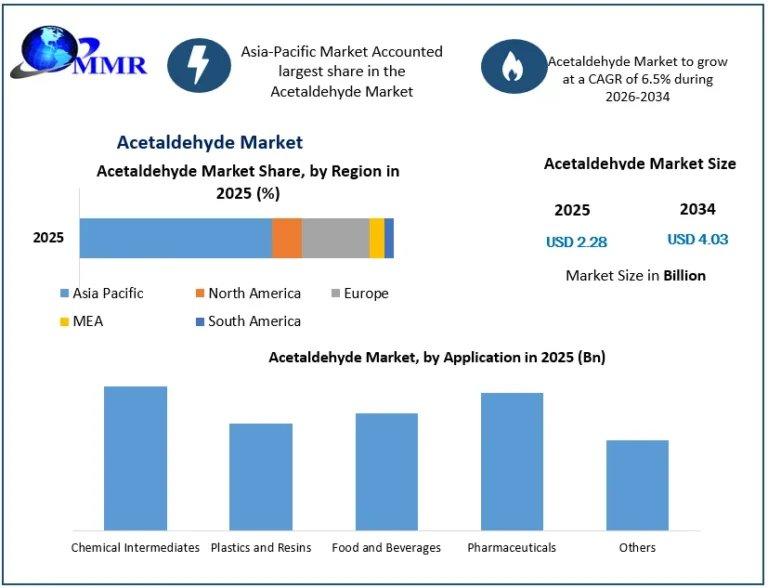
    Acetaldehyde Market to Reach USD 4.03 Billion by 2034, Driven by Chemical Manufacturing and Industrial Demand

    The Acetaldehyde Market is witnessing steady growth, supported by increasing demand for intermediate chemicals, pharmaceutical ingredients, agrochemicals, and specialty chemical production. According to Maximize Market Research, the market was valued at USD 2.28 billion in 2025 and is projected to reach nearly USD 4.03 billion by 2034, growing at a compound annual growth rate (CAGR) of 6.5% during the forecast period from 2026 to 2034. Expanding industrial applications, technological improvements in chemical processing, and investments in manufacturing infrastructure are expected to create new opportunities for market participants.

    Market Estimation, Growth Drivers, and Opportunities

    The Acetaldehyde Market is benefiting from its importance as a chemical intermediate used in producing acetic acid derivatives, pentaerythritol, pyridine and pyridine derivatives, and other industrial chemicals. These downstream products serve diverse industries, including pharmaceuticals, agriculture, paints and coatings, plastics, adhesives, and specialty chemicals. Growing industrial production and the need for reliable chemical feedstocks are strengthening demand across established and emerging manufacturing economies.

    The market's expansion is also supported by increasing consumption of agrochemicals, pharmaceutical compounds, and performance-oriented materials. Acetaldehyde plays an important role in synthesizing chemicals used in agricultural formulations and industrial manufacturing. As manufacturers seek consistent product quality, operational efficiency, and dependable raw material supplies, investments in production optimization and process control are creating additional opportunities.

    However, fluctuating feedstock prices, stringent environmental regulations, occupational exposure concerns, and the need for safe handling and storage can challenge market development. Manufacturers that improve process efficiency, reduce emissions, strengthen workplace safety, and optimize resource utilization will be better positioned to capture long-term growth. The projected increase from USD 2.28 billion in 2025 to USD 4.03 billion by 2034 highlights the commercial potential of the industry.

    Get a Sample Insight Report Now : https://www.maximizemarketresearch.com/request-sample/6262/

    US Market Trends and Investment Outlook

    The United States remains an important market for acetaldehyde because of its established chemical manufacturing infrastructure, advanced industrial capabilities, and demand for downstream chemical products. In 2025, investment priorities across the American chemical industry continued to emphasize manufacturing efficiency, supply-chain resilience, energy management, and lower-emission production technologies.
    Acetaldehyde Market Demands and Projected Industry Growth with 6.5% CAGR Forecast Report by MMR Acetaldehyde Market to Reach USD 4.03 Billion by 2034, Driven by Chemical Manufacturing and Industrial Demand The Acetaldehyde Market is witnessing steady growth, supported by increasing demand for intermediate chemicals, pharmaceutical ingredients, agrochemicals, and specialty chemical production. According to Maximize Market Research, the market was valued at USD 2.28 billion in 2025 and is projected to reach nearly USD 4.03 billion by 2034, growing at a compound annual growth rate (CAGR) of 6.5% during the forecast period from 2026 to 2034. Expanding industrial applications, technological improvements in chemical processing, and investments in manufacturing infrastructure are expected to create new opportunities for market participants. Market Estimation, Growth Drivers, and Opportunities The Acetaldehyde Market is benefiting from its importance as a chemical intermediate used in producing acetic acid derivatives, pentaerythritol, pyridine and pyridine derivatives, and other industrial chemicals. These downstream products serve diverse industries, including pharmaceuticals, agriculture, paints and coatings, plastics, adhesives, and specialty chemicals. Growing industrial production and the need for reliable chemical feedstocks are strengthening demand across established and emerging manufacturing economies. The market's expansion is also supported by increasing consumption of agrochemicals, pharmaceutical compounds, and performance-oriented materials. Acetaldehyde plays an important role in synthesizing chemicals used in agricultural formulations and industrial manufacturing. As manufacturers seek consistent product quality, operational efficiency, and dependable raw material supplies, investments in production optimization and process control are creating additional opportunities. However, fluctuating feedstock prices, stringent environmental regulations, occupational exposure concerns, and the need for safe handling and storage can challenge market development. Manufacturers that improve process efficiency, reduce emissions, strengthen workplace safety, and optimize resource utilization will be better positioned to capture long-term growth. The projected increase from USD 2.28 billion in 2025 to USD 4.03 billion by 2034 highlights the commercial potential of the industry. Get a Sample Insight Report Now : https://www.maximizemarketresearch.com/request-sample/6262/ US Market Trends and Investment Outlook The United States remains an important market for acetaldehyde because of its established chemical manufacturing infrastructure, advanced industrial capabilities, and demand for downstream chemical products. In 2025, investment priorities across the American chemical industry continued to emphasize manufacturing efficiency, supply-chain resilience, energy management, and lower-emission production technologies.
    0 Comments ·0 Shares ·394 Views
  • IoT Analytics Market Growth Supported by Edge Computing

    Market Estimation & Definition

    The global Internet of Things (IoT) Analytics Market is expanding as organizations seek to convert data generated by connected devices into practical business insights. According to Stellar Market Research, the market was valued at USD 81.94 billion in 2025 and is projected to reach approximately USD 857 billion by 2034, growing at a compound annual growth rate (CAGR) of 29.8% during 2026–2034.

    IoT analytics involves collecting, processing, and interpreting data generated by connected sensors, machines, equipment, and devices. These capabilities help businesses monitor operations, identify performance issues, improve asset utilization, and make informed decisions. Applications range from industrial equipment monitoring and smart-city infrastructure to healthcare devices, logistics, energy management, and agriculture.

    Download Free PDF Brochure: https://www.stellarmr.com/report/req_sample/IoT-Analytics-Market/520

    Market Growth Drivers & Opportunity

    The increasing use of connected devices across industrial and commercial environments is a major growth driver. Manufacturers use sensors to monitor operating conditions, detect irregularities, and reduce equipment downtime. In healthcare, connected devices support patient monitoring, while logistics companies use IoT data to improve tracking and operational visibility.

    The expansion of cloud computing is creating additional opportunities by making data storage and analytics services more accessible. Cloud platforms allow organizations to process information from multiple devices without depending entirely on extensive on-site infrastructure. Falling sensor costs and improvements in communication networks are also encouraging adoption across new applications.

    The rollout of 5G networks is another important factor. Greater network capacity and faster data transmission can support applications that require timely analysis of information from large numbers of connected devices. Nevertheless, limited communication infrastructure, shortages of IT expertise, cybersecurity concerns, and the cost of implementation may restrict adoption, particularly in developing markets.

    What Lies Ahead: Emerging Trends Shaping the Future

    The next phase of market development is likely to be shaped by artificial intelligence (AI), machine learning (ML), edge computing, and hybrid analytics architectures. AI-enabled analytics can help organizations identify patterns in sensor data, anticipate equipment failures, and improve operational planning.

    Edge computing is gaining importance because processing information closer to where it is generated can reduce delays and dependence on centralized computing resources. This approach is particularly relevant to industrial automation, connected infrastructure, and applications that require rapid responses.

    Cloud-based analytics is expected to remain significant as businesses connect distributed systems and scale their data operations. At the same time, organizations handling sensitive information may continue to favor on-site deployment to maintain greater control over data. Smart agriculture, connected healthcare, energy management, and smart-city projects provide further opportunities for providers that can deliver secure and scalable solutions.

    Get More Report Details: https://www.stellarmr.com/report/IoT-Analytics-Market/520

    Segmentation Analysis

    Stellar Market Research segments the IoT Analytics Market by industry vertical, deployment, organization size, and region.

    By Industry Vertical: Healthcare; Government & Defense; Manufacturing; Energy & Utilities; IT & Telecom; Logistics & Transportation; Retail; Others.
    By Deployment: Cloud-Based; On-Site.
    By Organization Size: SMEs; Large Enterprises.
    By Region: North America; Europe; Asia Pacific; Middle East and Africa; South America.
    Manufacturing held the largest share among industry verticals in 2025, supported by extensive sensor usage for monitoring equipment and production environments. North America led the market, while Asia Pacific and Australia are identified in the report as high-growth areas, supported by expanding network capabilities and 5G deployment.

    Country-Level Analysis: USA and Germany

    United States: The United States is a key market within North America, which leads global IoT analytics adoption. Established technology providers, cloud infrastructure, and demand for industrial and enterprise analytics support the market. Companies such as Microsoft, Amazon Web Services, Cisco, Oracle, IBM, and Google offer technologies relevant to connected-device data processing and analytics. Continued investment in connected infrastructure and real-time data capabilities provides opportunities across manufacturing, healthcare, logistics, and utilities.

    Germany: Germany is included in the report’s European market coverage. Its manufacturing and industrial technology base offers opportunities for IoT analytics in equipment monitoring, process optimization, and predictive maintenance. Siemens AG and other enterprise technology providers are relevant participants in the competitive landscape. However, the report does not state a separate headline market valuation for Germany, so country-specific growth figures should not be inferred.

    Competitive Analysis

    The market includes global technology companies, industrial solution providers, and specialist analytics vendors. Key players identified by Stellar Market Research include Microsoft Corporation, Amazon Web Services, Accenture PLC, Cisco Systems, Oracle Corporation, IBM Corporation, Salesforce, Siemens AG, General Electric Company, Vitria Technology, Larsen & Toubro Infotech, C3.ai, Dell Technologies, Google, and Hewlett Packard Enterprise.

    Competition centers on analytics performance, cloud integration, security, scalability, and the ability to support industry-specific requirements. Providers that combine advanced analytics with dependable connectivity and flexible deployment options may be well placed to serve organizations managing increasingly complex IoT environments.

    Download Free PDF Brochure: https://www.stellarmr.com/report/req_sample/IoT-Analytics-Market/520


    Contact Stellar Market Research:

    3rd Floor, Navale IT Park, Phase 2

    Pune Banglore Highway, Narhe,

    Pune, Maharashtra 411041, India

    [email protected]

    +91 20 6630 3320 | +91 9607365656
    IoT Analytics Market Growth Supported by Edge Computing Market Estimation & Definition The global Internet of Things (IoT) Analytics Market is expanding as organizations seek to convert data generated by connected devices into practical business insights. According to Stellar Market Research, the market was valued at USD 81.94 billion in 2025 and is projected to reach approximately USD 857 billion by 2034, growing at a compound annual growth rate (CAGR) of 29.8% during 2026–2034. IoT analytics involves collecting, processing, and interpreting data generated by connected sensors, machines, equipment, and devices. These capabilities help businesses monitor operations, identify performance issues, improve asset utilization, and make informed decisions. Applications range from industrial equipment monitoring and smart-city infrastructure to healthcare devices, logistics, energy management, and agriculture. Download Free PDF Brochure: https://www.stellarmr.com/report/req_sample/IoT-Analytics-Market/520 Market Growth Drivers & Opportunity The increasing use of connected devices across industrial and commercial environments is a major growth driver. Manufacturers use sensors to monitor operating conditions, detect irregularities, and reduce equipment downtime. In healthcare, connected devices support patient monitoring, while logistics companies use IoT data to improve tracking and operational visibility. The expansion of cloud computing is creating additional opportunities by making data storage and analytics services more accessible. Cloud platforms allow organizations to process information from multiple devices without depending entirely on extensive on-site infrastructure. Falling sensor costs and improvements in communication networks are also encouraging adoption across new applications. The rollout of 5G networks is another important factor. Greater network capacity and faster data transmission can support applications that require timely analysis of information from large numbers of connected devices. Nevertheless, limited communication infrastructure, shortages of IT expertise, cybersecurity concerns, and the cost of implementation may restrict adoption, particularly in developing markets. What Lies Ahead: Emerging Trends Shaping the Future The next phase of market development is likely to be shaped by artificial intelligence (AI), machine learning (ML), edge computing, and hybrid analytics architectures. AI-enabled analytics can help organizations identify patterns in sensor data, anticipate equipment failures, and improve operational planning. Edge computing is gaining importance because processing information closer to where it is generated can reduce delays and dependence on centralized computing resources. This approach is particularly relevant to industrial automation, connected infrastructure, and applications that require rapid responses. Cloud-based analytics is expected to remain significant as businesses connect distributed systems and scale their data operations. At the same time, organizations handling sensitive information may continue to favor on-site deployment to maintain greater control over data. Smart agriculture, connected healthcare, energy management, and smart-city projects provide further opportunities for providers that can deliver secure and scalable solutions. Get More Report Details: https://www.stellarmr.com/report/IoT-Analytics-Market/520 Segmentation Analysis Stellar Market Research segments the IoT Analytics Market by industry vertical, deployment, organization size, and region. By Industry Vertical: Healthcare; Government & Defense; Manufacturing; Energy & Utilities; IT & Telecom; Logistics & Transportation; Retail; Others. By Deployment: Cloud-Based; On-Site. By Organization Size: SMEs; Large Enterprises. By Region: North America; Europe; Asia Pacific; Middle East and Africa; South America. Manufacturing held the largest share among industry verticals in 2025, supported by extensive sensor usage for monitoring equipment and production environments. North America led the market, while Asia Pacific and Australia are identified in the report as high-growth areas, supported by expanding network capabilities and 5G deployment. Country-Level Analysis: USA and Germany United States: The United States is a key market within North America, which leads global IoT analytics adoption. Established technology providers, cloud infrastructure, and demand for industrial and enterprise analytics support the market. Companies such as Microsoft, Amazon Web Services, Cisco, Oracle, IBM, and Google offer technologies relevant to connected-device data processing and analytics. Continued investment in connected infrastructure and real-time data capabilities provides opportunities across manufacturing, healthcare, logistics, and utilities. Germany: Germany is included in the report’s European market coverage. Its manufacturing and industrial technology base offers opportunities for IoT analytics in equipment monitoring, process optimization, and predictive maintenance. Siemens AG and other enterprise technology providers are relevant participants in the competitive landscape. However, the report does not state a separate headline market valuation for Germany, so country-specific growth figures should not be inferred. Competitive Analysis The market includes global technology companies, industrial solution providers, and specialist analytics vendors. Key players identified by Stellar Market Research include Microsoft Corporation, Amazon Web Services, Accenture PLC, Cisco Systems, Oracle Corporation, IBM Corporation, Salesforce, Siemens AG, General Electric Company, Vitria Technology, Larsen & Toubro Infotech, C3.ai, Dell Technologies, Google, and Hewlett Packard Enterprise. Competition centers on analytics performance, cloud integration, security, scalability, and the ability to support industry-specific requirements. Providers that combine advanced analytics with dependable connectivity and flexible deployment options may be well placed to serve organizations managing increasingly complex IoT environments. Download Free PDF Brochure: https://www.stellarmr.com/report/req_sample/IoT-Analytics-Market/520 Contact Stellar Market Research: 3rd Floor, Navale IT Park, Phase 2 Pune Banglore Highway, Narhe, Pune, Maharashtra 411041, India [email protected] +91 20 6630 3320 | +91 9607365656
    0 Comments ·0 Shares ·466 Views
  • Specialty Surfactants Market Demand and Projected Industry Growth

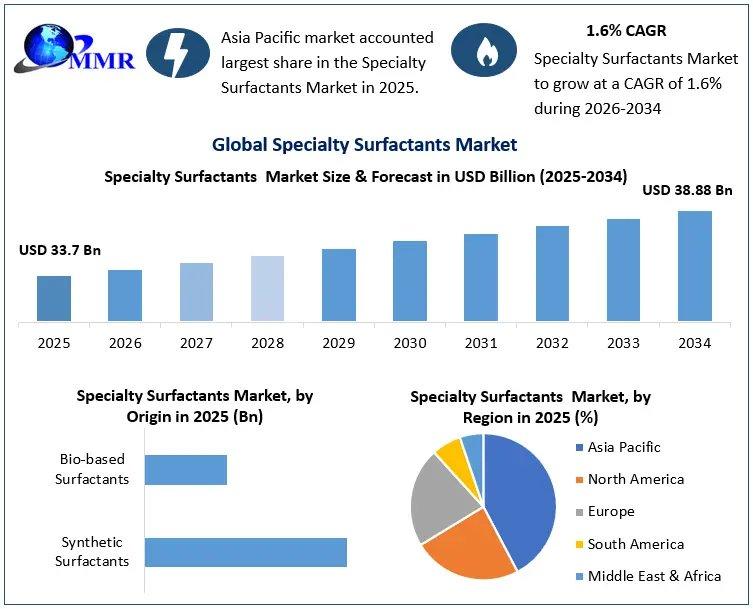
    Specialty Surfactants Market to Reach USD 38.88 Billion by 2034, Driven by Sustainable Formulations and High-Performance Applications

    The Specialty Surfactants Market is entering a period of steady transformation as manufacturers, formulators, and end-use industries increasingly seek high-performance ingredients that combine functionality, safety, and sustainability. According to Maximize Market Research, the market was valued at USD 33.7 billion in 2025 and is projected to reach USD 38.88 billion by 2034, expanding at a CAGR of 1.6% during 2026–2034.

    Market Estimation, Growth Drivers and Opportunities

    Specialty surfactants are surface-active chemicals designed to provide targeted properties such as emulsification, wetting, foaming, dispersion, solubilization, and cleaning. Their use across household detergents, personal care, industrial cleaning, agriculture, oilfield chemicals, textiles, lubricants, and other specialty applications continues to support market demand.

    One of the strongest growth drivers is the increasing consumption of personal care and home-care products. Premium skincare, shampoos, body washes, cosmetics, detergents, dishwashing liquids, and surface cleaners require surfactants with controlled performance and formulation compatibility. Industrialization and increasing hygiene awareness are also supporting demand for specialty cleaning formulations.

    Sustainability is creating another major opportunity. Manufacturers are investing in bio-based, biodegradable, low-toxicity, sugar-based, amino-acid-based, and biosurfactant technologies to address environmental concerns and changing customer expectations. At the same time, application-specific formulations are creating opportunities for suppliers to differentiate products through improved performance rather than competing only on price.

    However, raw-material price volatility, regulatory compliance costs, formulation complexity, and competition from conventional surfactants remain important challenges. Companies capable of combining performance, sustainability, cost efficiency, and reliable supply are positioned to capture emerging opportunities.

    Get Your Free Sample Report Link : https://www.maximizemarketresearch.com/request-sample/80533/

    U.S. Market Trends and Investment Outlook

    The United States remains an important specialty surfactants market because of its established personal care, household cleaning, industrial, pharmaceutical, agricultural, and specialty chemical industries. During 2025, sustainability and domestic production capacity became particularly important themes. BASF expanded its North American EcoBalanced Care Chemicals portfolio, including biomass-balance-certified betaine products, while six U.S. Care Chemicals production sites were powered with renewable electricity.

    Investment in domestic specialty surfactant capacity also accelerated. Stepan Company announced a 25% increase in Alpha Olefin Sulfonates (AOS) production capacity through investments and process improvements across facilities in Illinois, California, and Georgia. BASF also announced an additional APG production line in Cincinnati scheduled for start-up in 2026. These developments demonstrate the industry's movement toward higher-capacity, sustainable, and supply-chain-resilient specialty surfactant manufacturing in the U.S.

    Specialty Surfactants Market Demand and Projected Industry Growth Specialty Surfactants Market to Reach USD 38.88 Billion by 2034, Driven by Sustainable Formulations and High-Performance Applications The Specialty Surfactants Market is entering a period of steady transformation as manufacturers, formulators, and end-use industries increasingly seek high-performance ingredients that combine functionality, safety, and sustainability. According to Maximize Market Research, the market was valued at USD 33.7 billion in 2025 and is projected to reach USD 38.88 billion by 2034, expanding at a CAGR of 1.6% during 2026–2034. Market Estimation, Growth Drivers and Opportunities Specialty surfactants are surface-active chemicals designed to provide targeted properties such as emulsification, wetting, foaming, dispersion, solubilization, and cleaning. Their use across household detergents, personal care, industrial cleaning, agriculture, oilfield chemicals, textiles, lubricants, and other specialty applications continues to support market demand. One of the strongest growth drivers is the increasing consumption of personal care and home-care products. Premium skincare, shampoos, body washes, cosmetics, detergents, dishwashing liquids, and surface cleaners require surfactants with controlled performance and formulation compatibility. Industrialization and increasing hygiene awareness are also supporting demand for specialty cleaning formulations. Sustainability is creating another major opportunity. Manufacturers are investing in bio-based, biodegradable, low-toxicity, sugar-based, amino-acid-based, and biosurfactant technologies to address environmental concerns and changing customer expectations. At the same time, application-specific formulations are creating opportunities for suppliers to differentiate products through improved performance rather than competing only on price. However, raw-material price volatility, regulatory compliance costs, formulation complexity, and competition from conventional surfactants remain important challenges. Companies capable of combining performance, sustainability, cost efficiency, and reliable supply are positioned to capture emerging opportunities. Get Your Free Sample Report Link : https://www.maximizemarketresearch.com/request-sample/80533/ U.S. Market Trends and Investment Outlook The United States remains an important specialty surfactants market because of its established personal care, household cleaning, industrial, pharmaceutical, agricultural, and specialty chemical industries. During 2025, sustainability and domestic production capacity became particularly important themes. BASF expanded its North American EcoBalanced Care Chemicals portfolio, including biomass-balance-certified betaine products, while six U.S. Care Chemicals production sites were powered with renewable electricity. Investment in domestic specialty surfactant capacity also accelerated. Stepan Company announced a 25% increase in Alpha Olefin Sulfonates (AOS) production capacity through investments and process improvements across facilities in Illinois, California, and Georgia. BASF also announced an additional APG production line in Cincinnati scheduled for start-up in 2026. These developments demonstrate the industry's movement toward higher-capacity, sustainable, and supply-chain-resilient specialty surfactant manufacturing in the U.S.
    0 Comments ·0 Shares ·281 Views
  • Specialty Fertilizers Market Future Growth and Emerging Opportunities

    Specialty Fertilizers Market to Reach USD 53.81 Billion by 2032 as Sustainable Crop Nutrition Accelerates

    Maximize Market Research has released its analysis of the Specialty Fertilizers Market. The market was valued at USD 32.43 billion in 2025 and is expected to grow at 7.5% CAGR from 2026 to 2032, reaching USD 53.81 billion.

    Market Estimation, Growth Drivers and Opportunities

    Specialty fertilizers are formulated for specific plant nutritional requirements and growing conditions, providing targeted nutrient delivery and improved nutrient-use efficiency. Market growth is being supported by the shift toward sustainable agriculture, pressure to improve crop productivity, and concerns about nutrient losses, soil degradation, water pollution, and greenhouse-gas emissions linked to inefficient fertilizer use.

    Technological progress is creating new opportunities through controlled-release and slow-release formulations, variable-rate application, crop-specific blends, micronutrients, water-soluble products, and digital agriculture. Sensors, soil data, analytics, and farm-management platforms can improve decisions about where and when nutrients are applied. These developments create opportunities for enhanced-efficiency fertilizers, biological inputs, and precision nutrient solutions. Higher production and purchase costs remain a restraint, making measurable returns important for adoption.

    Get a Free Sample Market Report Link : https://www.maximizemarketresearch.com/request-sample/199861/

    U.S. Market: 2025 Trends and Investment

    The United States remained an important market as farmers managed fertilizer affordability, supply security, and productivity. In March 2025, USDA reported that fertilizer prices had stabilized near the planting season compared with the extreme highs of 2021–2022, while remaining exposed to supply, demand, and trade conditions. USDA’s 2025 fertilizer-production expansion program also supported projects involving regenerative plant nutrients, specialty chemicals, fertilizer alternatives, storage, and processing. One award supported Hydrite Chemical Co.’s expansion to produce potassium thiosulfate and low-salt fertilizer. These investments strengthen opportunities for differentiated nutrient products and domestic supply resilience.

    Specialty Fertilizers Market Future Growth and Emerging Opportunities Specialty Fertilizers Market to Reach USD 53.81 Billion by 2032 as Sustainable Crop Nutrition Accelerates Maximize Market Research has released its analysis of the Specialty Fertilizers Market. The market was valued at USD 32.43 billion in 2025 and is expected to grow at 7.5% CAGR from 2026 to 2032, reaching USD 53.81 billion. Market Estimation, Growth Drivers and Opportunities Specialty fertilizers are formulated for specific plant nutritional requirements and growing conditions, providing targeted nutrient delivery and improved nutrient-use efficiency. Market growth is being supported by the shift toward sustainable agriculture, pressure to improve crop productivity, and concerns about nutrient losses, soil degradation, water pollution, and greenhouse-gas emissions linked to inefficient fertilizer use. Technological progress is creating new opportunities through controlled-release and slow-release formulations, variable-rate application, crop-specific blends, micronutrients, water-soluble products, and digital agriculture. Sensors, soil data, analytics, and farm-management platforms can improve decisions about where and when nutrients are applied. These developments create opportunities for enhanced-efficiency fertilizers, biological inputs, and precision nutrient solutions. Higher production and purchase costs remain a restraint, making measurable returns important for adoption. Get a Free Sample Market Report Link : https://www.maximizemarketresearch.com/request-sample/199861/ U.S. Market: 2025 Trends and Investment The United States remained an important market as farmers managed fertilizer affordability, supply security, and productivity. In March 2025, USDA reported that fertilizer prices had stabilized near the planting season compared with the extreme highs of 2021–2022, while remaining exposed to supply, demand, and trade conditions. USDA’s 2025 fertilizer-production expansion program also supported projects involving regenerative plant nutrients, specialty chemicals, fertilizer alternatives, storage, and processing. One award supported Hydrite Chemical Co.’s expansion to produce potassium thiosulfate and low-salt fertilizer. These investments strengthen opportunities for differentiated nutrient products and domestic supply resilience.
    0 Comments ·0 Shares ·487 Views
  • Spunbond Nonwoven Market Demands and Projected Industry Growth

    Spunbond Nonwoven Market to Reach USD 43.50 Billion by 2034

    The Spunbond Nonwoven Market is entering a strong expansion phase as demand increases across personal care and hygiene, healthcare, agriculture, packaging, automotive, construction, filtration, and geotextile applications. The market was valued at USD 21.76 billion in 2025 and is projected to grow at a CAGR of 8% from 2026 to 2034, reaching nearly USD 43.50 billion by 2034.

    Market Estimation, Growth Drivers and Opportunities

    Spunbond nonwoven materials are gaining importance because they combine lightweight construction, strength, durability, chemical resistance, processability, and cost efficiency. Growing consumption of disposable hygiene products, increasing healthcare requirements, rising adoption of lightweight materials, and expanding applications in construction and geotextiles are supporting market growth.

    The polypropylene segment represents the leading material category. Polypropylene is widely used because of its low density, cost advantages, hydrophobic characteristics, chemical resistance, and suitability for high-volume nonwoven production. Healthcare and personal hygiene applications remain important demand centers, while growing geotextile adoption creates additional opportunities in infrastructure, drainage, soil stabilization, filtration, and construction.

    Get a Free Sample Market Report Link : https://www.maximizemarketresearch.com/request-sample/2636/

    U.S. Market Trends and Investment

    The United States remains an important market for advanced nonwoven materials, supported by demand from hygiene, healthcare, industrial, construction, and filtration applications. A significant 2025 development was Avgol’s opening of a new high-speed, high-capacity flexible multiple-beam nonwoven production line at its Mocksville, North Carolina facility, representing a USD 100 million investment. The facility also added a three-layer lamination line, expanding capabilities for composite nonwoven products. The investment is aimed at serving applications including baby diapers, adult incontinence products, and feminine hygiene.

    U.S. demand is also being influenced by increasing emphasis on domestic manufacturing capacity, supply-chain resilience, advanced hygiene materials, and higher-performance nonwoven products. In 2025, Fibertex Nonwovens also reported stronger U.S. sales supported by newly installed production capacity in South Carolina, highlighting continued investment in North American manufacturing.

    Spunbond Nonwoven Market Demands and Projected Industry Growth Spunbond Nonwoven Market to Reach USD 43.50 Billion by 2034 The Spunbond Nonwoven Market is entering a strong expansion phase as demand increases across personal care and hygiene, healthcare, agriculture, packaging, automotive, construction, filtration, and geotextile applications. The market was valued at USD 21.76 billion in 2025 and is projected to grow at a CAGR of 8% from 2026 to 2034, reaching nearly USD 43.50 billion by 2034. Market Estimation, Growth Drivers and Opportunities Spunbond nonwoven materials are gaining importance because they combine lightweight construction, strength, durability, chemical resistance, processability, and cost efficiency. Growing consumption of disposable hygiene products, increasing healthcare requirements, rising adoption of lightweight materials, and expanding applications in construction and geotextiles are supporting market growth. The polypropylene segment represents the leading material category. Polypropylene is widely used because of its low density, cost advantages, hydrophobic characteristics, chemical resistance, and suitability for high-volume nonwoven production. Healthcare and personal hygiene applications remain important demand centers, while growing geotextile adoption creates additional opportunities in infrastructure, drainage, soil stabilization, filtration, and construction. Get a Free Sample Market Report Link : https://www.maximizemarketresearch.com/request-sample/2636/ U.S. Market Trends and Investment The United States remains an important market for advanced nonwoven materials, supported by demand from hygiene, healthcare, industrial, construction, and filtration applications. A significant 2025 development was Avgol’s opening of a new high-speed, high-capacity flexible multiple-beam nonwoven production line at its Mocksville, North Carolina facility, representing a USD 100 million investment. The facility also added a three-layer lamination line, expanding capabilities for composite nonwoven products. The investment is aimed at serving applications including baby diapers, adult incontinence products, and feminine hygiene. U.S. demand is also being influenced by increasing emphasis on domestic manufacturing capacity, supply-chain resilience, advanced hygiene materials, and higher-performance nonwoven products. In 2025, Fibertex Nonwovens also reported stronger U.S. sales supported by newly installed production capacity in South Carolina, highlighting continued investment in North American manufacturing.
    0 Comments ·0 Shares ·525 Views
  • Narrow band IoT (NB-IoT) Chipset Market Smart Metering Applications, Network Connectivity, and Future Prospects 2030

    Narrowband IoT (NB-IoT) Chipset Market Overview

    The Narrowband IoT (NB-IoT) Chipset Market report provides an in-depth analysis that is required to make informed industry decisions and develop strategic growth plans. Regardless of the production method or cost structures, the Narrowband IoT (NB-IoT) Chipset market report provides a full understanding of advanced tactics and plans.

    Narrowband IoT (NB-IoT) Chipset Market Forecast

    Narrowband IoT (NBIoT) Chipset Market size is expected to grow at 38.9% throughout the forecast period, reaching nearly US$ 12.74 Bn by 2030.

    Please connect with our representative, who will ensure you to get a report sample here @https://www.maximizemarketresearch.com/request-sample/29666/

    Narrowband IoT (NB-IoT) Chipset Market Report Scope and Research Methodology

    The report offers an extensive examination of top players' strategies within the Narrowband IoT (NB-IoT) Chipset industry, coupled with an in-depth analysis of market segments and regional dynamics. In-depth insights into market dynamics, encompassing drivers, restraints, opportunities, and challenges, are provided both on a regional and segmental basis within the Narrowband IoT (NB-IoT) Chipset Market report. Additionally, the report presents import/export consumption, supply and demand, pricing, costs, revenue, and gross margins data, serving as an invaluable guide for investors.

    The data for the Narrowband IoT (NB-IoT) Chipset Market report was meticulously gathered through a combination of primary and secondary research methods, ensuring its authenticity. Primary research methods employed encompassed questionnaire distribution, surveys, and telephone interviews with Narrowband IoT (NB-IoT) Chipset industry experts, market leaders, marketing professionals, and entrepreneurs. The report's estimates of global and regional Narrowband IoT (NB-IoT) Chipset market size were derived using a bottom-up approach. Furthermore, the strengths and weaknesses of Narrowband IoT (NB-IoT) Chipset key players within the industry are outlined using SWOT analysis.

    Narrowband IoT (NB-IoT) Chipset Market Regional Insights

    The report delves into the Narrowband IoT (NB-IoT) Chipset business in great depth, segmenting it into numerous locations. North America, South America, Europe, Asia Pacific (APAC), Africa, and the Middle East are evaluated by region and country in the study. In the Narrowband IoT (NB-IoT) Chipset market report, regional markets are thoroughly investigated in order to uncover regional market trends, restrictions, and possible prospects.

    Narrowband IoT (NB-IoT) Chipset Market Segmentation

    by Deployment Type

    Stand-Alone
    Guard Band
    In-Band

    by Devices

    Smart Parking
    Smart Meters
    Trackers
    Alarms and Detectors
    Smart Streetlights
    Smart Appliances
    Wearable Devices
    Other Devices

    by Vertical

    Agriculture
    Automotive and Transportation
    Energy and Utilities
    Healthcare
    Manufacturing
    Safety and Security
    Infrastructure
    Building Automation
    Consumer Electronics

    Request Free Sample Copy:https://www.maximizemarketresearch.com/request-sample/29666/

    Narrowband IoT (NB-IoT) Chipset Market Key Players

    1. Huawei
    2. Qualcomm
    3. Nordic Semiconductor
    4. Samsung Electronics
    5. Intel
    6. Sanechips Technology
    7. Mediatek
    8. Altair Semiconductor
    9. Commsolid
    10. Riot Micro
    11. Sierra Wireless
    12. U-Blox
    13. Sequans Communication
    14. GCT Semiconductor
    15. Xiamen CheerzingIoT Technology
    16. Telit
    17. Quectel Wireless Solutions
    18. Simcom Wireless Solutions
    19. Gemalto
    20. Sercomm

    Key Offerings:

    A detailed market overview
    Market Share, Size & Forecast by Revenue | 2026−2034
    Market Dynamics – Growth Drivers, Restraints, Investment Opportunities, and Key Trends
    Market Segmentation – A detailed analysis by segments and sub-segments
    Regional Insights
    Competitive Landscape – Top Key Vendors and Other Prominent Vendors
    More Trending From MMR:

    Global Biliary Stents Market https://www.maximizemarketresearch.com/market-report/global-biliary-stents-market/30076/
    Lactose Intolerance Treatment Market https://www.maximizemarketresearch.com/market-report/lactose-intolerance-treatment-market/88724/
    Global Eubiotics Market https://www.maximizemarketresearch.com/market-report/global-eubiotics-market/84503/

    About Maximize Market Research:

    Maximize Market Research is a multifaceted market research and consulting company with professionals from several industries. Some of the industries we cover include medical devices, pharmaceutical manufacturers, science and engineering, electronic components, industrial equipment, technology and communication, cars and automobiles, chemical products and substances, general merchandise, beverages, personal care, and automated systems. To mention a few, we provide market-verified industry estimations, technical trend analysis, crucial market research, strategic advice, competition analysis, production and demand analysis, and client impact studies.

    Contact Maximize Market Research:

    3rd Floor, Naval IT Park, Phase 2

    Pune Banglore Highway, Narhe

    Pune, Maharashtra 411041, India

    [email protected]

    +91 96071 95908, +91 9607365656
    Narrow band IoT (NB-IoT) Chipset Market Smart Metering Applications, Network Connectivity, and Future Prospects 2030 Narrowband IoT (NB-IoT) Chipset Market Overview The Narrowband IoT (NB-IoT) Chipset Market report provides an in-depth analysis that is required to make informed industry decisions and develop strategic growth plans. Regardless of the production method or cost structures, the Narrowband IoT (NB-IoT) Chipset market report provides a full understanding of advanced tactics and plans. Narrowband IoT (NB-IoT) Chipset Market Forecast Narrowband IoT (NBIoT) Chipset Market size is expected to grow at 38.9% throughout the forecast period, reaching nearly US$ 12.74 Bn by 2030. Please connect with our representative, who will ensure you to get a report sample here @https://www.maximizemarketresearch.com/request-sample/29666/ Narrowband IoT (NB-IoT) Chipset Market Report Scope and Research Methodology The report offers an extensive examination of top players' strategies within the Narrowband IoT (NB-IoT) Chipset industry, coupled with an in-depth analysis of market segments and regional dynamics. In-depth insights into market dynamics, encompassing drivers, restraints, opportunities, and challenges, are provided both on a regional and segmental basis within the Narrowband IoT (NB-IoT) Chipset Market report. Additionally, the report presents import/export consumption, supply and demand, pricing, costs, revenue, and gross margins data, serving as an invaluable guide for investors. The data for the Narrowband IoT (NB-IoT) Chipset Market report was meticulously gathered through a combination of primary and secondary research methods, ensuring its authenticity. Primary research methods employed encompassed questionnaire distribution, surveys, and telephone interviews with Narrowband IoT (NB-IoT) Chipset industry experts, market leaders, marketing professionals, and entrepreneurs. The report's estimates of global and regional Narrowband IoT (NB-IoT) Chipset market size were derived using a bottom-up approach. Furthermore, the strengths and weaknesses of Narrowband IoT (NB-IoT) Chipset key players within the industry are outlined using SWOT analysis. Narrowband IoT (NB-IoT) Chipset Market Regional Insights The report delves into the Narrowband IoT (NB-IoT) Chipset business in great depth, segmenting it into numerous locations. North America, South America, Europe, Asia Pacific (APAC), Africa, and the Middle East are evaluated by region and country in the study. In the Narrowband IoT (NB-IoT) Chipset market report, regional markets are thoroughly investigated in order to uncover regional market trends, restrictions, and possible prospects. Narrowband IoT (NB-IoT) Chipset Market Segmentation by Deployment Type Stand-Alone Guard Band In-Band by Devices Smart Parking Smart Meters Trackers Alarms and Detectors Smart Streetlights Smart Appliances Wearable Devices Other Devices by Vertical Agriculture Automotive and Transportation Energy and Utilities Healthcare Manufacturing Safety and Security Infrastructure Building Automation Consumer Electronics Request Free Sample Copy:https://www.maximizemarketresearch.com/request-sample/29666/ Narrowband IoT (NB-IoT) Chipset Market Key Players 1. Huawei 2. Qualcomm 3. Nordic Semiconductor 4. Samsung Electronics 5. Intel 6. Sanechips Technology 7. Mediatek 8. Altair Semiconductor 9. Commsolid 10. Riot Micro 11. Sierra Wireless 12. U-Blox 13. Sequans Communication 14. GCT Semiconductor 15. Xiamen CheerzingIoT Technology 16. Telit 17. Quectel Wireless Solutions 18. Simcom Wireless Solutions 19. Gemalto 20. Sercomm Key Offerings: A detailed market overview Market Share, Size & Forecast by Revenue | 2026−2034 Market Dynamics – Growth Drivers, Restraints, Investment Opportunities, and Key Trends Market Segmentation – A detailed analysis by segments and sub-segments Regional Insights Competitive Landscape – Top Key Vendors and Other Prominent Vendors More Trending From MMR: Global Biliary Stents Market https://www.maximizemarketresearch.com/market-report/global-biliary-stents-market/30076/ Lactose Intolerance Treatment Market https://www.maximizemarketresearch.com/market-report/lactose-intolerance-treatment-market/88724/ Global Eubiotics Market https://www.maximizemarketresearch.com/market-report/global-eubiotics-market/84503/ About Maximize Market Research: Maximize Market Research is a multifaceted market research and consulting company with professionals from several industries. Some of the industries we cover include medical devices, pharmaceutical manufacturers, science and engineering, electronic components, industrial equipment, technology and communication, cars and automobiles, chemical products and substances, general merchandise, beverages, personal care, and automated systems. To mention a few, we provide market-verified industry estimations, technical trend analysis, crucial market research, strategic advice, competition analysis, production and demand analysis, and client impact studies. Contact Maximize Market Research: 3rd Floor, Naval IT Park, Phase 2 Pune Banglore Highway, Narhe Pune, Maharashtra 411041, India [email protected] +91 96071 95908, +91 9607365656
    0 Comments ·0 Shares ·263 Views
  • Commercial Satellite Imaging Market Trends, Demand and Industry Outlook 2030

    Commercial Satellite Imaging Market Overview

    The Commercial Satellite Imaging Market report provides an in-depth analysis that is required to make informed industry decisions and develop strategic growth plans. Regardless of the production method or cost structures, the Commercial Satellite Imaging market report provides a full understanding of advanced tactics and plans.

    Commercial Satellite Imaging Market Forecast

    Global Commercial Satellite Imaging Market size is expected to reach US$ 9.64 Bn in year 2030, at a CAGR of 11.05% during the forecast period.

    Please connect with our representative, who will ensure you to get a report sample here @https://www.maximizemarketresearch.com/request-sample/16869/

    Commercial Satellite Imaging Market Report Scope and Research Methodology

    The report offers an extensive examination of top players' strategies within the Commercial Satellite Imaging industry, coupled with an in-depth analysis of market segments and regional dynamics. In-depth insights into market dynamics, encompassing drivers, restraints, opportunities, and challenges, are provided both on a regional and segmental basis within the Commercial Satellite Imaging Market report. Additionally, the report presents import/export consumption, supply and demand, pricing, costs, revenue, and gross margins data, serving as an invaluable guide for investors.

    The data for the Commercial Satellite Imaging Market report was meticulously gathered through a combination of primary and secondary research methods, ensuring its authenticity. Primary research methods employed encompassed questionnaire distribution, surveys, and telephone interviews with Commercial Satellite Imaging industry experts, market leaders, marketing professionals, and entrepreneurs. The report's estimates of global and regional Commercial Satellite Imaging market size were derived using a bottom-up approach. Furthermore, the strengths and weaknesses of Commercial Satellite Imaging key players within the industry are outlined using SWOT analysis.

    Commercial Satellite Imaging Market Regional Insights

    The report delves into the Commercial Satellite Imaging business in great depth, segmenting it into numerous locations. North America, South America, Europe, Asia Pacific (APAC), Africa, and the Middle East are evaluated by region and country in the study. In the Commercial Satellite Imaging market report, regional markets are thoroughly investigated in order to uncover regional market trends, restrictions, and possible prospects.

    Commercial Satellite Imaging Market Segmentation

    by End-User

    Government
    Civil Engineering Industry
    Commercial Enterprises
    Military
    Forest
    Agriculture
    Energy Sectors
    Insurance

    by Application

    Energy
    Geospatial Technology
    Natural Resources Management
    Disaster Response Management
    Construction and Development
    Defense and Intelligence
    Conservation and Research
    Media
    Entertainment

    Request Free Sample Copy:https://www.maximizemarketresearch.com/request-sample/16869/

    Commercial Satellite Imaging Market Key Players

    1. Galileo Group Inc.
    2. Blacksky Global
    3. Planet Labs Inc.
    4. Astrium Geo
    5. Telespazio
    6. DigitalGlobe Inc.
    7. Exelis Inc.
    8. Trimble Navigation Ltd.
    9. Spaceknow Inc. ,
    10. SpaceKnow
    11. Airbus
    12. SkyLab Analytics
    13. Harris Corporation
    14. European Space Imaging
    15. UrtheCast
    16. GeoEye Inc.
    17. Image Sat International N.V.
    18. Google Inc.
    19. Galileo Group.
    20. Maxar Technologies Inc.
    21. UrtheCast Corp
    22. Digital Globe Inc.

    Key Offerings:

    A detailed market overview
    Market Share, Size & Forecast by Revenue | 2026−2034
    Market Dynamics – Growth Drivers, Restraints, Investment Opportunities, and Key Trends
    Market Segmentation – A detailed analysis by segments and sub-segments
    Regional Insights
    Competitive Landscape – Top Key Vendors and Other Prominent Vendors
    More Trending From MMR:

    HVAC Motors Market https://www.maximizemarketresearch.com/market-report/hvac-motors-market/66492/
    Microseismic Monitoring Technology Market https://www.maximizemarketresearch.com/market-report/global-microseismic-monitoring-technology-market/44398/
    Global Reusable Food Wrap Market https://www.maximizemarketresearch.com/market-report/global-reusable-food-wrap-market/111423/

    About Maximize Market Research:

    Maximize Market Research is a multifaceted market research and consulting company with professionals from several industries. Some of the industries we cover include medical devices, pharmaceutical manufacturers, science and engineering, electronic components, industrial equipment, technology and communication, cars and automobiles, chemical products and substances, general merchandise, beverages, personal care, and automated systems. To mention a few, we provide market-verified industry estimations, technical trend analysis, crucial market research, strategic advice, competition analysis, production and demand analysis, and client impact studies.

    Contact Maximize Market Research:

    3rd Floor, Naval IT Park, Phase 2

    Pune Banglore Highway, Narhe

    Pune, Maharashtra 411041, India

    [email protected]

    +91 96071 95908, +91 9607365656
    Commercial Satellite Imaging Market Trends, Demand and Industry Outlook 2030 Commercial Satellite Imaging Market Overview The Commercial Satellite Imaging Market report provides an in-depth analysis that is required to make informed industry decisions and develop strategic growth plans. Regardless of the production method or cost structures, the Commercial Satellite Imaging market report provides a full understanding of advanced tactics and plans. Commercial Satellite Imaging Market Forecast Global Commercial Satellite Imaging Market size is expected to reach US$ 9.64 Bn in year 2030, at a CAGR of 11.05% during the forecast period. Please connect with our representative, who will ensure you to get a report sample here @https://www.maximizemarketresearch.com/request-sample/16869/ Commercial Satellite Imaging Market Report Scope and Research Methodology The report offers an extensive examination of top players' strategies within the Commercial Satellite Imaging industry, coupled with an in-depth analysis of market segments and regional dynamics. In-depth insights into market dynamics, encompassing drivers, restraints, opportunities, and challenges, are provided both on a regional and segmental basis within the Commercial Satellite Imaging Market report. Additionally, the report presents import/export consumption, supply and demand, pricing, costs, revenue, and gross margins data, serving as an invaluable guide for investors. The data for the Commercial Satellite Imaging Market report was meticulously gathered through a combination of primary and secondary research methods, ensuring its authenticity. Primary research methods employed encompassed questionnaire distribution, surveys, and telephone interviews with Commercial Satellite Imaging industry experts, market leaders, marketing professionals, and entrepreneurs. The report's estimates of global and regional Commercial Satellite Imaging market size were derived using a bottom-up approach. Furthermore, the strengths and weaknesses of Commercial Satellite Imaging key players within the industry are outlined using SWOT analysis. Commercial Satellite Imaging Market Regional Insights The report delves into the Commercial Satellite Imaging business in great depth, segmenting it into numerous locations. North America, South America, Europe, Asia Pacific (APAC), Africa, and the Middle East are evaluated by region and country in the study. In the Commercial Satellite Imaging market report, regional markets are thoroughly investigated in order to uncover regional market trends, restrictions, and possible prospects. Commercial Satellite Imaging Market Segmentation by End-User Government Civil Engineering Industry Commercial Enterprises Military Forest Agriculture Energy Sectors Insurance by Application Energy Geospatial Technology Natural Resources Management Disaster Response Management Construction and Development Defense and Intelligence Conservation and Research Media Entertainment Request Free Sample Copy:https://www.maximizemarketresearch.com/request-sample/16869/ Commercial Satellite Imaging Market Key Players 1. Galileo Group Inc. 2. Blacksky Global 3. Planet Labs Inc. 4. Astrium Geo 5. Telespazio 6. DigitalGlobe Inc. 7. Exelis Inc. 8. Trimble Navigation Ltd. 9. Spaceknow Inc. , 10. SpaceKnow 11. Airbus 12. SkyLab Analytics 13. Harris Corporation 14. European Space Imaging 15. UrtheCast 16. GeoEye Inc. 17. Image Sat International N.V. 18. Google Inc. 19. Galileo Group. 20. Maxar Technologies Inc. 21. UrtheCast Corp 22. Digital Globe Inc. Key Offerings: A detailed market overview Market Share, Size & Forecast by Revenue | 2026−2034 Market Dynamics – Growth Drivers, Restraints, Investment Opportunities, and Key Trends Market Segmentation – A detailed analysis by segments and sub-segments Regional Insights Competitive Landscape – Top Key Vendors and Other Prominent Vendors More Trending From MMR: HVAC Motors Market https://www.maximizemarketresearch.com/market-report/hvac-motors-market/66492/ Microseismic Monitoring Technology Market https://www.maximizemarketresearch.com/market-report/global-microseismic-monitoring-technology-market/44398/ Global Reusable Food Wrap Market https://www.maximizemarketresearch.com/market-report/global-reusable-food-wrap-market/111423/ About Maximize Market Research: Maximize Market Research is a multifaceted market research and consulting company with professionals from several industries. Some of the industries we cover include medical devices, pharmaceutical manufacturers, science and engineering, electronic components, industrial equipment, technology and communication, cars and automobiles, chemical products and substances, general merchandise, beverages, personal care, and automated systems. To mention a few, we provide market-verified industry estimations, technical trend analysis, crucial market research, strategic advice, competition analysis, production and demand analysis, and client impact studies. Contact Maximize Market Research: 3rd Floor, Naval IT Park, Phase 2 Pune Banglore Highway, Narhe Pune, Maharashtra 411041, India [email protected] +91 96071 95908, +91 9607365656
    0 Comments ·0 Shares ·474 Views
  • Urea Market Demand and Growth Outlook Across Key Applications

    Urea Market Poised for Expansion as Food Security, Industrial Demand and Low-Carbon Fertilizer Investments Reshape Global Industry

    The Urea Market is entering a period of expansion as food requirements, agricultural productivity and cleaner nitrogen investments strengthen demand. According to Maximize Market Research, the Urea Market was valued at USD 46.75 billion in 2025 and is projected to grow at a CAGR of 2.8% from 2026 to 2032, reaching nearly USD 56.72 billion by 2032. Urea remains vital because it contains approximately 46% nitrogen and is cost-effective for crop yields. Food-security priorities and shrinking arable land are supporting fertilizer consumption across agricultural economies.

    Beyond agriculture, urea demand is supported by chemical manufacturing, resins, plastics, animal nutrition and diesel exhaust fluid. Precision farming, green ammonia and carbon capture are creating opportunities for more efficient and lower-carbon fertilizer production.

    United States Market: 2025 Trends and Investment

    The U.S. urea market benefited from resilient nitrogen demand in 2025, supported by favorable corn economics and expectations for higher corn acreage. CF Industries reported strong North American nitrogen demand during the 2025 spring application season, while its outlook pointed to continued positive global nitrogen demand and constrained supply. In April 2025, CF Industries formed a joint venture with JERA and Mitsui to develop a low-carbon ammonia facility at its Blue Point Complex in Louisiana, incorporating carbon capture infrastructure. The project illustrates the U.S. shift toward lower-carbon nitrogen production. The USDA highlighted that global supply conditions make domestic capacity and supply-chain resilience investment priorities.

    Download a Free Sample of the Market Report : https://www.maximizemarketresearch.com/request-sample/26788/

    Market Segmentation: Largest-Share Segment

    By grade, agricultural-grade urea holds the largest share of the market. Its dominance reflects broad crop use, high nitrogen concentration and affordability. By application, fertilizers account for the largest market share because urea is widely used as a nitrogen fertilizer for improving crop productivity. Strong agricultural demand and food-security programs should preserve its leadership.

    Competitive Analysis

    Nutrien is a major nitrogen fertilizer producer with an extensive agricultural retail network. In 2025, the company increased nitrogen operating rates at North American facilities and allocated approximately USD 400–500 million of investing capital toward proprietary products, network optimization, digital capabilities and low-cost nitrogen expansions. Nutrien also agreed to sell its Profertil stake for about USD 600 million, supporting targeted growth, debt reduction and shareholder returns.

    CF Industries is a leading global ammonia and nitrogen producer with strong U.S. manufacturing capabilities. In 2025, the company planned approximately USD 500–550 million in capital spending and advanced its Blue Point low-carbon ammonia joint venture with JERA and Mitsui. The project could support lower-carbon nitrogen production.

    Yara International is pursuing sustainable fertilizer and ammonia opportunities. In December 2025, Yara and Air Products entered advanced negotiations to partner on low-emission ammonia projects in the United States and Saudi Arabia. The strategy supports supply diversification and lower-carbon fertilizer production.
    Urea Market Demand and Growth Outlook Across Key Applications Urea Market Poised for Expansion as Food Security, Industrial Demand and Low-Carbon Fertilizer Investments Reshape Global Industry The Urea Market is entering a period of expansion as food requirements, agricultural productivity and cleaner nitrogen investments strengthen demand. According to Maximize Market Research, the Urea Market was valued at USD 46.75 billion in 2025 and is projected to grow at a CAGR of 2.8% from 2026 to 2032, reaching nearly USD 56.72 billion by 2032. Urea remains vital because it contains approximately 46% nitrogen and is cost-effective for crop yields. Food-security priorities and shrinking arable land are supporting fertilizer consumption across agricultural economies. Beyond agriculture, urea demand is supported by chemical manufacturing, resins, plastics, animal nutrition and diesel exhaust fluid. Precision farming, green ammonia and carbon capture are creating opportunities for more efficient and lower-carbon fertilizer production. United States Market: 2025 Trends and Investment The U.S. urea market benefited from resilient nitrogen demand in 2025, supported by favorable corn economics and expectations for higher corn acreage. CF Industries reported strong North American nitrogen demand during the 2025 spring application season, while its outlook pointed to continued positive global nitrogen demand and constrained supply. In April 2025, CF Industries formed a joint venture with JERA and Mitsui to develop a low-carbon ammonia facility at its Blue Point Complex in Louisiana, incorporating carbon capture infrastructure. The project illustrates the U.S. shift toward lower-carbon nitrogen production. The USDA highlighted that global supply conditions make domestic capacity and supply-chain resilience investment priorities. Download a Free Sample of the Market Report : https://www.maximizemarketresearch.com/request-sample/26788/ Market Segmentation: Largest-Share Segment By grade, agricultural-grade urea holds the largest share of the market. Its dominance reflects broad crop use, high nitrogen concentration and affordability. By application, fertilizers account for the largest market share because urea is widely used as a nitrogen fertilizer for improving crop productivity. Strong agricultural demand and food-security programs should preserve its leadership. Competitive Analysis Nutrien is a major nitrogen fertilizer producer with an extensive agricultural retail network. In 2025, the company increased nitrogen operating rates at North American facilities and allocated approximately USD 400–500 million of investing capital toward proprietary products, network optimization, digital capabilities and low-cost nitrogen expansions. Nutrien also agreed to sell its Profertil stake for about USD 600 million, supporting targeted growth, debt reduction and shareholder returns. CF Industries is a leading global ammonia and nitrogen producer with strong U.S. manufacturing capabilities. In 2025, the company planned approximately USD 500–550 million in capital spending and advanced its Blue Point low-carbon ammonia joint venture with JERA and Mitsui. The project could support lower-carbon nitrogen production. Yara International is pursuing sustainable fertilizer and ammonia opportunities. In December 2025, Yara and Air Products entered advanced negotiations to partner on low-emission ammonia projects in the United States and Saudi Arabia. The strategy supports supply diversification and lower-carbon fertilizer production.
    0 Comments ·0 Shares ·582 Views
More Results