

• All-Terrain Vehicle (ATV) Market: Increasing Adoption Across Utility and Recreational Sectors – Report by MMR

    All-Terrain Vehicle (ATV) Market Report Overview

    The forecasting process primarily hinges on the analysis of historical data alongside current trends in the All-Terrain Vehicle (ATV) Market. This comprehensive data collection employs a blend of primary and secondary research methodologies. The report encompasses vital components such as market size, share, regional analysis, dynamics, CAGR, and future trends. This holistic approach renders the report an invaluable guide for investors, as it offers an insightful and forward-looking perspective on the All-Terrain Vehicle (ATV) industry.

    All-Terrain Vehicle (ATV) Market Projection:

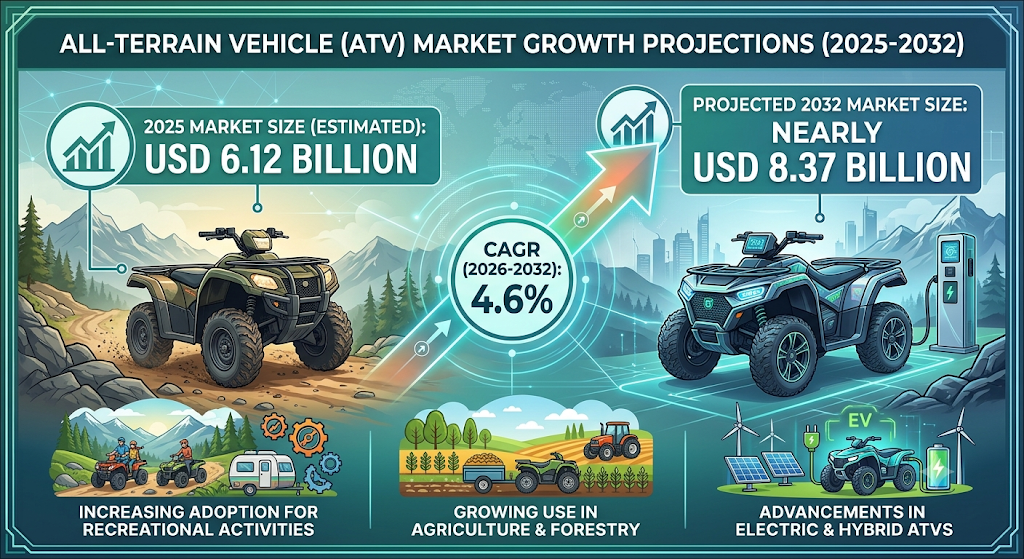
    The All-Terrain Vehicle (ATV) Market size was valued at USD 6.12 Billion in 2025 and is expected to grow by 4.6% from 2026 to 2032, reaching nearly USD 8.37 billion in 2032.

    Please connect with our representative, who will ensure you to get a report sample here @https://www.maximizemarketresearch.com/request-sample/12678/

    All-Terrain Vehicle (ATV) Market Report Scope and Research Methodology

    The report presents historical data and forecasts on a global, regional, and country level, delivering an in-depth examination of All-Terrain Vehicle (ATV) market trends within each segment and their respective sub-segments . Maximize Market Research employs data triangulation as the primary research methodology, encompassing an evaluation of how data variables impact the All-Terrain Vehicle (ATV) market, data mining, and validation via primary sources such as industry experts.

    The analysis of complex All-Terrain Vehicle (ATV) industry data has been presented in straightforward language within the research report. SWOT analysis was leveraged to outline the strengths, weaknesses, opportunities, and threats for key players in the industry. To estimate the market size, a bottom-up approach was employed.

    All-Terrain Vehicle (ATV) Market Regional Analysis

    The report provides a detailed analysis of the All-Terrain Vehicle (ATV) market dynamics, Government initiatives and stringent rules and regulations influencing the market in each region. A detailed analysis of the market in North America, Asia Pacific, Europe, Middle East and Africa and South America are included in the report.

    All-Terrain Vehicle (ATV) Market Segmentation

    by Vehicle Type

    Utility ATV (UTV)
    Sport ATV
    Recreational ATV
    Youth ATV
    Others

    by Engine Capacity

    Below 400cc
    400–800cc
    Above 800cc

    by Fuel Type

    Gasoline
    Electric
    Diesel

    by Application

    Agriculture & Farming
    Forestry & Logging
    Military & Defense
    Recreational & Sports
    Hunting & Fishing
    Utility & Industrial
    Others

    Request Free Sample Copy:https://www.maximizemarketresearch.com/request-sample/12678/

    All-Terrain Vehicle (ATV) Key Players

    1. Polaris Inc.
    2. Honda Motor Co., Ltd.
    3. Yamaha Motor Co., Ltd.
    4. BRP Inc. (Can-Am)
    5. Kawasaki Heavy Industries, Ltd.
    6. Suzuki Motor Corporation
    7. Arctic Cat Inc.
    8. Textron Inc.
    9. CFMOTO
    10. KYMCO (Kwang Yang Motor Co., Ltd.)
    11. Hisun Motors Corp., USA
    12. Linhai Group
    13. Runtong Group
    14. Italika
    15. Tomcar USA
    16. JSW Sarbloh Motors
    17. Ace ATV Ltd
    18. Supacat Ltd
    19. Ineos Automotive
    20. Land Rover (Defender OCTA)
    21. Ford Motor Company (Raptor line)
    22. Jeep (Wrangler & Gladiator)
    23. Isuzu (D-Max AT35)
    24. Mercedes-Benz (G-Class)
    25. Toyota Motor Corporation (Land Cruiser)
    26. Rivian Automotive
    27. Brunswick Corporation
    28. Thor Industries
    29. Briggs & Stratton Corporation
    30. Honda Power Equipment

    Key Questions answered in the All-Terrain Vehicle (ATV) Market Report are:

    What is the expected CAGR of the All-Terrain Vehicle (ATV) market during the forecast period?
    What are the All-Terrain Vehicle (ATV) market segments?
    Which region of the All-Terrain Vehicle (ATV) market is expected to grow at a high rate during the forecast period?
    What is the expected CAGR of the All-Terrain Vehicle (ATV) market during the forecast period?
    What are the emerging trends in the All-Terrain Vehicle (ATV) market?
    What are the factors restraining the All-Terrain Vehicle (ATV) market growth?
    Key offerings:

    Market Share, Size, and Forecast by Revenue|2026-2034
    Market Dynamics- Growth drivers, Restraints, Investment Opportunities, and key trends
    Market Segmentation- A detailed analysis of each segment and their segments
    Competitive Landscape - Leading key players and other prominent key players.
    Trending Reports:

    Global Cosmetic Dentistry Market https://www.maximizemarketresearch.com/market-report/cosmetic-dentistry-market/148509/
    Customer Journey Analytics Market https://www.maximizemarketresearch.com/market-report/global-customer-journey-analytics-market/6437/
    Mobile TV Market https://www.maximizemarketresearch.com/market-report/global-mobile-tv-market/55574/

    About Maximize Market Research:

    Maximize Market Research is a multifaceted market research and consulting company with professionals from several industries. Some of the industries we cover include medical devices, pharmaceutical manufacturers, science and engineering, electronic components, industrial equipment, technology and communication, cars and automobiles, chemical products and substances, general merchandise, beverages, personal care, and automated systems. To mention a few, we provide market-verified industry estimations, technical trend analysis, crucial market research, strategic advice, competition analysis, production and demand analysis, and client impact studies.

    Contact Maximize Market Research:

    3rd Floor, Navale IT Park, Phase 2

    Pune Banglore Highway, Narhe,

    Pune, Maharashtra 411041, India

    [email protected]

    +91 96071 95908, +91 9607365656
    All-Terrain Vehicle (ATV) Market: Increasing Adoption Across Utility and Recreational Sectors – Report by MMR All-Terrain Vehicle (ATV) Market Report Overview The forecasting process primarily hinges on the analysis of historical data alongside current trends in the All-Terrain Vehicle (ATV) Market. This comprehensive data collection employs a blend of primary and secondary research methodologies. The report encompasses vital components such as market size, share, regional analysis, dynamics, CAGR, and future trends. This holistic approach renders the report an invaluable guide for investors, as it offers an insightful and forward-looking perspective on the All-Terrain Vehicle (ATV) industry. All-Terrain Vehicle (ATV) Market Projection: The All-Terrain Vehicle (ATV) Market size was valued at USD 6.12 Billion in 2025 and is expected to grow by 4.6% from 2026 to 2032, reaching nearly USD 8.37 billion in 2032. Please connect with our representative, who will ensure you to get a report sample here @https://www.maximizemarketresearch.com/request-sample/12678/ All-Terrain Vehicle (ATV) Market Report Scope and Research Methodology The report presents historical data and forecasts on a global, regional, and country level, delivering an in-depth examination of All-Terrain Vehicle (ATV) market trends within each segment and their respective sub-segments . Maximize Market Research employs data triangulation as the primary research methodology, encompassing an evaluation of how data variables impact the All-Terrain Vehicle (ATV) market, data mining, and validation via primary sources such as industry experts. The analysis of complex All-Terrain Vehicle (ATV) industry data has been presented in straightforward language within the research report. SWOT analysis was leveraged to outline the strengths, weaknesses, opportunities, and threats for key players in the industry. To estimate the market size, a bottom-up approach was employed. All-Terrain Vehicle (ATV) Market Regional Analysis The report provides a detailed analysis of the All-Terrain Vehicle (ATV) market dynamics, Government initiatives and stringent rules and regulations influencing the market in each region. A detailed analysis of the market in North America, Asia Pacific, Europe, Middle East and Africa and South America are included in the report. All-Terrain Vehicle (ATV) Market Segmentation by Vehicle Type Utility ATV (UTV) Sport ATV Recreational ATV Youth ATV Others by Engine Capacity Below 400cc 400–800cc Above 800cc by Fuel Type Gasoline Electric Diesel by Application Agriculture & Farming Forestry & Logging Military & Defense Recreational & Sports Hunting & Fishing Utility & Industrial Others Request Free Sample Copy:https://www.maximizemarketresearch.com/request-sample/12678/ All-Terrain Vehicle (ATV) Key Players 1. Polaris Inc. 2. Honda Motor Co., Ltd. 3. Yamaha Motor Co., Ltd. 4. BRP Inc. (Can-Am) 5. Kawasaki Heavy Industries, Ltd. 6. Suzuki Motor Corporation 7. Arctic Cat Inc. 8. Textron Inc. 9. CFMOTO 10. KYMCO (Kwang Yang Motor Co., Ltd.) 11. Hisun Motors Corp., USA 12. Linhai Group 13. Runtong Group 14. Italika 15. Tomcar USA 16. JSW Sarbloh Motors 17. Ace ATV Ltd 18. Supacat Ltd 19. Ineos Automotive 20. Land Rover (Defender OCTA) 21. Ford Motor Company (Raptor line) 22. Jeep (Wrangler & Gladiator) 23. Isuzu (D-Max AT35) 24. Mercedes-Benz (G-Class) 25. Toyota Motor Corporation (Land Cruiser) 26. Rivian Automotive 27. Brunswick Corporation 28. Thor Industries 29. Briggs & Stratton Corporation 30. Honda Power Equipment Key Questions answered in the All-Terrain Vehicle (ATV) Market Report are: What is the expected CAGR of the All-Terrain Vehicle (ATV) market during the forecast period? What are the All-Terrain Vehicle (ATV) market segments? Which region of the All-Terrain Vehicle (ATV) market is expected to grow at a high rate during the forecast period? What is the expected CAGR of the All-Terrain Vehicle (ATV) market during the forecast period? What are the emerging trends in the All-Terrain Vehicle (ATV) market? What are the factors restraining the All-Terrain Vehicle (ATV) market growth? Key offerings: Market Share, Size, and Forecast by Revenue|2026-2034 Market Dynamics- Growth drivers, Restraints, Investment Opportunities, and key trends Market Segmentation- A detailed analysis of each segment and their segments Competitive Landscape - Leading key players and other prominent key players. Trending Reports: Global Cosmetic Dentistry Market https://www.maximizemarketresearch.com/market-report/cosmetic-dentistry-market/148509/ Customer Journey Analytics Market https://www.maximizemarketresearch.com/market-report/global-customer-journey-analytics-market/6437/ Mobile TV Market https://www.maximizemarketresearch.com/market-report/global-mobile-tv-market/55574/ About Maximize Market Research: Maximize Market Research is a multifaceted market research and consulting company with professionals from several industries. Some of the industries we cover include medical devices, pharmaceutical manufacturers, science and engineering, electronic components, industrial equipment, technology and communication, cars and automobiles, chemical products and substances, general merchandise, beverages, personal care, and automated systems. To mention a few, we provide market-verified industry estimations, technical trend analysis, crucial market research, strategic advice, competition analysis, production and demand analysis, and client impact studies. Contact Maximize Market Research: 3rd Floor, Navale IT Park, Phase 2 Pune Banglore Highway, Narhe, Pune, Maharashtra 411041, India [email protected] +91 96071 95908, +91 9607365656
    0 Comments ·0 Shares ·39 Views
  • Non-Woven Fabrics Market 2034: USD 85.07 Billion Growth Opportunity
    Market Overview: Rising Demand for Advanced Textiles Accelerates Global Industry Expansion

    The Non-Woven Fabrics Market was valued at USD 50.78 Billion in 2025 and is projected to reach nearly USD 85.07 Billion by 2034, expanding at a CAGR of 5.9% during 2026–2034, according to Maximize Market Research. Increasing demand for hygiene products, medical textiles, automotive components, and industrial filtration materials is strengthening global industry growth.

    The Non-Woven Fabrics Market benefits from expanding applications of lightweight, durable, and cost-effective textile materials manufactured without conventional weaving or knitting processes.

    Access Exclusive Insights – Get Your Free Sample Today @https://www.maximizemarketresearch.com/request-sample/17274/
    Non-Woven Fabrics Market 2034: USD 85.07 Billion Growth Opportunity Market Overview: Rising Demand for Advanced Textiles Accelerates Global Industry Expansion The Non-Woven Fabrics Market was valued at USD 50.78 Billion in 2025 and is projected to reach nearly USD 85.07 Billion by 2034, expanding at a CAGR of 5.9% during 2026–2034, according to Maximize Market Research. Increasing demand for hygiene products, medical textiles, automotive components, and industrial filtration materials is strengthening global industry growth. The Non-Woven Fabrics Market benefits from expanding applications of lightweight, durable, and cost-effective textile materials manufactured without conventional weaving or knitting processes. Access Exclusive Insights – Get Your Free Sample Today @https://www.maximizemarketresearch.com/request-sample/17274/
    0 Comments ·0 Shares ·337 Views
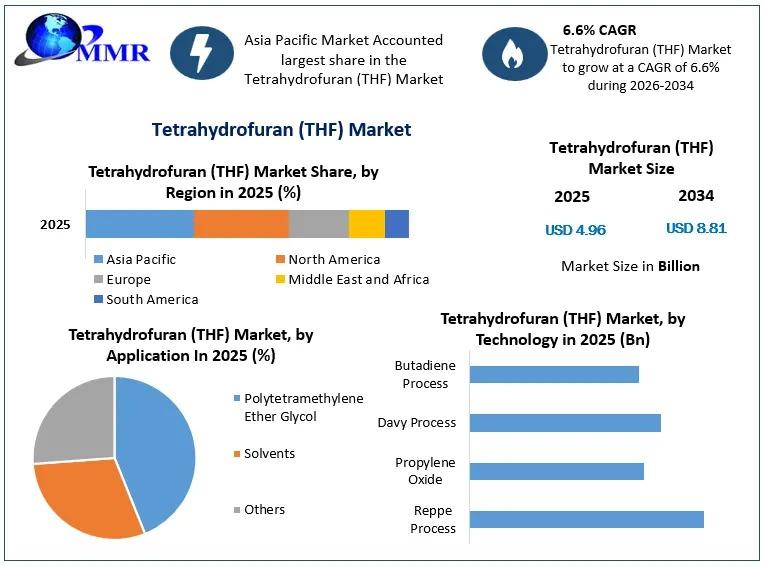
  • Tetrahydrofuran Market Growth Trends: Rising Spandex Consumption Drives USD 8.81 Billion Forecast by 2034
    The Tetrahydrofuran Market is driven by rising demand for spandex fibers, polyurethane elastomers, and high-performance polymers across textile, automotive, and industrial applications. Increasing use of tetrahydrofuran (THF) in pharmaceutical manufacturing, specialty chemicals, coatings, and adhesives is further supporting market expansion. Growing PTMEG production, advancements in bio-based THF technologies, and investments in sustainable chemical manufacturing are expected to drive the market at a CAGR of 6.6% from 2026 to 2034, reaching USD 8.81 billion by 2034.
    Tetrahydrofuran Market Growth Trends: Rising Spandex Consumption Drives USD 8.81 Billion Forecast by 2034 The Tetrahydrofuran Market is driven by rising demand for spandex fibers, polyurethane elastomers, and high-performance polymers across textile, automotive, and industrial applications. Increasing use of tetrahydrofuran (THF) in pharmaceutical manufacturing, specialty chemicals, coatings, and adhesives is further supporting market expansion. Growing PTMEG production, advancements in bio-based THF technologies, and investments in sustainable chemical manufacturing are expected to drive the market at a CAGR of 6.6% from 2026 to 2034, reaching USD 8.81 billion by 2034.
    0 Comments ·0 Shares ·118 Views
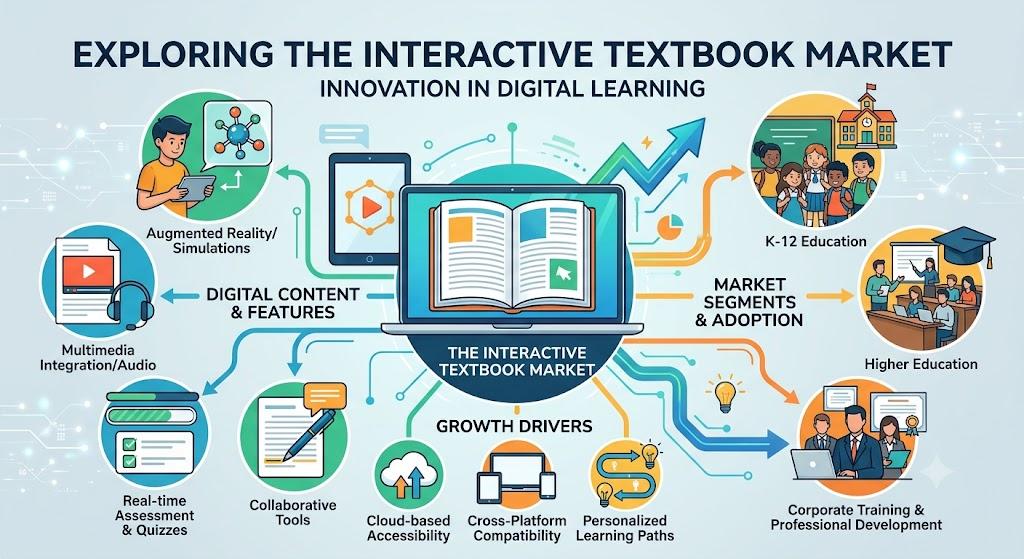
  • Interactive Textbook Market Research and Industry Insights – Report by MMR

    Interactive Textbook Market Overview

    The Interactive Textbook Market report provides an in-depth analysis that is required to make informed industry decisions and develop strategic growth plans. Regardless of the production method or cost structures, the Interactive Textbook market report provides a comprehensive understanding of advanced tactics and strategies.

    Interactive Textbook Market Forecast

    Interactive Textbook Market is expected to reach USD 5.12 billion by 2030, with a CAGR of 9% between 2024 and 2030.

    Please connect with our representative, who will ensure you to get a report sample here @https://www.maximizemarketresearch.com/request-sample/88932/

    Interactive Textbook Market Report Scope and Research Methodology

    The report offers an extensive examination of top players' strategies within the Interactive Textbook industry, coupled with an in-depth analysis of market segments and regional dynamics. In-depth insights into market dynamics, encompassing drivers, restraints, opportunities, and challenges, are provided both on a regional and segmental basis within the Interactive Textbook Market report. Additionally, the report presents import/export consumption, supply and demand, pricing, costs, revenue, and gross margins data, serving as an invaluable guide for investors.

    The data for the Interactive Textbook Market report was meticulously gathered through a combination of primary and secondary research methods, ensuring its authenticity. Primary research methods employed encompassed questionnaire distribution, surveys, and telephone interviews with Interactive Textbook industry experts, market leaders, marketing professionals, and entrepreneurs. The report's estimates of global and regional Interactive Textbook market size were derived using a bottom-up approach. Furthermore, the strengths and weaknesses of Interactive Textbook key players within the industry are outlined using SWOT analysis.

    Interactive Textbook Market Regional Insights

    The report delves into the Interactive Textbook business in great depth, segmenting it into numerous locations. North America, South America, Europe, Asia Pacific (APAC), Africa, and the Middle East are evaluated by region and country in the study. In the Interactive Textbook market report, regional markets are thoroughly investigated in order to uncover regional market trends, restrictions, and possible prospects.

    Interactive Textbook Market Segmentation

    by Type

    App-based
    E-books
    Web-based
    Software

    by Deployment Type

    Cloud
    On-premises

    by Application

    K-12 schools
    Higher Education Institutions
    Others

    Request Free Sample Copy:https://www.maximizemarketresearch.com/request-sample/88932/

    Interactive Textbook Market Key Players

    1. Apple
    2. Cambridge University Press
    3. Houghton Mifflin Harcourt
    4. John Wiley and Sons
    5. McGraw-Hill Education
    6. Oxford University Press
    7. Pearson Education
    8. VitalSource
    9. Metrodigi
    10.10+
    11. Kortext

    Key Offerings:

    A detailed market overview
    Market Share, Size & Forecast by Revenue | 2026−2034
    Market Dynamics – Growth Drivers, Restraints, Investment Opportunities, and Key Trends
    Market Segmentation – A detailed analysis by segments and sub-segments
    Regional Insights
    Competitive Landscape – Top Key Vendors and Other Prominent Vendors
    More Trending From MMR:

    Global Silicone Fluid Market https://www.maximizemarketresearch.com/market-report/global-silicone-fluid-market/107400/
    High-Silica Zeolite Market https://www.maximizemarketresearch.com/market-report/high-silica-zeolite-market/146764/
    Global Polysulfone Market https://www.maximizemarketresearch.com/market-report/global-polysulfone-market/71241/

    About Maximize Market Research:

    Maximize Market Research is a multifaceted market research and consulting company with professionals from several industries. Some of the industries we cover include medical devices, pharmaceutical manufacturers, science and engineering, electronic components, industrial equipment, technology and communication, cars and automobiles, chemical products and substances, general merchandise, beverages, personal care, and automated systems. To mention a few, we provide market-verified industry estimations, technical trend analysis, crucial market research, strategic advice, competition analysis, production and demand analysis, and client impact studies.

    Contact Maximize Market Research:

    3rd Floor, Naval IT Park, Phase 2

    Pune Banglore Highway, Narhe

    Pune, Maharashtra 411041, India

    [email protected]

    +91 96071 95908, +91 9607365656
    Interactive Textbook Market Research and Industry Insights – Report by MMR Interactive Textbook Market Overview The Interactive Textbook Market report provides an in-depth analysis that is required to make informed industry decisions and develop strategic growth plans. Regardless of the production method or cost structures, the Interactive Textbook market report provides a comprehensive understanding of advanced tactics and strategies. Interactive Textbook Market Forecast Interactive Textbook Market is expected to reach USD 5.12 billion by 2030, with a CAGR of 9% between 2024 and 2030. Please connect with our representative, who will ensure you to get a report sample here @https://www.maximizemarketresearch.com/request-sample/88932/ Interactive Textbook Market Report Scope and Research Methodology The report offers an extensive examination of top players' strategies within the Interactive Textbook industry, coupled with an in-depth analysis of market segments and regional dynamics. In-depth insights into market dynamics, encompassing drivers, restraints, opportunities, and challenges, are provided both on a regional and segmental basis within the Interactive Textbook Market report. Additionally, the report presents import/export consumption, supply and demand, pricing, costs, revenue, and gross margins data, serving as an invaluable guide for investors. The data for the Interactive Textbook Market report was meticulously gathered through a combination of primary and secondary research methods, ensuring its authenticity. Primary research methods employed encompassed questionnaire distribution, surveys, and telephone interviews with Interactive Textbook industry experts, market leaders, marketing professionals, and entrepreneurs. The report's estimates of global and regional Interactive Textbook market size were derived using a bottom-up approach. Furthermore, the strengths and weaknesses of Interactive Textbook key players within the industry are outlined using SWOT analysis. Interactive Textbook Market Regional Insights The report delves into the Interactive Textbook business in great depth, segmenting it into numerous locations. North America, South America, Europe, Asia Pacific (APAC), Africa, and the Middle East are evaluated by region and country in the study. In the Interactive Textbook market report, regional markets are thoroughly investigated in order to uncover regional market trends, restrictions, and possible prospects. Interactive Textbook Market Segmentation by Type App-based E-books Web-based Software by Deployment Type Cloud On-premises by Application K-12 schools Higher Education Institutions Others Request Free Sample Copy:https://www.maximizemarketresearch.com/request-sample/88932/ Interactive Textbook Market Key Players 1. Apple 2. Cambridge University Press 3. Houghton Mifflin Harcourt 4. John Wiley and Sons 5. McGraw-Hill Education 6. Oxford University Press 7. Pearson Education 8. VitalSource 9. Metrodigi 10.10+ 11. Kortext Key Offerings: A detailed market overview Market Share, Size & Forecast by Revenue | 2026−2034 Market Dynamics – Growth Drivers, Restraints, Investment Opportunities, and Key Trends Market Segmentation – A detailed analysis by segments and sub-segments Regional Insights Competitive Landscape – Top Key Vendors and Other Prominent Vendors More Trending From MMR: Global Silicone Fluid Market https://www.maximizemarketresearch.com/market-report/global-silicone-fluid-market/107400/ High-Silica Zeolite Market https://www.maximizemarketresearch.com/market-report/high-silica-zeolite-market/146764/ Global Polysulfone Market https://www.maximizemarketresearch.com/market-report/global-polysulfone-market/71241/ About Maximize Market Research: Maximize Market Research is a multifaceted market research and consulting company with professionals from several industries. Some of the industries we cover include medical devices, pharmaceutical manufacturers, science and engineering, electronic components, industrial equipment, technology and communication, cars and automobiles, chemical products and substances, general merchandise, beverages, personal care, and automated systems. To mention a few, we provide market-verified industry estimations, technical trend analysis, crucial market research, strategic advice, competition analysis, production and demand analysis, and client impact studies. Contact Maximize Market Research: 3rd Floor, Naval IT Park, Phase 2 Pune Banglore Highway, Narhe Pune, Maharashtra 411041, India [email protected] +91 96071 95908, +91 9607365656
    0 Comments ·0 Shares ·136 Views
  • The Industrial Boiler Market, projecting explosive valuation milestones through the next decade. According to the report, the market was valued at USD 17.12 billion in 2025 and is poised to scale up to USD 24.01 billion by 2032, expanding at a compound annual growth rate (CAGR) of 4.07%. This strategic growth trajectory underscores the critical role of high-efficiency thermal energy systems in enabling global industrial decarbonization, chemical processing, and smart manufacturing transformations.

    The global industrial landscape is undergoing a profound structural pivot. Driven by aggressive net-zero commitments and escalating carbon taxation, heavy industries are moving away from legacy, carbon-heavy coal-fired infrastructure toward advanced hybrid, hydrogen-ready, and ultra-efficient natural gas boilers. Simultaneously, the deployment of IoT-enabled automated combustion controls is redefining plant operations, turning traditional boilers from mere energy units into intelligent data nodes that optimize fuel efficiency and minimize downtime. This dual transition toward sustainability and digitization is opening lucrative avenues for equipment retrofitting, greenfield manufacturing expansions, and integrated smart-boiler services worldwide.

    Key Findings from the Report
    Valuation Milestone: The industrial boiler market reached a baseline valuation of USD 17.12 billion in 2025.

    Growth Trajectory: The market is projected to expand steadily at a 4.07% CAGR throughout the forecast period from 2026 to 2032.

    Dominant Segment (Type/Capacity): Water-tube and package boilers command the largest revenue shares, backed by high thermal efficiency and rapid steam generation capabilities required in heavy continuous-duty applications.

    Leading Application: The chemicals and petrochemicals sector remains the dominant end-user vertical, accounting for over one-third of total thermal energy equipment demand.

    Fuel Preferences: Natural gas continues to capture primary adoption share due to tightening emissions legislation, though biomass and hydrogen-compatible systems are registering the fastest incremental traction.

    Regional Dominance: The Asia-Pacific region leads global consumption, powered by expansive chemical hubs, textile manufacturing, and heavy industrialization in China and India.

    Investment Relevance: Capital expenditure is heavily skewed toward energy-efficient retrofits, IoT sensor integration, and low-emission boiler replacements.

    For further information, click the following link:https://www.stellarmr.com/report/req_sample/Industrial-Boiler-Market/339
    Market Drivers and Restraints
    Drivers
    Stringent Environmental Regulations: Global mandates capping greenhouse gas emissions force legacy plants to upgrade or replace high-polluting subcritical boilers with advanced low-NOx and low-CO2 alternatives.

    Industrial Expansion in Emerging Economies: Rapid manufacturing build-outs across Asia-Pacific and Latin America amplify the baseline demand for stable, high-capacity industrial steam generation.

    Rise of Energy-Efficient & Smart Technologies: Integration of IoT, predictive maintenance algorithms, and real-time fuel-to-steam efficiency monitoring drives widespread commercial adoption.

    Restraints
    High Initial Capital Outlay: The substantial upfront capital expenditure required for premium, low-emission boilers and auxiliary retrofitting can deter small and medium-scale enterprises (SMEs).

    Supply Chain Bottlenecks for Specialized Materials: Constraints in acquiring high-grade heat-resistant alloys and specialized automation components can cause project deployment delays.

    Technology, Regulation, and Sustainability Trends
    The industrial boiler ecosystem is experiencing an unprecedented convergence of digital technology and environmental compliance. Modern units are increasingly equipped with digital twins and IoT-enabled telemetry, allowing operators to monitor thermal efficiency, predict tube failures, and automate air-fuel ratios in real time. On the regulatory front, compliance frameworks such as the European Union’s Industrial Emissions Directive (IED) and stringent regional pollution control standards are penalizing high-emission operations, accelerating the phase-out of traditional coal units. Consequently, sustainability has shifted from a corporate PR objective to a core engineering requirement, with manufacturers prioritizing hydrogen-blended combustion capabilities and biomass co-firing.

    Regional Insights
    Asia-Pacific (Leading Region): APAC maintains its crown as the dominant and fastest-growing regional market. Accelerated by massive chemical corridor expansions in India, China, and Southeast Asia, local industries are aggressively modernizing legacy thermal infrastructure to match surging domestic manufacturing output.

    North America: Driven by rigorous EPA standards and widespread availability of affordable shale gas, North American industries are prioritizing high-efficiency package boilers and smart-grid integrated thermal systems.

    Europe: Europe spearheads the sustainability charge, focusing heavily on hydrogen-ready boilers, waste-heat recovery systems, and strict compliance with ultra-low carbon frameworks.

    Recent Industry Developments
    Thermax Ltd. (2025): Launched a new line of hybrid electric-steam industrial boilers designed to help chemical plants utilize surplus renewable energy, cutting direct fossil fuel consumption by up to 30%.

    Babcock & Wilcox (2025): Secured a major multi-million dollar contract to supply advanced, low-emission biomass-fired boilers for a municipal-industrial energy project in Europe, expanding its green-energy footprint.

    Siemens AG (2026): Partnered with leading boiler manufacturers to integrate industrial IoT edge controllers, delivering real-time thermodynamic efficiency optimization across heavy manufacturing lines.

    Cleaver-Brooks (2025): Expanded its North American manufacturing capacity with a specialized production line dedicated to ultra-low NOx packaged firetube boilers to meet strict regional clean air standards.

    Mitsubishi Heavy Industries (2026): Achieved successful commercial validation of its 100% hydrogen-ready combustion burner technology for industrial utility boilers, marking a critical milestone for net-zero heavy industry.

    Competitive Landscape
    The global industrial boiler market features a consolidated yet fiercely competitive landscape characterized by major engineering conglomerates and specialized thermal tech providers. Key players include Thermax Ltd., Siemens AG, Bharat Heavy Electricals Ltd. (BHEL), Mitsubishi Heavy Industries, Cleaver-Brooks, and Babcock & Wilcox. Leading corporations are focusing heavily on strategic mergers, acquisitions, and joint ventures to expand their geographic footprint and enhance their green-energy portfolios. Product differentiation is increasingly anchored around digital control integration, aftermarket servicing efficiency, and hydrogen fuel adaptability.

    Analyst Commentary
    "The industrial boiler market is no longer driven purely by basic steam generation capacity; it is undergoing a fundamental technological realignment centered around decarbonization and intelligence," said a Senior Research Analyst at Stellar Market Research. "As regulatory frameworks tighten globally, plant operators are moving past short-term cost-cutting. They are heavily investing in smart, fuel-flexible, and hydrogen-ready systems that future-proof their operations against both carbon taxation and volatile fuel pricing."

    Future Outlook
    Through the forecast horizon, the industrial boiler market will experience accelerated convergence between traditional heavy manufacturing and digital automation. Demand will increasingly pivot toward modular, scalable, and multi-fuel-capable systems that can seamlessly transition between natural gas, biomass, and green hydrogen. With emerging economies continuing to build out robust industrial infrastructure and developed nations prioritizing deep decarbonization retrofits, market participants that successfully embed advanced IoT diagnostics and carbon-neutral technologies into their core portfolios will capture dominant long-term market share.

    For further information, click the following link:https://www.stellarmr.com/report/req_sample/Industrial-Boiler-Market/339
    About Stellar Market Research
    Stellar Market Research is a multifaceted market research and consulting company with professionals from several industries. Some of the industries we cover include medical devices, pharmaceutical manufacturers, science and engineering, electronic components, industrial equipment, technology and communication, cars and automobiles, chemical products and substances, general merchandise, beverages, personal care, and automated systems. To mention a few, we provide market-verified industry estimations, technical trend analysis, crucial market research, strategic advice, competition analysis, production and demand analysis, and client impact studies.

    Address
    Phase 3, Navale IT Zone, S.No. 51/2A/2, Office No. 202, 2nd floor, Near, Navale Brg, Narhe, Pune, Maharashtra 411041

    Email
    [email protected]

    Mobile
    +91 9607365656
    The Industrial Boiler Market, projecting explosive valuation milestones through the next decade. According to the report, the market was valued at USD 17.12 billion in 2025 and is poised to scale up to USD 24.01 billion by 2032, expanding at a compound annual growth rate (CAGR) of 4.07%. This strategic growth trajectory underscores the critical role of high-efficiency thermal energy systems in enabling global industrial decarbonization, chemical processing, and smart manufacturing transformations. The global industrial landscape is undergoing a profound structural pivot. Driven by aggressive net-zero commitments and escalating carbon taxation, heavy industries are moving away from legacy, carbon-heavy coal-fired infrastructure toward advanced hybrid, hydrogen-ready, and ultra-efficient natural gas boilers. Simultaneously, the deployment of IoT-enabled automated combustion controls is redefining plant operations, turning traditional boilers from mere energy units into intelligent data nodes that optimize fuel efficiency and minimize downtime. This dual transition toward sustainability and digitization is opening lucrative avenues for equipment retrofitting, greenfield manufacturing expansions, and integrated smart-boiler services worldwide. Key Findings from the Report Valuation Milestone: The industrial boiler market reached a baseline valuation of USD 17.12 billion in 2025. Growth Trajectory: The market is projected to expand steadily at a 4.07% CAGR throughout the forecast period from 2026 to 2032. Dominant Segment (Type/Capacity): Water-tube and package boilers command the largest revenue shares, backed by high thermal efficiency and rapid steam generation capabilities required in heavy continuous-duty applications. Leading Application: The chemicals and petrochemicals sector remains the dominant end-user vertical, accounting for over one-third of total thermal energy equipment demand. Fuel Preferences: Natural gas continues to capture primary adoption share due to tightening emissions legislation, though biomass and hydrogen-compatible systems are registering the fastest incremental traction. Regional Dominance: The Asia-Pacific region leads global consumption, powered by expansive chemical hubs, textile manufacturing, and heavy industrialization in China and India. Investment Relevance: Capital expenditure is heavily skewed toward energy-efficient retrofits, IoT sensor integration, and low-emission boiler replacements. For further information, click the following link:https://www.stellarmr.com/report/req_sample/Industrial-Boiler-Market/339 Market Drivers and Restraints Drivers Stringent Environmental Regulations: Global mandates capping greenhouse gas emissions force legacy plants to upgrade or replace high-polluting subcritical boilers with advanced low-NOx and low-CO2 alternatives. Industrial Expansion in Emerging Economies: Rapid manufacturing build-outs across Asia-Pacific and Latin America amplify the baseline demand for stable, high-capacity industrial steam generation. Rise of Energy-Efficient & Smart Technologies: Integration of IoT, predictive maintenance algorithms, and real-time fuel-to-steam efficiency monitoring drives widespread commercial adoption. Restraints High Initial Capital Outlay: The substantial upfront capital expenditure required for premium, low-emission boilers and auxiliary retrofitting can deter small and medium-scale enterprises (SMEs). Supply Chain Bottlenecks for Specialized Materials: Constraints in acquiring high-grade heat-resistant alloys and specialized automation components can cause project deployment delays. Technology, Regulation, and Sustainability Trends The industrial boiler ecosystem is experiencing an unprecedented convergence of digital technology and environmental compliance. Modern units are increasingly equipped with digital twins and IoT-enabled telemetry, allowing operators to monitor thermal efficiency, predict tube failures, and automate air-fuel ratios in real time. On the regulatory front, compliance frameworks such as the European Union’s Industrial Emissions Directive (IED) and stringent regional pollution control standards are penalizing high-emission operations, accelerating the phase-out of traditional coal units. Consequently, sustainability has shifted from a corporate PR objective to a core engineering requirement, with manufacturers prioritizing hydrogen-blended combustion capabilities and biomass co-firing. Regional Insights Asia-Pacific (Leading Region): APAC maintains its crown as the dominant and fastest-growing regional market. Accelerated by massive chemical corridor expansions in India, China, and Southeast Asia, local industries are aggressively modernizing legacy thermal infrastructure to match surging domestic manufacturing output. North America: Driven by rigorous EPA standards and widespread availability of affordable shale gas, North American industries are prioritizing high-efficiency package boilers and smart-grid integrated thermal systems. Europe: Europe spearheads the sustainability charge, focusing heavily on hydrogen-ready boilers, waste-heat recovery systems, and strict compliance with ultra-low carbon frameworks. Recent Industry Developments Thermax Ltd. (2025): Launched a new line of hybrid electric-steam industrial boilers designed to help chemical plants utilize surplus renewable energy, cutting direct fossil fuel consumption by up to 30%. Babcock & Wilcox (2025): Secured a major multi-million dollar contract to supply advanced, low-emission biomass-fired boilers for a municipal-industrial energy project in Europe, expanding its green-energy footprint. Siemens AG (2026): Partnered with leading boiler manufacturers to integrate industrial IoT edge controllers, delivering real-time thermodynamic efficiency optimization across heavy manufacturing lines. Cleaver-Brooks (2025): Expanded its North American manufacturing capacity with a specialized production line dedicated to ultra-low NOx packaged firetube boilers to meet strict regional clean air standards. Mitsubishi Heavy Industries (2026): Achieved successful commercial validation of its 100% hydrogen-ready combustion burner technology for industrial utility boilers, marking a critical milestone for net-zero heavy industry. Competitive Landscape The global industrial boiler market features a consolidated yet fiercely competitive landscape characterized by major engineering conglomerates and specialized thermal tech providers. Key players include Thermax Ltd., Siemens AG, Bharat Heavy Electricals Ltd. (BHEL), Mitsubishi Heavy Industries, Cleaver-Brooks, and Babcock & Wilcox. Leading corporations are focusing heavily on strategic mergers, acquisitions, and joint ventures to expand their geographic footprint and enhance their green-energy portfolios. Product differentiation is increasingly anchored around digital control integration, aftermarket servicing efficiency, and hydrogen fuel adaptability. Analyst Commentary "The industrial boiler market is no longer driven purely by basic steam generation capacity; it is undergoing a fundamental technological realignment centered around decarbonization and intelligence," said a Senior Research Analyst at Stellar Market Research. "As regulatory frameworks tighten globally, plant operators are moving past short-term cost-cutting. They are heavily investing in smart, fuel-flexible, and hydrogen-ready systems that future-proof their operations against both carbon taxation and volatile fuel pricing." Future Outlook Through the forecast horizon, the industrial boiler market will experience accelerated convergence between traditional heavy manufacturing and digital automation. Demand will increasingly pivot toward modular, scalable, and multi-fuel-capable systems that can seamlessly transition between natural gas, biomass, and green hydrogen. With emerging economies continuing to build out robust industrial infrastructure and developed nations prioritizing deep decarbonization retrofits, market participants that successfully embed advanced IoT diagnostics and carbon-neutral technologies into their core portfolios will capture dominant long-term market share. For further information, click the following link:https://www.stellarmr.com/report/req_sample/Industrial-Boiler-Market/339 About Stellar Market Research Stellar Market Research is a multifaceted market research and consulting company with professionals from several industries. Some of the industries we cover include medical devices, pharmaceutical manufacturers, science and engineering, electronic components, industrial equipment, technology and communication, cars and automobiles, chemical products and substances, general merchandise, beverages, personal care, and automated systems. To mention a few, we provide market-verified industry estimations, technical trend analysis, crucial market research, strategic advice, competition analysis, production and demand analysis, and client impact studies. Address Phase 3, Navale IT Zone, S.No. 51/2A/2, Office No. 202, 2nd floor, Near, Navale Brg, Narhe, Pune, Maharashtra 411041 Email [email protected] Mobile +91 9607365656
    0 Comments ·0 Shares ·417 Views
  • Asia Pacific UPS Battery Market Trends Highlight Advanced Battery Technologies

    Market Estimation & Definition

    The Asia Pacific UPS Battery Market is expected to expand as businesses invest in digital infrastructure, data centers, telecommunications, and reliable power backup systems. According to Stellar Market Research, the market was valued at USD 412.18 million in 2025 and is projected to reach USD 917.63 million by 2035 , registering a compound annual growth rate (CAGR) of 9.3% during 2026–2035 .

    An uninterruptible power supply (UPS) battery provides backup electricity when the main power source fails or experiences a disruption. These batteries protect critical equipment, including servers, networking devices, industrial machinery, communication systems, and financial infrastructure. By maintaining power continuity, UPS batteries help prevent data loss, equipment damage, and costly operational interruptions. Their importance is increasing as businesses across Asia Pacific become more dependent on digital services and connected infrastructure.

    Download Free PDF Brochure: https://www.stellarmr.com/report/req_sample/Asia-Pacific-UPS-Battery-Market/136

    Market Growth Drivers & Opportunity

    The rapid expansion of data centers is a major driver of the Asia Pacific UPS Battery Market. Cloud computing, online transactions, artificial intelligence infrastructure, and enterprise digitalization are increasing the need for uninterrupted power. Data centers require dependable backup systems to protect servers and maintain service availability during electrical disturbances.

    Telecommunications development is another important growth factor. The expansion of 5G networks and edge computing infrastructure is creating demand for reliable backup power at communication facilities. Banking, financial services, and insurance companies also depend on UPS systems to maintain ATMs, transaction platforms, and data-processing operations.

    Government initiatives supporting smart cities, digital public services, and modern electricity infrastructure are creating additional opportunities. However, high initial investment, battery replacement costs, maintenance requirements, and differences in infrastructure development across the region can influence adoption. Suppliers that offer reliable products, efficient battery management, and competitive lifecycle costs may be better positioned to meet demand.

    What Lies Ahead: Emerging Trends Shaping the Future

    Lithium-ion technology is expected to play an increasingly important role in UPS battery applications. Compared with traditional lead-acid batteries, lithium-ion batteries can offer lower weight, a compact footprint, faster charging, and longer service life under suitable operating conditions. These characteristics make them attractive for data centers and facilities where space efficiency and reliability are priorities.

    Modular UPS systems are also gaining attention as businesses seek scalable power protection. Modular configurations can allow facilities to expand capacity as requirements increase, helping operators manage investment and operational needs.

    The development of smart grids, cloud services, and connected industrial systems will further support demand for advanced backup solutions. Battery monitoring and management technologies can help operators track battery health, identify potential failures, and plan maintenance more effectively. Manufacturers will need to balance performance, safety, affordability, and environmental considerations as battery deployment increases.

    Get More Report Details: https://www.stellarmr.com/report/Asia-Pacific-UPS-Battery-Market/136

    Segmentation Analysis

    According to Stellar Market Research, the Asia Pacific UPS Battery Market is segmented by topology, product type, and application.

    By Topology: Online, Standby, Line Interactive.
    By Product Type: Lead-acid, Lithium-Ion, Nickel Cadmium, Others.
    By Application: Residential, Commercial, Data Center, Industrial.
    Online UPS systems provide continuous power conditioning and are suitable for equipment requiring high levels of protection. Standby and line-interactive systems offer alternatives for applications with different power protection requirements.

    Within product types, lithium-ion batteries are projected to register strong growth because of their compact design, charging performance, and potential service-life advantages. By application, data centers represent a significant opportunity as cloud computing and digital services increase demand for dependable power infrastructure. The report identifies China as the leading country in the regional market, supported by its substantial digital infrastructure and investment in technology.

    Country-Level Analysis: USA and Germany

    United States: The United States is outside the geographic scope of this Asia Pacific report, but US-based companies participate in the broader UPS battery industry. Eaton Corporation and Vertiv Group Corporation are among the key players identified by Stellar Market Research. Their power management and critical-infrastructure solutions illustrate the importance of reliable backup power for data centers and industrial facilities.

    Germany: Germany is also outside the report's geographic scope. The study does not provide a separate German market valuation or forecast. For European industry context, the report identifies international suppliers operating in the wider power protection ecosystem, including Schneider Electric, although the company is headquartered in France rather than Germany. The market analysis therefore remains focused on Asia Pacific, where China, India, Japan, South Korea, Australia, ASEAN, and the rest of the region form the report's country coverage.

    Competitive Analysis

    The Asia Pacific UPS Battery Market features established battery manufacturers, electrical equipment suppliers, and power management companies. Key players identified by Stellar Market Research include CSB Battery Co., Ltd., East Penn Manufacturing Company, Eaton Corporation plc, Exide Industries Limited, FIAMM Energy Technology SpA, GS Yuasa International Ltd., Leoch International Technology Limited Inc., Schneider Electric SE, and Vertiv Group Corporation .

    Competition is shaped by battery performance, reliability, service life, safety, pricing, and compatibility with UPS systems. Companies investing in lithium-ion technology, intelligent monitoring, and scalable backup solutions may strengthen their position as data center and industrial power requirements grow.

    Download Free PDF Brochure: https://www.stellarmr.com/report/req_sample/Asia-Pacific-UPS-Battery-Market/136

    Press Release Conclusion

    The Asia Pacific UPS Battery Market is projected to reach USD 917.63 million by 2034 as digital infrastructure, data center development, telecommunications expansion, and industrial automation increase demand for dependable backup power.

    Although cost and maintenance considerations remain important, lithium-ion batteries, modular UPS systems, and advanced monitoring technologies are creating new opportunities. Manufacturers that combine reliability, efficiency, and competitive lifecycle costs will be well positioned to support the region's growing need for uninterrupted electricity.

    About Stellar Market Research:

    Stellar Market Research is a multifaceted market research and consulting company with professionals from several industries. Some of the industries we cover include medical devices, pharmaceutical manufacturers, science and engineering, electronic components, industrial equipment, technology and communication, cars and automobiles, chemical products and substances, general merchandise, beverages, personal care, and automated systems. To mention a few, we provide market-verified industry estimations, technical trend analysis, crucial market research, strategic advice, competition analysis, production and demand analysis, and client impact studies.

    Contact Stellar Market Research:

    3rd Floor, Navale IT Park, Phase 2

    Pune Banglore Highway, Narhe,

    Pune, Maharashtra 411041, India

    [email protected]

    +91 20 6630 3320 | +91 9607365656
    Asia Pacific UPS Battery Market Trends Highlight Advanced Battery Technologies Market Estimation & Definition The Asia Pacific UPS Battery Market is expected to expand as businesses invest in digital infrastructure, data centers, telecommunications, and reliable power backup systems. According to Stellar Market Research, the market was valued at USD 412.18 million in 2025 and is projected to reach USD 917.63 million by 2035 , registering a compound annual growth rate (CAGR) of 9.3% during 2026–2035 . An uninterruptible power supply (UPS) battery provides backup electricity when the main power source fails or experiences a disruption. These batteries protect critical equipment, including servers, networking devices, industrial machinery, communication systems, and financial infrastructure. By maintaining power continuity, UPS batteries help prevent data loss, equipment damage, and costly operational interruptions. Their importance is increasing as businesses across Asia Pacific become more dependent on digital services and connected infrastructure. Download Free PDF Brochure: https://www.stellarmr.com/report/req_sample/Asia-Pacific-UPS-Battery-Market/136 Market Growth Drivers & Opportunity The rapid expansion of data centers is a major driver of the Asia Pacific UPS Battery Market. Cloud computing, online transactions, artificial intelligence infrastructure, and enterprise digitalization are increasing the need for uninterrupted power. Data centers require dependable backup systems to protect servers and maintain service availability during electrical disturbances. Telecommunications development is another important growth factor. The expansion of 5G networks and edge computing infrastructure is creating demand for reliable backup power at communication facilities. Banking, financial services, and insurance companies also depend on UPS systems to maintain ATMs, transaction platforms, and data-processing operations. Government initiatives supporting smart cities, digital public services, and modern electricity infrastructure are creating additional opportunities. However, high initial investment, battery replacement costs, maintenance requirements, and differences in infrastructure development across the region can influence adoption. Suppliers that offer reliable products, efficient battery management, and competitive lifecycle costs may be better positioned to meet demand. What Lies Ahead: Emerging Trends Shaping the Future Lithium-ion technology is expected to play an increasingly important role in UPS battery applications. Compared with traditional lead-acid batteries, lithium-ion batteries can offer lower weight, a compact footprint, faster charging, and longer service life under suitable operating conditions. These characteristics make them attractive for data centers and facilities where space efficiency and reliability are priorities. Modular UPS systems are also gaining attention as businesses seek scalable power protection. Modular configurations can allow facilities to expand capacity as requirements increase, helping operators manage investment and operational needs. The development of smart grids, cloud services, and connected industrial systems will further support demand for advanced backup solutions. Battery monitoring and management technologies can help operators track battery health, identify potential failures, and plan maintenance more effectively. Manufacturers will need to balance performance, safety, affordability, and environmental considerations as battery deployment increases. Get More Report Details: https://www.stellarmr.com/report/Asia-Pacific-UPS-Battery-Market/136 Segmentation Analysis According to Stellar Market Research, the Asia Pacific UPS Battery Market is segmented by topology, product type, and application. By Topology: Online, Standby, Line Interactive. By Product Type: Lead-acid, Lithium-Ion, Nickel Cadmium, Others. By Application: Residential, Commercial, Data Center, Industrial. Online UPS systems provide continuous power conditioning and are suitable for equipment requiring high levels of protection. Standby and line-interactive systems offer alternatives for applications with different power protection requirements. Within product types, lithium-ion batteries are projected to register strong growth because of their compact design, charging performance, and potential service-life advantages. By application, data centers represent a significant opportunity as cloud computing and digital services increase demand for dependable power infrastructure. The report identifies China as the leading country in the regional market, supported by its substantial digital infrastructure and investment in technology. Country-Level Analysis: USA and Germany United States: The United States is outside the geographic scope of this Asia Pacific report, but US-based companies participate in the broader UPS battery industry. Eaton Corporation and Vertiv Group Corporation are among the key players identified by Stellar Market Research. Their power management and critical-infrastructure solutions illustrate the importance of reliable backup power for data centers and industrial facilities. Germany: Germany is also outside the report's geographic scope. The study does not provide a separate German market valuation or forecast. For European industry context, the report identifies international suppliers operating in the wider power protection ecosystem, including Schneider Electric, although the company is headquartered in France rather than Germany. The market analysis therefore remains focused on Asia Pacific, where China, India, Japan, South Korea, Australia, ASEAN, and the rest of the region form the report's country coverage. Competitive Analysis The Asia Pacific UPS Battery Market features established battery manufacturers, electrical equipment suppliers, and power management companies. Key players identified by Stellar Market Research include CSB Battery Co., Ltd., East Penn Manufacturing Company, Eaton Corporation plc, Exide Industries Limited, FIAMM Energy Technology SpA, GS Yuasa International Ltd., Leoch International Technology Limited Inc., Schneider Electric SE, and Vertiv Group Corporation . Competition is shaped by battery performance, reliability, service life, safety, pricing, and compatibility with UPS systems. Companies investing in lithium-ion technology, intelligent monitoring, and scalable backup solutions may strengthen their position as data center and industrial power requirements grow. Download Free PDF Brochure: https://www.stellarmr.com/report/req_sample/Asia-Pacific-UPS-Battery-Market/136 Press Release Conclusion The Asia Pacific UPS Battery Market is projected to reach USD 917.63 million by 2034 as digital infrastructure, data center development, telecommunications expansion, and industrial automation increase demand for dependable backup power. Although cost and maintenance considerations remain important, lithium-ion batteries, modular UPS systems, and advanced monitoring technologies are creating new opportunities. Manufacturers that combine reliability, efficiency, and competitive lifecycle costs will be well positioned to support the region's growing need for uninterrupted electricity. About Stellar Market Research: Stellar Market Research is a multifaceted market research and consulting company with professionals from several industries. Some of the industries we cover include medical devices, pharmaceutical manufacturers, science and engineering, electronic components, industrial equipment, technology and communication, cars and automobiles, chemical products and substances, general merchandise, beverages, personal care, and automated systems. To mention a few, we provide market-verified industry estimations, technical trend analysis, crucial market research, strategic advice, competition analysis, production and demand analysis, and client impact studies. Contact Stellar Market Research: 3rd Floor, Navale IT Park, Phase 2 Pune Banglore Highway, Narhe, Pune, Maharashtra 411041, India [email protected] +91 20 6630 3320 | +91 9607365656
    0 Comments ·0 Shares ·469 Views
  • Bamboos Market Size and Share Outlook Driven by Eco-Friendly Product Demand Report by MMR

    Bamboos Market to Reach USD 123.92 Billion by 2034, Driven by Sustainable Construction and Industrial Applications

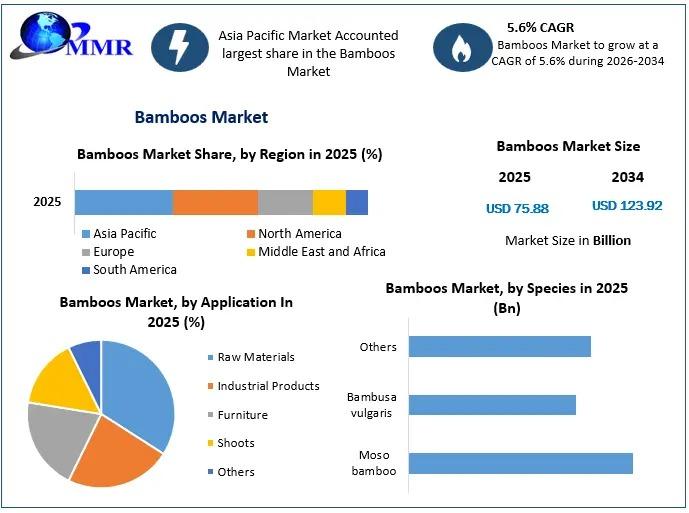
    The Bamboos Market is projected to grow at a CAGR of 5.6% from 2026 to 2034, supported by increasing demand for renewable materials, eco-friendly packaging, engineered building products, and sustainable industrial solutions.

    Bamboos Market Overview and Market Estimation

    The global Bamboos Market was valued at USD 75.88 billion in 2025 and is expected to reach approximately USD 123.92 billion by 2034, expanding at a compound annual growth rate (CAGR) of 5.6% during the forecast period from 2026 to 2034. The market is gaining momentum as industries increasingly explore renewable alternatives to conventional timber, plastics, and other resource-intensive materials.

    Bamboo is a rapidly renewable natural resource with applications across construction, furniture, flooring, textiles, pulp and paper, packaging, and food products. Its versatility, lightweight structure, and potential for responsible cultivation make it an attractive material for manufacturers seeking to improve resource efficiency and meet sustainability objectives.

    Major growth drivers include rising investment in sustainable infrastructure, increasing environmental awareness, expanding demand for renewable building materials, and the development of advanced bamboo-processing technologies. Engineered bamboo products are creating additional opportunities in residential construction, commercial interiors, outdoor decking, and architectural applications.

    Get a Free Sample Market Report Link : https://www.maximizemarketresearch.com/request-sample/126098/

    Bamboos Market Size and Share Outlook Driven by Eco-Friendly Product Demand Report by MMR Bamboos Market to Reach USD 123.92 Billion by 2034, Driven by Sustainable Construction and Industrial Applications The Bamboos Market is projected to grow at a CAGR of 5.6% from 2026 to 2034, supported by increasing demand for renewable materials, eco-friendly packaging, engineered building products, and sustainable industrial solutions. Bamboos Market Overview and Market Estimation The global Bamboos Market was valued at USD 75.88 billion in 2025 and is expected to reach approximately USD 123.92 billion by 2034, expanding at a compound annual growth rate (CAGR) of 5.6% during the forecast period from 2026 to 2034. The market is gaining momentum as industries increasingly explore renewable alternatives to conventional timber, plastics, and other resource-intensive materials. Bamboo is a rapidly renewable natural resource with applications across construction, furniture, flooring, textiles, pulp and paper, packaging, and food products. Its versatility, lightweight structure, and potential for responsible cultivation make it an attractive material for manufacturers seeking to improve resource efficiency and meet sustainability objectives. Major growth drivers include rising investment in sustainable infrastructure, increasing environmental awareness, expanding demand for renewable building materials, and the development of advanced bamboo-processing technologies. Engineered bamboo products are creating additional opportunities in residential construction, commercial interiors, outdoor decking, and architectural applications. Get a Free Sample Market Report Link : https://www.maximizemarketresearch.com/request-sample/126098/
    0 Comments ·0 Shares ·380 Views
  • Magnesium Sulphate Market Industry Analysis, Demand, and Revenue Forecast Report by MMR

    Magnesium Sulphate Market to Reach USD 1,054.27 Million by 2032, Driven by Agricultural Demand and Pharmaceutical Applications

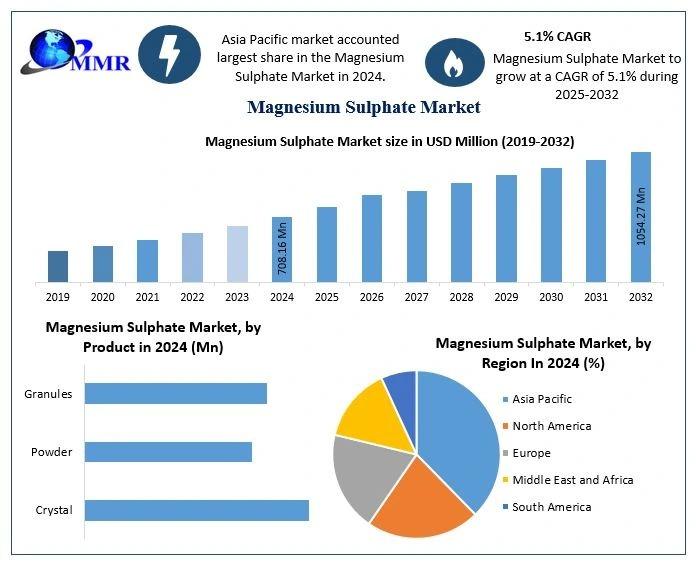
    The Magnesium Sulphate Market is witnessing steady growth, supported by rising agricultural productivity requirements, expanding pharmaceutical applications, and increasing demand from industrial manufacturing. According to Maximize Market Research, the market was valued at USD 708.16 million in 2024 and is projected to reach approximately USD 1,054.27 million by 2032, growing at a compound annual growth rate (CAGR) of 5.1% from 2025 to 2032. Increasing interest in efficient nutrient management, specialty chemicals, and high-quality pharmaceutical formulations is expected to create new opportunities for manufacturers and investors.

    Market Estimation, Growth Drivers and Opportunities

    Magnesium sulphate, commonly known as Epsom salt in certain applications, is an important inorganic compound used across agriculture, healthcare, food processing, personal care, water treatment, paints, textiles, and chemical manufacturing. Its versatility makes it a valuable ingredient for industries seeking reliable magnesium and sulphur sources.

    Agriculture remains a major growth driver because magnesium supports chlorophyll formation, photosynthesis, and plant development, while sulphur contributes to essential plant functions. Growing food requirements, soil nutrient deficiencies, and the adoption of balanced fertilization practices are increasing demand for magnesium sulphate-based fertilizers. Farmers are increasingly interested in improving crop yields and nutrient-use efficiency, creating opportunities for agricultural-grade products.

    Pharmaceutical demand also supports market expansion. Magnesium sulphate is used in clinical settings, including the management of pre-eclampsia and eclampsia, subject to appropriate medical supervision. Demand for dependable pharmaceutical ingredients and ready-to-use injectable formulations creates opportunities for manufacturers that can meet stringent quality and regulatory requirements.

    Get a Sample Insight Report Now : https://www.maximizemarketresearch.com/request-sample/148167/

    Magnesium Sulphate Market Industry Analysis, Demand, and Revenue Forecast Report by MMR Magnesium Sulphate Market to Reach USD 1,054.27 Million by 2032, Driven by Agricultural Demand and Pharmaceutical Applications The Magnesium Sulphate Market is witnessing steady growth, supported by rising agricultural productivity requirements, expanding pharmaceutical applications, and increasing demand from industrial manufacturing. According to Maximize Market Research, the market was valued at USD 708.16 million in 2024 and is projected to reach approximately USD 1,054.27 million by 2032, growing at a compound annual growth rate (CAGR) of 5.1% from 2025 to 2032. Increasing interest in efficient nutrient management, specialty chemicals, and high-quality pharmaceutical formulations is expected to create new opportunities for manufacturers and investors. Market Estimation, Growth Drivers and Opportunities Magnesium sulphate, commonly known as Epsom salt in certain applications, is an important inorganic compound used across agriculture, healthcare, food processing, personal care, water treatment, paints, textiles, and chemical manufacturing. Its versatility makes it a valuable ingredient for industries seeking reliable magnesium and sulphur sources. Agriculture remains a major growth driver because magnesium supports chlorophyll formation, photosynthesis, and plant development, while sulphur contributes to essential plant functions. Growing food requirements, soil nutrient deficiencies, and the adoption of balanced fertilization practices are increasing demand for magnesium sulphate-based fertilizers. Farmers are increasingly interested in improving crop yields and nutrient-use efficiency, creating opportunities for agricultural-grade products. Pharmaceutical demand also supports market expansion. Magnesium sulphate is used in clinical settings, including the management of pre-eclampsia and eclampsia, subject to appropriate medical supervision. Demand for dependable pharmaceutical ingredients and ready-to-use injectable formulations creates opportunities for manufacturers that can meet stringent quality and regulatory requirements. Get a Sample Insight Report Now : https://www.maximizemarketresearch.com/request-sample/148167/
    0 Comments ·0 Shares ·197 Views
  • Belarus Potato Chips Market Opportunities Expand Across Retail Networks

    Market Estimation & Definition

    The Belarus Potato Chips Market is expected to maintain steady growth as changing consumer lifestyles, expanding retail networks, and increasing demand for convenient snack foods support consumption. According to Stellar Market Research, the market was valued at USD 35.49 million in 2023 and is projected to reach USD 47.98 million by 2030, registering a compound annual growth rate (CAGR) of 4.4% during 2024–2030.

    Potato chips are snack products manufactured from thinly sliced potatoes that are typically fried or baked and seasoned with salt or other flavorings. Their convenience, portability, variety, and shelf life make them popular among consumers seeking ready-to-eat food options. In Belarus, the market's development is influenced by consumer purchasing habits, product availability, retail expansion, and manufacturers' ability to offer appealing flavors at competitive prices.

    Download Free PDF Brochure: https://www.stellarmr.com/report/req_sample/Belarus-Potato-Chips-Market/603

    Market Growth Drivers & Opportunity

    The demand for convenient food products is a major driver of the Belarus Potato Chips Market. Busy lifestyles and changing eating habits encourage consumers to purchase packaged snacks for consumption at home, during travel, or between meals. Economic development, urbanization, and changes in consumer spending patterns also create opportunities for snack manufacturers.

    The expansion of organized retail is another important factor. Supermarkets and other food retailers provide greater product visibility, wider selections, and opportunities for promotional pricing. Improved distribution networks can help manufacturers reach consumers across different locations while supporting consistent product availability.

    Product innovation presents further opportunities. Manufacturers can expand their offerings through new seasonings, locally appealing flavors, and variations in texture and packaging. Rising health awareness is also encouraging interest in baked products and options marketed with reduced fat or simpler ingredients. However, changing consumer preferences, competition from alternative snacks, price sensitivity, and fluctuations in raw material costs may limit growth. Companies must balance product innovation with affordability and consistent quality.

    What Lies Ahead: Emerging Trends Shaping the Future

    Innovation in flavors and product formats is expected to remain important to market development. Traditional plain and salted chips continue to appeal to consumers, while flavored products offer manufacturers opportunities to attract younger buyers and consumers looking for new taste experiences. Local flavor development and targeted promotional campaigns can help brands differentiate their products.

    Health-conscious purchasing may also influence product development. Baked chips and products positioned around ingredient transparency or reduced-fat formulations offer alternatives for consumers seeking different snack choices. Nevertheless, manufacturers must ensure that new products maintain the taste, texture, and value consumers expect.

    Digital retail is another area of opportunity. Online stores enable consumers to compare products, explore different flavors, and purchase packaged snacks conveniently. As digital shopping becomes more established, manufacturers and retailers may benefit from improved product discovery, promotional campaigns, and broader distribution options.

    Get More Report Details: https://www.stellarmr.com/report/Belarus-Potato-Chips-Market/603

    Segmentation Analysis

    According to the Stellar Market Research report, the Belarus Potato Chips Market is segmented by product type, distribution channel, and variant.

    By Product Type: Plain, Salted, Flavored.
    By Distribution Channel: Supermarkets, Specialty Stores, Online Stores, Others.
    By Variant: Fried, Baked.
    The plain potato chips segment held the largest share in 2023 and is expected to maintain strong demand, supported by familiarity, affordability, and widespread availability. Flavored chips offer additional growth potential, with the report projecting a CAGR of 3.8% for this segment during the forecast period.

    Supermarkets accounted for the largest distribution-channel share in 2023, benefiting from product variety, promotions, and convenient shopping. Online stores offer opportunities through easy product comparison and access to a wider selection. Fried and baked chips serve consumers with different preferences for taste, texture, and preparation methods.

    Country-Level Analysis: USA and Germany

    United States: The United States is relevant to the competitive landscape through major snack-food companies identified in the report, including PepsiCo, Kraft Foods, Utz Quality Foods, and The Campbell Soup Company. Their broad product portfolios and established distribution capabilities illustrate how brand recognition, product variety, and retail reach can influence competition. These companies' inclusion does not establish a separate US market valuation for Belarusian potato chips.

    Germany: Germany is represented by Intersnack Group GmbH & Co. KG, a key player listed in the report. The company's presence highlights the relevance of established European snack manufacturers and product-development capabilities. However, the report focuses on Belarus, and it does not provide separate market-size estimates for the United States or Germany.

    Competitive Analysis

    The Belarus Potato Chips Market includes established international snack companies and other competitors seeking to strengthen their product portfolios and market positions. Key players listed by Stellar Market Research include PepsiCo, Inc., Kraft Foods, Kellogg's, Burts Potato Chips Ltd., Calbee Inc., Utz Quality Foods, Inc., The Campbell Soup Company, Great Lakes Potato Chip Co., Intersnack Group GmbH & Co. KG, Herr Foods Inc., and Snyder's-Lance.

    Competition is shaped by pricing, brand recognition, distribution coverage, flavor innovation, and product quality. Companies that respond effectively to local preferences while maintaining reliable supply and competitive pricing can strengthen their position. Retail partnerships and product launches may also help businesses reach new customer groups.

    Download Free PDF Brochure: https://www.stellarmr.com/report/req_sample/Belarus-Potato-Chips-Market/603

    Press Release Conclusion

    The Belarus Potato Chips Market is projected to grow steadily through 2030, supported by demand for convenient snacks, organized retail expansion, and continued product innovation. With the market forecast to reach USD 47.98 million by 2030, opportunities remain in flavored products, alternative preparation methods, and online distribution.

    Although competition, health concerns, and raw material price fluctuations present challenges, manufacturers that combine affordability, quality, and consumer-focused innovation may be better positioned to capture future demand. The ability to adapt product offerings and distribution strategies to changing purchasing habits will remain important to long-term market development.

    About Stellar Market Research:

    Stellar Market Research is a multifaceted market research and consulting company with professionals from several industries. Some of the industries we cover include medical devices, pharmaceutical manufacturers, science and engineering, electronic components, industrial equipment, technology and communication, cars and automobiles, chemical products and substances, general merchandise, beverages, personal care, and automated systems. To mention a few, we provide market-verified industry estimations, technical trend analysis, crucial market research, strategic advice, competition analysis, production and demand analysis, and client impact studies.
    Contact Stellar Market Research:

    3rd Floor, Navale IT Park, Phase 2

    Pune Banglore Highway, Narhe,

    Pune, Maharashtra 411041, India

    [email protected]

    +91 20 6630 3320 | +91 9607365656
    Belarus Potato Chips Market Opportunities Expand Across Retail Networks Market Estimation & Definition The Belarus Potato Chips Market is expected to maintain steady growth as changing consumer lifestyles, expanding retail networks, and increasing demand for convenient snack foods support consumption. According to Stellar Market Research, the market was valued at USD 35.49 million in 2023 and is projected to reach USD 47.98 million by 2030, registering a compound annual growth rate (CAGR) of 4.4% during 2024–2030. Potato chips are snack products manufactured from thinly sliced potatoes that are typically fried or baked and seasoned with salt or other flavorings. Their convenience, portability, variety, and shelf life make them popular among consumers seeking ready-to-eat food options. In Belarus, the market's development is influenced by consumer purchasing habits, product availability, retail expansion, and manufacturers' ability to offer appealing flavors at competitive prices. Download Free PDF Brochure: https://www.stellarmr.com/report/req_sample/Belarus-Potato-Chips-Market/603 Market Growth Drivers & Opportunity The demand for convenient food products is a major driver of the Belarus Potato Chips Market. Busy lifestyles and changing eating habits encourage consumers to purchase packaged snacks for consumption at home, during travel, or between meals. Economic development, urbanization, and changes in consumer spending patterns also create opportunities for snack manufacturers. The expansion of organized retail is another important factor. Supermarkets and other food retailers provide greater product visibility, wider selections, and opportunities for promotional pricing. Improved distribution networks can help manufacturers reach consumers across different locations while supporting consistent product availability. Product innovation presents further opportunities. Manufacturers can expand their offerings through new seasonings, locally appealing flavors, and variations in texture and packaging. Rising health awareness is also encouraging interest in baked products and options marketed with reduced fat or simpler ingredients. However, changing consumer preferences, competition from alternative snacks, price sensitivity, and fluctuations in raw material costs may limit growth. Companies must balance product innovation with affordability and consistent quality. What Lies Ahead: Emerging Trends Shaping the Future Innovation in flavors and product formats is expected to remain important to market development. Traditional plain and salted chips continue to appeal to consumers, while flavored products offer manufacturers opportunities to attract younger buyers and consumers looking for new taste experiences. Local flavor development and targeted promotional campaigns can help brands differentiate their products. Health-conscious purchasing may also influence product development. Baked chips and products positioned around ingredient transparency or reduced-fat formulations offer alternatives for consumers seeking different snack choices. Nevertheless, manufacturers must ensure that new products maintain the taste, texture, and value consumers expect. Digital retail is another area of opportunity. Online stores enable consumers to compare products, explore different flavors, and purchase packaged snacks conveniently. As digital shopping becomes more established, manufacturers and retailers may benefit from improved product discovery, promotional campaigns, and broader distribution options. Get More Report Details: https://www.stellarmr.com/report/Belarus-Potato-Chips-Market/603 Segmentation Analysis According to the Stellar Market Research report, the Belarus Potato Chips Market is segmented by product type, distribution channel, and variant. By Product Type: Plain, Salted, Flavored. By Distribution Channel: Supermarkets, Specialty Stores, Online Stores, Others. By Variant: Fried, Baked. The plain potato chips segment held the largest share in 2023 and is expected to maintain strong demand, supported by familiarity, affordability, and widespread availability. Flavored chips offer additional growth potential, with the report projecting a CAGR of 3.8% for this segment during the forecast period. Supermarkets accounted for the largest distribution-channel share in 2023, benefiting from product variety, promotions, and convenient shopping. Online stores offer opportunities through easy product comparison and access to a wider selection. Fried and baked chips serve consumers with different preferences for taste, texture, and preparation methods. Country-Level Analysis: USA and Germany United States: The United States is relevant to the competitive landscape through major snack-food companies identified in the report, including PepsiCo, Kraft Foods, Utz Quality Foods, and The Campbell Soup Company. Their broad product portfolios and established distribution capabilities illustrate how brand recognition, product variety, and retail reach can influence competition. These companies' inclusion does not establish a separate US market valuation for Belarusian potato chips. Germany: Germany is represented by Intersnack Group GmbH & Co. KG, a key player listed in the report. The company's presence highlights the relevance of established European snack manufacturers and product-development capabilities. However, the report focuses on Belarus, and it does not provide separate market-size estimates for the United States or Germany. Competitive Analysis The Belarus Potato Chips Market includes established international snack companies and other competitors seeking to strengthen their product portfolios and market positions. Key players listed by Stellar Market Research include PepsiCo, Inc., Kraft Foods, Kellogg's, Burts Potato Chips Ltd., Calbee Inc., Utz Quality Foods, Inc., The Campbell Soup Company, Great Lakes Potato Chip Co., Intersnack Group GmbH & Co. KG, Herr Foods Inc., and Snyder's-Lance. Competition is shaped by pricing, brand recognition, distribution coverage, flavor innovation, and product quality. Companies that respond effectively to local preferences while maintaining reliable supply and competitive pricing can strengthen their position. Retail partnerships and product launches may also help businesses reach new customer groups. Download Free PDF Brochure: https://www.stellarmr.com/report/req_sample/Belarus-Potato-Chips-Market/603 Press Release Conclusion The Belarus Potato Chips Market is projected to grow steadily through 2030, supported by demand for convenient snacks, organized retail expansion, and continued product innovation. With the market forecast to reach USD 47.98 million by 2030, opportunities remain in flavored products, alternative preparation methods, and online distribution. Although competition, health concerns, and raw material price fluctuations present challenges, manufacturers that combine affordability, quality, and consumer-focused innovation may be better positioned to capture future demand. The ability to adapt product offerings and distribution strategies to changing purchasing habits will remain important to long-term market development. About Stellar Market Research: Stellar Market Research is a multifaceted market research and consulting company with professionals from several industries. Some of the industries we cover include medical devices, pharmaceutical manufacturers, science and engineering, electronic components, industrial equipment, technology and communication, cars and automobiles, chemical products and substances, general merchandise, beverages, personal care, and automated systems. To mention a few, we provide market-verified industry estimations, technical trend analysis, crucial market research, strategic advice, competition analysis, production and demand analysis, and client impact studies. Contact Stellar Market Research: 3rd Floor, Navale IT Park, Phase 2 Pune Banglore Highway, Narhe, Pune, Maharashtra 411041, India [email protected] +91 20 6630 3320 | +91 9607365656
    0 Comments ·0 Shares ·254 Views
  • The Prompt Engineering Market is undergoing an unprecedented expansion phase, according to a comprehensive intelligence study released by Stellar Market Research. Propelled by the rapid enterprise integration of large language models (LLMs) and multimodal artificial intelligence frameworks, the market is fundamentally altering how organizations interact with digital infrastructure. Strategic market analysis indicates that optimizing human-to-AI communication layers has transitioned from a niche technical workaround to a mission-critical operational pillar for modern enterprises seeking maximized ROI from automation investments.

    As generative artificial intelligence matures from a tech-sector novelty into the backbone of global enterprise digital transformation, companies face a distinct operational bottleneck: generic model outputs rarely align with specific business logic or regulatory mandates. This friction has unlocked a massive commercial opening for prompt engineering infrastructure, automated prompt lifecycle management, and enterprise-grade execution frameworks. Rather than investing heavily in retraining proprietary foundational models—a process fraught with high capital expenditure and heavy computational overhead—businesses are heavily pivoting toward sophisticated prompt architecture.

    Key Findings from the Report
    Market Valuation Trajectory: The global prompt engineering market is valued at USD 673.59 million, surging toward a projected valuation of USD 6,703.84 million by 2034.

    Growth Momentum: The market is advancing at an aggressive compound annual growth rate (CAGR) of 33.27% throughout the 2026–2034 forecast period.

    Component Dominance: The Software segment commands the largest market share, driven by surging enterprise demand for automated prompt generation, version control, and performance monitoring tools.

    Deployment Preference: Cloud-based deployment holds the leading market share due to its scalability, elasticity, and seamless integration capabilities with cloud-hosted foundational models.

    Leading Application: Content generation and conversational AI lead application segments, fueled by corporate demands for scaled marketing automation and intelligent customer service architectures.

    Regional Powerhouse: North America represents the leading regional market, capturing a dominant 40% revenue share backed by robust venture funding and early enterprise technology adoption.

    Investment Relevance: Venture capital and corporate IT budgets are increasingly prioritizing AI governance and workflow integration tools, driving high-value merger and acquisition activity across the sector.

    For further information, click the following link:https://www.stellarmr.com/report/req_sample/Prompt-Engineering-Market/2801

    Market Drivers and Restraints
    Drivers
    Rapid Enterprise Adoption of Generative AI: Organizations across BFSI, healthcare, retail, and IT services are scaling generative AI models to drive business automation, necessitating precise output control mechanisms.

    Cost Efficiency Over Model Retraining: Prompt engineering enables businesses to customize and optimize LLM outputs dynamically without incurring the massive capital outlays required to retrain base neural networks.

    Proliferation of Complex Multimodal Systems: The shift toward multimodal AI frameworks handling text, code, voice, and imagery requires sophisticated prompt structuring to maintain context and operational reliability.

    Restraints
    Lack of Standardized Skills and Prompt Governance: The market faces a shortage of unified frameworks and certified professionals, leading to inconsistent prompt performance and execution silos across legacy enterprises.

    Security, Compliance, and Data Vulnerabilities: Ineffectively structured prompts can expose organizations to data leakage, prompt injection vulnerabilities, and stringent regulatory non-compliance penalties.

    Technology, Regulation, and Sustainability Trends
    The prompt engineering landscape is heavily defined by convergence across advanced technology, evolving regulatory frameworks, and operational sustainability. Technologically, the integration of low-code prompt design interfaces and automated prompt optimization APIs is democratizing AI interaction for non-technical business units. From a regulatory standpoint, increasing governmental scrutiny regarding AI transparency—such as compliance mandates under emerging international frameworks—requires enterprises to maintain verifiable prompt audit trails. On the ESG front, prompt engineering champions operational sustainability; by optimizing query paths and reducing redundant model iterations, enterprises significantly lower the carbon footprint and electrical power consumption associated with heavy data center compute loads.

    Regional Insights
    North America: Leading the global ecosystem with a 40% market share, North America’s dominance is anchored in the United States. Heavy density of major tech conglomerates, early enterprise cloud adoption, and substantial federal and private investments in AI safety and research anchor the region's top-tier standing.

    Europe: Capturing roughly 27% of the global market, Europe exhibits strong growth driven by strict data sovereignty laws (such as the EU AI Act), compelling enterprises to adopt rigorous prompt governance and localized compliance software.

    Asia-Pacific: Emerging as a hyper-growth frontier, the Asia-Pacific region is propelled by rapid industrial digitalization, expanding IT sectors in India and Japan, and aggressive public-private digital initiatives aimed at sovereign AI capabilities.

    Recent Industry Developments
    Amazon Web Services (2023): Expanded its generative AI capabilities with Amazon Bedrock, incorporating automated prompt engineering features and managed APIs to streamline foundation model experimentation for enterprise users.

    Vocify Inc. / Vellum (2023): Launched production-grade APIs—Execute Prompt and Execute Prompt Stream—giving developers direct infrastructure tools for version-controlled prompt management and execution.

    OpenAI (2024): Introduced advanced developer tooling and structured prompt guidelines designed to minimize hallucination rates and improve deterministic output across enterprise API deployments.

    Microsoft (2025): Deepened its Azure AI ecosystem integration by embedding automated prompt optimization modules into corporate productivity suites, directly accelerating enterprise workflow automation.

    Google Cloud (2025): Rolled out enhanced Vertex AI prompt gallery features and evaluation toolkits, enabling cross-functional teams to test, benchmark, and deploy secure prompt templates at scale.

    Competitive Landscape
    The competitive matrix of the prompt engineering market features a dynamic blend of hyper-scale cloud providers, specialized AI infrastructure startups, and enterprise software incumbents. Leading market participants are focusing aggressively on platform interoperability, low-code interface expansion, and built-in security compliance. Strategic partnerships between cloud infrastructure giants and specialized LLM developers dominate current market maneuvers, with firms aiming to capture sticky, recurring enterprise revenue streams through comprehensive lifecycle management dashboards.

    Analyst Commentary
    "Prompt engineering has moved well beyond trial-and-error text manipulation; it is now the foundational syntax of the enterprise software stack. Organizations that treat prompt architecture as an afterthought will struggle with operational drift, security liabilities, and runaway compute costs. Our findings at Stellar Market Research indicate that the real winners of the next decade will be enterprises that institutionalize prompt governance as a core component of their digital asset management."

    — Senior Research Analyst, Stellar Market Research

    Future Outlook
    Throughout the forecast period, the prompt engineering market is set to transition toward hyper-automated, AI-driven prompt optimization. As foundational models become increasingly commoditized, competitive differentiation will shift toward proprietary prompt libraries, domain-specific tuning frameworks, and automated security guardrails. Regulatory compliance will tighten, forcing vendors to build auditable, transparent prompt workflows. Investment activity will pivot toward B2B software solutions that seamlessly bridge non-technical business logic with underlying machine learning architecture, cementing prompt engineering as an indispensable pillar of the global digital economy.

    For further information, click the following link:https://www.stellarmr.com/report/req_sample/Prompt-Engineering-Market/2801 
    About Stellar Market Research

    Stellar Market Research is a multifaceted market research and consulting company with professionals from several industries. Some of the industries we cover include medical devices, pharmaceutical manufacturers, science and engineering, electronic components, industrial equipment, technology and communication, cars and automobiles, chemical products and substances, general merchandise, beverages, personal care, and automated systems. To mention a few, we provide market-verified industry estimations, technical trend analysis, crucial market research, strategic advice, competition analysis, production and demand analysis, and client impact studies.

    Address
    Phase 3, Navale IT Zone, S.No. 51/2A/2, Office No. 202, 2nd floor, Near, Navale Brg, Narhe, Pune, Maharashtra 411041

    Email
    [email protected]

    Mobile
    +91 9607365656
    The Prompt Engineering Market is undergoing an unprecedented expansion phase, according to a comprehensive intelligence study released by Stellar Market Research. Propelled by the rapid enterprise integration of large language models (LLMs) and multimodal artificial intelligence frameworks, the market is fundamentally altering how organizations interact with digital infrastructure. Strategic market analysis indicates that optimizing human-to-AI communication layers has transitioned from a niche technical workaround to a mission-critical operational pillar for modern enterprises seeking maximized ROI from automation investments. As generative artificial intelligence matures from a tech-sector novelty into the backbone of global enterprise digital transformation, companies face a distinct operational bottleneck: generic model outputs rarely align with specific business logic or regulatory mandates. This friction has unlocked a massive commercial opening for prompt engineering infrastructure, automated prompt lifecycle management, and enterprise-grade execution frameworks. Rather than investing heavily in retraining proprietary foundational models—a process fraught with high capital expenditure and heavy computational overhead—businesses are heavily pivoting toward sophisticated prompt architecture. Key Findings from the Report Market Valuation Trajectory: The global prompt engineering market is valued at USD 673.59 million, surging toward a projected valuation of USD 6,703.84 million by 2034. Growth Momentum: The market is advancing at an aggressive compound annual growth rate (CAGR) of 33.27% throughout the 2026–2034 forecast period. Component Dominance: The Software segment commands the largest market share, driven by surging enterprise demand for automated prompt generation, version control, and performance monitoring tools. Deployment Preference: Cloud-based deployment holds the leading market share due to its scalability, elasticity, and seamless integration capabilities with cloud-hosted foundational models. Leading Application: Content generation and conversational AI lead application segments, fueled by corporate demands for scaled marketing automation and intelligent customer service architectures. Regional Powerhouse: North America represents the leading regional market, capturing a dominant 40% revenue share backed by robust venture funding and early enterprise technology adoption. Investment Relevance: Venture capital and corporate IT budgets are increasingly prioritizing AI governance and workflow integration tools, driving high-value merger and acquisition activity across the sector. For further information, click the following link:https://www.stellarmr.com/report/req_sample/Prompt-Engineering-Market/2801 Market Drivers and Restraints Drivers Rapid Enterprise Adoption of Generative AI: Organizations across BFSI, healthcare, retail, and IT services are scaling generative AI models to drive business automation, necessitating precise output control mechanisms. Cost Efficiency Over Model Retraining: Prompt engineering enables businesses to customize and optimize LLM outputs dynamically without incurring the massive capital outlays required to retrain base neural networks. Proliferation of Complex Multimodal Systems: The shift toward multimodal AI frameworks handling text, code, voice, and imagery requires sophisticated prompt structuring to maintain context and operational reliability. Restraints Lack of Standardized Skills and Prompt Governance: The market faces a shortage of unified frameworks and certified professionals, leading to inconsistent prompt performance and execution silos across legacy enterprises. Security, Compliance, and Data Vulnerabilities: Ineffectively structured prompts can expose organizations to data leakage, prompt injection vulnerabilities, and stringent regulatory non-compliance penalties. Technology, Regulation, and Sustainability Trends The prompt engineering landscape is heavily defined by convergence across advanced technology, evolving regulatory frameworks, and operational sustainability. Technologically, the integration of low-code prompt design interfaces and automated prompt optimization APIs is democratizing AI interaction for non-technical business units. From a regulatory standpoint, increasing governmental scrutiny regarding AI transparency—such as compliance mandates under emerging international frameworks—requires enterprises to maintain verifiable prompt audit trails. On the ESG front, prompt engineering champions operational sustainability; by optimizing query paths and reducing redundant model iterations, enterprises significantly lower the carbon footprint and electrical power consumption associated with heavy data center compute loads. Regional Insights North America: Leading the global ecosystem with a 40% market share, North America’s dominance is anchored in the United States. Heavy density of major tech conglomerates, early enterprise cloud adoption, and substantial federal and private investments in AI safety and research anchor the region's top-tier standing. Europe: Capturing roughly 27% of the global market, Europe exhibits strong growth driven by strict data sovereignty laws (such as the EU AI Act), compelling enterprises to adopt rigorous prompt governance and localized compliance software. Asia-Pacific: Emerging as a hyper-growth frontier, the Asia-Pacific region is propelled by rapid industrial digitalization, expanding IT sectors in India and Japan, and aggressive public-private digital initiatives aimed at sovereign AI capabilities. Recent Industry Developments Amazon Web Services (2023): Expanded its generative AI capabilities with Amazon Bedrock, incorporating automated prompt engineering features and managed APIs to streamline foundation model experimentation for enterprise users. Vocify Inc. / Vellum (2023): Launched production-grade APIs—Execute Prompt and Execute Prompt Stream—giving developers direct infrastructure tools for version-controlled prompt management and execution. OpenAI (2024): Introduced advanced developer tooling and structured prompt guidelines designed to minimize hallucination rates and improve deterministic output across enterprise API deployments. Microsoft (2025): Deepened its Azure AI ecosystem integration by embedding automated prompt optimization modules into corporate productivity suites, directly accelerating enterprise workflow automation. Google Cloud (2025): Rolled out enhanced Vertex AI prompt gallery features and evaluation toolkits, enabling cross-functional teams to test, benchmark, and deploy secure prompt templates at scale. Competitive Landscape The competitive matrix of the prompt engineering market features a dynamic blend of hyper-scale cloud providers, specialized AI infrastructure startups, and enterprise software incumbents. Leading market participants are focusing aggressively on platform interoperability, low-code interface expansion, and built-in security compliance. Strategic partnerships between cloud infrastructure giants and specialized LLM developers dominate current market maneuvers, with firms aiming to capture sticky, recurring enterprise revenue streams through comprehensive lifecycle management dashboards. Analyst Commentary "Prompt engineering has moved well beyond trial-and-error text manipulation; it is now the foundational syntax of the enterprise software stack. Organizations that treat prompt architecture as an afterthought will struggle with operational drift, security liabilities, and runaway compute costs. Our findings at Stellar Market Research indicate that the real winners of the next decade will be enterprises that institutionalize prompt governance as a core component of their digital asset management." — Senior Research Analyst, Stellar Market Research Future Outlook Throughout the forecast period, the prompt engineering market is set to transition toward hyper-automated, AI-driven prompt optimization. As foundational models become increasingly commoditized, competitive differentiation will shift toward proprietary prompt libraries, domain-specific tuning frameworks, and automated security guardrails. Regulatory compliance will tighten, forcing vendors to build auditable, transparent prompt workflows. Investment activity will pivot toward B2B software solutions that seamlessly bridge non-technical business logic with underlying machine learning architecture, cementing prompt engineering as an indispensable pillar of the global digital economy. For further information, click the following link:https://www.stellarmr.com/report/req_sample/Prompt-Engineering-Market/2801  About Stellar Market Research Stellar Market Research is a multifaceted market research and consulting company with professionals from several industries. Some of the industries we cover include medical devices, pharmaceutical manufacturers, science and engineering, electronic components, industrial equipment, technology and communication, cars and automobiles, chemical products and substances, general merchandise, beverages, personal care, and automated systems. To mention a few, we provide market-verified industry estimations, technical trend analysis, crucial market research, strategic advice, competition analysis, production and demand analysis, and client impact studies. Address Phase 3, Navale IT Zone, S.No. 51/2A/2, Office No. 202, 2nd floor, Near, Navale Brg, Narhe, Pune, Maharashtra 411041 Email [email protected] Mobile +91 9607365656
    0 Comments ·0 Shares ·486 Views
  • Asia Pacific Freeze-Dried Food Market Growth Driven by Convenience Food Demand

    Market Estimation & Definition

    The Asia Pacific Freeze-Dried Food Market is witnessing strong growth as consumers increasingly seek convenient, nutritious, and shelf-stable food products that fit modern lifestyles. According to the Stellar Market Research report, the Asia Pacific Freeze-Dried Food Market is estimated to grow at a CAGR of 10.01% during the forecast period. Asia Pacific Freeze-Dried Food Market is expected to reach US$ 70.56 Bn. in 2032 from US$ 32.89 Bn in 2024.

    Freeze-dried food is produced through a dehydration process known as lyophilization, where frozen food undergoes sublimation to remove moisture while preserving its nutritional value, flavor, texture, and appearance. The technology significantly extends shelf life without requiring artificial preservatives, making freeze-dried products ideal for retail food, ready-to-eat meals, emergency food supplies, outdoor recreation, military applications, and foodservice operations.

    The Asia Pacific region has emerged as one of the fastest-growing markets due to rising disposable incomes, rapid urbanization, expanding retail infrastructure, and increasing consumer preference for premium convenience foods.

    Download Free PDF Brochure: https://www.stellarmr.com/report/req_sample/Asia-Pacific-Freeze-Dried-Food-Market/814

    Market Growth Drivers & Opportunity

    One of the major drivers of the Asia Pacific Freeze-Dried Food Market is the growing demand for convenient meal solutions. Busy lifestyles, rising urban populations, and increasing workforce participation have encouraged consumers to purchase foods that require minimal preparation while maintaining high nutritional quality.

    The report highlights increasing demand for freeze-dried fruits, vegetables, dairy products, meat products, seafood, beverages, coffee, and ready-to-eat meals across both household and commercial applications. The technology preserves product quality while reducing transportation and storage costs, making it attractive for manufacturers and retailers alike.

    The rapid expansion of e-commerce and organized retail channels has significantly improved product accessibility across emerging economies. Online grocery platforms allow consumers to explore a broader range of freeze-dried products while supporting premium product positioning and direct-to-consumer sales.

    Another important growth opportunity lies in the expanding health and wellness sector. Consumers increasingly seek natural, minimally processed foods with high nutritional value, clean-label ingredients, and longer shelf life. Freeze-dried products satisfy these requirements while supporting growing demand for functional foods, healthy snacks, and sports nutrition products.

    Increasing exports of freeze-dried ingredients used in food processing, beverages, pharmaceuticals, and nutraceuticals are also contributing to market expansion across the region.

    What Lies Ahead: Emerging Trends Shaping the Future

    Technological innovation continues to shape the future of the Asia Pacific Freeze-Dried Food Market. Manufacturers are investing in advanced freeze-drying equipment that improves production efficiency, reduces processing time, and lowers energy consumption while maintaining superior product quality.

    Clean-label products remain one of the industry's strongest trends. Consumers increasingly favor foods free from artificial preservatives, synthetic additives, and excessive processing, encouraging manufacturers to expand natural product portfolios.

    Plant-based nutrition is another important trend influencing product innovation. Companies are introducing freeze-dried fruits, vegetables, plant proteins, herbs, and vegan meal solutions to address changing dietary preferences.

    Premium snack products, instant beverages, specialty coffee, functional nutrition, and personalized meal solutions continue gaining popularity across younger consumer segments. Sustainable packaging, recyclable materials, and environmentally responsible production methods are also becoming increasingly important purchasing considerations.

    Artificial intelligence and automation are improving manufacturing processes through predictive maintenance, quality monitoring, inventory optimization, and supply chain management, helping manufacturers improve operational efficiency and product consistency.

    Segmentation Analysis

    According to the Stellar Market Research report, the Asia Pacific Freeze-Dried Food Market is segmented based on Product Type, Nature, Distribution Channel, Application, End User, and Country.

    Based on product type, freeze-dried fruits and vegetables account for a substantial share of the market due to growing consumer demand for healthy snacks and natural food ingredients. Freeze-dried coffee, dairy products, meat, seafood, prepared meals, and nutritional ingredients also contribute significantly to market growth.

    By distribution channel, supermarkets and hypermarkets continue to dominate product sales, while online retail platforms represent one of the fastest-growing segments owing to expanding e-commerce adoption throughout the region.

    Household consumption remains the largest application segment, supported by increasing demand for convenient meal preparation, while foodservice, hospitality, military, healthcare, and industrial food processing sectors continue expanding their use of freeze-dried products.

    Country-Level Analysis

    United States

    The United States remains one of the world's leading markets for freeze-dried foods, supported by strong consumer demand for convenient nutrition, outdoor recreation products, emergency food supplies, and premium snack categories. Advanced food processing technologies and continuous product innovation have positioned American manufacturers among global industry leaders.

    Growing demand for functional foods, organic products, sports nutrition, and clean-label ingredients continues encouraging investments in advanced freeze-drying technologies and sustainable food manufacturing.

    Germany

    Germany represents a major European market for freeze-dried foods, driven by increasing consumer interest in healthy eating, organic products, and premium convenience foods. Strong demand exists across retail grocery, foodservice, nutraceutical, and beverage industries.

    German manufacturers emphasize product quality, food safety, and sustainable production while investing in energy-efficient processing technologies and environmentally responsible packaging. Rising demand for plant-based nutrition and natural food ingredients continues supporting long-term market expansion.

    Competitive Analysis

    Asahi Group Holdings Ltd. (Japan)

    Unilever Group (India)

    Ajinomoto Co., Inc. (Japan)

    Bajaj Agro Foods India Ltd. (India)

    Totally Pure Fruits Pty Ltd. (Australia)

    Thai Ao Chi Fruits Co., Ltd. (Thailand)

    Nutra Grand Co., Ltd (Thailand)

    Chantaburi Global Trade Co. (Thailand)

    Zhangzhou Henco Trading Co., Ltd. (China)

    Download Free PDF Brochure: https://www.stellarmr.com/report/req_sample/Asia-Pacific-Freeze-Dried-Food-Market/814

    Press Release Conclusion

    The Asia Pacific Freeze-Dried Food Market is well positioned for sustained growth through 2032 as rising health awareness, changing consumer lifestyles, expanding retail infrastructure, and continuous technological innovation reshape the regional food industry. Increasing demand for nutritious convenience foods, clean-label products, and premium ingredients is creating substantial opportunities for manufacturers across multiple application segments.

    As food producers continue investing in advanced processing technologies, sustainable packaging, and product innovation, the freeze-dried food industry is expected to play an increasingly important role in meeting evolving consumer expectations. Companies that prioritize nutritional quality, operational excellence, digital transformation, and sustainable production will be best positioned to capitalize on the long-term growth opportunities within the Asia Pacific Freeze-Dried Food Market.

    About Stellar Market Research:

    Stellar Market Research is a multifaceted market research and consulting company with professionals from several industries. Some of the industries we cover include medical devices, pharmaceutical manufacturers, science and engineering, electronic components, industrial equipment, technology and communication, cars and automobiles, chemical products and substances, general merchandise, beverages, personal care, and automated systems. To mention a few, we provide market-verified industry estimations, technical trend analysis, crucial market research, strategic advice, competition analysis, production and demand analysis, and client impact studies.

    Contact Stellar Market Research:

    3rd Floor, Navale IT Park, Phase 2

    Pune Banglore Highway, Narhe,

    Pune, Maharashtra 411041, India

    [email protected]

    +91 20 6630 3320 | +91 9607365656
    Asia Pacific Freeze-Dried Food Market Growth Driven by Convenience Food Demand Market Estimation & Definition The Asia Pacific Freeze-Dried Food Market is witnessing strong growth as consumers increasingly seek convenient, nutritious, and shelf-stable food products that fit modern lifestyles. According to the Stellar Market Research report, the Asia Pacific Freeze-Dried Food Market is estimated to grow at a CAGR of 10.01% during the forecast period. Asia Pacific Freeze-Dried Food Market is expected to reach US$ 70.56 Bn. in 2032 from US$ 32.89 Bn in 2024. Freeze-dried food is produced through a dehydration process known as lyophilization, where frozen food undergoes sublimation to remove moisture while preserving its nutritional value, flavor, texture, and appearance. The technology significantly extends shelf life without requiring artificial preservatives, making freeze-dried products ideal for retail food, ready-to-eat meals, emergency food supplies, outdoor recreation, military applications, and foodservice operations. The Asia Pacific region has emerged as one of the fastest-growing markets due to rising disposable incomes, rapid urbanization, expanding retail infrastructure, and increasing consumer preference for premium convenience foods. Download Free PDF Brochure: https://www.stellarmr.com/report/req_sample/Asia-Pacific-Freeze-Dried-Food-Market/814 Market Growth Drivers & Opportunity One of the major drivers of the Asia Pacific Freeze-Dried Food Market is the growing demand for convenient meal solutions. Busy lifestyles, rising urban populations, and increasing workforce participation have encouraged consumers to purchase foods that require minimal preparation while maintaining high nutritional quality. The report highlights increasing demand for freeze-dried fruits, vegetables, dairy products, meat products, seafood, beverages, coffee, and ready-to-eat meals across both household and commercial applications. The technology preserves product quality while reducing transportation and storage costs, making it attractive for manufacturers and retailers alike. The rapid expansion of e-commerce and organized retail channels has significantly improved product accessibility across emerging economies. Online grocery platforms allow consumers to explore a broader range of freeze-dried products while supporting premium product positioning and direct-to-consumer sales. Another important growth opportunity lies in the expanding health and wellness sector. Consumers increasingly seek natural, minimally processed foods with high nutritional value, clean-label ingredients, and longer shelf life. Freeze-dried products satisfy these requirements while supporting growing demand for functional foods, healthy snacks, and sports nutrition products. Increasing exports of freeze-dried ingredients used in food processing, beverages, pharmaceuticals, and nutraceuticals are also contributing to market expansion across the region. What Lies Ahead: Emerging Trends Shaping the Future Technological innovation continues to shape the future of the Asia Pacific Freeze-Dried Food Market. Manufacturers are investing in advanced freeze-drying equipment that improves production efficiency, reduces processing time, and lowers energy consumption while maintaining superior product quality. Clean-label products remain one of the industry's strongest trends. Consumers increasingly favor foods free from artificial preservatives, synthetic additives, and excessive processing, encouraging manufacturers to expand natural product portfolios. Plant-based nutrition is another important trend influencing product innovation. Companies are introducing freeze-dried fruits, vegetables, plant proteins, herbs, and vegan meal solutions to address changing dietary preferences. Premium snack products, instant beverages, specialty coffee, functional nutrition, and personalized meal solutions continue gaining popularity across younger consumer segments. Sustainable packaging, recyclable materials, and environmentally responsible production methods are also becoming increasingly important purchasing considerations. Artificial intelligence and automation are improving manufacturing processes through predictive maintenance, quality monitoring, inventory optimization, and supply chain management, helping manufacturers improve operational efficiency and product consistency. Segmentation Analysis According to the Stellar Market Research report, the Asia Pacific Freeze-Dried Food Market is segmented based on Product Type, Nature, Distribution Channel, Application, End User, and Country. Based on product type, freeze-dried fruits and vegetables account for a substantial share of the market due to growing consumer demand for healthy snacks and natural food ingredients. Freeze-dried coffee, dairy products, meat, seafood, prepared meals, and nutritional ingredients also contribute significantly to market growth. By distribution channel, supermarkets and hypermarkets continue to dominate product sales, while online retail platforms represent one of the fastest-growing segments owing to expanding e-commerce adoption throughout the region. Household consumption remains the largest application segment, supported by increasing demand for convenient meal preparation, while foodservice, hospitality, military, healthcare, and industrial food processing sectors continue expanding their use of freeze-dried products. Country-Level Analysis United States The United States remains one of the world's leading markets for freeze-dried foods, supported by strong consumer demand for convenient nutrition, outdoor recreation products, emergency food supplies, and premium snack categories. Advanced food processing technologies and continuous product innovation have positioned American manufacturers among global industry leaders. Growing demand for functional foods, organic products, sports nutrition, and clean-label ingredients continues encouraging investments in advanced freeze-drying technologies and sustainable food manufacturing. Germany Germany represents a major European market for freeze-dried foods, driven by increasing consumer interest in healthy eating, organic products, and premium convenience foods. Strong demand exists across retail grocery, foodservice, nutraceutical, and beverage industries. German manufacturers emphasize product quality, food safety, and sustainable production while investing in energy-efficient processing technologies and environmentally responsible packaging. Rising demand for plant-based nutrition and natural food ingredients continues supporting long-term market expansion. Competitive Analysis Asahi Group Holdings Ltd. (Japan) Unilever Group (India) Ajinomoto Co., Inc. (Japan) Bajaj Agro Foods India Ltd. (India) Totally Pure Fruits Pty Ltd. (Australia) Thai Ao Chi Fruits Co., Ltd. (Thailand) Nutra Grand Co., Ltd (Thailand) Chantaburi Global Trade Co. (Thailand) Zhangzhou Henco Trading Co., Ltd. (China) Download Free PDF Brochure: https://www.stellarmr.com/report/req_sample/Asia-Pacific-Freeze-Dried-Food-Market/814 Press Release Conclusion The Asia Pacific Freeze-Dried Food Market is well positioned for sustained growth through 2032 as rising health awareness, changing consumer lifestyles, expanding retail infrastructure, and continuous technological innovation reshape the regional food industry. Increasing demand for nutritious convenience foods, clean-label products, and premium ingredients is creating substantial opportunities for manufacturers across multiple application segments. As food producers continue investing in advanced processing technologies, sustainable packaging, and product innovation, the freeze-dried food industry is expected to play an increasingly important role in meeting evolving consumer expectations. Companies that prioritize nutritional quality, operational excellence, digital transformation, and sustainable production will be best positioned to capitalize on the long-term growth opportunities within the Asia Pacific Freeze-Dried Food Market. About Stellar Market Research: Stellar Market Research is a multifaceted market research and consulting company with professionals from several industries. Some of the industries we cover include medical devices, pharmaceutical manufacturers, science and engineering, electronic components, industrial equipment, technology and communication, cars and automobiles, chemical products and substances, general merchandise, beverages, personal care, and automated systems. To mention a few, we provide market-verified industry estimations, technical trend analysis, crucial market research, strategic advice, competition analysis, production and demand analysis, and client impact studies. Contact Stellar Market Research: 3rd Floor, Navale IT Park, Phase 2 Pune Banglore Highway, Narhe, Pune, Maharashtra 411041, India [email protected] +91 20 6630 3320 | +91 9607365656
    0 Comments ·0 Shares ·513 Views
  • Best Homeopathic Medicines for Acne Scars

    Acne scars and post-acne marks are common skin concerns that can affect skin texture, appearance, and self-confidence. They can develop after inflammatory acne and may appear as dark spots, uneven skin tone, or raised and depressed areas. Understanding the difference between acne marks and permanent scars is important when exploring suitable skincare and treatment options.

    Excel Pharma offers homeopathic products for people exploring options for acne and related skin concerns, including E-Skin Drops (AKG-22) and E-Skin Tablets (AKG-82). For persistent acne scars, dark marks, or uneven skin texture, consult a qualified dermatologist to understand evidence-based treatment options. Please note that no reliable scientific evidence shows homeopathic medicines remove acne scars.

    For more information, call or WhatsApp +91 98155 67678.


    #HomeopathicMedicineForAcneScars #AcneScars #AcneMarks #SkinCare #ExcelPharma
    Best Homeopathic Medicines for Acne Scars Acne scars and post-acne marks are common skin concerns that can affect skin texture, appearance, and self-confidence. They can develop after inflammatory acne and may appear as dark spots, uneven skin tone, or raised and depressed areas. Understanding the difference between acne marks and permanent scars is important when exploring suitable skincare and treatment options. Excel Pharma offers homeopathic products for people exploring options for acne and related skin concerns, including E-Skin Drops (AKG-22) and E-Skin Tablets (AKG-82). For persistent acne scars, dark marks, or uneven skin texture, consult a qualified dermatologist to understand evidence-based treatment options. Please note that no reliable scientific evidence shows homeopathic medicines remove acne scars. For more information, call or WhatsApp +91 98155 67678. #HomeopathicMedicineForAcneScars #AcneScars #AcneMarks #SkinCare #ExcelPharma
    Homeopathic Medicine for Acne and Pimples | Excel Pharma
    www.excelpharma.co.in
    Buy E-Skin Drops (AKG-22) and E-Skin Tablets (AKG-82) online for homeopathic support for acne, pimples and healthy-looking skin.
    0 Comments ·0 Shares ·283 Views
More Results