

Isobutanol Market Growth, Demand and Future Industry Outlook
Isobutanol Market Set to Reach USD 1.47 Billion by 2032, Driven by Growing Demand for Solvents, Chemical Intermediates and Sustainable Fuels
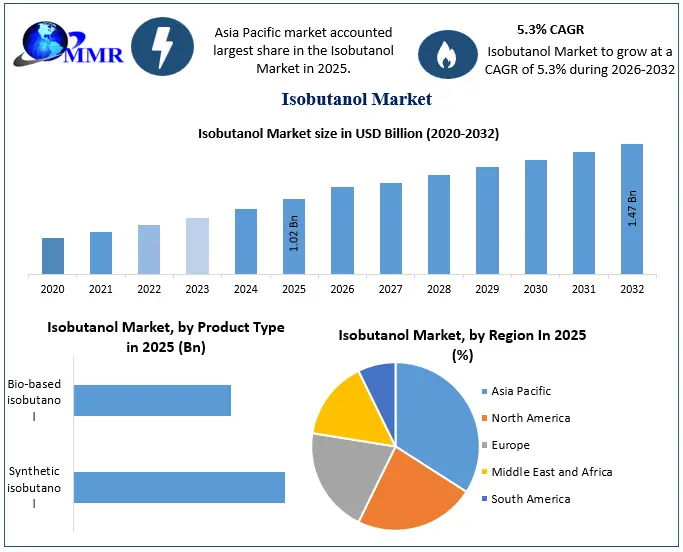
The Isobutanol Market is entering a period of steady expansion as manufacturers across chemicals, coatings, oil & gas, pharmaceuticals and related industries increase their use of isobutanol as a versatile solvent and chemical intermediate. According to Maximize Market Research, the global Isobutanol Market size was valued at USD 1.02 billion in 2025 and is expected to grow at a CAGR of 5.3% from 2026 to 2032, reaching nearly USD 1.47 billion by 2032. Increasing industrial production, expanding applications in paints and coatings, demand for specialty chemical intermediates and growing interest in bio-based production technologies are expected to create attractive opportunities for market participants. Isobutanol's functional properties make it valuable in solvent formulations, coatings, chemical synthesis and fuel-related applications.
U.S. Isobutanol Market Gains Momentum Through Industrial Demand and Low-Carbon Investment
The United States remains an important market for isobutanol because of its large chemical manufacturing base, established refining infrastructure and expanding interest in renewable fuels. During 2025, industry activity highlighted both pricing pressure and investment in low-carbon technologies. Eastman announced a USD 0.05-per-pound increase on its N-Isobutyl Alcohol and selected Oxo products in North America and Latin America effective February 15, 2025, citing higher operating costs, particularly raw-material expenses. At the same time, Gevo completed its USD 210 million acquisition of Red Trail Energy's ethanol and carbon-capture assets in North Dakota in January 2025. The investment strengthens the company's low-carbon alcohol and renewable-fuels platform and creates an opportunity to develop additional alcohol-to-jet and related projects. Such developments demonstrate how U.S. producers are combining established alcohol infrastructure with carbon capture, renewable feedstocks and advanced conversion technologies. This trend can support longer-term opportunities for bio-based isobutanol and other renewable chemical products.
Get a Free Sample Market Report Link : https://www.maximizemarketresearch.com/request-sample/56743/
Synthetic Isobutanol Holds the Largest Market Share
Based on the segmentation covered in the Maximize Market Research study, the market is analyzed according to Type, Application and Region. Among the segments, Synthetic Isobutanol represents the leading product category, supported by its established industrial manufacturing base, reliable availability and broad use in chemical and solvent applications. Synthetic production continues to benefit from mature production technologies and its ability to supply large-volume industrial requirements.
Competitive Landscape: Companies Invest in Capacity, Sustainability and Advanced Chemistry
The global Isobutanol Market remains competitive, with major chemical producers focusing on production reliability, downstream integration, product quality and technological development.
Eastman Chemical Company maintains a significant position through its established Oxo alcohol portfolio and broad industrial customer base. In 2025, the company implemented a price increase for N-Isobutyl Alcohol in North America and Latin America because of elevated raw-material and operating costs. Its broad specialty-materials platform and application-development capabilities provide opportunities to optimize isobutanol-based products for coatings, construction, transportation and other markets.
OQ Chemicals is strengthening its position through its extensive Oxo alcohol production network. Its Bay City, Texas operations are particularly important to the North American supply chain. Expansion of isobutanol production capacity in the United States is aligned with increasing demand from coatings, printing inks and chemical-intermediate manufacturers. Greater production capability can improve supply security while supporting downstream growth.
BASF SE benefits from its global chemical manufacturing infrastructure and integrated approach to solvents, intermediates and performance chemicals. Continued investment in process efficiency, sustainable chemistry and specialty chemical applications can create additional opportunities for isobutanol-based formulations.
Sasol Limited participates across the chemicals and solvents value chain, with its integrated production capabilities supporting industrial customers. The company's focus on operational efficiency and specialty chemical applications provides a platform for serving markets where performance solvents and chemical intermediates are required.
Gevo Inc. represents an important emerging force in renewable alcohol and low-carbon chemical technologies. Its 2025 acquisition of Red Trail Energy for approximately USD 210 million added ethanol production and carbon-capture assets to its portfolio. The acquired site provides a platform for future sustainable aviation fuel and renewable-chemical projects, demonstrating how low-carbon alcohol technologies can become increasingly interconnected with the broader isobutanol and renewable chemicals ecosystem.
Regional Analysis: United States, Germany, France, UK, Japan and China
United States: The U.S. benefits from a strong petrochemical and chemical manufacturing ecosystem, extensive downstream solvent demand and growing investment in renewable fuels. Federal incentives supporting carbon reduction and renewable fuel production can encourage investment in low-carbon alcohol technologies.
China: China offers substantial growth potential because of its large chemical manufacturing sector, expanding coatings industry and increasing demand for chemical intermediates. Domestic investment in integrated chemical complexes and downstream manufacturing is strengthening the country's role in global isobutanol supply.
Germany: Germany's advanced chemical industry and emphasis on resource efficiency and sustainable manufacturing support demand for high-performance solvents and intermediates. European decarbonization initiatives can further encourage lower-carbon production routes.
France: France is supported by its diversified chemical, coatings, automotive and industrial manufacturing industries. Increasing attention to sustainable chemistry and reduced-emission production can create opportunities for bio-based and advanced isobutanol technologies.
United Kingdom: The UK market benefits from demand from specialty chemicals, coatings and industrial applications. Sustainability objectives and research into renewable chemicals may support the gradual adoption of bio-based alternatives.
Japan: Japan's technologically advanced chemical and manufacturing industries create demand for high-purity and performance-oriented chemical materials. Applications in coatings, specialty chemicals and industrial formulations are expected to sustain demand for isobutanol.
Key Players
Key companies operating in the global Isobutanol Market include Eastman Chemical Company, OQ Chemicals, BASF SE, Sasol Limited and Gevo Inc. These companies compete through manufacturing capacity, product quality, technological innovation, supply-chain capabilities, sustainability initiatives and downstream application development.
Isobutanol Market Set to Reach USD 1.47 Billion by 2032, Driven by Growing Demand for Solvents, Chemical Intermediates and Sustainable Fuels
The Isobutanol Market is entering a period of steady expansion as manufacturers across chemicals, coatings, oil & gas, pharmaceuticals and related industries increase their use of isobutanol as a versatile solvent and chemical intermediate. According to Maximize Market Research, the global Isobutanol Market size was valued at USD 1.02 billion in 2025 and is expected to grow at a CAGR of 5.3% from 2026 to 2032, reaching nearly USD 1.47 billion by 2032. Increasing industrial production, expanding applications in paints and coatings, demand for specialty chemical intermediates and growing interest in bio-based production technologies are expected to create attractive opportunities for market participants. Isobutanol's functional properties make it valuable in solvent formulations, coatings, chemical synthesis and fuel-related applications.
U.S. Isobutanol Market Gains Momentum Through Industrial Demand and Low-Carbon Investment
The United States remains an important market for isobutanol because of its large chemical manufacturing base, established refining infrastructure and expanding interest in renewable fuels. During 2025, industry activity highlighted both pricing pressure and investment in low-carbon technologies. Eastman announced a USD 0.05-per-pound increase on its N-Isobutyl Alcohol and selected Oxo products in North America and Latin America effective February 15, 2025, citing higher operating costs, particularly raw-material expenses. At the same time, Gevo completed its USD 210 million acquisition of Red Trail Energy's ethanol and carbon-capture assets in North Dakota in January 2025. The investment strengthens the company's low-carbon alcohol and renewable-fuels platform and creates an opportunity to develop additional alcohol-to-jet and related projects. Such developments demonstrate how U.S. producers are combining established alcohol infrastructure with carbon capture, renewable feedstocks and advanced conversion technologies. This trend can support longer-term opportunities for bio-based isobutanol and other renewable chemical products.
Get a Free Sample Market Report Link : https://www.maximizemarketresearch.com/request-sample/56743/
Synthetic Isobutanol Holds the Largest Market Share
Based on the segmentation covered in the Maximize Market Research study, the market is analyzed according to Type, Application and Region. Among the segments, Synthetic Isobutanol represents the leading product category, supported by its established industrial manufacturing base, reliable availability and broad use in chemical and solvent applications. Synthetic production continues to benefit from mature production technologies and its ability to supply large-volume industrial requirements.
Competitive Landscape: Companies Invest in Capacity, Sustainability and Advanced Chemistry
The global Isobutanol Market remains competitive, with major chemical producers focusing on production reliability, downstream integration, product quality and technological development.
Eastman Chemical Company maintains a significant position through its established Oxo alcohol portfolio and broad industrial customer base. In 2025, the company implemented a price increase for N-Isobutyl Alcohol in North America and Latin America because of elevated raw-material and operating costs. Its broad specialty-materials platform and application-development capabilities provide opportunities to optimize isobutanol-based products for coatings, construction, transportation and other markets.
OQ Chemicals is strengthening its position through its extensive Oxo alcohol production network. Its Bay City, Texas operations are particularly important to the North American supply chain. Expansion of isobutanol production capacity in the United States is aligned with increasing demand from coatings, printing inks and chemical-intermediate manufacturers. Greater production capability can improve supply security while supporting downstream growth.
BASF SE benefits from its global chemical manufacturing infrastructure and integrated approach to solvents, intermediates and performance chemicals. Continued investment in process efficiency, sustainable chemistry and specialty chemical applications can create additional opportunities for isobutanol-based formulations.
Sasol Limited participates across the chemicals and solvents value chain, with its integrated production capabilities supporting industrial customers. The company's focus on operational efficiency and specialty chemical applications provides a platform for serving markets where performance solvents and chemical intermediates are required.
Gevo Inc. represents an important emerging force in renewable alcohol and low-carbon chemical technologies. Its 2025 acquisition of Red Trail Energy for approximately USD 210 million added ethanol production and carbon-capture assets to its portfolio. The acquired site provides a platform for future sustainable aviation fuel and renewable-chemical projects, demonstrating how low-carbon alcohol technologies can become increasingly interconnected with the broader isobutanol and renewable chemicals ecosystem.
Regional Analysis: United States, Germany, France, UK, Japan and China
United States: The U.S. benefits from a strong petrochemical and chemical manufacturing ecosystem, extensive downstream solvent demand and growing investment in renewable fuels. Federal incentives supporting carbon reduction and renewable fuel production can encourage investment in low-carbon alcohol technologies.
China: China offers substantial growth potential because of its large chemical manufacturing sector, expanding coatings industry and increasing demand for chemical intermediates. Domestic investment in integrated chemical complexes and downstream manufacturing is strengthening the country's role in global isobutanol supply.
Germany: Germany's advanced chemical industry and emphasis on resource efficiency and sustainable manufacturing support demand for high-performance solvents and intermediates. European decarbonization initiatives can further encourage lower-carbon production routes.
France: France is supported by its diversified chemical, coatings, automotive and industrial manufacturing industries. Increasing attention to sustainable chemistry and reduced-emission production can create opportunities for bio-based and advanced isobutanol technologies.
United Kingdom: The UK market benefits from demand from specialty chemicals, coatings and industrial applications. Sustainability objectives and research into renewable chemicals may support the gradual adoption of bio-based alternatives.
Japan: Japan's technologically advanced chemical and manufacturing industries create demand for high-purity and performance-oriented chemical materials. Applications in coatings, specialty chemicals and industrial formulations are expected to sustain demand for isobutanol.
Key Players
Key companies operating in the global Isobutanol Market include Eastman Chemical Company, OQ Chemicals, BASF SE, Sasol Limited and Gevo Inc. These companies compete through manufacturing capacity, product quality, technological innovation, supply-chain capabilities, sustainability initiatives and downstream application development.
Isobutanol Market Growth, Demand and Future Industry Outlook
Isobutanol Market Set to Reach USD 1.47 Billion by 2032, Driven by Growing Demand for Solvents, Chemical Intermediates and Sustainable Fuels
The Isobutanol Market is entering a period of steady expansion as manufacturers across chemicals, coatings, oil & gas, pharmaceuticals and related industries increase their use of isobutanol as a versatile solvent and chemical intermediate. According to Maximize Market Research, the global Isobutanol Market size was valued at USD 1.02 billion in 2025 and is expected to grow at a CAGR of 5.3% from 2026 to 2032, reaching nearly USD 1.47 billion by 2032. Increasing industrial production, expanding applications in paints and coatings, demand for specialty chemical intermediates and growing interest in bio-based production technologies are expected to create attractive opportunities for market participants. Isobutanol's functional properties make it valuable in solvent formulations, coatings, chemical synthesis and fuel-related applications.
U.S. Isobutanol Market Gains Momentum Through Industrial Demand and Low-Carbon Investment
The United States remains an important market for isobutanol because of its large chemical manufacturing base, established refining infrastructure and expanding interest in renewable fuels. During 2025, industry activity highlighted both pricing pressure and investment in low-carbon technologies. Eastman announced a USD 0.05-per-pound increase on its N-Isobutyl Alcohol and selected Oxo products in North America and Latin America effective February 15, 2025, citing higher operating costs, particularly raw-material expenses. At the same time, Gevo completed its USD 210 million acquisition of Red Trail Energy's ethanol and carbon-capture assets in North Dakota in January 2025. The investment strengthens the company's low-carbon alcohol and renewable-fuels platform and creates an opportunity to develop additional alcohol-to-jet and related projects. Such developments demonstrate how U.S. producers are combining established alcohol infrastructure with carbon capture, renewable feedstocks and advanced conversion technologies. This trend can support longer-term opportunities for bio-based isobutanol and other renewable chemical products.
Get a Free Sample Market Report Link : https://www.maximizemarketresearch.com/request-sample/56743/
Synthetic Isobutanol Holds the Largest Market Share
Based on the segmentation covered in the Maximize Market Research study, the market is analyzed according to Type, Application and Region. Among the segments, Synthetic Isobutanol represents the leading product category, supported by its established industrial manufacturing base, reliable availability and broad use in chemical and solvent applications. Synthetic production continues to benefit from mature production technologies and its ability to supply large-volume industrial requirements.
Competitive Landscape: Companies Invest in Capacity, Sustainability and Advanced Chemistry
The global Isobutanol Market remains competitive, with major chemical producers focusing on production reliability, downstream integration, product quality and technological development.
Eastman Chemical Company maintains a significant position through its established Oxo alcohol portfolio and broad industrial customer base. In 2025, the company implemented a price increase for N-Isobutyl Alcohol in North America and Latin America because of elevated raw-material and operating costs. Its broad specialty-materials platform and application-development capabilities provide opportunities to optimize isobutanol-based products for coatings, construction, transportation and other markets.
OQ Chemicals is strengthening its position through its extensive Oxo alcohol production network. Its Bay City, Texas operations are particularly important to the North American supply chain. Expansion of isobutanol production capacity in the United States is aligned with increasing demand from coatings, printing inks and chemical-intermediate manufacturers. Greater production capability can improve supply security while supporting downstream growth.
BASF SE benefits from its global chemical manufacturing infrastructure and integrated approach to solvents, intermediates and performance chemicals. Continued investment in process efficiency, sustainable chemistry and specialty chemical applications can create additional opportunities for isobutanol-based formulations.
Sasol Limited participates across the chemicals and solvents value chain, with its integrated production capabilities supporting industrial customers. The company's focus on operational efficiency and specialty chemical applications provides a platform for serving markets where performance solvents and chemical intermediates are required.
Gevo Inc. represents an important emerging force in renewable alcohol and low-carbon chemical technologies. Its 2025 acquisition of Red Trail Energy for approximately USD 210 million added ethanol production and carbon-capture assets to its portfolio. The acquired site provides a platform for future sustainable aviation fuel and renewable-chemical projects, demonstrating how low-carbon alcohol technologies can become increasingly interconnected with the broader isobutanol and renewable chemicals ecosystem.
Regional Analysis: United States, Germany, France, UK, Japan and China
United States: The U.S. benefits from a strong petrochemical and chemical manufacturing ecosystem, extensive downstream solvent demand and growing investment in renewable fuels. Federal incentives supporting carbon reduction and renewable fuel production can encourage investment in low-carbon alcohol technologies.
China: China offers substantial growth potential because of its large chemical manufacturing sector, expanding coatings industry and increasing demand for chemical intermediates. Domestic investment in integrated chemical complexes and downstream manufacturing is strengthening the country's role in global isobutanol supply.
Germany: Germany's advanced chemical industry and emphasis on resource efficiency and sustainable manufacturing support demand for high-performance solvents and intermediates. European decarbonization initiatives can further encourage lower-carbon production routes.
France: France is supported by its diversified chemical, coatings, automotive and industrial manufacturing industries. Increasing attention to sustainable chemistry and reduced-emission production can create opportunities for bio-based and advanced isobutanol technologies.
United Kingdom: The UK market benefits from demand from specialty chemicals, coatings and industrial applications. Sustainability objectives and research into renewable chemicals may support the gradual adoption of bio-based alternatives.
Japan: Japan's technologically advanced chemical and manufacturing industries create demand for high-purity and performance-oriented chemical materials. Applications in coatings, specialty chemicals and industrial formulations are expected to sustain demand for isobutanol.
Key Players
Key companies operating in the global Isobutanol Market include Eastman Chemical Company, OQ Chemicals, BASF SE, Sasol Limited and Gevo Inc. These companies compete through manufacturing capacity, product quality, technological innovation, supply-chain capabilities, sustainability initiatives and downstream application development.
0 Comments
·0 Shares
·498 Views