

• The Guar Gum Market is projected to achieve monumental growth. According to a comprehensive market intelligence report published by Stellar Market Research, the global market size was valued at USD 1.11 billion in 2025 and is poised to expand at a robust compound annual growth rate (CAGR) of 7.4% from 2026 to 2034, reaching nearly USD 2.1 billion by the end of the forecast period.

    The global guar gum landscape is undergoing a structural pivot defined by dual-engine demand: high-performance energy extraction and health-conscious consumerism. Processed primarily from the endosperm of the cluster bean (Cyamopsis tetragonoloba), guar gum’s unique ability to form hydrogen bonds with water molecules makes it an irreplaceable natural hydrocolloid.

    Key Findings from the Report
    Valuation & Growth Trajectory: The global guar gum market reached USD 1.11 billion in 2025 and is projected to scale to USD 2.1 billion by 2034, registering a 7.4% CAGR.

    Grade Segment Dominance: The Food grade segment held the leading market share in 2025, propelled by surging demand for clean-label, low-fat, and convenience foods.

    Application Segment Insights: The Oil & Gas application segment captured the largest market share (37.62%) in 2025, heavily driven by North American shale gas extraction and global drilling projects.

    Functional Insights: Stabilizers and emulsifiers dominated functional segments with a 54.38% market share in 2025, expanding at a projected 6.9% CAGR due to widespread utility in dairy, confectionery, and personal care.

    Geographical Leadership: North America commanded a 43.2% market share in 2025, underpinned by extensive shale operations and robust processed food consumption.

    Production Hub: Asia-Pacific—led by India, which accounts for approximately 65% to 78% of global exports and production—remains the indispensable agricultural backbone of the supply chain.

    Investment Relevance: Rising trade volumes (such as India exporting over 417,000 metric tons valued at USD 541.65 million) highlight immense investment opportunities in seed quality, processing efficiency, and supply chain logistics.

    For further information, click the following link:https://www.stellarmr.com/report/req_sample/guar-gum-market/2828

    Market Drivers and Restraints
    Drivers:
    Shale Gas Exploration and Drilling Expansion: The rapid expansion of hydraulic fracturing in North America and emerging regions requires high-viscosity friction reducers, cementing guar gum's critical role in energy extraction.

    Explosion of Clean-Label and Convenience Foods: Changing lifestyles, urban work hours, and rising disposable incomes have elevated convenience food consumption, driving demand for natural stabilizers in soups, sauces, bakery items, and frozen desserts.

    Nutritional and Health Benefits: Heightened consumer focus on functional foods that improve glucose tolerance, reduce serum LDL cholesterol, and provide soluble dietary fiber is accelerating plant hydrocolloid utilization.

    Restraints:
    Raw Material Price Volatility: Unpredictable weather patterns, monsoon variability, and fluctuating crop yields in key agricultural belts cause sharp raw material price swings.

    Limited R&D and Infrastructure Deficits: A historical lack of specialized research facilities, certified seed breeding programs, and modernized processing machinery in primary producing regions constrains yield optimization and technological upgrading.

    Technology, Regulation, and Sustainability Trends
    The guar gum industry is undergoing rapid modernization driven by evolving compliance standards and technological integration. Regulatory bodies like the U.S. Food and Drug Administration (FDA) recognize guar gum as safe (GRAS) within specified limits, fostering consumer trust.

    On the operational front, processors are adopting advanced thermal-mechanical processing techniques to enhance powder solubility, lower microbial loads, and tailor viscosity profiles for specialized industrial uses. Furthermore, sustainability and ESG considerations are taking center stage; agricultural stakeholders are promoting climate-resilient cluster bean farming, micro-irrigation, and certified seed adoption to reduce environmental footprints and stabilize farmer incomes against climate shocks.

    Regional Insights
    North America: Dominating the global landscape with a 43.2% market share in 2025, North America's leadership is anchored by extensive shale oil and gas operations in Texas and widespread adoption of functional, low-calorie convenience foods. The U.S. alone accounts for over 41% of global guar gum imports.

    Asia-Pacific: Serving as the world's primary cultivation hub, India and Pakistan drive global supply. India contributes roughly 65% to 78% of global exports, with robust export growth heading into Western markets. Domestic cultivation is also expanding in response to international demand.

    Europe & Emerging Markets: Europe maintains steady demand driven by stringent clean-label food standards and pharmaceutical binder applications, while emerging markets in the Middle East and Latin America show rising promise in water treatment and mining sectors.

    Recent Industry Developments
    VedaOils (2025): Expanded its organic cosmetic-grade guar gum powder portfolio, capturing a wider footprint in natural personal care formulations and increasing eco-friendly product output by 15%.

    Sunita Hydrocolloids (2024): Invested in upgraded hydro-thermal processing units at its Rajasthan facility, boosting high-viscosity industrial-grade production capacity by 20% to meet North American oilfield demands.

    APEDA & Indian Exporters Consortium (2025): Implemented streamlined agricultural export quality certification protocols, stabilizing outbound shipments which crossed 417,000 metric tons valued at over USD 541 million.

    Global Hydrocolloids (2024): Formed a strategic supply partnership with major North American oilfield service providers, securing long-term delivery contracts for frac-grade fracturing guar.

    Agricultural Universities of Rajasthan & Gujarat (2024): Launched collaborative drought-resistant cluster bean seed development initiatives, improving agricultural yields by 8–10% for participating regional farmers.

    Competitive Landscape
    The global guar gum market features a consolidated yet competitive landscape characterized by integrated processors, specialized refiners, and multinational ingredient suppliers. Leading players are focusing on backward integration, strategic export partnerships, and customized grade formulations for pharmaceutical and oilfield applications.

    Key market participants profiled in the report include Sunita Hydrocolloids, Vikas WSP Ltd., Hindustan Gum & Chemicals Ltd., Cargill, Inc., Ashland Global Holdings Inc., Kerry Group, and Lotus Gums & Chemicals. These companies actively deploy capacity expansions, joint ventures, and customized bio-polymer innovations to reinforce their market positioning.

    Analyst Commentary
    "The guar gum market has evolved far beyond traditional food stabilization into a high-tech biopolymer essential for modern energy extraction and advanced pharmaceutical drug delivery," said a Senior Research Analyst at Stellar Market Research. "While agricultural volatility and processing infrastructure bottlenecks remain challenges, the pivot toward sustainable, plant-based hydrocolloids and enhanced shale exploration guarantees a lucrative pathway for stakeholders willing to invest in R&D and supply chain transparency through 2034."

    Future Outlook
    Looking toward 2034, the guar gum market is set for sustained evolution. Demand will increasingly favor high-purity, enzymatically modified, and sustainably sourced derivatives. Investment will concentrate on digitalizing agricultural supply chains, establishing dedicated R&D institutes for cluster bean genetics, and optimizing eco-friendly extraction technologies. As regulatory frameworks tighten around synthetic additives, natural hydrocolloids like guar gum will secure an irreplaceable strategic role across industrial ecosystems worldwide.

    For further information, click the following link:https://www.stellarmr.com/report/req_sample/guar-gum-market/2828

    About Stellar Market Research

    Stellar Market Research is a multifaceted market research and consulting company with professionals from several industries. Some of the industries we cover include medical devices, pharmaceutical manufacturers, science and engineering, electronic components, industrial equipment, technology and communication, cars and automobiles, chemical products and substances, general merchandise, beverages, personal care, and automated systems. To mention a few, we provide market-verified industry estimations, technical trend analysis, crucial market research, strategic advice, competition analysis, production and demand analysis, and client impact studies.

    Address
    Phase 3, Navale IT Zone, S.No. 51/2A/2, Office No. 202, 2nd floor, Near, Navale Brg, Narhe, Pune, Maharashtra 411041

    Email
    [email protected]

    Mobile
    +91 9607365656
    The Guar Gum Market is projected to achieve monumental growth. According to a comprehensive market intelligence report published by Stellar Market Research, the global market size was valued at USD 1.11 billion in 2025 and is poised to expand at a robust compound annual growth rate (CAGR) of 7.4% from 2026 to 2034, reaching nearly USD 2.1 billion by the end of the forecast period. The global guar gum landscape is undergoing a structural pivot defined by dual-engine demand: high-performance energy extraction and health-conscious consumerism. Processed primarily from the endosperm of the cluster bean (Cyamopsis tetragonoloba), guar gum’s unique ability to form hydrogen bonds with water molecules makes it an irreplaceable natural hydrocolloid. Key Findings from the Report Valuation & Growth Trajectory: The global guar gum market reached USD 1.11 billion in 2025 and is projected to scale to USD 2.1 billion by 2034, registering a 7.4% CAGR. Grade Segment Dominance: The Food grade segment held the leading market share in 2025, propelled by surging demand for clean-label, low-fat, and convenience foods. Application Segment Insights: The Oil & Gas application segment captured the largest market share (37.62%) in 2025, heavily driven by North American shale gas extraction and global drilling projects. Functional Insights: Stabilizers and emulsifiers dominated functional segments with a 54.38% market share in 2025, expanding at a projected 6.9% CAGR due to widespread utility in dairy, confectionery, and personal care. Geographical Leadership: North America commanded a 43.2% market share in 2025, underpinned by extensive shale operations and robust processed food consumption. Production Hub: Asia-Pacific—led by India, which accounts for approximately 65% to 78% of global exports and production—remains the indispensable agricultural backbone of the supply chain. Investment Relevance: Rising trade volumes (such as India exporting over 417,000 metric tons valued at USD 541.65 million) highlight immense investment opportunities in seed quality, processing efficiency, and supply chain logistics. For further information, click the following link:https://www.stellarmr.com/report/req_sample/guar-gum-market/2828 Market Drivers and Restraints Drivers: Shale Gas Exploration and Drilling Expansion: The rapid expansion of hydraulic fracturing in North America and emerging regions requires high-viscosity friction reducers, cementing guar gum's critical role in energy extraction. Explosion of Clean-Label and Convenience Foods: Changing lifestyles, urban work hours, and rising disposable incomes have elevated convenience food consumption, driving demand for natural stabilizers in soups, sauces, bakery items, and frozen desserts. Nutritional and Health Benefits: Heightened consumer focus on functional foods that improve glucose tolerance, reduce serum LDL cholesterol, and provide soluble dietary fiber is accelerating plant hydrocolloid utilization. Restraints: Raw Material Price Volatility: Unpredictable weather patterns, monsoon variability, and fluctuating crop yields in key agricultural belts cause sharp raw material price swings. Limited R&D and Infrastructure Deficits: A historical lack of specialized research facilities, certified seed breeding programs, and modernized processing machinery in primary producing regions constrains yield optimization and technological upgrading. Technology, Regulation, and Sustainability Trends The guar gum industry is undergoing rapid modernization driven by evolving compliance standards and technological integration. Regulatory bodies like the U.S. Food and Drug Administration (FDA) recognize guar gum as safe (GRAS) within specified limits, fostering consumer trust. On the operational front, processors are adopting advanced thermal-mechanical processing techniques to enhance powder solubility, lower microbial loads, and tailor viscosity profiles for specialized industrial uses. Furthermore, sustainability and ESG considerations are taking center stage; agricultural stakeholders are promoting climate-resilient cluster bean farming, micro-irrigation, and certified seed adoption to reduce environmental footprints and stabilize farmer incomes against climate shocks. Regional Insights North America: Dominating the global landscape with a 43.2% market share in 2025, North America's leadership is anchored by extensive shale oil and gas operations in Texas and widespread adoption of functional, low-calorie convenience foods. The U.S. alone accounts for over 41% of global guar gum imports. Asia-Pacific: Serving as the world's primary cultivation hub, India and Pakistan drive global supply. India contributes roughly 65% to 78% of global exports, with robust export growth heading into Western markets. Domestic cultivation is also expanding in response to international demand. Europe & Emerging Markets: Europe maintains steady demand driven by stringent clean-label food standards and pharmaceutical binder applications, while emerging markets in the Middle East and Latin America show rising promise in water treatment and mining sectors. Recent Industry Developments VedaOils (2025): Expanded its organic cosmetic-grade guar gum powder portfolio, capturing a wider footprint in natural personal care formulations and increasing eco-friendly product output by 15%. Sunita Hydrocolloids (2024): Invested in upgraded hydro-thermal processing units at its Rajasthan facility, boosting high-viscosity industrial-grade production capacity by 20% to meet North American oilfield demands. APEDA & Indian Exporters Consortium (2025): Implemented streamlined agricultural export quality certification protocols, stabilizing outbound shipments which crossed 417,000 metric tons valued at over USD 541 million. Global Hydrocolloids (2024): Formed a strategic supply partnership with major North American oilfield service providers, securing long-term delivery contracts for frac-grade fracturing guar. Agricultural Universities of Rajasthan & Gujarat (2024): Launched collaborative drought-resistant cluster bean seed development initiatives, improving agricultural yields by 8–10% for participating regional farmers. Competitive Landscape The global guar gum market features a consolidated yet competitive landscape characterized by integrated processors, specialized refiners, and multinational ingredient suppliers. Leading players are focusing on backward integration, strategic export partnerships, and customized grade formulations for pharmaceutical and oilfield applications. Key market participants profiled in the report include Sunita Hydrocolloids, Vikas WSP Ltd., Hindustan Gum & Chemicals Ltd., Cargill, Inc., Ashland Global Holdings Inc., Kerry Group, and Lotus Gums & Chemicals. These companies actively deploy capacity expansions, joint ventures, and customized bio-polymer innovations to reinforce their market positioning. Analyst Commentary "The guar gum market has evolved far beyond traditional food stabilization into a high-tech biopolymer essential for modern energy extraction and advanced pharmaceutical drug delivery," said a Senior Research Analyst at Stellar Market Research. "While agricultural volatility and processing infrastructure bottlenecks remain challenges, the pivot toward sustainable, plant-based hydrocolloids and enhanced shale exploration guarantees a lucrative pathway for stakeholders willing to invest in R&D and supply chain transparency through 2034." Future Outlook Looking toward 2034, the guar gum market is set for sustained evolution. Demand will increasingly favor high-purity, enzymatically modified, and sustainably sourced derivatives. Investment will concentrate on digitalizing agricultural supply chains, establishing dedicated R&D institutes for cluster bean genetics, and optimizing eco-friendly extraction technologies. As regulatory frameworks tighten around synthetic additives, natural hydrocolloids like guar gum will secure an irreplaceable strategic role across industrial ecosystems worldwide. For further information, click the following link:https://www.stellarmr.com/report/req_sample/guar-gum-market/2828 About Stellar Market Research Stellar Market Research is a multifaceted market research and consulting company with professionals from several industries. Some of the industries we cover include medical devices, pharmaceutical manufacturers, science and engineering, electronic components, industrial equipment, technology and communication, cars and automobiles, chemical products and substances, general merchandise, beverages, personal care, and automated systems. To mention a few, we provide market-verified industry estimations, technical trend analysis, crucial market research, strategic advice, competition analysis, production and demand analysis, and client impact studies. Address Phase 3, Navale IT Zone, S.No. 51/2A/2, Office No. 202, 2nd floor, Near, Navale Brg, Narhe, Pune, Maharashtra 411041 Email [email protected] Mobile +91 9607365656
    0 Comments ·0 Shares ·1K Views
  • Coffee Production Market Expands with Increasing Demand for Specialty Coffee

    Coffee Production Market size was valued at US$ 505.43 Bn. in 2025 and the total revenue is expected to grow at 4.28% through 2026 to 2032, reaching nearly US$ 677.75 Bn. by 2032.

    Coffee is one of the world's most widely consumed beverages, supporting millions of livelihoods and driving a global industry that spans farming, processing, trading, roasting, and retail. As consumer preferences continue to evolve and demand for premium, sustainably sourced coffee grows, the coffee production market is undergoing significant transformation. Advances in agricultural technology, climate-resilient farming practices, and growing investments in sustainable production are reshaping the future of the industry.

    Download Free PDF Brochure: https://www.stellarmr.com/report/req_sample/Coffee-Production-Market/667

    Understanding the Coffee Production Market

    The coffee production market encompasses the cultivation, harvesting, processing, and distribution of coffee beans for commercial use. The industry involves a complex supply chain that begins with coffee farmers and extends to processors, exporters, manufacturers, retailers, and foodservice providers.

    Coffee is primarily cultivated in tropical regions across Latin America, Africa, and Asia-Pacific, where climatic conditions support the growth of Arabica and Robusta coffee varieties. Increasing global consumption, expanding café culture, and the popularity of specialty coffee continue to fuel demand across both developed and emerging economies.

    Today, coffee production is no longer focused solely on increasing output. Producers are placing greater emphasis on quality improvement, sustainable farming methods, traceability, and environmental responsibility to meet changing consumer expectations.

    Key Factors Driving Market Growth

    Several factors are contributing to the steady expansion of the coffee production market.

    One of the primary growth drivers is the rising global consumption of coffee. Increasing urbanization, changing lifestyles, and growing disposable incomes have encouraged consumers to include coffee as part of their daily routine. Younger consumers, in particular, are exploring premium coffee experiences, specialty blends, and artisanal brewing methods.

    The rapid expansion of coffee shop chains and independent cafés has further strengthened demand for high-quality coffee beans. Specialty coffee has become a major trend, encouraging producers to focus on superior bean quality, unique flavor profiles, and sustainable sourcing practices.

    Technological advancements are also improving production efficiency. Precision agriculture, drone-based farm monitoring, satellite imaging, and data-driven irrigation systems are helping farmers optimize yields while reducing resource consumption. These innovations support better crop management and improve resilience against changing weather conditions.

    Sustainability Becomes a Competitive Advantage

    Sustainability has become one of the defining characteristics of modern coffee production.

    Consumers increasingly want to know where their coffee comes from and whether it has been produced responsibly. As a result, coffee growers and manufacturers are adopting environmentally friendly farming techniques, reducing chemical usage, conserving water resources, and promoting biodiversity.

    Certification programs focusing on sustainable agriculture and ethical sourcing are becoming more common across the global coffee supply chain. Companies are also investing in carbon reduction initiatives and regenerative farming practices to strengthen long-term environmental sustainability.

    Climate change remains one of the industry's biggest challenges. Rising temperatures, unpredictable rainfall patterns, and increasing pest infestations threaten coffee-producing regions worldwide. Consequently, research institutions and agricultural organizations are developing climate-resilient coffee varieties capable of maintaining productivity under changing environmental conditions.

    Emerging Trends Shaping the Coffee Production Industry

    Several emerging trends are expected to redefine the coffee production market over the next decade.

    Premiumization continues to influence purchasing behavior, with consumers increasingly seeking single-origin coffee, organic products, and specialty blends that offer distinctive taste experiences. This trend encourages farmers to prioritize quality over volume.

    Digital technologies are transforming coffee farming through precision agriculture and artificial intelligence. Smart sensors, automated irrigation systems, and predictive weather analytics enable producers to improve efficiency while reducing production costs.

    Supply chain transparency is another important trend. Blockchain technology and digital traceability systems allow consumers and businesses to verify the origin of coffee beans, strengthening trust and supporting responsible sourcing initiatives.

    Demand for sustainable packaging is also increasing as companies seek environmentally friendly alternatives to conventional materials. Recyclable, biodegradable, and compostable packaging solutions are becoming increasingly important for coffee brands looking to reduce their environmental footprint.

    Market Segmentation Overview

    The coffee production market can be broadly segmented based on product type, production method, distribution channel, and end use.

    By product type, Arabica coffee continues to dominate due to its superior flavor profile and widespread popularity in premium coffee products. Robusta coffee remains an important segment because of its higher caffeine content, disease resistance, and extensive use in instant coffee production.

    Production methods include conventional and organic farming. Organic coffee production is witnessing increasing demand as consumers become more conscious of health and environmental sustainability.

    Distribution channels include direct trade, exporters, wholesalers, retailers, and online platforms. Digital commerce is expanding rapidly, providing producers with greater market access and improving supply chain efficiency.

    End users include coffee manufacturers, cafés, restaurants, hotels, institutional buyers, and household consumers, all contributing to consistent market demand.

    Regional Market Outlook

    Latin America continues to play a central role in global coffee production due to favorable climatic conditions and extensive cultivation areas. Countries in the region remain major exporters serving international markets.

    The Asia-Pacific region is emerging as both a major producer and consumer of coffee. Rising disposable incomes, expanding café culture, and increasing urbanization are driving regional demand while encouraging investments in domestic coffee production.

    Europe remains one of the world's largest coffee-consuming regions. Growing interest in premium coffee, specialty beverages, and ethically sourced products continues to support imports and long-term market growth.

    North America also represents a significant market characterized by strong demand for specialty coffee, ready-to-drink beverages, and premium roasting products.

    Challenges Facing the Industry

    Despite positive growth prospects, the coffee production market faces several challenges.

    Climate change poses ongoing risks to crop yields and production stability. Labor shortages in coffee-producing regions, fluctuating commodity prices, and supply chain disruptions also create uncertainty for producers.

    Maintaining profitability while meeting sustainability requirements requires significant investment in technology, training, and infrastructure. Smallholder farmers, who account for a large share of global coffee production, often require financial support and technical assistance to adopt modern agricultural practices.

    Competitive Landscape

    J.M. Smucker (United States)
    Eight O’ Clock (India)
    AMT (United Kingdom)
    Dulce Café (South Africa)
    Lavazza (Italy)
    Keurig Green Mountain (United States)
    Nestle SA (Switzerland)
    The Coca Cola Company (United States)
    JAB Holding Company (Luxembourg)
    Starbucks Coffee Company (United States)
    Download Free PDF Brochure: https://www.stellarmr.com/report/req_sample/Coffee-Production-Market/667

    Conclusion

    The global coffee production market is evolving rapidly as sustainability, technological innovation, and premium consumer preferences reshape the industry. Growing worldwide demand for high-quality coffee, combined with advances in precision agriculture and environmentally responsible farming, presents significant opportunities for producers across the value chain.

    While climate change and supply chain challenges remain important considerations, ongoing investments in resilient farming practices and digital technologies are helping secure the industry's future. As consumers continue to value quality, transparency, and sustainability, the coffee production market is well positioned for long-term growth and innovation, making it one of the most dynamic segments within the global food and beverage industry.

    About Stellar Market Research:

    Stellar Market Research is a multifaceted market research and consulting company with professionals from several industries. Some of the industries we cover include medical devices, pharmaceutical manufacturers, science and engineering, electronic components, industrial equipment, technology and communication, cars and automobiles, chemical products and substances, general merchandise, beverages, personal care, and automated systems. To mention a few, we provide market-verified industry estimations, technical trend analysis, crucial market research, strategic advice, competition analysis, production and demand analysis, and client impact studies.

    Contact Stellar Market Research:

    3rd Floor, Navale IT Park, Phase 2

    Pune Banglore Highway, Narhe,

    Pune, Maharashtra 411041, India

    [email protected]

    +91 20 6630 3320 | +91 9607365656

    Coffee Production Market Expands with Increasing Demand for Specialty Coffee Coffee Production Market size was valued at US$ 505.43 Bn. in 2025 and the total revenue is expected to grow at 4.28% through 2026 to 2032, reaching nearly US$ 677.75 Bn. by 2032. Coffee is one of the world's most widely consumed beverages, supporting millions of livelihoods and driving a global industry that spans farming, processing, trading, roasting, and retail. As consumer preferences continue to evolve and demand for premium, sustainably sourced coffee grows, the coffee production market is undergoing significant transformation. Advances in agricultural technology, climate-resilient farming practices, and growing investments in sustainable production are reshaping the future of the industry. Download Free PDF Brochure: https://www.stellarmr.com/report/req_sample/Coffee-Production-Market/667 Understanding the Coffee Production Market The coffee production market encompasses the cultivation, harvesting, processing, and distribution of coffee beans for commercial use. The industry involves a complex supply chain that begins with coffee farmers and extends to processors, exporters, manufacturers, retailers, and foodservice providers. Coffee is primarily cultivated in tropical regions across Latin America, Africa, and Asia-Pacific, where climatic conditions support the growth of Arabica and Robusta coffee varieties. Increasing global consumption, expanding café culture, and the popularity of specialty coffee continue to fuel demand across both developed and emerging economies. Today, coffee production is no longer focused solely on increasing output. Producers are placing greater emphasis on quality improvement, sustainable farming methods, traceability, and environmental responsibility to meet changing consumer expectations. Key Factors Driving Market Growth Several factors are contributing to the steady expansion of the coffee production market. One of the primary growth drivers is the rising global consumption of coffee. Increasing urbanization, changing lifestyles, and growing disposable incomes have encouraged consumers to include coffee as part of their daily routine. Younger consumers, in particular, are exploring premium coffee experiences, specialty blends, and artisanal brewing methods. The rapid expansion of coffee shop chains and independent cafés has further strengthened demand for high-quality coffee beans. Specialty coffee has become a major trend, encouraging producers to focus on superior bean quality, unique flavor profiles, and sustainable sourcing practices. Technological advancements are also improving production efficiency. Precision agriculture, drone-based farm monitoring, satellite imaging, and data-driven irrigation systems are helping farmers optimize yields while reducing resource consumption. These innovations support better crop management and improve resilience against changing weather conditions. Sustainability Becomes a Competitive Advantage Sustainability has become one of the defining characteristics of modern coffee production. Consumers increasingly want to know where their coffee comes from and whether it has been produced responsibly. As a result, coffee growers and manufacturers are adopting environmentally friendly farming techniques, reducing chemical usage, conserving water resources, and promoting biodiversity. Certification programs focusing on sustainable agriculture and ethical sourcing are becoming more common across the global coffee supply chain. Companies are also investing in carbon reduction initiatives and regenerative farming practices to strengthen long-term environmental sustainability. Climate change remains one of the industry's biggest challenges. Rising temperatures, unpredictable rainfall patterns, and increasing pest infestations threaten coffee-producing regions worldwide. Consequently, research institutions and agricultural organizations are developing climate-resilient coffee varieties capable of maintaining productivity under changing environmental conditions. Emerging Trends Shaping the Coffee Production Industry Several emerging trends are expected to redefine the coffee production market over the next decade. Premiumization continues to influence purchasing behavior, with consumers increasingly seeking single-origin coffee, organic products, and specialty blends that offer distinctive taste experiences. This trend encourages farmers to prioritize quality over volume. Digital technologies are transforming coffee farming through precision agriculture and artificial intelligence. Smart sensors, automated irrigation systems, and predictive weather analytics enable producers to improve efficiency while reducing production costs. Supply chain transparency is another important trend. Blockchain technology and digital traceability systems allow consumers and businesses to verify the origin of coffee beans, strengthening trust and supporting responsible sourcing initiatives. Demand for sustainable packaging is also increasing as companies seek environmentally friendly alternatives to conventional materials. Recyclable, biodegradable, and compostable packaging solutions are becoming increasingly important for coffee brands looking to reduce their environmental footprint. Market Segmentation Overview The coffee production market can be broadly segmented based on product type, production method, distribution channel, and end use. By product type, Arabica coffee continues to dominate due to its superior flavor profile and widespread popularity in premium coffee products. Robusta coffee remains an important segment because of its higher caffeine content, disease resistance, and extensive use in instant coffee production. Production methods include conventional and organic farming. Organic coffee production is witnessing increasing demand as consumers become more conscious of health and environmental sustainability. Distribution channels include direct trade, exporters, wholesalers, retailers, and online platforms. Digital commerce is expanding rapidly, providing producers with greater market access and improving supply chain efficiency. End users include coffee manufacturers, cafés, restaurants, hotels, institutional buyers, and household consumers, all contributing to consistent market demand. Regional Market Outlook Latin America continues to play a central role in global coffee production due to favorable climatic conditions and extensive cultivation areas. Countries in the region remain major exporters serving international markets. The Asia-Pacific region is emerging as both a major producer and consumer of coffee. Rising disposable incomes, expanding café culture, and increasing urbanization are driving regional demand while encouraging investments in domestic coffee production. Europe remains one of the world's largest coffee-consuming regions. Growing interest in premium coffee, specialty beverages, and ethically sourced products continues to support imports and long-term market growth. North America also represents a significant market characterized by strong demand for specialty coffee, ready-to-drink beverages, and premium roasting products. Challenges Facing the Industry Despite positive growth prospects, the coffee production market faces several challenges. Climate change poses ongoing risks to crop yields and production stability. Labor shortages in coffee-producing regions, fluctuating commodity prices, and supply chain disruptions also create uncertainty for producers. Maintaining profitability while meeting sustainability requirements requires significant investment in technology, training, and infrastructure. Smallholder farmers, who account for a large share of global coffee production, often require financial support and technical assistance to adopt modern agricultural practices. Competitive Landscape J.M. Smucker (United States) Eight O’ Clock (India) AMT (United Kingdom) Dulce Café (South Africa) Lavazza (Italy) Keurig Green Mountain (United States) Nestle SA (Switzerland) The Coca Cola Company (United States) JAB Holding Company (Luxembourg) Starbucks Coffee Company (United States) Download Free PDF Brochure: https://www.stellarmr.com/report/req_sample/Coffee-Production-Market/667 Conclusion The global coffee production market is evolving rapidly as sustainability, technological innovation, and premium consumer preferences reshape the industry. Growing worldwide demand for high-quality coffee, combined with advances in precision agriculture and environmentally responsible farming, presents significant opportunities for producers across the value chain. While climate change and supply chain challenges remain important considerations, ongoing investments in resilient farming practices and digital technologies are helping secure the industry's future. As consumers continue to value quality, transparency, and sustainability, the coffee production market is well positioned for long-term growth and innovation, making it one of the most dynamic segments within the global food and beverage industry. About Stellar Market Research: Stellar Market Research is a multifaceted market research and consulting company with professionals from several industries. Some of the industries we cover include medical devices, pharmaceutical manufacturers, science and engineering, electronic components, industrial equipment, technology and communication, cars and automobiles, chemical products and substances, general merchandise, beverages, personal care, and automated systems. To mention a few, we provide market-verified industry estimations, technical trend analysis, crucial market research, strategic advice, competition analysis, production and demand analysis, and client impact studies. Contact Stellar Market Research: 3rd Floor, Navale IT Park, Phase 2 Pune Banglore Highway, Narhe, Pune, Maharashtra 411041, India [email protected] +91 20 6630 3320 | +91 9607365656
    0 Comments ·0 Shares ·318 Views
  • The Agrivoltaics Market reveals that the global market is experiencing a structural transformation, driven by the imperative to maximize land productivity, accelerate clean energy integration, and adopt climate-resilient farming techniques.

    The global agricultural and energy landscapes are undergoing a profound paradigm shift. Traditionally, land allocation has faced a zero-sum conflict between food production and photovoltaic (PV) solar installations. However, the agrivoltaics paradigm—co-locating agricultural activity and solar photovoltaic electricity generation on the same parcel of land—has emerged as a transformative solution to the land-food-energy nexus.

    Key Findings from the Report
    Valuation & Growth Trajectory: The global agrivoltaics market is projected to expand at a robust CAGR of over 11.5% throughout the forecast period from 2024 to 2034.

    Dominant Segment: Ground-mounted photovoltaic systems currently dominate the market share, favored by structural scalability and ease of integration with large-scale agricultural machinery.

    Fastest-Growing Segment: Tracking-system-integrated agrivoltaics represents the fastest-growing segment, driven by dynamic solar-tracking algorithms that optimize both crop microclimate exposure and energy generation yields.

    Crop Application Insight: Shade-tolerant crops—including berries, leafy greens, root vegetables, and select specialty vineyards—account for the largest share of commercial crop integration.

    Leading Region: Europe holds the leading revenue share, supported by stringent European Union decarbonization targets, favorable feed-in tariffs, and robust governmental subsidies for dual-use agricultural tech.

    Emerging Region: Asia-Pacific is positioned as the fastest-growing regional market, catalyzed by intensive land-use pressures in nations like China, Japan, and India, alongside national solar-agriculture integration initiatives.

    Investment Relevance: Venture capital and project-finance investments in agrivoltaic infrastructure have surged, attracting institutional capital focused on long-term Environmental, Social, and Governance (ESG) assets.

    For further information, click the following link:https://www.stellarmr.com/report/req_sample/agrivoltaics-market/2915
    Market Drivers and Restraints
    Drivers
    Land-Use Optimization and Dual Revenue Streams: The ability to simultaneously harvest crops and generate commercial electricity provides farmers with financial hedging against commodity price volatility and volatile crop yields.

    Climate Resilience and Microclimate Protection: Agrivoltaic shade structures reduce evapotranspiration, lower ambient soil and leaf temperatures during heatwaves, and conserve crucial irrigation water in arid and semi-arid agricultural zones.

    Decarbonization and Renewable Energy Mandates: Government incentives, carbon credit frameworks, and corporate net-zero commitments are driving agricultural enterprises to adopt on-site clean energy generation infrastructure.

    Restraints
    High Initial Capital Expenditure (CapEx): Specialized elevated mounting structures, custom PV spacing, and dual-purpose engineering designs incur significantly higher upfront setup costs compared to conventional solar farms.

    Operational and Mechanization Complexities: Operating heavy agricultural machinery beneath solar arrays requires precise layout planning, specialized equipment maneuvering, and ongoing operational coordination between farmers and energy operators.

    Technology, Regulation, and Sustainability Trends
    The agrivoltaics sector is being reshaped by rapid advancements in semi-transparent photovoltaic glass, bifacial solar modules, and automated smart-tracking systems that optimize light transmission based on real-time crop growth cycles. Regulatory frameworks are progressively evolving from ambiguous zoning restrictions to dedicated policy incentives, particularly across European and North American jurisdictions.

    From an ESG and sustainability standpoint, agrivoltaics delivers exceptional impact metrics: it drastically lowers the carbon footprint of food production, curtails agricultural water consumption by up to 20–30% in arid climates, and prevents the conversion of virgin ecosystems into industrial solar plants by utilizing pre-disturbed agricultural land.

    Regional Insights
    Europe: Leads the global market due to aggressive EU climate neutrality roadmaps, institutional research backing, and pioneering national policies in countries like France, Germany, and Italy that mandate or subsidize agrivoltaic zoning.

    Asia-Pacific: Represents the high-growth frontier. High population density and limited arable land per capita in nations such as China, Japan, and South Korea have forced accelerated adoption. Government-backed agricultural modernization programs are integrating solar PV directly into greenhouse horticulture and paddy cultivation.

    North America: Exhibiting rapid expansion driven by commercial farm consolidations, state-level clean energy portfolio standards, and growing pilot programs across the US Midwest and agricultural hubs in California.

    Recent Industry Developments
    Enel Green Power (2025): Launched an advanced commercial agrivoltaics pilot project in Southern Europe integrating high-clearance tracking PV arrays with olive groves, delivering a verified 15% reduction in irrigation water usage and stable crop yields.

    BayWa r.e. (2025): Expanded its international portfolio by completing a multi-megawatt fruit-protection agrivoltaic installation in Germany, safeguarding soft fruit yields against severe hail and extreme heat while generating clean electricity for regional grid injection.

    SunAgri (2024): Partnered with major European agricultural cooperatives to deploy dynamic smart-slat solar panels over vineyard acreage, demonstrating optimized grape maturation and enhanced wine quality alongside commercial power generation.

    TotalEnergies (2024): Acquired a controlling stake in a specialized agrivoltaics technology developer, injecting capital to scale modular, farmer-friendly elevation structures designed for seamless tractor access.

    NLC India Limited (2025): Initiated large-scale agricultural co-location initiatives beneath existing utility solar parks, proving the commercial viability of intercropping shade-tolerant legumes and fodder crops on degraded mining and industrial tracts.

    Competitive Landscape
    The global agrivoltaics market features a dynamic mix of specialized agritech innovators, renewable energy developers, and agricultural engineering conglomerates. Leading market players include BayWa r.e., Enel Green Power, TotalEnergies, SunAgri, Lightsource bp, Nexans, and REM TEC.

    Market participants are actively engaging in strategic joint ventures, proprietary mounting-structure patent filings, and collaboration agreements with agricultural universities to validate crop-specific yield models and de-risk investments for commercial farming enterprises.

    Analyst Commentary
    "The agrivoltaics market has transitioned past the experimental phase into a vital commercial pillar of the global energy-food nexus," said a Senior Research Analyst at Stellar Market Research. "As land scarcity intensifies and climate volatility threatens traditional agriculture, co-locating solar infrastructure with crop production is no longer merely an environmental option—it is a fundamental economic imperative that secures both our food supply and our renewable energy future."

    Future Outlook
    Through the forecast period to 2034, the agrivoltaics market is poised for exponential mainstream integration. Expected technological breakthroughs in bifacial transparency, wireless sensor-driven microclimate management, and standardized modular mounting kits will continue to compress installation costs. As regulatory bodies streamline dual-use zoning laws and institutional ESG investors direct capital toward verifiable land-restoration assets, agrivoltaics will firmly establish itself as a cornerstone of resilient, climate-smart global agriculture.

    For further information, click the following link:https://www.stellarmr.com/report/req_sample/agrivoltaics-market/2915
    About Stellar Market Research
    Stellar Market Research is a multifaceted market research and consulting company with professionals from several industries. Some of the industries we cover include medical devices, pharmaceutical manufacturers, science and engineering, electronic components, industrial equipment, technology and communication, cars and automobiles, chemical products and substances, general merchandise, beverages, personal care, and automated systems. To mention a few, we provide market-verified industry estimations, technical trend analysis, crucial market research, strategic advice, competition analysis, production and demand analysis, and client impact studies.

    Address
    Phase 3, Navale IT Zone, S.No. 51/2A/2, Office No. 202, 2nd floor, Near, Navale Brg, Narhe, Pune, Maharashtra 411041

    Email
    [email protected]

    Mobile
    +91 9607365656
    The Agrivoltaics Market reveals that the global market is experiencing a structural transformation, driven by the imperative to maximize land productivity, accelerate clean energy integration, and adopt climate-resilient farming techniques. The global agricultural and energy landscapes are undergoing a profound paradigm shift. Traditionally, land allocation has faced a zero-sum conflict between food production and photovoltaic (PV) solar installations. However, the agrivoltaics paradigm—co-locating agricultural activity and solar photovoltaic electricity generation on the same parcel of land—has emerged as a transformative solution to the land-food-energy nexus. Key Findings from the Report Valuation & Growth Trajectory: The global agrivoltaics market is projected to expand at a robust CAGR of over 11.5% throughout the forecast period from 2024 to 2034. Dominant Segment: Ground-mounted photovoltaic systems currently dominate the market share, favored by structural scalability and ease of integration with large-scale agricultural machinery. Fastest-Growing Segment: Tracking-system-integrated agrivoltaics represents the fastest-growing segment, driven by dynamic solar-tracking algorithms that optimize both crop microclimate exposure and energy generation yields. Crop Application Insight: Shade-tolerant crops—including berries, leafy greens, root vegetables, and select specialty vineyards—account for the largest share of commercial crop integration. Leading Region: Europe holds the leading revenue share, supported by stringent European Union decarbonization targets, favorable feed-in tariffs, and robust governmental subsidies for dual-use agricultural tech. Emerging Region: Asia-Pacific is positioned as the fastest-growing regional market, catalyzed by intensive land-use pressures in nations like China, Japan, and India, alongside national solar-agriculture integration initiatives. Investment Relevance: Venture capital and project-finance investments in agrivoltaic infrastructure have surged, attracting institutional capital focused on long-term Environmental, Social, and Governance (ESG) assets. For further information, click the following link:https://www.stellarmr.com/report/req_sample/agrivoltaics-market/2915 Market Drivers and Restraints Drivers Land-Use Optimization and Dual Revenue Streams: The ability to simultaneously harvest crops and generate commercial electricity provides farmers with financial hedging against commodity price volatility and volatile crop yields. Climate Resilience and Microclimate Protection: Agrivoltaic shade structures reduce evapotranspiration, lower ambient soil and leaf temperatures during heatwaves, and conserve crucial irrigation water in arid and semi-arid agricultural zones. Decarbonization and Renewable Energy Mandates: Government incentives, carbon credit frameworks, and corporate net-zero commitments are driving agricultural enterprises to adopt on-site clean energy generation infrastructure. Restraints High Initial Capital Expenditure (CapEx): Specialized elevated mounting structures, custom PV spacing, and dual-purpose engineering designs incur significantly higher upfront setup costs compared to conventional solar farms. Operational and Mechanization Complexities: Operating heavy agricultural machinery beneath solar arrays requires precise layout planning, specialized equipment maneuvering, and ongoing operational coordination between farmers and energy operators. Technology, Regulation, and Sustainability Trends The agrivoltaics sector is being reshaped by rapid advancements in semi-transparent photovoltaic glass, bifacial solar modules, and automated smart-tracking systems that optimize light transmission based on real-time crop growth cycles. Regulatory frameworks are progressively evolving from ambiguous zoning restrictions to dedicated policy incentives, particularly across European and North American jurisdictions. From an ESG and sustainability standpoint, agrivoltaics delivers exceptional impact metrics: it drastically lowers the carbon footprint of food production, curtails agricultural water consumption by up to 20–30% in arid climates, and prevents the conversion of virgin ecosystems into industrial solar plants by utilizing pre-disturbed agricultural land. Regional Insights Europe: Leads the global market due to aggressive EU climate neutrality roadmaps, institutional research backing, and pioneering national policies in countries like France, Germany, and Italy that mandate or subsidize agrivoltaic zoning. Asia-Pacific: Represents the high-growth frontier. High population density and limited arable land per capita in nations such as China, Japan, and South Korea have forced accelerated adoption. Government-backed agricultural modernization programs are integrating solar PV directly into greenhouse horticulture and paddy cultivation. North America: Exhibiting rapid expansion driven by commercial farm consolidations, state-level clean energy portfolio standards, and growing pilot programs across the US Midwest and agricultural hubs in California. Recent Industry Developments Enel Green Power (2025): Launched an advanced commercial agrivoltaics pilot project in Southern Europe integrating high-clearance tracking PV arrays with olive groves, delivering a verified 15% reduction in irrigation water usage and stable crop yields. BayWa r.e. (2025): Expanded its international portfolio by completing a multi-megawatt fruit-protection agrivoltaic installation in Germany, safeguarding soft fruit yields against severe hail and extreme heat while generating clean electricity for regional grid injection. SunAgri (2024): Partnered with major European agricultural cooperatives to deploy dynamic smart-slat solar panels over vineyard acreage, demonstrating optimized grape maturation and enhanced wine quality alongside commercial power generation. TotalEnergies (2024): Acquired a controlling stake in a specialized agrivoltaics technology developer, injecting capital to scale modular, farmer-friendly elevation structures designed for seamless tractor access. NLC India Limited (2025): Initiated large-scale agricultural co-location initiatives beneath existing utility solar parks, proving the commercial viability of intercropping shade-tolerant legumes and fodder crops on degraded mining and industrial tracts. Competitive Landscape The global agrivoltaics market features a dynamic mix of specialized agritech innovators, renewable energy developers, and agricultural engineering conglomerates. Leading market players include BayWa r.e., Enel Green Power, TotalEnergies, SunAgri, Lightsource bp, Nexans, and REM TEC. Market participants are actively engaging in strategic joint ventures, proprietary mounting-structure patent filings, and collaboration agreements with agricultural universities to validate crop-specific yield models and de-risk investments for commercial farming enterprises. Analyst Commentary "The agrivoltaics market has transitioned past the experimental phase into a vital commercial pillar of the global energy-food nexus," said a Senior Research Analyst at Stellar Market Research. "As land scarcity intensifies and climate volatility threatens traditional agriculture, co-locating solar infrastructure with crop production is no longer merely an environmental option—it is a fundamental economic imperative that secures both our food supply and our renewable energy future." Future Outlook Through the forecast period to 2034, the agrivoltaics market is poised for exponential mainstream integration. Expected technological breakthroughs in bifacial transparency, wireless sensor-driven microclimate management, and standardized modular mounting kits will continue to compress installation costs. As regulatory bodies streamline dual-use zoning laws and institutional ESG investors direct capital toward verifiable land-restoration assets, agrivoltaics will firmly establish itself as a cornerstone of resilient, climate-smart global agriculture. For further information, click the following link:https://www.stellarmr.com/report/req_sample/agrivoltaics-market/2915 About Stellar Market Research Stellar Market Research is a multifaceted market research and consulting company with professionals from several industries. Some of the industries we cover include medical devices, pharmaceutical manufacturers, science and engineering, electronic components, industrial equipment, technology and communication, cars and automobiles, chemical products and substances, general merchandise, beverages, personal care, and automated systems. To mention a few, we provide market-verified industry estimations, technical trend analysis, crucial market research, strategic advice, competition analysis, production and demand analysis, and client impact studies. Address Phase 3, Navale IT Zone, S.No. 51/2A/2, Office No. 202, 2nd floor, Near, Navale Brg, Narhe, Pune, Maharashtra 411041 Email [email protected] Mobile +91 9607365656
    0 Comments ·0 Shares ·446 Views
  • Artificial Turf Market Growth, Demand Trends and Future Scope Analysis

    Key Highlights

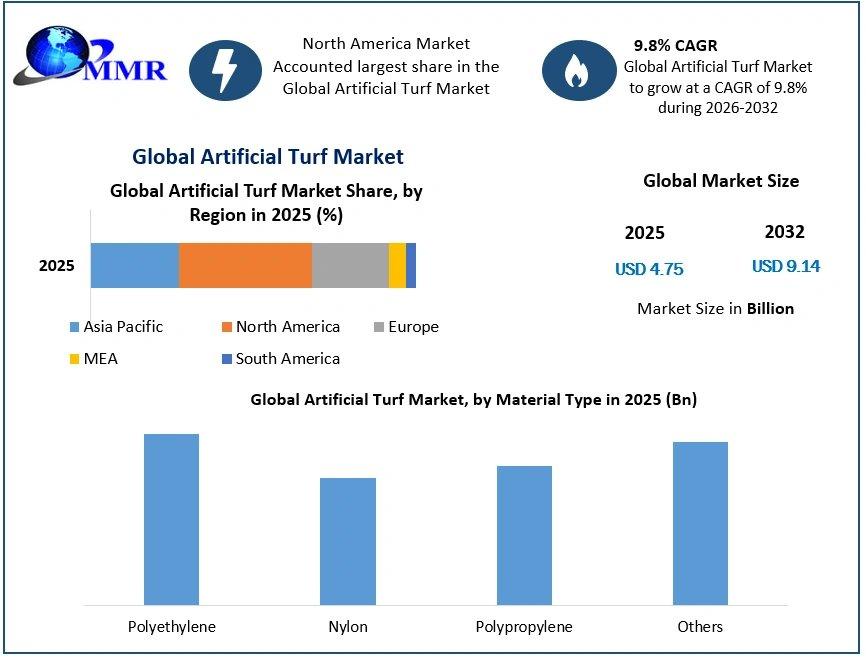
    The Artificial Turf Market was valued at USD 4.75 billion in 2025.
    Revenue is projected to reach nearly USD 9.14 billion by 2032.
    The market is expected to expand at a 9.8% CAGR from 2026 to 2032.
    Sports accounted for about 48% of the market by application in 2025.
    North America held the largest market share in 2025.
    Asia Pacific is expected to record the fastest growth during the forecast period.

    Market Overview

    The Artificial Turf Market is moving beyond its traditional role in sports facilities and becoming a practical surface solution for residential, commercial and landscaping applications. The Artificial Turf Market reached USD 4.75 billion in 2025, showing that demand is increasingly connected to broader construction, recreation and water-management requirements.

    Unlike natural grass, synthetic turf requires limited maintenance and does not depend on regular sunlight or watering. This difference matters for buyers managing operating costs, particularly in regions where water availability and maintenance requirements influence property development decisions.

    Sports remains the strongest application area. In 2025, the segment represented about 48% of the market, supported by adoption across football, rugby, hockey, golf, baseball and multipurpose sports facilities. Heavy-use surfaces that provide consistent playing conditions are encouraging stadiums and sports authorities to reconsider traditional grass.

    Why This Market Matters Now

    Urbanization and construction activity are expanding the addressable market for synthetic surfaces. Residential gardens, commercial properties, playgrounds, patios, medians and poolside areas are increasingly becoming potential applications.

    Water scarcity is another important catalyst. Artificial turf can reduce dependence on irrigation, making it attractive where maintaining natural lawns is difficult or expensive. Consequently, procurement decisions are increasingly influenced not only by appearance and durability but also by maintenance requirements and resource consumption.

    Request Your Sample Report Now : https://www.maximizemarketresearch.com/request-sample/119541/

    Artificial Turf Market Growth, Demand Trends and Future Scope Analysis Key Highlights The Artificial Turf Market was valued at USD 4.75 billion in 2025. Revenue is projected to reach nearly USD 9.14 billion by 2032. The market is expected to expand at a 9.8% CAGR from 2026 to 2032. Sports accounted for about 48% of the market by application in 2025. North America held the largest market share in 2025. Asia Pacific is expected to record the fastest growth during the forecast period. Market Overview The Artificial Turf Market is moving beyond its traditional role in sports facilities and becoming a practical surface solution for residential, commercial and landscaping applications. The Artificial Turf Market reached USD 4.75 billion in 2025, showing that demand is increasingly connected to broader construction, recreation and water-management requirements. Unlike natural grass, synthetic turf requires limited maintenance and does not depend on regular sunlight or watering. This difference matters for buyers managing operating costs, particularly in regions where water availability and maintenance requirements influence property development decisions. Sports remains the strongest application area. In 2025, the segment represented about 48% of the market, supported by adoption across football, rugby, hockey, golf, baseball and multipurpose sports facilities. Heavy-use surfaces that provide consistent playing conditions are encouraging stadiums and sports authorities to reconsider traditional grass. Why This Market Matters Now Urbanization and construction activity are expanding the addressable market for synthetic surfaces. Residential gardens, commercial properties, playgrounds, patios, medians and poolside areas are increasingly becoming potential applications. Water scarcity is another important catalyst. Artificial turf can reduce dependence on irrigation, making it attractive where maintaining natural lawns is difficult or expensive. Consequently, procurement decisions are increasingly influenced not only by appearance and durability but also by maintenance requirements and resource consumption. Request Your Sample Report Now : https://www.maximizemarketresearch.com/request-sample/119541/
    0 Comments ·0 Shares ·986 Views
  • Global Water Treatment Agrochemicals Market to reach USD 5.05 Billion by 2034 at 5.1% CAGR. Irrigation water management and crop protection drive demand.

    View full report: https://www.24chemicalresearch.com/reports/313267/water-treatment-agrochemicals-market

    #MarketResearch #WaterTreatment #Agrochemicals #Irrigation #SustainableAgriculture
    Global Water Treatment Agrochemicals Market to reach USD 5.05 Billion by 2034 at 5.1% CAGR. Irrigation water management and crop protection drive demand. View full report: https://www.24chemicalresearch.com/reports/313267/water-treatment-agrochemicals-market #MarketResearch #WaterTreatment #Agrochemicals #Irrigation #SustainableAgriculture
    0 Comments ·0 Shares ·372 Views
  • Global Agrivoltaics Market Growth Driven by Renewable Energy Expansion and Innovative Agricultural Solar Solutions
    Market Overview

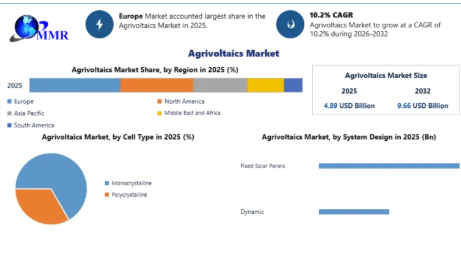
    The global Agrivoltaics Market was valued at USD 4.89 Billion in 2025 and is projected to reach approximately USD 9.66 Billion by 2032, expanding at a CAGR of 10.2% during the forecast period. The market is growing rapidly due to increasing global demand for renewable energy, rising pressure to improve agricultural productivity, and government initiatives promoting sustainable land use. Agrivoltaic systems provide an effective solution by enabling simultaneous electricity generation and crop cultivation, supporting both food security and clean energy goals.

    Get Full PDF Sample Copy of Report: (Including Full TOC, List )@https://www.maximizemarketresearch.com/request-sample/184243/

    Technology and Innovation Landscape

    Advancements in solar and agricultural technologies are accelerating the deployment of agrivoltaic systems worldwide. Key innovations include:

    High-efficiency bifacial solar PV modules
    Single-axis and dual-axis solar tracking systems
    AI-driven precision farming and crop analytics
    Smart irrigation powered by renewable energy

    These technologies improve solar power generation, optimize water usage, enhance crop yields, and increase overall land-use efficiency.

    Largest Market Segment Analysis

    The Fixed Solar Panel Systems segment dominates the global market due to its affordability, operational reliability, lower maintenance requirements, and widespread adoption in commercial agrivoltaic installations.

    Its simple infrastructure makes it suitable for large-scale farming applications.

    Fastest-Growing Segment Analysis

    The Tracking Solar Panel Systems segment is anticipated to witness the fastest growth during the forecast period.

    The growing need to maximize solar energy production while maintaining optimal conditions for crop cultivation is driving increased adoption of advanced tracking technologies.

    Regional Insights

    Europe leads the global agrivoltaics market due to favorable renewable energy regulations, supportive government funding, and growing implementation of sustainable agricultural practices across major economies.

    Asia-Pacific is expected to experience the fastest growth owing to rapid solar infrastructure expansion, increasing investments in agricultural modernization, and strong government support for renewable energy initiatives in China, Japan, and India.

    Competitive Landscape

    Leading companies continue to expand their market presence through technological innovation, strategic collaborations, and investments in integrated solar farming projects.

    Key Players Include:
    BayWa r.e.
    Enel Green Power
    Sun'Agri
    Next2Sun
    REM TEC
    Insolight SA
    Trina Solar
    JinkoSolar
    JA Solar Technology Co., Ltd.
    First Solar, Inc.

    Get Full PDF Sample Copy of Report: (Including Full TOC, List )@https://www.maximizemarketresearch.com/request-sample/184243/

    Market Dynamics

    The market is driven by increasing renewable energy adoption, growing demand for climate-smart agriculture, supportive government incentives, and rising emphasis on maximizing agricultural land productivity.

    However, high installation costs, complex project planning, and evolving regulatory frameworks may challenge market growth. Despite these barriers, ongoing advancements in photovoltaic technologies, digital farming tools, and energy-efficient agricultural systems are expected to create significant growth opportunities throughout the forecast period.

    Get access to the full description of the report @https://www.maximizemarketresearch.com/market-report/agrivoltaics-market/184243/

    About Maximize Market Research

    Maximize Market Research Pvt. Ltd. is a leading global market research and consulting company providing comprehensive business intelligence across renewable energy, agriculture, industrial, automotive, healthcare, manufacturing, chemicals, consumer goods, and technology sectors. Through detailed market research, strategic consulting, and competitive intelligence, the company helps businesses identify emerging market opportunities, enhance strategic planning, and achieve sustainable long-term growth.
    Global Agrivoltaics Market Growth Driven by Renewable Energy Expansion and Innovative Agricultural Solar Solutions Market Overview The global Agrivoltaics Market was valued at USD 4.89 Billion in 2025 and is projected to reach approximately USD 9.66 Billion by 2032, expanding at a CAGR of 10.2% during the forecast period. The market is growing rapidly due to increasing global demand for renewable energy, rising pressure to improve agricultural productivity, and government initiatives promoting sustainable land use. Agrivoltaic systems provide an effective solution by enabling simultaneous electricity generation and crop cultivation, supporting both food security and clean energy goals. Get Full PDF Sample Copy of Report: (Including Full TOC, List )@https://www.maximizemarketresearch.com/request-sample/184243/ Technology and Innovation Landscape Advancements in solar and agricultural technologies are accelerating the deployment of agrivoltaic systems worldwide. Key innovations include: High-efficiency bifacial solar PV modules Single-axis and dual-axis solar tracking systems AI-driven precision farming and crop analytics Smart irrigation powered by renewable energy These technologies improve solar power generation, optimize water usage, enhance crop yields, and increase overall land-use efficiency. Largest Market Segment Analysis The Fixed Solar Panel Systems segment dominates the global market due to its affordability, operational reliability, lower maintenance requirements, and widespread adoption in commercial agrivoltaic installations. Its simple infrastructure makes it suitable for large-scale farming applications. Fastest-Growing Segment Analysis The Tracking Solar Panel Systems segment is anticipated to witness the fastest growth during the forecast period. The growing need to maximize solar energy production while maintaining optimal conditions for crop cultivation is driving increased adoption of advanced tracking technologies. Regional Insights Europe leads the global agrivoltaics market due to favorable renewable energy regulations, supportive government funding, and growing implementation of sustainable agricultural practices across major economies. Asia-Pacific is expected to experience the fastest growth owing to rapid solar infrastructure expansion, increasing investments in agricultural modernization, and strong government support for renewable energy initiatives in China, Japan, and India. Competitive Landscape Leading companies continue to expand their market presence through technological innovation, strategic collaborations, and investments in integrated solar farming projects. Key Players Include: BayWa r.e. Enel Green Power Sun'Agri Next2Sun REM TEC Insolight SA Trina Solar JinkoSolar JA Solar Technology Co., Ltd. First Solar, Inc. Get Full PDF Sample Copy of Report: (Including Full TOC, List )@https://www.maximizemarketresearch.com/request-sample/184243/ Market Dynamics The market is driven by increasing renewable energy adoption, growing demand for climate-smart agriculture, supportive government incentives, and rising emphasis on maximizing agricultural land productivity. However, high installation costs, complex project planning, and evolving regulatory frameworks may challenge market growth. Despite these barriers, ongoing advancements in photovoltaic technologies, digital farming tools, and energy-efficient agricultural systems are expected to create significant growth opportunities throughout the forecast period. Get access to the full description of the report @https://www.maximizemarketresearch.com/market-report/agrivoltaics-market/184243/ About Maximize Market Research Maximize Market Research Pvt. Ltd. is a leading global market research and consulting company providing comprehensive business intelligence across renewable energy, agriculture, industrial, automotive, healthcare, manufacturing, chemicals, consumer goods, and technology sectors. Through detailed market research, strategic consulting, and competitive intelligence, the company helps businesses identify emerging market opportunities, enhance strategic planning, and achieve sustainable long-term growth.
    0 Comments ·0 Shares ·415 Views